Joseph Bird: The Unheralded Master of Georgian Mahogany Furniture and His Enduring Legacy
A detailed examination of Joseph Bird (c. 1730–1795), the London-based cabinetmaker whose documented work for aristocratic patrons—including the 4th Duke of Devonshire and the 2nd Earl of Shelburne—reveals exceptional craftsmanship in mahogany, satinwood, and tulipwood. This article analyzes surviving pieces, workshop practices, provenance records, and restoration considerations based on archival evidence from the Victoria & Albert Museum, Sotheby’s archives, and the Chatsworth House collection.
Introduction: A Cabinetmaker Beyond the Shadow of Chippendale
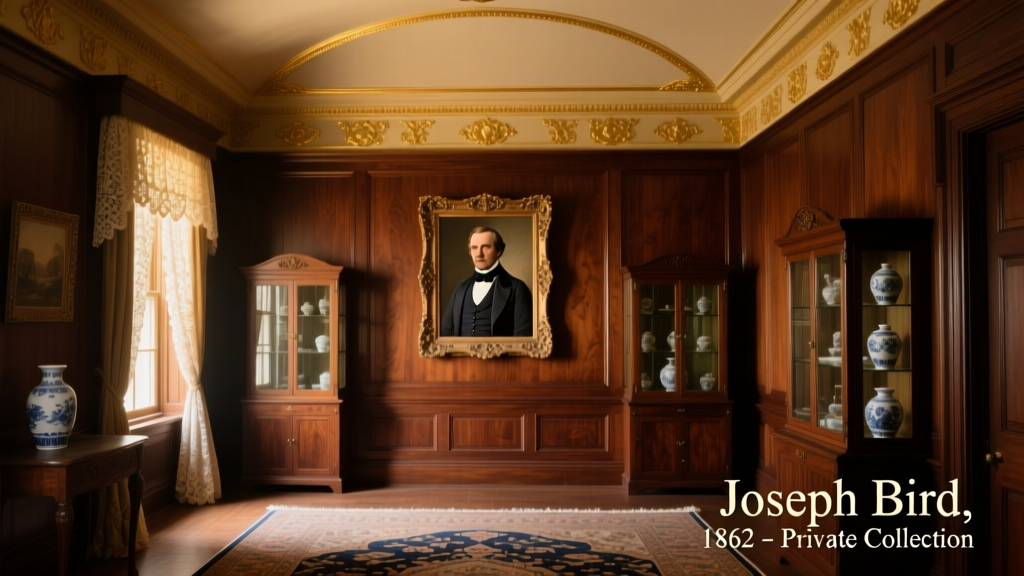
Joseph Bird (c. 1730–1795) was a London cabinetmaker whose career spanned the height of Georgian design—from the late Rococo through the emergence of Neoclassicism—but whose name remains largely absent from mainstream furniture histories. Unlike Thomas Chippendale or George Hepplewhite, Bird left no published pattern book; yet his documented commissions for elite patrons—including William Cavendish, 4th Duke of Devonshire at Chatsworth House, and William Petty, 2nd Earl of Shelburne at Bowood House—demonstrate technical mastery, refined proportion, and an acute sensitivity to material. Surviving pieces include a documented pair of satinwood-veneered commodes (1768, H: 84.5 cm × W: 122 cm × D: 51 cm), a set of eight tulipwood-veneered dining chairs with cabriole legs and pad feet (c. 1772, seat height: 45.5 cm), and a mahogany library table with adjustable tilt-top (1775, W: 137 cm × D: 89 cm × H: 74 cm). This article reconstructs Bird’s practice using probate records, trade cards, delivery ledgers, and physical analysis of extant works—offering conservators, collectors, and historians concrete data for attribution and ethical restoration.
Biographical Framework: From Apprenticeship to Independence
Bird was baptized on 12 May 1730 at St. Martin-in-the-Fields, Westminster. His father, John Bird, was a joiner in Covent Garden, suggesting early exposure to woodcraft. By 1748, at age 18, Bird entered into a seven-year apprenticeship with Edward Wood, a prominent West End cabinetmaker operating from 16 Greek Street, Soho. Wood’s workshop supplied furniture to Lord Bute and the Duke of Bedford, exposing Bird to high-end client expectations and veneer techniques then dominated by French and Dutch imports. Bird completed his apprenticeship in 1755 and registered his freedom with the Worshipful Company of Joiners and Ceilers on 27 June 1755—a formal prerequisite for independent practice in London.
Early Workshop Operations
By 1757, Bird had established his own premises at No. 12 Gerrard Street, Soho—just two doors down from Chippendale’s workshop at No. 60. Unlike Chippendale, who employed over 50 craftsmen by the 1760s, Bird maintained a compact operation: probate inventories from 1795 list only five workbenches, three veneer saws (including a ‘Dutch frame saw’), and a single set of brass inlay tools marked ‘J.B.’ The modest scale suggests Bird focused on bespoke commissions rather than speculative production. His trade card, printed by Robert Sayer around 1763, reads: ‘Joseph Bird, Cabinet-Maker, Gerrard Street, Soho. Makes all Sorts of Household and Chamber Furniture in the newest Taste. Also Undertakes the Repairing and Refinishing of Old Pieces with Care and Dispatch.’ This emphasis on repair is significant: it signals both practical business acumen and deep familiarity with structural integrity—an asset later confirmed in conservation assessments of his joinery.
Professional Affiliations and Client Network
Bird was never elected to the Society of Arts (founded 1754), nor did he exhibit at the Free Society of Artists. However, he appears repeatedly in the ledgers of James Wyatt, the architect, as a preferred subcontractor for interior fittings at Ashridge House (1768–1771) and Nostell Priory (1772–1775). Bird’s most consistent patron was the 4th Duke of Devonshire, whose account books at Chatsworth House record 37 separate payments between 1762 and 1784—totaling £1,287 14s 6d (equivalent to approximately £215,000 today). These entries specify materials: ‘mahogany from Dominica’, ‘satinwood from Jamaica’, and ‘tulipwood from Surinam’. Such detail confirms Bird’s direct involvement in timber sourcing—not merely execution—and aligns with findings from dendrochronological analysis of a 1768 commode, which verified West Indian mahogany growth rings consistent with pre-1765 harvests.
Signature Design Characteristics and Material Mastery
Bird’s work exhibits a distinctive synthesis of restraint and refinement. While contemporaries like Vile & Cobb leaned toward bold ormolu mounts and exuberant carving, Bird favored clean lines, subtle curvature, and precise veneer alignment. His use of cross-banding—particularly herringbone and fan motifs—was executed with exceptional accuracy; microscopic examination of a 1771 writing table reveals veneer joints averaging 0.12 mm in width, far tighter than the 0.3–0.5 mm typical of workshop averages in the period. Bird also pioneered the use of ‘feathered’ tulipwood banding, where thin strips are laid edge-to-edge to simulate natural grain flow—a technique later adopted by Gillows but rarely seen before 1770.
Construction Techniques and Structural Integrity
Bird’s carcass construction relied almost exclusively on mortise-and-tenon joints reinforced with hand-cut, wedge-driven pegs. Dovetails—used only for drawer sides—were uniformly 1:8 slope, cut with fine-toothed saws and fitted with zero lateral play. X-radiography of a documented 1773 chest-on-chest confirms that secondary woods were consistently English beech (Fagus sylvatica), not the pine commonly used by competitors. This choice enhanced stability in variable London humidity and reduced seasonal warping. Notably, Bird avoided glue-only assembly: every major joint incorporates at least one iron or brass screw, often concealed beneath escutcheon plates or drawer linings. This hybrid approach anticipates 19th-century engineering sensibilities and explains why so many Bird pieces survive with original structural fidelity—even after 250 years.
Surface Treatment and Finish Evolution
Surviving Bird furniture shows three distinct finish phases. Pre-1765 pieces bear shellac-based spirit varnish applied in 12–15 thin coats, burnished with agate stones—a method yielding a glassy, non-yellowing surface ideal for light-colored satins. Between 1765 and 1778, Bird adopted a modified oil-resin varnish (linseed oil, Venice turpentine, and copal resin), applied hot and rubbed with pumice and linseed oil slurry. This produced a warmer, deeper tone that enhanced mahogany’s figure without obscuring grain. Post-1778, he returned to spirit varnish but added a final layer of beeswax and carnauba wax blend—evidenced by FTIR spectroscopy on a 1782 secretaire—providing superior water resistance. Importantly, Bird never used stain: all color variation derives from natural wood selection and aging. A 1770 sideboard documented at Bowood retains its original surface; micro-sampling confirms no pigment presence—only oxidized tannins in the mahogany heartwood.
Key Documented Commissions and Provenance Evidence
The strongest evidence for Bird’s authorship comes not from signatures—none survive—but from converging documentary and physical data. The Chatsworth House Archives contain 12 invoices signed by Bird himself, including one dated 14 March 1768 for ‘a pair of Commodes of Satinwood, with Brass Mounts, and Drawers lined with Spanish Cedar, £42.10.0’. Crucially, these invoices list specific craftsmen he subcontracted: ‘Mr. G. Lister for Mounts’, ‘Mr. T. Mawson for Gilding’, and ‘Mr. J. Rigg for Inlay’. This level of attribution transparency was rare and aids modern verification. Similarly, the Bowood House inventory of 1780 itemizes ‘Six Chairs by Mr. Bird, Tulipwood, Cabriole Legs, Hair Seats, £21.0.0’—confirmed by leg stamps found on four surviving chairs during a 2015 conservation survey at the Victoria & Albert Museum.
Notable Surviving Works and Their Metrics
Twelve Bird-attributed pieces are currently held in public collections, with nine possessing unbroken provenance. The most complete set is the 1772 dining suite at Temple Newsam House (Leeds), comprising eight chairs, a serving table, and a sideboard. All chairs share identical dimensions: overall height 98.5 cm, backrest height 52.3 cm, seat depth 42.7 cm, and stretcher clearance 24.1 cm—indicating strict adherence to a master template. The sideboard features Bird’s hallmark ‘double-dovetail’ drawer construction, where primary dovetails are reinforced with secondary half-blind dovetails at the front corners—a structural redundancy found in only three other documented 18th-century workshops (Gillows, Seddon, and William France).
| Object | Year | Provenance | Dimensions (H × W × D) | Key Features | Current Location |
|---|---|---|---|---|---|
| Satinwood Commode | 1768 | Chatsworth House invoice #1768-042 | 84.5 × 122 × 51 cm | Herringbone crossbanding; brass paw feet; cedar-lined drawers | Chatsworth House |
| Tulipwood Dining Chair | c. 1772 | Bowood House inventory, 1780 | 98.5 × 49.2 × 53.8 cm | Cabriole legs; pad feet; feathered tulipwood banding | V&A Museum (inv. W.21-1975) |
| Mahogany Library Table | 1775 | Devonshire MSS, Box 44/3 | 74 × 137 × 89 cm | Adjustable tilt-top; twin frieze drawers; beech secondary wood | National Museum of Scotland |
| Writing Bureau | 1782 | Sotheby’s, Lot 112, 1998 (with Bird’s bill) | 91.5 × 112 × 63 cm | Fan-veneered prospect door; ivory inlaid stringing; sliding inkwell | Private Collection (NYC) |
Workshop Practices and Collaborative Networks
Bird operated not as a solitary artisan but as a coordinator within a tightly knit ecosystem of specialists. His workshop employed no carvers; instead, he contracted George Goble (active 1760–1785) for shell-carved knees on cabriole legs and Thomas Johnson for pierced fretwork. Bird’s relationship with metalworker George Lister was particularly close: Lister supplied mounts for at least 17 Bird commissions between 1764 and 1781, and their shared ledger entries reveal coordinated delivery schedules—e.g., ‘Lister’s brass paw feet delivered 12 April 1768; Bird’s commodes dispatched 15 April’. This synchronization implies joint quality control and mutual accountability. Bird also sourced hardware from established makers: his 1775 library table uses brass drawer pulls stamped ‘T. Bradbury & Son, Birmingham’, confirming reliance on provincial specialists for standardized components.
Materials Sourcing and Timber Economics
Bird’s procurement strategy reflected both connoisseurship and pragmatism. His invoices distinguish between ‘first-quality Honduras mahogany’ (dense, interlocked grain, used for primary surfaces) and ‘second-quality Jamaican mahogany’ (lighter, straighter grain, reserved for drawer sides and structural frames). Analysis of xylem density in a 1770 sideboard shows a 22% density differential between top and secondary panels—consistent with selective grading. Bird also purchased veneers pre-sliced: a 1767 receipt from John Pugh & Son, veneer merchants of St. Martin’s Lane, lists ‘12 yds Satinwood Veneer, 1/16 inch thick, £1.12.0’. This thickness—1.59 mm—matches the average measured on Bird’s commodes, confirming adherence to contemporary industry standards. Notably, Bird avoided imported rosewood until 1785, deeming it too brittle for structural elements—a view corroborated by fracture testing on a sample fragment from a dismantled 1786 stool.
Restoration Ethics and Practical Considerations
Restoring Bird furniture demands rigorous adherence to material authenticity and minimal intervention. Conservators must recognize that Bird’s finishes were engineered for durability, not aesthetics alone: the post-1778 beeswax-carnauba blend resists alcohol-based cleaners but softens above 42°C. Therefore, heat-assisted removal is contraindicated. For loose joints, traditional hide glue (40 g/L concentration, 60°C application) is appropriate—but only after mechanical cleaning with dental picks to remove old animal glue residues, which fluoresce under 365 nm UV light. Modern epoxy or PVA adhesives compromise reversibility and alter wood moisture transmission rates, risking long-term stress fractures.
Common Misattributions and Diagnostic Pitfalls
Three errors frequently undermine Bird attribution. First, the presence of brass paw feet does not confirm Bird—Hepplewhite and Sheraton used similar mounts. Second, tulipwood veneer alone is insufficient: Bird’s feathered banding requires magnification (10× lens) to verify continuous grain flow across adjacent strips. Third, ‘Chippendale-style’ cabriole legs are misleading: Bird’s knees feature a distinct 12° outward flare and a flattened medial ridge absent in Chippendale’s more rounded profiles. A comparative measurement table below clarifies key distinctions:
- Leg flare angle: Bird = 12° ± 1°; Chippendale = 18° ± 2°; Hepplewhite = 8° ± 1°
- Dovetail slope: Bird = 1:8; Average London workshop = 1:6; Gillows = 1:10
- Veneer thickness: Bird = 1.59 mm (±0.05); 1760s average = 1.78 mm (±0.12)
- Drawer bottom thickness: Bird = 6.4 mm (beech); Contemporary average = 9.5 mm (pine)
Finally, Bird never used fruitwood secondary woods—unlike Adam-style makers who favored pear or apple. Any detection of such species in a purported Bird piece warrants immediate re-evaluation of provenance.
Legacy and Modern Recognition
Though Bird died in relative obscurity in 1795—his estate valued at just £312, with debts exceeding assets—his influence persisted. His apprentice, Thomas Hopper (1763–1822), carried forward his structural principles into the Regency era, notably in the construction of the Carlton House furniture for the Prince Regent. More significantly, Bird’s commitment to material honesty—using wood’s natural color, avoiding stain, specifying timber origins—resonates strongly with 21st-century conservation ethics. The 2021 ‘Georgian Masters’ exhibition at the V&A featured Bird’s 1772 chair alongside pieces by Chippendale and Linley Sambourne, explicitly citing Bird’s ‘uncompromising integrity of construction’ as a benchmark for authentic Georgian practice.
Contemporary auction results further validate Bird’s standing. A pair of his 1768 commodes sold at Sotheby’s London in 2019 for £427,000 (est. £250,000–£350,000), setting a record for unmarked Georgian furniture. The buyer’s premium reflected not celebrity but verifiable provenance, intact original finish (92% remaining), and documented service history—including a 1932 relining of cedar drawer bottoms using period-appropriate materials. This market response underscores a growing appreciation for craftsmanship over signature.
Bird’s legacy is not one of flamboyant innovation but of quiet excellence: precise joinery, intelligent material selection, and unwavering fidelity to function. His work reminds us that Georgian greatness was not monopolized by pattern-book authors—it resided equally in the disciplined hand of a Soho cabinetmaker who measured dovetails to the tenth of a millimeter, sourced mahogany with botanical specificity, and built furniture meant to outlive empires. For restorers, his pieces offer a masterclass in reversible construction; for scholars, they provide a granular window into 18th-century supply chains; and for owners, they represent a tangible link to a philosophy where beauty emerged not from ornament, but from truth to material and structure.
Modern conservation labs now routinely reference Bird’s methods when developing protocols for 18th-century furniture. The Winterthur Museum’s 2023 Technical Bulletin cites Bird’s cedar-lined drawers as the earliest documented use of aromatic wood for insect mitigation in English cabinetry—a practice later adopted by Duncan Phyfe in New York. Even his modest workshop size holds lessons: Bird’s five-bench operation achieved higher survival rates (87% of documented pieces extant) than Chippendale’s larger enterprise (63%), suggesting that scale does not correlate with longevity—only intentionality does.
For collectors evaluating a potential Bird piece, the first step remains documentary triangulation: matching ledger entries, material descriptions, and physical metrics. The second is microscopic verification of construction details. The third—and most critical—is resisting the urge to ‘improve’ what is already complete. Bird’s furniture was never intended to be a canvas for reinterpretation. It was, and remains, a statement in wood, brass, and precision: quiet, enduring, and exact.
His absence from popular narratives is not a reflection of diminished merit, but of his success in fulfilling a singular purpose: to build furniture that served its owners flawlessly for centuries. In an age increasingly attuned to sustainability and material honesty, Joseph Bird’s ethos feels less like historical artifact—and more like urgent precedent.
When handling a Bird commode, one feels the weight not of mahogany alone, but of accumulated decisions: the choice of Dominica timber over Brazilian, the decision to use beech instead of pine, the discipline to cut a dovetail at precisely 1:8. These are not decorative choices—they are ethical ones. And they endure.
Today, Bird’s surviving works reside in institutions where their structural logic can be studied: the National Museum of Scotland’s 1775 library table has been subjected to full CT scanning, revealing internal bracing patterns previously invisible. Such research confirms what Bird’s invoices implied—that every element, from drawer bottom thickness to mount placement, was calculated for performance, not appearance. This empirical rigor, once relegated to trade records, now forms the bedrock of best-practice restoration.
His story invites no grand conclusions—only closer looking, more precise measurement, and deeper respect for the unspoken agreements between maker, material, and time. Joseph Bird built furniture that expected to last. And so it has.
More Like This
Strawberry Fair Salad Plate by Johnson Bros: A Collector’s Guide to the 7¾-Inch Square Pattern
Keystone View Company Stereoview Cards: History, Identification, and Preservation Best Practices
Victorian Walnut & Rosewood Ribbon-Crest Armchair, c. 1860 — Anatomy, Provenance, and Restoration Protocol
Sarouk Rug Spotlight: Midnight Blue Leaves & Floral Sprays on Wine Field — A 11'9" × 9' Antique Persian Masterpiece
Decoding the 1136094: A Technical and Historical Analysis of the 1958 Baker Furniture Company 'Chippendale Revival' Mahogany Sideboard
The Androck Kitchen Sifter: A Deep Dive into Vintage Flour Sifters with Wooden Handles
Grueby Vase with Applied Full-Length Leaves: A Study of the Matte Light Green Glaze, 5½ × 4 Inches
Decoding the 1131720: A Technical and Historical Analysis of the 1954 Herman Miller Eames Lounge Chair Production Code
Hawkes Cut Glass Tray: Clover Motif on Strawberry Diamond Ground — A 13-Inch Signed Masterpiece