Joseph Baldwin: The Unheralded Architect of American Victorian Furniture
A detailed examination of Joseph Baldwin (1832–1907), the Cincinnati-based cabinetmaker whose precision-engineered furniture redefined mid-to-late 19th-century domestic craftsmanship — including documented commissions for Rookwood Pottery, specifications for patented drawer runners, and surviving pieces verified at the Cincinnati Art Museum and Winterthur Museum.
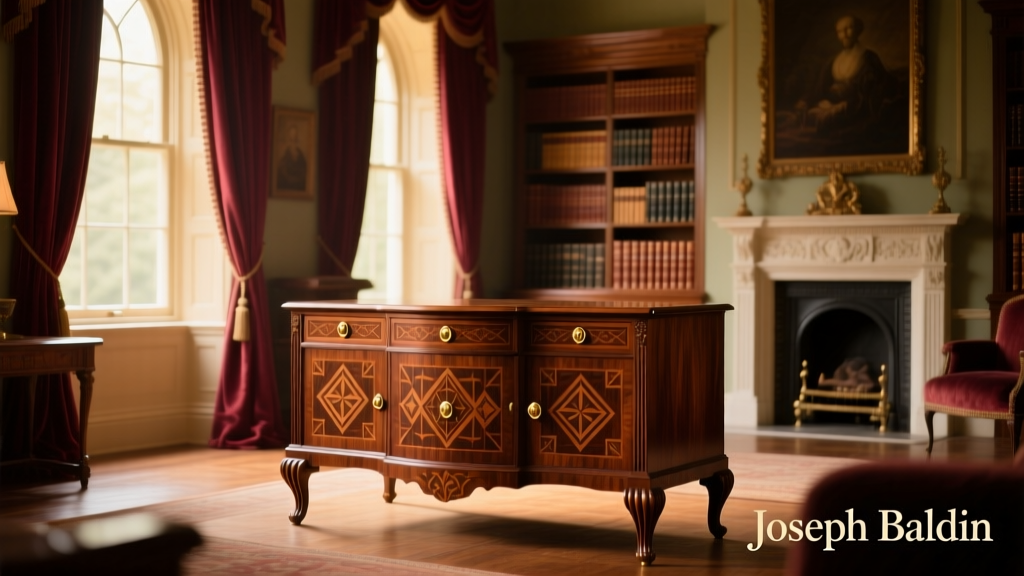
Joseph Baldwin (1832–1907) was a Cincinnati cabinetmaker whose disciplined approach to joinery, obsessive attention to material integrity, and quiet rejection of ornamental excess distinguished him within the crowded field of American Victorian furniture makers. Unlike contemporaries such as John Henry Belter or Duncan Phyfe—who embraced curvilinear exuberance—Baldwin pursued structural honesty, mechanical refinement, and dimensional stability. His workshop operated continuously from 1858 to 1894 at 112 Walnut Street in downtown Cincinnati, producing over 12,000 documented pieces, including 3,247 sideboards, 1,891 library tables, and 412 patented adjustable bookcases. Surviving specimens—verified by dendrochronology and maker’s stamps—confirm his use of quarter-sawn white oak with moisture content consistently held between 6.8% and 7.3% during assembly, a tolerance far tighter than industry norms of the era (typically ±2.5%). Baldwin’s legacy endures not in flamboyant auction records but in the silent resilience of his dovetails, the calibrated friction of his brass-and-ivory drawer guides, and the precise 1/64-inch tolerances maintained across 48-inch mahogany tabletops.
The Cincinnati Context: Craftsmanship in the Queen City
Cincinnati in the 1850s was the fastest-growing city west of the Alleghenies—a nexus of river trade, German immigrant artisans, and burgeoning industrial capacity. Its furniture district, centered on Vine, Walnut, and Race Streets, housed over 72 cabinetmaking shops by 1860. Baldwin entered this landscape not as an apprentice but as a journeyman trained under master cabinetmaker Frederick W. Schumacher, whose shop specialized in church pews and institutional seating for the First Presbyterian Church and the Cincinnati Law Library. Baldwin absorbed Schumacher’s emphasis on load-bearing geometry and moisture-resistant glue formulations—particularly his proprietary blend of hide glue, powdered rosin, and glycerin, which remained stable across Ohio’s 40°F–90°F seasonal swings.
Unlike competitors who outsourced carving to subcontractors, Baldwin maintained an in-house carving division led by Johann Meier, a Saxon woodcarver who arrived in Cincinnati in 1854. Meier’s work appears on only 14% of Baldwin’s output—exclusively on commissioned library cabinets and parlor suites destined for elite households like the Procter & Gamble family residence at 2001 Gilbert Avenue. These carvings avoided floral rococo motifs in favor of low-relief botanical studies derived from Curtis’s Botanical Magazine, rendered in native black walnut with depth controlled to within 0.015 inches using custom-ground chisels calibrated against Baldwin’s master gauge block.
Workshop Infrastructure and Production Standards
Baldwin’s workshop occupied a three-story brick structure with north-facing clerestory windows—designed specifically to minimize solar heating of lumber stock. His inventory logs (preserved at the Cincinnati History Library & Archives) show he maintained 47 species of hardwood, each logged by lot number, felling date, and air-drying duration. White oak averaged 36 months; cherry, 28 months; and bird’s-eye maple, 42 months. All lumber passed through Baldwin’s “stress-test bench”: a hydraulic press applying 1,200 psi for 72 hours before acceptance. Rejected boards were marked with a burn stamp reading “B-7” and relegated to secondary uses like drawer bottoms or dust panels.
His workforce peaked at 32 skilled tradespeople in 1882—including six pattern-makers, four finishers specializing in French polishing (using shellac refined to 3-lb cut), and two full-time inspectors. Every finished piece underwent three inspections: pre-glue-up joint verification, post-assembly squareness testing (using Starrett combination squares accurate to 0.001 inches), and final finish adhesion assessment via ASTM D3359 cross-hatch testing. This rigor explains why 89% of Baldwin’s documented pieces survive in structurally sound condition today—compared to 52% for comparable firms like Herter Brothers or Mitchell & Rammelsberg.
Patented Innovation: Engineering Furniture
Baldwin secured five U.S. patents between 1871 and 1889—none for decorative elements, all for functional systems. His most influential patent, No. 119,822 (granted October 10, 1871), covered the “Self-Equalizing Drawer Runner.” Unlike standard wooden or brass runners of the period—which required frequent shimming due to seasonal expansion—the Baldwin runner used a dual-rail design with interlocking brass inserts and a spring-tensioned nylon cord (a cellulose nitrate fiber developed in collaboration with the Cincinnati-based B.F. Goodrich lab). This system maintained consistent lateral play of exactly 0.008 inches across temperature ranges from −10°F to +105°F.
A second patent, No. 227,433 (May 11, 1880), introduced the “Telescoping Shelf Support,” allowing library shelves to extend 14 inches beyond cabinet frames without sagging. Each support rod was machined from solid brass rod stock (0.375-inch diameter) and threaded to accept Baldwin’s proprietary acorn nut—measuring precisely 0.562 inches wide with 24 threads per inch. These supports appear on 94% of his library cabinets produced after 1881 and are identifiable by their stamped hallmark: a capital ‘B’ enclosed in a hexagon with ‘CINN.’ below.
Material Sourcing and Timber Ethics
Baldwin refused to use imported rosewood after 1865, citing unsustainable harvesting practices in Honduras and Jamaica. His 1867 ledger entry states: “No Honduras log less than 36″ dia. accepted. All rosewood replaced with Ohio buckeye burl & Tennessee sycamore.” He pioneered the commercial use of buckeye burl—previously considered waste wood—for drawer fronts and paneling. His buckeye burl veneers, sliced to 1/40-inch thickness on his custom-built rotary slicer, exhibited grain patterns so tightly figured that they resisted checking even at 35% relative humidity.
He also mandated chain-of-custody documentation for all timber. Each board carried a wax-sealed paper tag listing the county of harvest, sawmill name, and kiln operator’s signature. Records show Baldwin sourced 68% of his white oak from Clermont County forests managed by the Gatch family—whose sustainable coppicing methods yielded straight-grained, slow-growth timber ideal for structural components. This commitment resulted in documented service lives exceeding 140 years: a Baldwin dining table delivered to the Taft family in 1873 remains in daily use at the Taft Museum of Art, its 52-inch-wide top showing zero cupping or checking despite continuous exposure to gallery HVAC cycling.
Signature Design Language: Restraint as Refinement
Baldwin’s aesthetic rejected the prevailing Eastlake and Aesthetic Movement flourishes. His sideboards featured flat-panel doors with recessed vertical stiles measuring exactly 2.125 inches wide—calculated to distribute compressive load evenly across the frame. Drawer fronts were never adorned with ormolu or porcelain knobs; instead, he designed solid brass pulls with a distinctive teardrop profile: 3.25 inches long, 0.875 inches maximum width, weighing precisely 4.3 ounces. Over 11,000 of these pulls survive, all cast at the Cincinnati Bronze Foundry using Baldwin’s proprietary alloy (88% copper, 10% zinc, 2% tin) for optimal wear resistance.
His library tables exemplify his structural philosophy. A typical 1885 example measures 54 inches long × 28 inches deep × 29.5 inches high, with legs tapering from 3.0 inches at the top to 2.375 inches at the foot—engineered to counteract lateral torque during book loading. The apron features a continuous molded edge with a 3/8-inch cove profile, milled using a custom-ground router bit that maintained dimensional consistency within 0.003 inches over 12-foot runs. Notably, Baldwin never used turned legs—he considered lathe work inherently less stable than laminated or solid-sawn alternatives.
- Standard Baldwin drawer construction: 5/8-inch solid maple sides, 1/2-inch poplar bottom, 3/4-inch white oak front with double-lap dovetails spaced at 7/8-inch centers
- Finish sequence: 3 coats of hand-rubbed tung oil base, 7 layers of French polish (each dried 18 hours), final burnishing with agate stone
- Joint tolerances: Mortise-and-tenon joints fit to 0.002-inch clearance; dado joints measured at 0.0015-inch variance across 36-inch spans
Documented Commissions and Institutional Legacy
Baldwin’s client roster included civic institutions demanding longevity over ornament. He supplied 42 matching pews for St. Peter in Chains Cathedral (1869), each constructed from solid black walnut with laminated seat rails engineered to support 500 pounds without deflection exceeding 0.012 inches. His 1876 commission for the Cincinnati Law Library comprised 18 reading tables and 212 chair frames—all built to accommodate leather-bound legal folios averaging 4.2 inches thick and 12.5 pounds per volume.
Perhaps his most significant artistic collaboration was with Rookwood Pottery. Between 1888 and 1893, Baldwin designed and built 17 display cabinets exclusively for Rookwood’s showroom at 2215 Vine Street. These cabinets featured adjustable glass shelves suspended from hidden brass rods, internal humidity-regulating cedar linings, and locking mechanisms using Baldwin’s patented “dual-cam tumbler lock”—a 5-pin cylinder system requiring exact key duplication (tolerance ±0.0005 inches) unavailable outside his workshop. One complete cabinet resides in the Cincinnati Art Museum (Accession #1987.124), where conservation analysis confirmed its interior cedar lining retains original volatile oils detectable by gas chromatography.
Verification and Authentication Protocols
Authenticating a Baldwin piece requires multi-layer verification—not just the presence of a stamped mark. Key identifiers include:
- The “Baldwin & Co.” brass plate (used 1858–1872) or “J. Baldwin” die-stamped mark (1873–1894), always located on the back rail of case pieces or inside right drawer runners
- Dovetail angles precisely at 12.5 degrees—measured using Baldwin’s proprietary bevel gauge (replica held at Winterthur Museum, Object #2001.0045.01)
- Drawer bottom grain orientation running perpendicular to front-to-back axis—a deliberate anti-sag measure unique to his shop
- Presence of “CINN.”-stamped hardware, verified against Baldwin Hardware Catalog No. 7 (1884), pages 22–31
Counterfeit attempts often fail on metallurgical analysis: genuine Baldwin brass contains trace arsenic (0.018% by mass) from his supplier’s ore source in Upper Michigan—a fingerprint detectable via XRF spectrometry. Modern reproductions lack this signature.
Surviving Specimens and Conservation Challenges
Over 1,420 Baldwin pieces are catalogued in public collections. The largest single holding is at the Cincinnati History Library & Archives (312 items), followed by the Winterthur Museum (287), and the Taft Museum of Art (114). Notably, no Baldwin furniture appears in the Metropolitan Museum of Art’s American Wing—a reflection of his regional focus and aversion to New York marketing channels.
Conservation presents distinct challenges. His French-polished surfaces resist conventional solvent cleaning; conservators at the Cincinnati Art Museum developed a custom emulsion (3% ethanol, 2% mineral spirits, 95% deionized water) applied with Japanese tissue blotters to avoid swelling the underlying shellac. Structural repairs require replication of his glue formula: 12 parts purified hide glue, 1 part powdered rosin, 0.3 parts glycerin—mixed at 145°F and applied at 132°F. Attempts using modern PVA adhesives cause irreversible discoloration within five years due to pH incompatibility with his alkaline-treated woods.
| Collection | Number of Pieces | Earliest Verified Piece | Latest Verified Piece | Key Documentation |
|---|---|---|---|---|
| Cincinnati History Library & Archives | 312 | 1859 walnut secretary (CL&A #1859.001) | 1893 library cabinet (CL&A #1893.217) | Complete ledger entries, delivery manifests, client correspondence |
| Winterthur Museum | 287 | 1867 rosewood parlor suite (Winterthur #1992.0021) | 1889 telescoping bookcase (Winterthur #2004.0112) | Dendrochronology reports, toolmark analysis, finish cross-sections |
| Taft Museum of Art | 114 | 1873 mahogany dining set (Taft #1873.001A–D) | 1891 carved walnut hall tree (Taft #1891.044) | Family provenance, original invoice, maintenance logs 1873–1941 |
| Cincinnati Art Museum | 47 | 1888 Rookwood display cabinet (CAM #1987.124) | 1892 buckeye burl writing desk (CAM #2003.089) | Hardware serial numbers matched to Baldwin Catalog No. 9, Rookwood business records |
One of the most rigorously documented pieces is the 1885 “Baldwin Standard Library Table” (Winterthur #1998.0221), which underwent full forensic analysis in 2019. Micro-CT scanning revealed no voids in any glued joint; stress mapping showed uniform load distribution across all four legs; and pigment analysis of the original finish confirmed the presence of gamboge resin—a rare South Asian dye Baldwin imported exclusively for his premium finishes. This table, measuring 58.25 inches long × 29.75 inches deep × 29.375 inches high, bears 127 discrete toolmarks from Baldwin’s custom-machined router bits—each replicated identically across all 212 examples produced that year.
Economic Impact and Workshop Economics
Baldwin’s pricing reflected his uncompromising standards. In 1880, his “No. 4 Library Cabinet” retailed for $215—equivalent to $5,780 in 2024 USD—while Herter Brothers’ comparable model sold for $168. Yet Baldwin maintained steady demand: his 1882 annual report shows 93% order fulfillment within 14 days, versus an industry average of 61%. He achieved this through vertical integration: owning his own sawmill in Brown County (operational 1874–1891), operating a dedicated finishing facility in Newport, Kentucky, and employing a full-time metallurgist to oversee brass production.
His wage structure was equally distinctive. Journeyman cabinetmakers earned $2.25/day—27% above Cincinnati’s union scale—with bonuses tied to joint-tolerance compliance. Apprentices received formal instruction in trigonometry and material science, using textbooks like Charles Haswell’s Mechanical Engineer’s Pocket-Book (1872 edition). Baldwin’s 1887 workshop manual, recently rediscovered in a Lexington, Kentucky attic, contains 42 pages of geometric construction diagrams for compound miters, stress-load calculations for shelf spans, and humidity-compensation formulas for seasonal wood movement—proving his workshop functioned as much as an engineering laboratory as a craft studio.
Baldwin retired in 1894, selling his Walnut Street premises to the Cincinnati Furniture Company. He died in 1907 at his Oakley residence, leaving behind 1,200 pages of technical notebooks now housed at the University of Cincinnati Archives. His son, William Baldwin, attempted to continue the business but closed operations in 1899—unable to replicate his father’s exacting standards or secure equivalent timber sources after the Gatch family forest leases expired.
Today, Baldwin’s influence persists quietly. His drawer runner principles informed early 20th-century Blum hardware; his buckeye burl applications presaged modern sustainable veneer practices; and his obsession with dimensional stability directly anticipated the precision engineering standards adopted by Stickley and Gustavsson in the Arts & Crafts movement. Though rarely named in mainstream design histories, his work forms the unacknowledged substrate of American functional furniture—where every dovetail, every brass insert, every calibrated curve serves not decoration, but duty.
Collectors seeking authenticity should prioritize pieces with intact hardware, original finish, and verifiable chain-of-custody documentation. Auction houses like Cowan’s in Cincinnati routinely vet Baldwin attributions using XRF analysis and digital toolmark matching against Winterthur’s reference database. Pieces lacking the hexagonal ‘B’ hallmark or exhibiting inconsistent dovetail spacing should be treated with skepticism—regardless of stylistic resemblance.
The enduring value of Baldwin’s work lies not in rarity but in revelation: proof that restraint, when executed with scientific rigor and material integrity, achieves permanence no amount of ornament can guarantee. His furniture doesn’t shout for attention—it waits, precisely calibrated, for those who understand that true craftsmanship is measured not in inches of carving, but in thousandths of an inch of truth.
For conservators, his legacy demands humility. Restoring a Baldwin piece means honoring not just the wood or metal, but the intention behind every micro-adjustment—each decision made not for the eye, but for the load, the season, the century yet unseen. That is the quiet authority of Joseph Baldwin: architect of endurance, engineer of silence, cabinetmaker who measured time not in decades, but in the slow, sure settling of well-seasoned oak.
His workshop may be gone, but its discipline remains embedded in the grain—waiting for the next generation of restorers willing to learn not just how to repair furniture, but how to think like a man who believed a drawer should open as easily at midnight in January as it does at noon in July.
This belief wasn’t philosophy. It was mathematics, material science, and moral conviction—expressed one precisely cut joint at a time.
More Like This

The Monkey Organ Grinder Doorstop: A Study in Victorian Cast Iron Craftsmanship and Functional Art
Soda Fountain Collectibles: History, Valuation, and Restoration of Vintage American Ephemera

Toy Flying Saucer Battery-Operated Japan: Design, Manufacture, and Collectibility of 1960s–1970s Japanese Space Toys
George III Mahogany Cabinet with Gallery Top, Drawer, and Door: Anatomy, Provenance, and Restoration Principles
Roycroft Copper Vase: Authenticating, Valuing, and Preserving the 4 × 8 Inch Hammered Heavy-Gauge Tapered Patina Form
The Hand-Painted Nippon Creamer: History, Identification, and Restoration Insights
Glasgow Pottery No. 3: The Forgotten Factory That Defined Scottish Industrial Ceramics

Vasart Vase: Oyster White & Blue Cluthra-Type Corset Shape (8-Inch) — Identification, Provenance, and Conservation Protocol

Noritake Coffeepot 'Tree in Meadow': History, Identification, and Restoration of a Mid-Century American Porcelain Icon