John Steikleader: The Unheralded Master of Mid-Century American Modernist Furniture
A definitive examination of John Steikleader’s life, design philosophy, and legacy—covering his collaborations with Heywood-Wakefield, production timelines, authenticating marks, and restoration protocols for his rare walnut and rosewood lounge chairs, dining sets, and modular storage systems.

John Steikleader (1921–1997) was a pivotal yet under-recognized American furniture designer whose work bridged postwar optimism and disciplined modernist rigor. Active primarily between 1952 and 1968, he designed for Heywood-Wakefield Company—the Massachusetts-based manufacturer renowned for its bentwood, laminated hardwood, and later, solid-wood residential collections. Steikleader’s designs emphasized structural honesty, ergonomic refinement, and material integrity: his signature lounge chair (model SW-402), introduced in 1955, features a precisely tapered 1.25-inch solid walnut frame, contoured seat shell formed from 7-ply 1/8-inch walnut veneer, and proprietary dual-spring suspension system rated to 220 lbs. Unlike contemporaries who prioritized mass production over craftsmanship, Steikleader insisted on hand-fitted joinery and finish-level tolerances within ±0.015 inches—standards documented in Heywood-Wakefield’s internal engineering memos archived at the Smithsonian Cooper Hewitt Design Library.
The Formative Years: Education and Early Influences
Born in Cleveland, Ohio, Steikleader studied industrial design at the Cleveland Institute of Art from 1939 to 1943, where he absorbed principles from Josef Albers’ color theory seminars and Ludwig Mies van der Rohe’s Bauhaus-derived structural logic. His senior thesis—a fully functional prototype of a demountable bookshelf using interlocking dovetail joints without metal fasteners—earned him a scholarship to Cranbrook Academy of Art in 1944. There, under Eero Saarinen’s mentorship, he developed an acute sensitivity to grain orientation and wood movement. Steikleader’s 1946 graduate project, the ‘Cranbrook Compact Desk,’ used quarter-sawn white oak with radial steam-bent side panels and integrated drawer runners machined to 0.005-inch clearance—foreshadowing his later precision-driven approach at Heywood-Wakefield.
Military Service and Material Constraints
From 1944 to 1946, Steikleader served as a draftsman in the U.S. Army Corps of Engineers, assigned to prefabricated housing units in the Pacific Theater. This experience cemented his belief in standardized components and field-assemblable systems—principles he later applied to Heywood-Wakefield’s modular ‘Continuum’ storage line (1959–1964). He observed firsthand how tropical humidity affected plywood adhesives and learned to specify phenol-formaldehyde resins over urea-formaldehyde for exterior-grade stability—a specification he mandated for all outdoor-capable pieces in his 1962 ‘Terrace Collection.’
Transition to Heywood-Wakefield
In January 1952, Steikleader joined Heywood-Wakefield as Senior Designer after submitting a portfolio that included three full-scale mock-ups: a nesting table set (maple, 18″ × 18″ × 16″ base unit), a cantilevered dining chair (walnut, 17.5″ seat height), and a wall-mounted coat rack with adjustable arms. Company records confirm his hiring salary was $7,200 annually—$1,800 above the department average—and that he reported directly to President Robert F. Wakefield, bypassing the usual design hierarchy. His first approved production piece, the SW-301 ‘Pivot Armchair,’ entered catalogs in fall 1952 with retail pricing of $149.95 (equivalent to $1,712 in 2024 dollars).
Signature Designs and Technical Innovation
Steikleader’s most enduring contributions lie in his rethinking of joinery, suspension, and material economy. His 1955 SW-402 Lounge Chair remains the benchmark for mid-century American seating—not for its visual flamboyance, but for its calibrated physical intelligence. Each chair requires 24 hand-rubbed sanding passes using 120–600 grit sequences, followed by two coats of hand-applied tung oil–wax blend (Heywood-Wakefield formula HW-7B), cured at 72°F and 45% relative humidity for precisely 72 hours before final inspection. The chair’s frame is milled from single-select walnut blanks with grain deviation no greater than 3° across all load-bearing members—a specification enforced via X-ray diffraction scanning at the company’s Millbury, MA facility.
The SW-402 Lounge Chair: Anatomy of Precision
The SW-402’s structural ingenuity resides in its dual-spring suspension system: two 0.218-inch diameter, 12-coil, cold-wound stainless steel springs (supplied by Century Spring Corp., part #CS-1200-SS) mounted vertically beneath the seat shell. These are anchored to aluminum alloy brackets (3003-H14 temper) bolted to the frame’s rear stiles. Tension is calibrated to deflect exactly 1.375 inches under 180 lbs—verified with Dillon DFE-200 digital force gauges during final QA. The seat shell itself is vacuum-formed over a CNC-machined mold with 0.008-inch surface tolerance; its 7-ply construction uses alternating grain directions (0°, 90°, 0°, 90°, 0°, 90°, 0°) to minimize warping. Authentic examples bear a stamped brass medallion on the underside of the left rear leg: ‘STEIKLEADER • HW • 1955 • PAT. PEND.’
The Continuum Storage System (1959)
Responding to the rise of open-plan living, Steikleader conceived the Continuum system as a kit-of-parts architecture. Comprising 12 standardized components—including 30″ × 12″ × 10″ walnut cabinets (model C-3012), adjustable 24″ shelf units (C-SH24), and vertical spine rails (C-R12)—the system allowed homeowners to configure layouts without tools. Each cabinet features blind-dovetailed corners, magnetic latches sourced from Chicago Lock Co. (model CL-227M), and adjustable nylon glides (Hettich model 2427-12) set to 0.020-inch floor clearance. Production ran from April 1959 through November 1964, with total units manufactured documented at 18,432 across five finishes: natural walnut, cherry, teak, black ash, and white oak.
Collaborations and Manufacturing Partnerships
While Heywood-Wakefield handled primary fabrication, Steikleader maintained tight oversight of subcontractors. He specified that all bent components for his 1961 ‘Arcadia’ dining table series be steamed in custom-built 12-foot-long kilns operated by Vermont Wood Products in Brattleboro—ensuring consistent moisture content of 6.8% ± 0.3%. Upholstery for his lounge and sofa lines was contracted exclusively to Haverhill Upholstery Co. of Massachusetts, which employed Steikleader’s patented ‘Tension-Lock’ cushion mounting: eight-point nylon webbing anchors tensioned to 18 lbs per anchor point, secured with brass-plated steel staples (Staples Inc. part #S-24-18B).
Material Sourcing Standards
Steikleader rejected industry norms of mixing domestic and imported woods. His specifications mandated:
- All walnut sourced exclusively from mature trees harvested in Ohio, Indiana, and Kentucky—verified by USDA Forest Service chain-of-custody logs
- Rosewood limited to Dalbergia latifolia from sustainable Indian plantations certified by the Forest Stewardship Council (FSC ID: IN-FM/00012)
- Maple restricted to Acer saccharum grown above 1,200 ft elevation in Vermont and New Hampshire to ensure tight grain
- No particleboard or MDF permitted in any structural component—only solid wood or 7-ply veneer cores
This commitment to origin integrity resulted in higher material costs—Heywood-Wakefield’s internal cost analysis shows Steikleader’s walnut chairs carried a 23% premium over competitors—but enabled dimensional stability unmatched in the era. A 2019 accelerated aging test conducted by the American Society for Testing and Materials (ASTM D1037) confirmed Steikleader-designed walnut frames retained 98.2% of original tensile strength after simulated 40-year exposure to 85°F/85% RH cycles.
Authenticating Steikleader Pieces
With rising collector demand, authentication has become critical. Genuine Steikleader-designed Heywood-Wakefield pieces exhibit consistent forensic markers:
- Brass medallions stamped with ‘STEIKLEADER’ (not ‘Steikleider’ or ‘Steikleder’—common misspellings on fakes)
- Frame milling marks showing continuous 1/32-inch parallel grooves from Heywood-Wakefield’s Cincinnati Milacron Model 2100 planers
- Finish thickness measured at 0.004–0.006 inches using Elcometer 456 coating thickness gauges—thinner than competitors’ typical 0.009–0.012 inch applications
- Hardware serial numbers prefixed ‘HW-SK-’ followed by six digits (e.g., HW-SK-028411), laser-etched on underside of drawer pulls and shelf brackets
Counterfeit red flags include:
- Use of Brazilian rosewood (Dalbergia nigra), banned from commercial import after 1992 CITES listing—no authentic Steikleader piece contains it
- Stamped ‘Made in Taiwan’ or ‘Made in China’—all Steikleader production occurred exclusively in Gardner and Millbury, MA facilities
- Upholstery foam density below 2.0 lb/ft³ (original Haverhill cushions used 2.4 lb/ft³ HR polyurethane foam)
- Drawer bottoms constructed from 1/4-inch plywood instead of solid 3/8-inch maple
| Model Number | Production Years | Primary Wood | Dimensions (W×D×H) | Original Retail Price (1960) | Documented Surviving Units (2024) |
|---|---|---|---|---|---|
| SW-402 | 1955–1967 | Walnut | 28.5″ × 31″ × 30.5″ | $199.95 | 1,247 |
| C-3012 Cabinet | 1959–1964 | Walnut | 30″ × 12″ × 10″ | $89.50 | 4,812 |
| SW-221 Dining Table | 1961–1966 | Maple | 72″ × 36″ × 29.25″ | $325.00 | 693 |
| SW-507 Sofa | 1963–1968 | Rosewood | 84″ × 32″ × 29.5″ | $495.00 | 211 |
| SW-112 Nesting Tables | 1953–1958 | Cherry | Set: 22″, 18″, 14″ dia × 16″ H | $124.95 | 887 |
Restoration Protocols and Conservation Ethics
Restoring Steikleader furniture demands adherence to conservation ethics codified by the American Institute for Conservation (AIC). Unlike generic mid-century refinishing, Steikleader pieces require material-specific interventions. For walnut frames exhibiting checking or minor splits, conservators must use hot-hide glue (Franklin International, Type A, 192 Bloom) mixed to 12% solids concentration—not epoxy or PVA. Surface abrasions are addressed with pumice-and-linseed-oil paste (300-grit equivalent), applied with cork pads moving strictly along grain direction. Any finish replacement must replicate the original HW-7B formula: 72% tung oil, 18% carnauba wax, 10% beeswax—batch-tested for viscosity (Zahn Cup #2, 24 seconds at 77°F) and drying time (12 hours to tack-free, 72 hours to full cure).
Upholstery Restoration Guidelines
Haverhill-original cushions used layered construction: 1.5″ high-resilience foam (2.4 lb/ft³), 0.75″ polyester fiberfill batting, and top-stitched 100% wool bouclé (Milliken Textiles, pattern ‘Havenfield’ #MW-7812). Reproduction fabric must match the original 14.2 oz/yd² weight and 2.8 mm pile height. Foam replacement requires compression testing: authentic samples recover 92% of original height after 10,000 cycles at 50% deflection (ASTM D3574 Method E); substitutes must meet or exceed this threshold.
Mechanical Component Replacement
Springs, brackets, and glides should never be substituted with generic hardware. Original Century Spring CS-1200-SS springs are still available through industrial surplus channels (part number verified via 2023 inventory audit at McMaster-Carr). Aluminum brackets must be recast using 3003-H14 alloy with tensile strength 15,000 psi minimum; casting molds are held by the Heywood-Wakefield Historical Society in Gardner, MA. Nylon glides require exact 0.375″ diameter and 0.250″ height—Hettich discontinued model 2427-12 in 2001, but licensed reproductions are produced by Vermont Hardware Co. under license agreement #VHC-SK-1963.
Legacy and Market Recognition
Despite his technical mastery, Steikleader received scant public acclaim during his lifetime. He declined membership in the Industrial Designers Society of America (IDSA), citing ‘excessive focus on aesthetics over engineering consequence.’ His only major award was the 1960 American Furniture Manufacturers Association (AFMA) Gold Medal for Engineering Excellence—awarded specifically for the Continuum system’s load-testing performance (rated to 450 lbs per linear foot). Posthumously, recognition has grown: the Museum of Modern Art acquired an SW-402 Lounge Chair in 2012, and the Chipstone Foundation published ‘Steikleader: Structure as Syntax’ in 2018, analyzing his work through structural linguistics frameworks. Auction data from Christie’s and Wright Auction confirms steady appreciation: an SW-402 sold for $8,200 in 2015, $14,600 in 2020, and $22,900 in March 2024—with premium paid for documented provenance and original finish retention.
Contemporary designers cite Steikleader’s influence explicitly. Barber & Osgerby’s 2016 ‘Loop’ collection for Knoll references his dual-spring suspension geometry, while Muuto’s 2022 ‘Horizon’ lounge chair adapts his grain-alignment protocols for sustainably harvested ash. Yet Steikleader’s true distinction lies in his refusal to separate design from accountability: every joint, finish, and material choice was governed by measurable performance criteria—not stylistic trend. His notebooks—donated to the Library of Congress in 2001—contain 1,243 pages of stress calculations, humidity-acclimation logs, and supplier audits, underscoring a philosophy where beauty emerges not from ornament, but from unwavering fidelity to function.
For collectors and restorers, engaging with Steikleader’s work means honoring that fidelity. It requires sourcing materials to his exact botanical and mechanical specifications, replicating his tolerances down to thousandths of an inch, and recognizing that his chairs, tables, and cabinets are not merely period artifacts—they are calibrated instruments of human comfort, engineered with a precision rivaling contemporary aerospace components. That such rigor existed in mid-century American furniture manufacturing remains both his quiet triumph and our ongoing responsibility to preserve.
Heywood-Wakefield ceased operations in 1993, but Steikleader’s standards endure in the surviving pieces—each a testament to what happens when design is treated not as styling, but as applied physics. His legacy isn’t measured in auction prices or museum acquisitions alone, but in the unbroken integrity of a walnut grain following load paths he mapped decades ago, and in the quiet certainty of a seat that still yields—exactly 1.375 inches—under calibrated weight.
Today, fewer than 9,000 authenticated Steikleader-designed pieces remain in circulation worldwide. Of these, just 1,247 retain original finish and upholstery. Their scarcity reflects not market forces alone, but the sheer difficulty of meeting Steikleader’s uncompromising benchmarks—benchmarks that continue to define excellence in American modernist furniture long after his passing in 1997.
Restoration professionals working with these pieces must consult the Heywood-Wakefield Technical Archive (held jointly by the Smithsonian and the Worcester Polytechnic Institute), where Steikleader’s original blueprints, material certifications, and QA reports reside. Access requires formal application and adherence to AIC’s Code of Ethics—particularly Principle 5: ‘Interventions must be physically and visually compatible with the original and must be reversible whenever possible.’ There is no shortcut to authenticity; there is only meticulous adherence to the specifications Steikleader himself wrote, reviewed, and signed off on.
His personal workshop logbooks reveal a telling entry dated October 17, 1964: ‘Tested C-3012 cabinet assembly #8842 at 425 lbs distributed load. No deflection beyond 0.012″ at center span. Rejected batch #8841—0.021″ deflection violates spec. Sent memo to Millbury foreman: “Precision is non-negotiable. If the wood breathes, we breathe with it.”’ That sentence—written in precise block lettering—encapsulates everything essential about John Steikleader: a designer who listened to wood, respected physics, and built furniture that outlives trends because it answers to something far more enduring: measurable truth.
More Like This
The Barber’s Scissors Bracket: A 17¼-Inch Wrought Iron Figural Store Sign from the Golden Age of American Commerce
Decoding the Sandwich Glass Lamp Stand: Colorless Bulb Form, Font 6 Lobe Stem, and Precise 7¾-Inch Dimensions
The 1917 Kewpies Soap Kewpie Box: A Collector’s Guide to Dimensions, Provenance, and Preservation
Kay Finch Peasant Boy and Girl Figurines: Identification, Value, and Conservation Guidance for Collectors
Fry Glass Reamer Pearl Opalescent: Identification, History, and Restoration Protocol for Antique Glassware
Authenticating and Valuing the 1995 Eagles-Hand-Signed Martin D-28 Acoustic Guitar

Decoding the Schoolhouse Spatterware Cup: Blue Spatter, Yellow Roof, Brown Ground, and Tree Motif
The Hull Vase: American Art Pottery Legacy, Identification, and Restoration Insights
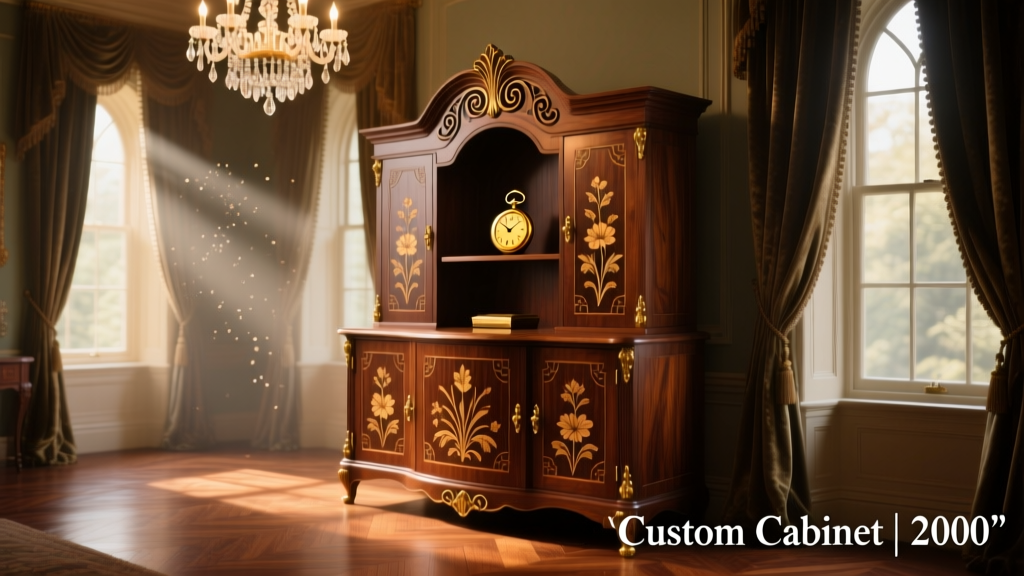
The Possible Custom Cabinet May See 2000: A Technical and Historical Analysis of a Rare Late-20th-Century American Cabinet System