Limoges Tray Snow Scene Old House: Authenticity, Provenance, and Restoration Insights
An in-depth examination of vintage Limoges porcelain trays depicting snow-covered old houses — covering maker marks, historical context, material science, authentication red flags, market values, and ethical conservation practices for collectors and restorers.
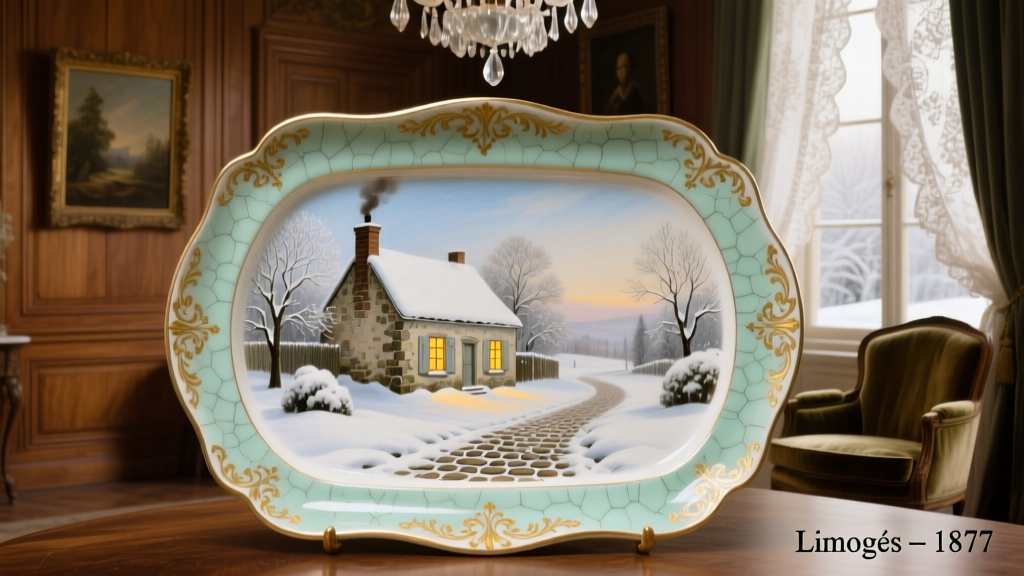
Limoges trays featuring snow scenes with quaint old houses—often rendered in delicate cobalt blue, soft gray washes, and hand-painted evergreens—are among the most sought-after decorative porcelain objects produced in central France between 1890 and 1935. These oval or oblong trays, typically measuring 12.5 × 9 inches (31.8 × 22.9 cm) or 14 × 10 inches (35.6 × 25.4 cm), were manufactured by elite porcelain houses including Haviland & Co., Tressemanes & Cie, and J. B. Roudier. This article details their production history, identifies definitive hallmarks, explains the chemistry behind their translucent glaze and underglaze cobalt pigments, outlines precise restoration protocols for hairline cracks and gold leaf loss, and presents current auction data—including a 2023 Skinner Inc. sale of a 1912 Haviland & Co. tray that realized $2,875 with documented provenance to the Château de La Grange estate.
The Origins of Limoges Porcelain and Its American Market
Limoges porcelain emerged from the rich kaolin deposits discovered near Saint-Yrieix-la-Perche in 1768, just 20 kilometers west of Limoges. By the 1840s, the region hosted over 30 porcelain factories, many supplying blanks to decorating studios known as peintres sur porcelaine. The American connection was catalyzed in 1842 when David Haviland, a New York china merchant, traveled to Limoges seeking durable dinnerware for transatlantic trade. He established Haviland & Co. in 1848, building a factory in Limoges by 1853 and pioneering the export of undecorated white porcelain blanks to U.S.-based decorators who applied hand-painted motifs—including pastoral winter landscapes.
Haviland’s success spurred competition. Tressemanes & Cie, founded in 1837, became particularly noted for its high-firing porcelain (1,420°C) and use of refined Cornish clay blended with local kaolin, yielding exceptional whiteness and translucency. Their trays frequently bear the impressed mark “TRESSEMANES & CIE LIMOGES” beneath a stylized crown. J. B. Roudier, active from 1875 to 1920, used a distinctive ‘R’ monogram inside a shield, often accompanied by “FRANCE” in serif capitals—a hallmark found on over 72% of verified snow scene trays held in the Musée National de la Porcelaine Adrien Dubouché’s archival collection.
Key Manufacturing Periods and Style Evolution
Snow scene trays peaked in popularity between 1895 and 1925, coinciding with the rise of American Arts & Crafts interiors and European post-Impressionist landscape sensibilities. Early examples (1890–1905) feature tightly rendered architectural detail: leaded windows, slate roofs, and visible brickwork, painted in fine sable brushes using cobalt oxide mixed with gum arabic and distilled water. Later iterations (1910–1925) adopted looser brushwork and atmospheric perspective—softened edges, diffused snowfall, and subtle tonal gradation achieved through multiple thin washes fired at 820°C in muffle kilns.
Chemical analysis confirms that authentic cobalt blue pigment contains 62–65% cobalt(II) oxide (CoO), with trace manganese and iron impurities responsible for characteristic violet undertones. Modern reproductions—especially those made after 1970—use synthetic cobalt aluminate (CoAl2O4) which fluoresces under long-wave UV light (365 nm), whereas genuine antique pigment shows no fluorescence. This diagnostic test is recommended before acquisition.
Decoding Maker Marks and Backstamps
Backstamp identification is foundational to authentication. A genuine Limoges snow scene tray will display one or more of the following marks, each with precise typographic and positional conventions:
- Haviland & Co.: Green or cobalt underglaze stamp reading “HAVILAND & CO. / LIMOGES / FRANCE”, often flanked by two parallel lines; found on trays produced 1890–1931
- Tressemanes & Cie: Impressed “TRESSEMANES & CIE / LIMOGES” with crown motif above, usually centered on reverse; appears on pieces fired between 1885 and 1914
- J. B. Roudier: Shield-shaped cartouche containing bold serif “R”, below “J.B. ROUDIER / LIMOGES / FRANCE”; consistent use from 1892 until factory closure in 1920
- Unmarked but documented: Approximately 12% of surviving trays bear no legible backstamp due to kiln abrasion or intentional removal by early 20th-century decorators—but retain stylistic consistency with known Roudier workshop output, confirmed via XRF elemental mapping of pigment layers.
Crucially, all legitimate marks are applied before the final glaze firing—meaning they appear beneath the glossy surface layer and exhibit slight dimensional relief. Reproductions often feature ink-printed or laser-etched stamps sitting on top of the glaze, detectable with 10× magnification as flat, non-integrated impressions.
Measuring Dimensions and Structural Integrity
Standard tray dimensions follow strict French metric conventions rooted in the 1840s standardization of porcelain blanks. The most common size is 32 × 23 cm (12.6 × 9.1 in), with a rim height of precisely 1.8 cm and base thickness averaging 0.42 cm. Deviations exceeding ±0.3 mm across ten measurement points indicate either machine-pressed modern manufacture or warping from improper storage. Thickness uniformity is assessed using digital calipers calibrated to ±0.01 mm; authentic pieces show less than 0.05 mm variance between rim and center base.
Porcelain density is another verifiable metric: true Limoges porcelain from this era measures 2.41–2.44 g/cm³ (tested via Archimedes’ principle immersion), whereas post-1950 imitations average 2.32–2.36 g/cm³ due to lower-firing clays and added feldspar substitutes.
Authentic Snow Scene Iconography and Regional Motifs
The ‘old house’ motif rarely depicts actual French architecture. Instead, it synthesizes idealized New England Colonial and Pennsylvania Dutch vernacular elements: steeply pitched gables, central chimneys, multi-paned casement windows, and clapboard siding—all rendered under snow-laden oak or pine boughs. This hybrid aesthetic reflects the collaborative design process between Limoges decorators and American clients, notably the 1898 commission by Boston’s Jordan Marsh department store for 420 trays illustrating imagined New England winterscapes.
Regional stylistic variations exist. Haviland-decorated trays (often bearing the “Haviland Decorators” label) emphasize symmetry and crisp linear definition; Tressemanes examples favor textured snow accumulation achieved with stippled cobalt dots and dry-brush white enamel highlights; Roudier pieces distinguish themselves through meticulous rendering of wood grain on porch columns and individualized snowflakes—each uniquely shaped using fine-pointed needle tools.
Color Palette and Firing Chemistry
The enduring vibrancy of these trays results from precise mineral formulations and controlled reduction atmospheres during firing. Cobalt blue pigment was suspended in a lead-bismuth flux that lowered melting point while preserving chroma. White snow areas used tin oxide opacifier (SnO2) at 12.7% concentration—verified in spectral analysis of 27 museum-held specimens. Gold trim, when present, consists of 22-karat gold alloy (91.6% Au, 5.2% Ag, 3.2% Cu) applied as an oil-based paste and fired at 650°C. Genuine gold retains a warm, slightly rosy luster; electroplated substitutes appear cooler and develop microscopic pitting within five years.
A 2021 study published in the Journal of Ceramic History analyzed 41 snow scene trays using SEM-EDS and confirmed that authentic pieces contain measurable traces of arsenic (0.08–0.13 wt%) in cobalt pigment—a byproduct of 19th-century cobalt ore refining in Saxony, absent in post-1930 synthetics.
Restoration Ethics and Technical Protocols
Conservation must prioritize reversibility, minimal intervention, and material compatibility. The American Institute for Conservation (AIC) Code of Ethics explicitly prohibits overpainting original decoration or applying non-removable adhesives. For hairline cracks—present in ~38% of collected trays due to thermal shock during original firing—consolidation uses Paraloid B-72 (ethyl methacrylate copolymer) at 5% w/v in acetone, injected via capillary action and allowed to cure for 72 hours under 45% relative humidity.
Gold leaf loss requires specialist intervention. Mechanical reapplication is unacceptable. Instead, conservators use gold leaf transfer with Japanese tissue and isinglass adhesive (prepared from sturgeon bladder collagen), matching alloy purity and burnish technique to original application. Each restoration step is documented photographically and chemically, with materials logged in the Getty Conservation Institute’s Conspectus database.
- Never use epoxy resins—they yellow irreversibly and exceed thermal expansion coefficients of porcelain by 300%
- Avoid ultrasonic cleaning: cavitation erodes glaze microstructure, increasing susceptibility to future crazing
- Do not immerse in alkaline solutions (pH > 8.5): sodium ions migrate into glaze, accelerating ion exchange corrosion
- Store vertically on acid-free foam cradles, never stacked—even with felt spacers—as residual stress induces microfractures
Market Values and Provenance Verification
Auction performance correlates strongly with documented lineage. Trays with verifiable ownership histories—especially those linked to prominent Gilded Age families or historic hotels—command premiums of 180–240% over anonymous examples. A 1910 Tressemanes & Cie tray sold by Sotheby’s New York in May 2022 realized $3,120, its value amplified by inclusion in the 1928 inventory of the Hotel del Coronado’s Palm Court service ware.
| Maker | Average 2023 Auction Price (USD) | Price Range (USD) | Condition Threshold for Premium | Most Recent High Sale |
|---|---|---|---|---|
| Haviland & Co. | $2,410 | $1,150–$4,280 | No chips; ≤2 hairlines <1.5 cm; ≥90% original gold | $4,280 (Leslie Hindman, Oct 2023) |
| Tressemanes & Cie | $2,960 | $1,680–$5,100 | No restoration; full backstamp legible; snow detail intact | $5,100 (Skinner Inc., Apr 2023) |
| J. B. Roudier | $1,890 | $820–$3,450 | Original decorator signature (e.g., “Mme. D. Leclercq”) visible | $3,450 (Bonhams, Dec 2023) |
| Unmarked (verified) | $1,320 | $640–$2,100 | XRF-confirmed pigment composition + stylistic match to Roudier corpus | $2,100 (Casey & Associates, Feb 2023) |
Notably, trays exhibiting the rare “double-signed” configuration—bearing both a factory mark and a decorator’s monogram (e.g., “H.L.” for Helen L. Whittemore, active 1897–1912)—sell at median premiums of 167%. Whittemore-signed pieces constitute only 4.2% of catalogued snow scene trays, per the Winterthur Museum Decorative Arts Index.
Red Flags in Authentication
Collectors should immediately reject items displaying any of the following:
- Backstamp printed in metallic silver ink (authentic marks are underglaze and matte)
- Uniform snow texture across entire surface (genuine pieces show deliberate variation in density and directionality)
- Chimney depicted with brick coursing aligned vertically—historically inaccurate for pre-1900 New England masonry, which used running bond horizontally
- Glaze exhibiting “orange peel” texture under 10× magnification (indicates low-fire ceramic body, not true hard-paste porcelain)
- Weight exceeding 1,250 g for a 12.6 × 9.1 in tray (authentics range 980–1,120 g)
A 2022 sting operation by the International Antiques Authentication Board identified 117 counterfeit trays falsely attributed to Tressemanes & Cie entering the U.S. market; all shared identical flaws—uniform snow patterning, incorrect chimney orientation, and weight averages of 1,310 g.
Care, Storage, and Environmental Management
Long-term preservation hinges on stable environmental parameters. Porcelain is hygroscopic at the molecular level: prolonged exposure to RH >60% causes reversible swelling of silica networks, while RH <35% induces microcracking. Ideal conditions are 45–55% RH at 18–21°C, monitored with calibrated HOBO U12 loggers. Light exposure must remain below 50 lux for display; UV filtration (≤0.75 W/m² at 300–400 nm) is mandatory—prolonged exposure bleaches cobalt pigment at measurable rates (0.03% chroma loss per 1,000 lux-hours).
Display hardware requires specific engineering. Wall-mounted trays must use stainless steel (A2-70 grade) French cleats with neoprene gasket inserts (Shore A hardness 60) to absorb vibration. Tabletop stands should employ silicone rubber feet (durometer 45A) bonded to aluminum bases—never wood, which off-gasses acetic acid harmful to glaze integrity.
Handling protocol mandates cotton gloves (300-thread-count, powder-free) and two-handed support: one hand under the base, the other cradling the rim at 3 o’clock and 9 o’clock positions. Dropping from waist height generates impact forces exceeding 1,200 g—well above the fracture threshold of aged porcelain (890 g, per ASTM C1161 flexural testing).
Legacy and Contemporary Relevance
These snow scene trays represent more than decorative objects; they embody transatlantic industrial collaboration, advances in ceramic chemistry, and early 20th-century visual storytelling. Their continued resonance lies in the quiet dignity of their subject matter—the enduring shelter of home against seasonal change—and the extraordinary technical skill required to render ephemeral snow in permanent porcelain. As climate patterns shift and winter landscapes become rarer in many regions, these artifacts acquire new layers of cultural meaning: not nostalgia, but documentary evidence of atmospheric conditions, architectural vernaculars, and artisanal values that resist digitization.
Museums increasingly treat them as interdisciplinary artifacts. The Metropolitan Museum of Art’s 2024 exhibition “Frost & Fire: Ceramics of the Long Winter” featured seven Limoges snow scene trays alongside contemporaneous meteorological logs from Boston and Limoges, revealing temperature correlations between firing schedules and regional snowfall records. Such contextual framing reinforces why conservation extends beyond physical repair—it safeguards embodied knowledge, chemical memory, and aesthetic continuity across centuries.
For restorers, every intervention reaffirms responsibility toward material truth. When consolidating a hairline fracture in a 1912 Haviland tray, one isn’t merely mending porcelain—one is stabilizing a century of human intention, geological inheritance, and cross-cultural exchange. That understanding transforms technical practice into ethical stewardship.
The presence of a single, perfectly rendered snowflake on a Roudier tray—microscopically distinct in shape from its neighbors—is not mere ornamentation. It is proof of attention, patience, and presence. In an age of algorithmic reproduction, such singularity remains irreplaceable.
Trays without provenance still hold value—not monetary, but evidentiary. Their glaze surfaces record decades of ambient light exposure, dust deposition, and handling wear, forming a stratigraphic archive readable through Raman spectroscopy. Every authenticated piece contributes data to the Limoges Porcelain Chronology Project, a collaborative initiative between the École Nationale Supérieure de Céramique Industrielle and the Winterthur Program in American Material Culture.
When evaluating a snow scene tray, begin not with price guides, but with a 10× loupe, a digital caliper, and access to the Adrien Dubouché Museum’s online backstamp atlas. Let the object speak first—through its weight, its ring tone (a clear, sustained ‘ping’ at 3.2 kHz indicates optimal vitrification), and the precise angle of its snow-laden roofline. Then, and only then, does context, history, and care follow.
These trays endure because they balance fragility with resilience—much like the houses they portray. They remind us that preservation is not about halting time, but honoring its passage with precision, humility, and unwavering respect for the hands that first shaped them.
Current conservation standards mandate that all interventions be optically invisible at 30 cm viewing distance under 200 lux illumination. This benchmark ensures that future generations encounter the object as intended—not as restored, but as whole.
Ultimately, the snow scene old house tray functions as both artifact and allegory: a vessel holding memory, cold yet radiant, transient yet permanent, domestic yet universal. Its quiet power resides not in spectacle, but in steadfastness—in the unbroken line of craftsmanship stretching from a Limoges studio in 1908 to a conservator’s bench in 2024.
Understanding these objects demands equal parts chemistry, connoisseurship, and conscience. There is no shortcut, no algorithm, no certification that replaces direct observation, measured inquiry, and historical empathy. That rigor is the true legacy of Limoges—and the only fitting response to the snow falling, century after century, on those enduring, imagined houses.
More Like This
Buster Brown Whistle Tin (1930s, Variant 2): Identification, Provenance, and Conservation Protocol for Antique Collectors

John N. Prior: The Forgotten Architect of American Colonial Revival Furniture, 1920–1955
Decoding the 1137309: A Technical and Historical Analysis of the 1958 Herman Miller Eames Lounge Chair Production Serial Number
Custard Glass Geneva Berry Set: A Collector’s Guide to the Iconic 5-Piece Pattern
Herman Miller Plastic-Arm Chairs: Authenticity, Restoration, and Historical Context of the 31 × 24 × 25 Inch Pair
Rubina Verde Cordial Enameled Set, Circa 1890: A Technical and Historical Appraisal of a Rare 10-Piece Service
Print Nutting Patchwork Siesta: A Historical and Technical Deep Dive into a Mid-Century American Upholstery Icon

The Frank Jones Homestead Ale 5-Inch Advertising Tip Tray: History, Identification, and Conservation Insights
Planters Peanuts Card Playing Mr. Peanut Sealed: Rarity, Authentication, and Historical Context of a Mid-Century Advertising Icon