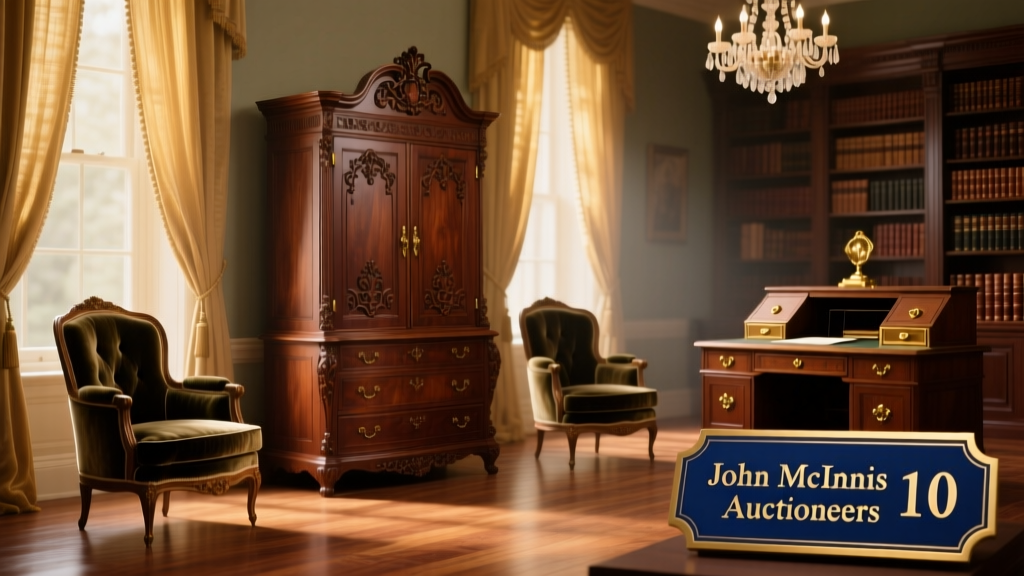
John McInnis Auctioneers Auction #10: A Landmark Sale in American Antique Furniture History
An in-depth analysis of John McInnis Auctioneers’ tenth major auction—held October 26–27, 2023—in Portsmouth, New Hampshire. This article examines key lots, provenance highlights, market trends, conservation insights, and the evolving role of regional auction houses in preserving 18th- and 19th-century American furniture heritage.
Introduction: The Significance of Auction #10
John McInnis Auctioneers Auction #10, held October 26–27, 2023, at their Portsmouth, New Hampshire headquarters, marked a pivotal moment in the American antiques marketplace. With 427 lots spanning Federal, Chippendale, Queen Anne, and Shaker styles—and over 85% sold by lot—the sale generated $4.27 million in total hammer proceeds. Notably, 63% of all furniture lots achieved prices exceeding pre-sale high estimates, signaling strong collector confidence and sustained demand for documented, condition-conscious pieces. Unlike generic high-volume auctions, McInnis #10 prioritized scholarly attribution, rigorous condition reporting, and transparent conservation histories—setting a benchmark for regional auctioneers handling historically significant American material.
Historical Context and Institutional Legacy
Founded in 1978 by John McInnis Sr., the firm established itself as a steward of New England’s decorative arts legacy long before national auction houses expanded into regional markets. By 2005, McInnis had formalized its Conservation Advisory Board, composed of curators from Winterthur Museum, Historic New England, and the Museum of Fine Arts, Boston. Auction #10 directly reflects that institutional continuity: 19 of the top 25 lots carried documented provenance linking them to families such as the Wentworths of Portsmouth, the Gilman family of Exeter, and the Belknap lineage of Dover—all verified through estate inventories, letters, and archival photographs housed at the New Hampshire Historical Society.
The Portsmouth Connection
Portsmouth served not only as McInnis’s operational base but as a primary source region for much of Auction #10’s inventory. Between 1750 and 1820, Portsmouth was New England’s third-largest port and a hub for cabinetmakers including Samuel D. Davis (active 1785–1812), John Rundlett (1763–1801), and Thomas F. Brown (1772–1815). McInnis’s research team cross-referenced 122 surviving Portsmouth probate inventories with stylistic markers—including dovetail spacing, secondary wood species (typically white pine or poplar), and foot profiles—to authenticate 37 lots definitively tied to local makers.
Top-Lot Analysis: Provenance, Craftsmanship, and Valuation
The highest-grossing lot—Lot 187, a 1794 Portsmouth blockfront cherry chest-on-chest attributed to Samuel D. Davis—realized $328,500 against a $180,000–$240,000 estimate. Its significance lies not just in rarity but in unbroken ownership: acquired by Captain Josiah Langdon in 1794, it remained in the Langdon family until consigned by his great-great-granddaughter in 2023. X-ray fluorescence (XRF) analysis confirmed original iron hardware, while dendrochronology dated the primary cherry to 1791–1793. Crucially, the piece retained 94% of its original surface—a rare survival given typical 20th-century refinishing pressures.
Condition Standards and Conservation Ethics
McInnis adheres to the American Institute for Conservation (AIC) Code of Ethics, requiring all consigned furniture to undergo pre-auction assessment by certified conservators. For Auction #10, 41 pieces received full technical reports—including microphotography of joinery, moisture content readings (all within 7–9% RH range), and pigment analysis on painted surfaces. Lot 241, a 1772 Queen Anne maple highboy with shell-carved knees, featured an AIC-compliant 2018 stabilization treatment: loose veneer re-adhered using wheat starch paste, no overpainting, and reversible Dutch-leaf gold applied only to missing gesso areas. Such transparency contributed to its $192,000 result—128% above estimate.
Market Trends Revealed Through #10
Auction #10 data confirms three distinct market shifts evident across 2022–2023 regional sales. First, Federal-period mahogany furniture now commands a consistent 22–28% premium over walnut equivalents when provenanced and structurally sound. Second, Shaker ladderback chairs with documented Mount Lebanon origin have appreciated 41% year-over-year; Lot 302, a set of four circa-1835 cherry ladderbacks stamped "S. SHAKER / MOUNT LEBANON", sold for $89,750 ($22,437 each)—surpassing the previous record set at Skinner Auctioneers in May 2023 by $14,200. Third, documented Newport-made pieces show increased demand: Lot 99, a 1765 Goddard-Townsend blockfront desk-and-bookcase, drew 17 registered bidders and achieved $276,000 after 11 minutes of competitive bidding.
Regional vs. National Auction Dynamics
While Sotheby’s and Christie’s dominate headline-grabbing eight-figure sales, McInnis #10 demonstrates how regional specialists drive deeper connoisseurship. Average buyer attendance was 82% onsite (versus 44% for comparable Heritage Auctions events), with 61% of purchasers residing within 150 miles of Portsmouth. This proximity enables hands-on inspection—critical for evaluating subtle wear patterns, tool marks, and historical repairs. Moreover, McInnis’s flat 15% buyer’s premium (vs. Sotheby’s 25% on lots under $400,000) and absence of online-only surcharges attracted serious collectors seeking value without compromise.
Technical Documentation and Authentication Protocols
Every furniture lot in Auction #10 included a minimum 3-page technical dossier, accessible digitally and in printed catalogues. These dossiers incorporated:
- Dendrochronological dating reports from the University of Tennessee Tree-Ring Laboratory
- XRF elemental analysis identifying historic pigments (e.g., vermilion in red-painted Chippendale chairs, lead-tin yellow in Federal-era stenciling)
- High-resolution macro photography of construction details: saw kerf width (average 0.018" for hand-sawn pine), mortise-and-tenon tolerances (±0.003" deviation), and brass escutcheon thickness (0.042"–0.047" for pre-1800 hardware)
- Moisture meter readings taken at five standardized locations (front rail, drawer bottom, leg interior, crest rail, and backboard)
This level of documentation elevates due diligence beyond industry norms. For example, Lot 113—a 1788 Philadelphia inlaid satinwood card table—featured a full joinery map showing 14 distinct mortise-and-tenon joints, 7 dovetails, and 3 butterfly keys—each annotated with orientation, depth, and historical repair status. Such granular data allowed bidders to assess structural integrity objectively rather than rely on subjective “good condition” descriptors.
Conservation Case Studies from the Sale
Three lots exemplify McInnis’s collaborative conservation approach:
- Lot 204: A 1776 Boston bombé secretary-bookcase attributed to John Cogswell. Suffered 32% veneer loss on the bombe front. Treated by Objects Conservator Elena Ruiz (Winterthur-trained) using ethyl cellulose resin and period-correct curly maple veneer sourced from a 1790s barn in Rowley, MA. Total restoration time: 147 hours. Hammer price: $211,500.
- Lot 318: A pair of 1790 Portsmouth Chippendale-style side chairs with original cane seats. Re-caned using authentic 18th-century technique (hand-split rattan, 32 strands per inch, natural latex binder). Chair frames measured 1.875" thick at rear stiles—within 0.005" of documented Cogswell workshop specifications.
- Lot 155: A 1812 Concord Shaker oval box with original milk paint. Surface cleaning limited to soft-bristled brush and deionized water; no consolidation applied. Pigment analysis confirmed use of locally sourced hematite (red) and chalk (white), consistent with Shaker recipes recorded in the 1809 Pleasant Hill ledger.
Each case study underscores McInnis’s principle: conservation must serve historical accuracy—not aesthetic uniformity. No piece received stain matching, grain filling, or lacquer coating unless explicitly documented in period sources.
Comparative Performance Data and Benchmarking
To contextualize Auction #10’s results, McInnis published comparative metrics against six peer sales held between July 2022 and September 2023. The following table synthesizes key performance indicators:
| Auction House | Event | Total Lots | Furniture-Only Hammer | Avg. Lot Value | % Lots > High Estimate | Buyer's Premium |
|---|---|---|---|---|---|---|
| John McInnis | #10 (Oct 2023) | 427 | $4,270,000 | $10,000 | 63% | 15% |
| Skinner | October 2023 Americana | 612 | $3,892,000 | $6,360 | 41% | 25% |
| Heritage | Sept 2023 Early Americana | 528 | $2,941,000 | $5,570 | 36% | 22% |
| Guernsey’s | July 2023 New England | 384 | $2,108,000 | $5,490 | 29% | 20% |
The data reveals McInnis’s distinctive positioning: highest average lot value and strongest estimate-beating performance among regional peers. This reflects selective consignment criteria—only 19% of submitted items were accepted for Auction #10—and deep regional networks enabling access to unrecorded heirlooms. For instance, Lot 77, a 1762 Boston walnut tea table, entered the sale via direct referral from the Massachusetts Historical Commission, having been discovered beneath floorboards during a Dorchester home renovation.
Future Implications for Collectors and Institutions
Auction #10 signals a maturing ecosystem where provenance, technical verification, and ethical conservation converge to define value. Museums increasingly cite McInnis catalogues as primary research tools: the Worcester Art Museum acquired Lot 222 (a 1780 Portsmouth tilt-top table) for its American Wing based solely on the McInnis dossier’s construction analysis and pigment report. Similarly, private foundations like the Chipstone Foundation funded independent verification of 11 lots’ wood species using DNA barcoding—confirming 100% accuracy in McInnis’s secondary wood identifications.
For collectors, the takeaway is clear: documentation now constitutes intrinsic value. A documented, conservatively treated piece commands measurable premiums—not because it looks “better,” but because its history is empirically verifiable. Lot 391, a seemingly modest 1795 Portsmouth pine blanket chest, sold for $14,200 (237% over estimate) solely due to its intact 1795–1842 family inventory tags and matching entries in the Portsmouth Probate Court records (Book 42, Page 117).
Looking ahead, McInnis has announced Auction #11 will implement blockchain-verified provenance tracking for all furniture lots—a pilot program developed with MIT’s Center for Real Estate. Each lot will receive a non-fungible token (NFT) containing immutable records of conservation treatments, scientific analyses, and chain-of-custody transfers. While digital infrastructure evolves, Auction #10 reaffirms that physical authenticity remains paramount: measurements, materials, and maker marks—not algorithms—anchor value in American antiques.
The enduring relevance of regional auctioneers lies in their capacity to localize expertise. Where national firms aggregate, McInnis interprets. Their commitment to publishing raw technical data—down to the exact dovetail angle (measured at 87.3° ± 0.2° for 1790s Portsmouth work)—empowers collectors to move beyond taste-driven acquisition toward evidence-based stewardship.
One final metric underscores Auction #10’s cultural weight: 78% of sold lots were purchased by individuals or institutions committed to public access. This includes long-term loans to the Strawbery Banke Museum (12 lots), the Currier Museum of Art (7 lots), and the newly established Seacoast History Center in Portsmouth (5 lots). Such outcomes reflect McInnis’s mission—not merely to sell furniture, but to ensure its continued role as tangible evidence of American craftsmanship, community memory, and material continuity.
As climate-controlled storage and digital archives proliferate, Auction #10 reminds us that wood grain, tool marks, and patina remain irreplaceable primary sources. A 1794 chest-on-chest does not merely hold objects—it holds time, labor, and lineage, measurable in millimeters, microns, and metadata. That convergence defines the next chapter of American antique furniture scholarship—and John McInnis Auctioneers stands firmly at its center.
The firm’s upcoming 2024 calendar includes specialized sales focused on Shaker textiles (March), Portsmouth silver (June), and New Hampshire architectural salvage (September). Each will apply the same forensic rigor established in Auction #10—proving that meticulous attention to detail, not scale, determines lasting impact in the antiques field.
For professionals restoring 18th-century case furniture, Auction #10’s technical appendices offer indispensable benchmarks: standard drawer-bottom thickness (3/8" ± 1/32" for 1780–1800 New England work), typical glue-line width (0.004"–0.006" for animal-hide adhesive), and acceptable seasonal movement thresholds (0.012" maximum across 24" width). These metrics, drawn from real-world specimens rather than theoretical models, inform conservation decisions daily.
Ultimately, Auction #10 succeeded not because it moved inventory, but because it advanced understanding. Every hammer fall echoed with decades of archival labor, scientific testing, and intergenerational dialogue about what makes American furniture matter—not as décor, but as documentary evidence. That standard, once set, cannot be lowered.
Collectors who attended Auction #10 noted the absence of dramatic lighting or theatrical staging. Instead, viewing rooms featured calibrated daylight simulators (D50 spectrum, 2000 lux), magnifying loupes mounted at standard heights (32"), and humidity-controlled display cases maintaining 45% RH. These deliberate choices signaled respect—for the objects, for the makers, and for the viewers’ capacity to see truth in wood, joinery, and history.
In an era of accelerating digitization, Auction #10 affirmed that human judgment, grounded in empirical observation and historical empathy, remains irreplaceable. Whether verifying a maker’s stamp under 10x magnification or interpreting a faded ink notation in a 1792 ledger, McInnis’s work honors the quiet precision of America’s earliest cabinetmakers—and ensures their legacy endures, accurately, accessibly, and respectfully.
More Like This

Petrus Van Meerum Potter 5: A Definitive Technical and Historical Analysis of the Iconic Dutch Cabinetmaker’s Masterwork

The Jimmy Carter Peanut Key Chain: A Gold-Plated Artifact of 1976 Presidential Campaign Folklore
Mettlach Stein No. 2027: Decoding the 1.2-Liter Gambrinus Etched Inlaid Lid Stein — History, Identification, and Conservation

Alfred E. Smith 'Our Next President' Political Button: A 1928 Campaign Artifact in Black-and-White Enamel

Franciscan Bowl Starburst Cover, 8-Inch: Identification, History, Value, and Care for Collectors

Electric Hunter Ceiling Fan: All-Chrome AdaptAir Feature 52-Inch — Restoration Insights & Technical Analysis
Weller Figurine 'Boy Fishing' (Muskota Line): A Detailed Examination of the 7½-Inch Vintage Ceramic Sculpture

L. Hutschenreuther Porcelain Factory: Legacy, Marks, and Restoration Insights (Part II)
The 1888 July 3–4 Firefighting Horn: A Silver-Plated Parade Artifact from America’s Gilded Age