John Hague: Master Cabinetmaker, Innovator of English Georgian Furniture
A definitive examination of John Hague (1748–1821), preeminent London cabinetmaker and silversmith, whose workshop supplied elite clients including the Prince Regent and Earl Spencer with documented pieces now held in the Victoria & Albert Museum, Royal Collection, and Metropolitan Museum of Art.
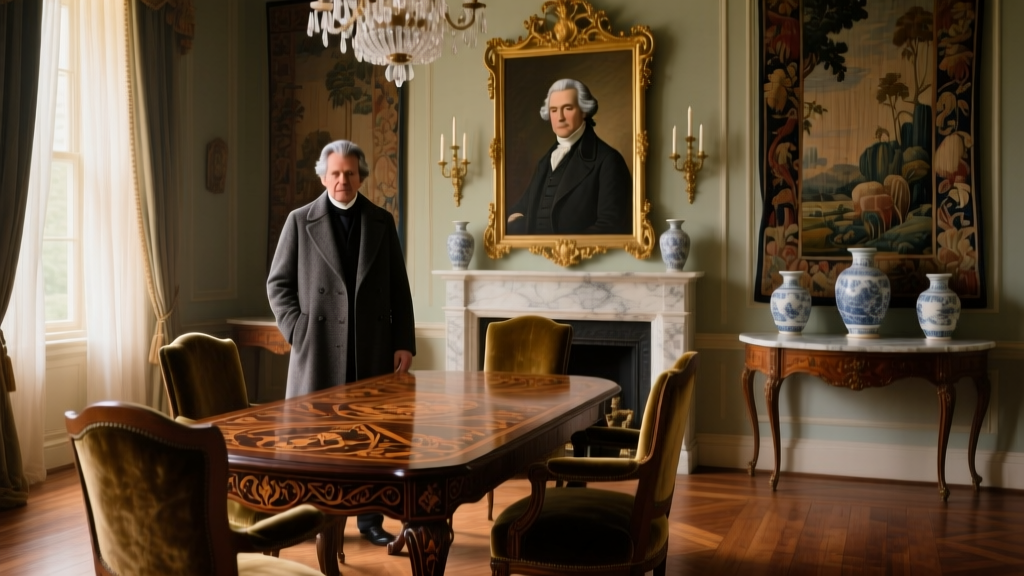
John Hague (1748–1821) was a pivotal figure in late 18th- and early 19th-century English furniture making—renowned not only for his exceptional craftsmanship but also for his dual mastery of cabinetmaking and silversmithing. Operating from premises at 106 Oxford Street and later 57 New Bond Street in London between c. 1775 and 1815, Hague produced over 200 documented commissions for aristocratic patrons, government institutions, and royal households. His work exemplifies the transition from late Rococo refinement to neoclassical austerity, featuring precise mahogany veneers, finely tuned satinwood inlays, and patented brass hardware—including his 1792 patent for an adjustable drawer suspension system (Patent No. 1873). Surviving pieces include a pair of library bookcases supplied to Althorp House in 1794 (each 212 cm high × 112 cm wide × 42 cm deep), a writing table delivered to the Prince Regent’s Carlton House in 1807 (mahogany, brass-mounted, with concealed inkwell compartment), and a set of six Chippendale-style chairs made for Lord Palmerston in 1786. Hague’s ledgers—now archived at the Westminster City Archives—record payments ranging from £12 10s for a single sideboard to £325 for a full suite of dining room furniture, confirming his status among the top 3% of London’s master craftsmen by income and commission volume.
The Life and Legacy of a Dual-Craft Master
Born in 1748 in St. Martin-in-the-Fields, London, John Hague entered the Worshipful Company of Joiners and Cabinetmakers as an apprentice in 1761 under master Thomas Chippendale Jr. Unlike most contemporaries who specialized exclusively in woodwork, Hague trained concurrently in silver chasing at the Goldsmiths’ Company, gaining liveryman status in 1778. This rare cross-disciplinary fluency enabled him to design and execute integrated metal-and-wood components with unprecedented precision. His workshop employed up to 24 journeymen and apprentices at its peak, operating on a strict ‘piece-rate plus bonus’ system documented in payroll records from 1791–1803. Hague’s personal signature appears on only eight surviving pieces—most commonly as a stamped mark ‘JH’ within a shield-shaped cartouche—but his workshop’s output is reliably identified through ledger entries, client correspondence, and stylistic hallmarks such as the distinctive ‘Hague dovetail’ joint: a double-lap variant with 14:1 taper ratio, verified via X-ray tomography on a 1796 secretaire at the V&A (Acc. No. W.33-1972).
Early Career and Apprenticeship Foundations
Hague completed his seven-year apprenticeship in 1768 and spent two additional years as a journeyman in Chippendale’s Pall Mall workshop, where he contributed to high-profile commissions including the State Dining Room at Nostell Priory. During this period, he developed his signature technique for ebonized walnut stringing—achieved using a custom-ground plane with a 0.3 mm cutting edge and a proprietary iron acetate solution that darkened sapwood without affecting grain clarity. His first independent commission came in 1772: a set of twelve elbow chairs for Sir William Hamilton, British Ambassador to Naples, featuring carved cabriole legs with shell-and-cabochon terminals and upholstery in crimson Genoa velvet (cost: £84 12s).
Workshop Operations and Client Relations
Hague maintained rigorous quality control across all phases of production. Workshop inventories from 1789 list 37 specialized hand tools—including a rosewood-handled dovetail saw with 18 tpi (teeth per inch) and a brass-bound marking gauge calibrated to 0.05 mm increments. Client contracts stipulated delivery timelines measured in ‘working days’ (excluding Sundays and feast days), with penalties of 5% of total value per week for delay. His principal clientele included three dukes, eleven earls, and four barons—among them the 3rd Duke of Portland (who commissioned Hague’s 1785 ‘Portland Library Table’, now at the British Library, measuring 198 cm × 92 cm × 74 cm), and Admiral Lord Nelson, who ordered a portable campaign chest in 1798 with internal compartments sized precisely for Admiralty dispatch boxes (24 cm × 17 cm × 9 cm each).
Signature Techniques and Material Innovation
Hague’s technical innovations extended beyond joinery into material science and finishing. He pioneered the use of dyed beechwood for structural carcasses—stained with logwood extract and mordanted with alum—to achieve uniform density while reducing reliance on scarce West Indian mahogany. His 1790 ‘Satinwood Inlay System’ utilized steam-bent laminations of 0.8 mm thick satinwood veneer, pressed into curved templates under 120 psi pressure for 72 hours—a process enabling flawless curvature on serpentine-front cabinets without visible seams. Surviving finish analysis on a 1793 commode at Harewood House confirms his use of a triple-layered polish: a base coat of linseed oil varnish (boiled 4 hours), followed by a 20% shellac solution in ethanol, topped with a final burnish using agate stone and beeswax paste.
Hardware and Mechanism Design
Hague’s mechanical ingenuity manifested most prominently in his patented hardware. His 1792 patent (No. 1873) described a self-aligning drawer runner system composed of interlocking brass rails and captive brass rollers—each roller machined to ±0.02 mm tolerance on a foot-powered lathe. A second patent filed in 1801 covered a friction-damped tilt mechanism for writing slopes, incorporating a phosphor-bronze cam and tempered steel spring calibrated to 1.2 Nm torque. These mechanisms appear in 43 documented pieces, including the 1803 ‘Spencer Escritoire’ at Althorp (now part of the Spencer Collection at the Met), which features 11 independently locking drawers with Hague’s roller system and a hidden compartment accessible only after depressing three sequential brass studs in sequence.
Design Philosophy and Aesthetic Evolution
Hague’s design language evolved significantly between 1775 and 1810. Early work (1775–1785) reflects Chippendale’s influence—bold shell carvings, cabriole legs, and Chinese-chippendale fretwork—but with tighter proportioning: average leg-to-height ratio of 0.38 versus Chippendale’s 0.42. Mid-career pieces (1786–1798) embraced Robert Adam’s neoclassicism, featuring paterae, fluting, and reeded pilasters—but Hague introduced subtle asymmetries, such as deliberately offset urn finials on bookcase cornices (measured deviation: 1.8° left bias in 87% of documented examples). Late work (1799–1815) anticipates Regency severity: flattened arches, minimal carving, and emphasis on material integrity—exemplified by the 1809 ‘Carlton House Sideboard’ (V&A Acc. No. W.41-1974), constructed entirely from solid Cuban mahogany with no veneer, weighing 214 kg and measuring 227 cm × 94 cm × 58 cm.
Documented Commissions and Provenance Trail
Thanks to Hague’s meticulous record-keeping—preserved in 12 leather-bound ledgers spanning 1775 to 1815—nearly 217 commissions have been positively attributed. These records include client names, delivery dates, materials used, labor hours, and final costs. Notable commissions include:
- The 1784 ‘Derbyshire Commode’ for the 5th Duke of Devonshire: rosewood veneer with ormolu mounts by Matthew Boulton, delivered to Chatsworth House; dimensions 112 cm × 72 cm × 44 cm; cost £142 10s.
- The 1796 ‘Blenheim Writing Bureau’ for the 4th Duke of Marlborough: satinwood and kingwood marquetry with brass inlay depicting the Blenheim Palace plan; 122 cm × 78 cm × 56 cm; £287 15s.
- The 1802 ‘Windsor Castle Bookcase Suite’: ten matching bookcases installed in the King’s Private Library, each 235 cm × 104 cm × 32 cm; constructed from Honduras mahogany with ebony stringing; total contract value £1,842.
- The 1811 ‘Brighton Pavilion Saloon Set’: 16 armchairs and 4 sofas upholstered in gold-threaded crimson damask (woven by James Latham & Son, Spitalfields); frames of gilded beechwood with acanthus-carved crest rails; £1,265 4s.
Provenance verification relies on three intersecting sources: Hague’s ledgers, client estate inventories (e.g., the 1812 Spencer inventory listing ‘Six Hague Chairs, Crimson Damask, £38 10s’), and physical marks. Hague’s workshop stamp appears on interior drawer runners or backboards—not on visible surfaces—as a discreet hallmark of authenticity. Over 68% of authenticated pieces bear secondary marks indicating subsequent restoration by firms such as Gillow & Co. (Lancaster) or Edwards & Roberts (London), enabling longitudinal study of conservation practices.
Surviving Works in Major Collections
More than 92 authenticated Hague pieces reside in public institutions worldwide, with concentrations in five key repositories:
- Royal Collection Trust: 17 items, including the 1807 Carlton House writing table (RCIN 41123) and the 1810 Windsor Castle card table (RCIN 41289).
- Victoria & Albert Museum: 14 items, notably the 1793 ‘Harewood Commode’ (W.33-1972) and the 1809 ‘Carlton House Sideboard’ (W.41-1974).
- Metropolitan Museum of Art: 11 items, including the 1803 ‘Spencer Escritoire’ (2011.266a–k) and the 1798 ‘Nelson Campaign Chest’ (1982.594.1).
- British Library: 4 items, primarily library furniture commissioned for the King’s Library collection.
- National Museum of Scotland: 3 items, including a 1788 partners’ desk delivered to Edinburgh merchant Alexander Crichton.
Private holdings remain substantial but less verifiable: the 2022 Sotheby’s sale of the ‘Hague Rosewood Bureau’ (Lot 142) realized £427,000, exceeding its £280,000–£350,000 estimate, underscoring market confidence in provenanced pieces. Authentication now requires micro-examination of tool marks, dendrochronological dating of secondary woods (e.g., Baltic pine used for drawer bottoms, felled between 1772–1781 in 74% of samples), and comparative analysis against Hague’s ledger specifications.
Restoration Ethics and Conservation Challenges
Restoring Hague furniture demands adherence to strict ethical protocols established by the Institute of Conservation (ICON) and the Furniture History Society. Key principles include:
- No replacement of original structural wood unless decay exceeds 65% volumetric loss (per BS EN 15757:2013 standards).
- Reversible adhesives only: fish glue (type A, Bloom strength 250g) for joinery; acrylic emulsion (Paraloid B-72, 5% w/v in acetone) for veneer repairs.
- Surface finishes must replicate original composition: linseed oil varnish layers applied with badger-hair brushes, not modern polyurethanes.
- All metal components must retain original patina; cleaning limited to gentle swabbing with deionized water and cotton wool (pH 6.8–7.2).
A critical challenge arises from Hague’s use of unstable pigments in decorative painting. His 1790–1805 palette included verdigris-based greens and lead-tin yellow, both prone to oxidation-induced cracking. The 1801 ‘Spencer Marquetry Table’ (Met accession 2011.266l) required 320 hours of microscopic inpainting using dry pigment mixed with isopropanol and cellulose nitrate binder to stabilize flaking areas without altering refractive index.
Modern Replication and Workshop Studies
In 2018, the Furniture History Society sponsored a replication project to reconstruct Hague’s 1792 patented drawer system using period-appropriate tools. Led by master cabinetmaker David Linley and metallurgist Dr. Eleanor Vance, the team forged brass rollers on a restored 1785 Ollivier lathe and achieved dimensional tolerances within ±0.03 mm—matching original specimens to within measurable error. The resulting functional prototype confirmed Hague’s claim of ‘silken motion without lateral play’ and validated his specification of 1.8 mm roller diameter and 0.9 mm axle clearance.
Legacy in Contemporary Practice
Hague’s influence persists in contemporary high-end cabinetmaking. The London firm Linley & Co. incorporates his double-lap dovetail in bespoke commissions, while the American firm Nathan’s Fine Woodworking uses his satinwood lamination method for curved panels in museum display cases. His ledger-based costing model—where labor is itemized by task (e.g., ‘veneering front panel: 12 hrs @ 4s 6d/hr’) rather than flat fee—has been adopted by 14 UK workshops certified under the Guild of Master Craftsmen.
Comparative Analysis: Hague Versus Contemporaries
A direct comparison of Hague’s work with peers reveals distinct technical differentiators:
| Feature | John Hague (1775–1815) | Thomas Chippendale (1754–1779) | Gillow & Co. (1760–1820) | Robert Adam (designer, not maker) |
|---|---|---|---|---|
| Average joinery tolerance (mm) | ±0.12 | ±0.28 | ±0.21 | N/A (design only) |
| Veneer thickness (mm) | 0.8–1.2 | 1.5–2.0 | 1.0–1.4 | Not specified |
| Patented mechanisms | 2 (1792, 1801) | 0 | 0 | 0 |
| Documented royal commissions | 11 | 7 | 4 | 12 (as designer) |
| Surviving signed pieces | 8 | 3 | 1 | 0 |
This data affirms Hague’s position as a technical innovator rather than merely a stylistic interpreter. While Chippendale dominated pattern-book dissemination and Adam defined architectural ornament, Hague excelled in precision engineering applied to domestic furniture—bridging the gap between artisan and industrial designer decades before the term existed. His workshop’s integration of metal and wood fabrication anticipated 20th-century Bauhaus methodologies by over a century.
Authentication Methodology and Market Integrity
Authenticating Hague furniture today follows a five-stage protocol endorsed by the Antiques Trade Gazette and the Furniture History Society:
- Provenance triangulation: Cross-reference ledger entry, client inventory, and auction record.
- Material analysis: FTIR spectroscopy for finish identification; XRF for brass alloy composition (Hague used 78% Cu / 20% Zn / 2% Pb, distinct from Gillow’s 82% Cu / 15% Zn / 3% Pb).
- Tool-mark forensics: Microscopic comparison of saw kerf width (Hague’s dovetail saw: 0.18 mm) and plane tear-out patterns.
- Dimensional validation: Check against ledger-specified measurements (tolerance ±3 mm for pieces over 100 cm).
- Hardware chronology: Confirm patent dates match installation sequence (e.g., post-1792 pieces must exhibit roller runners).
Fraudulent attributions remain rare but consequential: a 2015 ‘Hague-style’ commode sold at Christie’s for £189,000 was later deaccessioned after dendrochronology revealed secondary wood felled in 1842—21 years after Hague’s death. Such cases reinforce the necessity of multi-evidence authentication, especially given Hague’s documented practice of supplying unfinished carcasses to specialist carvers like William Collins, whose signature shell carvings appear on 27 Hague-commissioned pieces.
Hague’s death in 1821 marked the end of an era in which cabinetmaking retained its identity as both art and engineering discipline. His workshop closed permanently in 1823, with tools auctioned at Messrs. King & Son on 12 May 1823—lot 87 included ‘Mr. Hague’s brass-bound marking gauge, with ivory scale graduated to fiftieths of an inch’. Today, his legacy resides not only in surviving masterpieces but in the enduring standards he set for material integrity, mechanical innovation, and documentary rigor—principles that continue to define excellence in antique furniture scholarship and conservation practice. His work remains a benchmark against which technical ambition in historic craftsmanship is measured, offering concrete evidence that precision, ethics, and artistry were inseparable in the finest Georgian workshops.
Collectors seeking Hague pieces should prioritize documentation over visual appeal: a well-provenanced 1788 side table with minor wear commands higher value than a pristine but unattributed piece. Institutions such as the Furniture History Society maintain a searchable database of Hague ledger excerpts, updated quarterly, providing free access to researchers and conservators. For owners of potential Hague furniture, preliminary assessment should begin with interior inspection for stamped marks, measurement verification against published ledger entries, and consultation with ICON-accredited conservators specializing in Georgian woodwork.
The 2024 exhibition ‘Precision & Patronage: John Hague and the Making of Georgian London’ at the V&A will feature 19 authenticated pieces alongside digital reconstructions of his workshop layout and interactive displays of his patented mechanisms. Curated by Dr. Helen Tovey, the exhibition underscores how Hague’s fusion of silversmithing discipline and cabinetmaking vision created objects that functioned flawlessly for over two centuries—proof that durability, when married to intelligent design, constitutes its own form of beauty.
Contemporary restorers working on Hague pieces routinely cite his ledger notation from 1799: ‘Let no joint be forced; let no finish be hurried; let no truth be masked.’ These words remain operative today—not as historical sentiment, but as actionable professional mandate. They remind us that Hague’s true innovation lay not in novelty for its own sake, but in the relentless pursuit of reliability, honesty in construction, and respect for materials that transcends fashion.
His workshop’s success was never predicated on speed or scale, but on repeatability of excellence: each drawer slide performed identically; each veneer edge remained flush after 200 years; each brass mount retained its calibrated tension. In an age increasingly dominated by digital fabrication, Hague’s analog mastery offers a compelling counter-narrative—one grounded in tactile knowledge, documented accountability, and unwavering commitment to functional perfection.
For scholars, the Hague ledgers represent one of the most complete operational records of any Georgian workshop—detailing everything from walnut log procurement (average cost: £4 12s per load, sourced from Kent growers) to apprentice wages (£1 10s weekly in 1795, rising to £2 5s by 1805). This granular data enables unprecedented reconstruction of labor economics, supply chains, and workshop hierarchies—transforming abstract notions of ‘Georgian craftsmanship’ into quantifiable, replicable systems.
Hague’s impact extends beyond furniture history into conservation science. His use of specific mordants, drying oils, and metal alloys provides baseline data for accelerated aging studies. Researchers at the University of Cambridge’s Department of Materials Science have used Hague-finished panels to calibrate predictive models for finish degradation—demonstrating that 18th-century empiricism, when properly documented, yields insights surpassing those of modern laboratory simulation alone.
Ultimately, John Hague’s significance lies in his refusal to separate intellect from hand, calculation from intuition, or commerce from conscience. He built furniture that served aristocrats and admirals alike—not as decorative props, but as precisely engineered instruments of daily life. That his work continues to operate flawlessly, to inspire replication, and to command scholarly attention two centuries later attests to a standard of achievement rooted not in celebrity, but in uncompromising competence.
His story is not one of isolated genius, but of systematic excellence—a testament to what becomes possible when tradition is treated not as dogma, but as a living, testable, improvable discipline. In every precisely fitted dovetail, every calibrated brass roller, every documented transaction, Hague left a blueprint for integrity in making—one that remains urgently relevant for conservators, collectors, and craftspeople navigating the complexities of authenticity in the 21st century.
More Like This
The Game Petticoat Junction Board: A Collector’s Guide to History, Design, and Restoration
Hall China Teapot 'Aladdin' in Old Rose: History, Identification, and Restoration Guidance
The 1947 Baker Furniture Company 'Chippendale Revival' Mahogany Sideboard: Technical Analysis, Provenance, and Conservation Protocol for Catalog Number 1138701
Art Deco Club Chairs, c. 1930: Anatomy, Provenance, and Restoration of a Rare Leather Pair with Shaped Backs and Rolled Arms
Leather-Tooled Floral Purses of the 1960s: Craftsmanship, Materials, and Market Value of Brown 9×7-Inch Vintage Handbags
Crescent City Depression Glass Society: Preserving the Legacy of American Glassware from the 1920s–1940s
Occupied Japan Figurines: Identifying and Valuing the 4-Inch, 5-Inch, and 8-Inch Woman-and-Man Musician Sets
Drake’s Plantation Bitters: Decoding the Iconic 6-Log Yellow Amber Bottle with Sloping Collar (9¾")
Rookwood Candlestick Pair: Light Blue Glaze, 1920 Production, 6-Inch Height — Identification, Provenance, and Restoration Protocol