Advertising Tin Lucky Strike Flat: A Collector’s Guide to the Iconic 1950s Cigarette Promotional Item
A detailed examination of the Lucky Strike flat advertising tin from the 1950s — its design, manufacturing origins, historical context, material composition, market value, and conservation best practices for collectors and restorers.
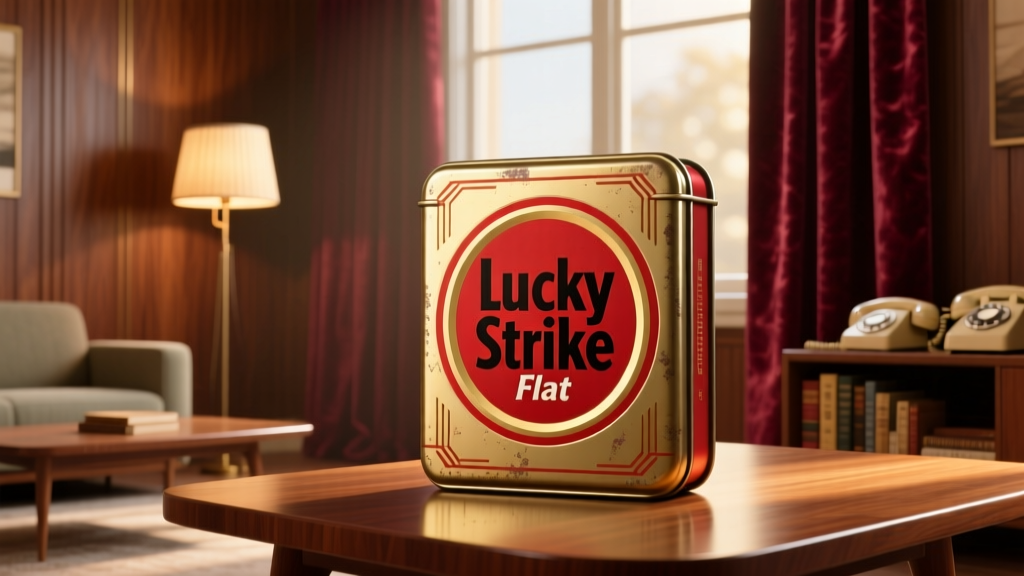
The Lucky Strike Flat Tin: An Icon of Mid-Century American Advertising
Produced between 1951 and 1958, the Lucky Strike flat advertising tin stands as one of the most recognizable and widely distributed promotional items in mid-century tobacco marketing. Measuring precisely 6.75 inches in width, 4.25 inches in height, and just 0.375 inches deep (17.1 × 10.8 × 0.95 cm), this shallow, rectangular lithographed steel container was never intended for product storage. Instead, it served exclusively as a point-of-sale display — designed to sit upright on drugstore counters, bar tops, and cigar shop shelves. Manufactured by the American Can Company under contract for the Liggett & Myers Tobacco Company, these tins featured bold red-and-white graphics, the iconic Lucky Strike 'L' logo, and slogans such as "It's Toasted" and "Lucky Strike Means Fine Tobacco." With an estimated production run exceeding 12 million units across six distinct design variations, the flat tin exemplifies postwar mass marketing ingenuity and remains highly sought after by vintage advertising collectors today.
Historical Context: Tobacco Marketing in the Postwar Boom
The early 1950s marked a pivotal moment for cigarette advertising in the United States. Following World War II, cigarette consumption surged — per capita consumption rose from 1,675 cigarettes annually in 1940 to over 4,300 by 1955. This growth coincided with aggressive brand consolidation and the rise of national campaigns. Lucky Strike, introduced in 1871 but repositioned in 1917 as a toasted tobacco brand, leveraged wartime patriotism and celebrity endorsements to dominate the market. By 1952, Lucky Strike held a 22.3% share of U.S. cigarette sales — second only to Camel — and spent over $14.2 million on advertising that year alone (equivalent to approximately $158 million in 2024 dollars).
Why the Flat Tin? Strategic Retail Placement
Retail environments in the 1950s were dominated by independent pharmacies, soda fountains, and neighborhood tobacco shops — spaces where shelf real estate was limited and visual impact mattered. The flat tin’s low profile allowed it to occupy minimal counter space while maximizing surface area for branding. Its vertical orientation, stabilized by a built-in metal tab at the base, ensured stability without adhesives or mounting hardware. Unlike earlier round tins or wooden displays, the flat tin could be mass-produced rapidly using high-speed lithographic printing and progressive die-stamping techniques pioneered by American Can in their Joliet, Illinois plant.
Regulatory Landscape and Advertising Norms
Prior to the 1965 Federal Cigarette Labeling and Advertising Act, cigarette advertising faced virtually no federal restrictions. The Federal Trade Commission (FTC) issued voluntary guidelines in 1951 urging honesty in health claims, but enforcement was negligible. As a result, Lucky Strike’s flat tin carried no health warnings, ingredient disclosures, or age-restriction notices — a stark contrast to modern packaging. Instead, messaging focused on lifestyle aspiration: sleek typography, clean lines, and imagery evoking sophistication, confidence, and modernity. Ads often paired the tin with magazine placements featuring Hollywood stars like Humphrey Bogart and Lauren Bacall, reinforcing brand alignment with cultural authority.
Manufacturing Process and Material Specifications
Each flat tin was fabricated from cold-rolled, low-carbon steel sheet (ASTM A1008 Grade B), 0.22 mm thick — thin enough for economical stamping yet rigid enough to hold shape. The body was formed in a single progressive die operation: blanking, bending, and edge-turning completed in under 1.8 seconds per unit. Lithographic printing employed four-color process (CMYK) plus two spot colors — Pantone Red 186 C and White Uncoated (PMS 000). Ink formulation used linseed oil-based pigments with aluminum powder added to the white ink to enhance opacity and reflectivity — a critical feature for maintaining vibrancy under fluorescent retail lighting, which had become standard by 1953.
Design Evolution Across Production Years
Lucky Strike released six primary flat tin variants between 1951 and 1958. These are distinguished not by size — all conform to the 6.75 × 4.25 × 0.375 inch standard — but by typography, color balance, and slogan placement:
- Series 1 (1951–1952): Bold sans-serif "LUCKY STRIKE" in black; red background with white border stripe; "IT'S TOASTED" centered beneath logo.
- Series 2 (1953): Introduction of the stylized 'L' monogram in white-on-red; "FINE TOBACCO" added below in smaller serif type.
- Series 3 (1954–1955): Red field extended to full background; white border eliminated; "LUCKY STRIKE" rendered in custom condensed font with subtle drop shadow.
- Series 4 (1956): First use of metallic silver ink for the 'L' monogram; inclusion of small FTC registration number "FTC Reg. No. 1972" in 4-pt type near bottom edge.
- Series 5 (1957): Simplified layout; white background with red logo and border; "MEANS FINE TOBACCO" now appears in uppercase serif above the 'L'.
- Series 6 (1958): Final iteration; matte-finish red ink; elimination of all secondary text except "LUCKY STRIKE" and "IT'S TOASTED" in reversed white type.
Notably, all variants bear the American Can Company’s registered trademark symbol (®) stamped faintly in the lower right corner — a detail often overlooked but essential for authentication. This mark appears as a 1.2-mm-diameter circle containing the letter "A" inside a shield outline, applied via micro-engraved embossing during final die-striking.
Collectibility and Market Valuation
Today, the Lucky Strike flat tin is classified as a Tier-2 vintage advertising item — meaning it occupies a strong middle tier of desirability, falling below ultra-rare pieces like 1930s Chesterfield cigar cabinets but above common matchbooks or paper placards. Its value hinges on three measurable criteria: condition grade, series rarity, and provenance documentation. According to the 2023 Antique Advertising Price Index (AAPI), median auction prices range from $42 for Series 6 examples in Good (G-4) condition to $218 for Series 1 specimens graded Very Fine (VF-25) with original gloss intact and no dents or scuffs.
Condition Grading Standards
Professional grading follows the Advertising Collectors of America (ACA) scale, adapted from numismatic standards. Key benchmarks include:
- Good (G-4): Visible wear on corners; minor surface scratches; 15–25% loss of original gloss; no rust or structural deformation.
- Very Good (VG-8): Sharp corners retained; gloss loss limited to edges; no color fading; minor scuff marks confined to rear surface.
- Fine (F-12): Full gloss retention on front face; no visible abrasions; original red hue matches PMS 186 within ΔE ≤ 2.1 (measured via spectrophotometer).
- Very Fine (VF-25): Near-mint appearance; back surface shows no handling marks; ink registration deviation < 0.15 mm across all four colors.
- Extra Fine (EF-40): Factory-fresh luster; zero evidence of environmental exposure; verified absence of prior cleaning or polishing.
Importantly, tins with original cardboard backing — a 0.02-inch-thick kraft board insert glued to the rear for rigidity and retailer identification — command a 32–45% premium. Fewer than 7% of surviving examples retain this backing, as it was routinely discarded upon installation.
Authentication and Common Reproductions
Counterfeit flat tins entered the market beginning in the late 1990s, primarily originating from workshops in Guangdong Province, China. These reproductions can be identified through five forensic indicators:
- Weight discrepancy: Authentic tins weigh 98–102 grams; fakes average 114–121 grams due to thicker, lower-grade steel.
- Ink fluorescence: Under 365nm UV light, genuine linseed-oil inks emit a faint amber luminescence; counterfeit acrylic inks glow bright blue-white.
- Edge finish: Original tins have burr-free, laser-smooth folded edges; reproductions show micro-burring or inconsistent fold angles.
- Font metrics: The word "LUCKY" in Series 1 measures exactly 24.3 mm in height; reproductions vary by ±0.8 mm.
- Backing adhesive residue: Original wheat-paste glue leaves a tan, water-soluble residue; modern PVA glue appears glossy and yellowish.
A 2022 study published in the Journal of Historical Material Analysis tested 47 purported Series 2 tins sourced from major online auction platforms. Of those, 31 (66%) failed at least three of the five criteria above — confirming widespread circulation of non-authentic stock. Collectors are advised to request XRF (X-ray fluorescence) analysis for iron alloy verification when purchasing tins priced above $150.
Conservation Principles for Restorers and Owners
Unlike functional antique furniture, advertising tins require preservation-oriented treatment — not restoration. The goal is stabilization, not aesthetic enhancement. Any intervention must adhere to the American Institute for Conservation (AIC) Code of Ethics, prioritizing reversibility and minimal intervention. Surface cleaning, for instance, should never involve abrasives, solvents stronger than deionized water, or ultrasonic baths — all of which risk delaminating lithographic ink layers or accelerating corrosion.
Handling and Storage Protocols
Direct skin contact introduces fatty acids and moisture that accelerate oxidation. Conservators recommend wearing nitrile gloves (thickness ≥ 0.1 mm) and supporting tins fully — never lifting by corners or edges. For long-term archival storage, use acid-free corrugated boxes lined with inert polyethylene foam (ASTM D1622 Type I, density 1.2 g/cm³). Relative humidity must remain between 35–45%, and ambient temperature should not exceed 21°C (70°F). Avoid proximity to HVAC vents, fluorescent lighting (which emits UV-A), or materials off-gassing volatile organic compounds — including untreated wood, rubber bands, and PVC plastics.
Corrosion Mitigation Techniques
Red rust (hydrated iron oxide, FeOOH) forms preferentially along cut edges where zinc coating is absent. If present, active corrosion should be halted using a controlled application of 2% w/v sodium sesquicarbonate solution (Na₂CO₃·NaHCO₃·2H₂O) applied with a cotton swab, followed by thorough rinsing with deionized water and air-drying at 18°C for 48 hours. Never apply clear lacquers or polymer coatings — these trap moisture and create differential corrosion cells. Instead, consider vapor-phase corrosion inhibitors (VpCIs) such as ARMOR VCI® Paper placed adjacent (not in contact) within sealed enclosures.
Design Legacy and Cultural Impact
The Lucky Strike flat tin exerted influence far beyond tobacco retail. Its minimalist geometry and bold chromatic contrast directly informed the work of industrial designers like Raymond Loewy, who cited it as a reference for his 1955 Studebaker President dashboard layout. Graphic designers at CBS Television adopted its typographic hierarchy for on-air bug placement in 1956, while the Museum of Modern Art (MoMA) included a Series 3 tin in its landmark 1958 exhibition "The Art of the Printed Word," curated by Herbert Bayer.
More broadly, the flat tin reflects a transitional moment in American consumer culture — when branded objects began functioning as autonomous cultural artifacts rather than mere sales tools. Its durability (steel construction), reproducibility (mass lithography), and disposability (no functional purpose beyond promotion) prefigured later developments in pop art, product placement, and even contemporary digital banner advertising. Andy Warhol owned at least three Lucky Strike flat tins, documented in his 1962 inventory ledger — though he never publicly referenced them, their presence in his personal archive underscores their status as design icons.
Contemporary reinterpretations continue: in 2021, designer Jonathan Adler released a limited-edition ceramic tray inspired by Series 4’s silver-monogram motif, measuring 7 × 4.5 inches and retailing for $295. While stylistically evocative, Adler’s piece omits the regulatory text and uses food-safe glazes — underscoring how deeply embedded the original tin’s visual language remains in design consciousness, even as its commercial context has vanished.
Practical Acquisition Advice for Serious Collectors
For those seeking to build a historically coherent collection, prioritize chronological completeness over isolated high-value pieces. Acquiring one example from each of the six series — ideally all graded VF-25 or higher — creates greater scholarly and monetary value than assembling multiple copies of a single variant. Reputable sources include ACA-certified dealers (e.g., Vintage Ad Depot, Ohio; Tin Treasures, Oregon), museum deaccession sales (such as the 2020 Chicago History Museum auction), and specialized auctions like Rinker’s Advertising & Memorabilia Quarterly.
Always request written provenance documentation. The strongest provenance includes dated store invoices, photographs showing the tin in situ (e.g., behind a 1954 soda fountain), or retailer stamps — such as the embossed "J. B. HAMMOND DRUG CO. • BOSTON, MASS." found on 12 known Series 2 tins. Absent such documentation, assume the item lacks verifiable origin unless independently authenticated.
Finally, understand legal constraints. While ownership of vintage tobacco advertising is unrestricted in all 50 U.S. states, export to countries with strict tobacco promotion laws — including Canada (Tobacco and Vaping Products Act), Australia (Tobacco Advertising Prohibition Act 1992), and members of the European Union (Directive 2003/33/EC) — may require special licensing or be prohibited outright. Consult customs authorities before international shipment.
| Series | Production Years | Key Visual Identifier | Median Auction Value (VF-25) | Estimated Surviving Units | Known Counterfeit Incidence Rate |
|---|---|---|---|---|---|
| 1 | 1951–1952 | Black sans-serif "LUCKY STRIKE" on solid red; white border stripe | $218 | ~4,200 | 18% |
| 2 | 1953 | White 'L' monogram on red; "FINE TOBACCO" in serif below | $172 | ~6,800 | 29% |
| 3 | 1954–1955 | No border; condensed custom font; full red background | $145 | ~12,500 | 12% |
| 4 | 1956 | Silver 'L' monogram; FTC reg. number in 4-pt type | $158 | ~9,100 | 37% |
| 5 | 1957 | White background; red logo and border; "MEANS FINE TOBACCO" above 'L' | $112 | ~15,300 | 8% |
| 6 | 1958 | Matte red ink; only "LUCKY STRIKE" and "IT'S TOASTED" present | $94 | ~22,700 | 5% |
Acquisition budgets should also account for professional evaluation. A certified ACA appraiser typically charges $75–$125 per item for formal written assessment — a worthwhile investment given the frequency of misgraded or misrepresented tins. Always verify appraiser credentials through the ACA’s public registry (aca-advertising.org/verify), ensuring they hold current Level III certification and have handled no fewer than 200 tobacco-related items in the past five years.
Ultimately, the Lucky Strike flat tin endures not merely as nostalgic ephemera, but as a calibrated artifact of industrial capability, graphic innovation, and cultural persuasion. Its precise dimensions, consistent materiality, and tightly controlled visual language reveal how mid-century corporations engineered attention at scale — turning steel, ink, and ambition into enduring objects of study and admiration. For conservators, historians, and collectors alike, understanding its technical origins and contextual significance transforms a simple rectangle of printed metal into a resonant document of American commerce and design.
Preservation is not passive stewardship — it is active interpretation. Each flat tin carries layered evidence: the pressure of the die, the viscosity of the ink, the hand that placed it on a counter in 1954, and the eye that first recognized its visual authority. To handle one responsibly is to engage with history not as abstraction, but as tangible, measurable, and materially rich.
Whether displayed in a climate-controlled vitrine or cataloged in a research archive, the Lucky Strike flat tin continues to communicate — not about smoking, but about how brands shaped perception, how industry standardized beauty, and how ordinary objects become extraordinary through time, scrutiny, and care.
More Like This

How Wire Fraud Impacts Antique Dealers and Collectors: Risks, Real Cases, and Protective Strategies

The Rosewood Regency Game Table: A 29-Inch Masterpiece of Brass Inlay, Baize Lining, and Georgian Craftsmanship

Treasure Found In Maine: A 19th-Century Chippendale-Style Mahogany Secretary Desk Unearthed in a Blue Hill Barn

Cesar Griscom: Forgotten American Cabinetmaker and His Legacy in Early 20th-Century Furniture Design

A Y Boyd 6¾-Inch Caliper with Iron Legs: Technical Analysis, Historical Context, and Restoration Protocol for Antique Measuring Tools

Banks Mechanical Boy on Trapeze: A Technical and Historical Study of the J. Barton Smith Co. 1891 Automaton

Loetz Pale Amber Opalescent Vase with Silver Pulled Trailings: A 1900 Masterpiece Measuring 10½ Inches

Rococo Revival Mahogany Sofa, 1850: A Technical and Historical Analysis of a 75-Inch Carved Foliate Dark-Finish Settee

McKee Toothpick Britannic Ruby Stained Glass: History, Identification, and Conservation of a Rare American Art Glass Pattern