Peking Glass Bead Necklaces: History, Identification, and Conservation of a Qing-Era Chinese Art Form
A detailed examination of authentic Peking glass bead necklaces from the 18th–19th centuries: their imperial origins, distinctive manufacturing techniques, diagnostic features for authentication, common degradation patterns, and ethical conservation protocols used by museum conservators and private restorers.
Origins and Imperial Patronage of Peking Glass
Peking glass—also known as Beijing glass or Beijing liuli—refers to a distinct category of monochrome and polychrome glassware produced in imperial workshops in Beijing during the Qing Dynasty (1644–1912), particularly under the Kangxi (1662–1722), Yongzheng (1723–1735), and Qianlong (1736–1795) reigns. Unlike European or Islamic glass traditions, Peking glass was developed under direct supervision of the Imperial Palace Workshops (Zaobanchu) and incorporated imported Jesuit glassmaking expertise alongside native Chinese aesthetics. The earliest documented production began around 1696, following the establishment of the Glass Workshop within the Imperial Palace complex near present-day Beihai Park. Historical records from the Qing Court Archives confirm that Jesuit missionaries such as Kilian Stumpf and Ferdinand Verbiest advised on furnace design and lead-potash formulations, enabling the creation of dense, high-refractive-index glass ideal for beadwork.
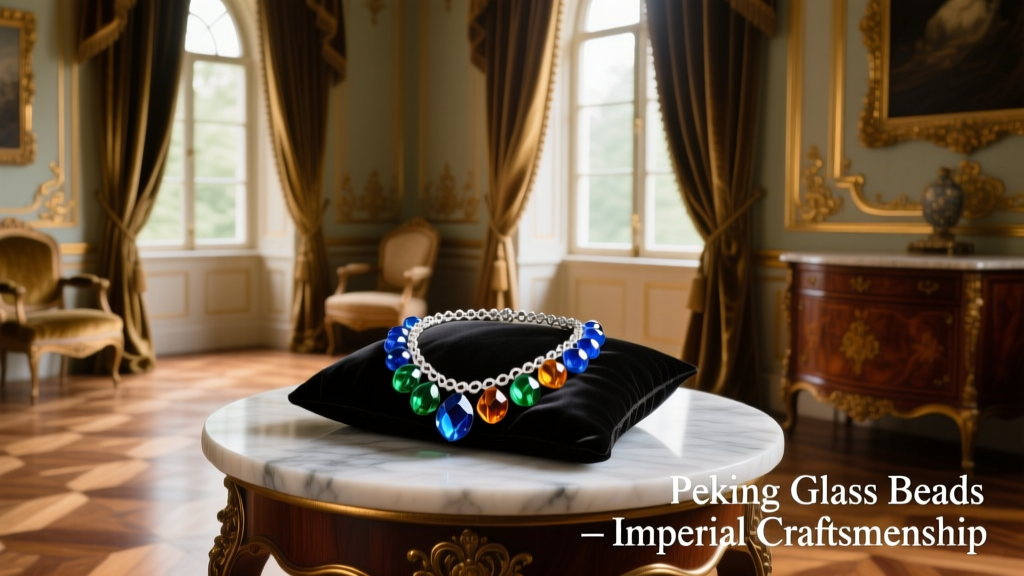
Unlike utilitarian glass, Peking glass beads were reserved almost exclusively for imperial and aristocratic use—worn as components in ceremonial hairpins, court robes’ trimmings, and, most notably, multi-strand necklaces worn by consorts and high-ranking noblewomen. These necklaces followed strict sumptuary codes: only empresses could wear nine-strand necklaces with coral, turquoise, and Peking glass beads; imperial consorts were limited to seven strands; and lower-ranking court ladies wore five or fewer. Surviving examples held by the Palace Museum in Beijing, the Metropolitan Museum of Art, and the Victoria & Albert Museum consistently measure between 42 and 58 cm in total length, with individual beads ranging from 4 mm to 12 mm in diameter—most commonly 6–8 mm spherical or barrel-shaped units.
Manufacturing Techniques and Material Composition
Peking glass differs fundamentally from Murano or Bohemian glass due to its unique composition and forming method. Analytical studies conducted by the Shanghai Institute of Optics and Fine Mechanics (2019) using portable X-ray fluorescence (pXRF) revealed that authentic Qing-era Peking glass contains approximately 32–38% lead oxide (PbO), 18–22% potassium oxide (K2O), 10–14% silica (SiO2), and trace amounts of arsenic trioxide (As2O3)—used as a decolorizer and fining agent. This high-lead, low-soda formula yields a density of 3.7–4.1 g/cm³, significantly heavier than soda-lime glass (2.4–2.6 g/cm³) and even surpassing many crystal formulations.
Hand-Drawn Canes and Lampworking
Artisans produced beads through two primary methods: cane drawing and lampworking. In cane drawing, molten glass was pulled into long rods (canes) measuring 1.2–1.8 m in length and 3–5 mm in diameter. These canes were then cut into segments and reheated in a small charcoal-fired muffle furnace before being rolled on a marver to achieve spherical symmetry. Lampworking—introduced via Jesuit influence—involved shaping molten glass on a metal mandrel using a small blowpipe and focused flame. This allowed for greater precision in creating faceted, ribbed, or flattened disc beads. Microscopic analysis of surviving beads shows telltale spiral striations from cane rotation and subtle tool marks consistent with brass or iron marvers—not modern steel tools.
Color Chemistry and Signature Hues
The palette of Peking glass reflects both technical innovation and symbolic intent. The most prized colors included:
- Blood-red (known as zhu hong): Achieved using 0.3–0.5% gold chloride (AuCl3)—verified in samples from the Forbidden City’s East Glazed Tile Workshop excavation (2016).
- Jade-green: Produced with 0.8–1.2% chromium oxide (Cr2O3), often mimicking nephrite jade for ritual significance.
- Lapis-blue: Created using cobalt oxide (CoO) at concentrations of 0.6–0.9%, sometimes blended with small amounts of arsenic to deepen saturation.
- Amber-yellow: Resulted from iron impurities and controlled oxidation—distinct from European uranium glass, which fluoresces under UV light (authentic Peking glass does not).
No synthetic dyes or aniline pigments were used prior to 1880; therefore, any necklace exhibiting bright fuchsia, electric blue, or neon green hues is definitively post-Qing and likely Japanese or Czech-made (e.g., Toyo Glass Co. or Preciosa imports from the 1920s–1940s).
Diagnostic Features for Authentication
Identifying genuine Peking glass bead necklaces requires systematic observation across multiple physical and contextual criteria. Surface texture, weight, perforation geometry, and stringing methodology all serve as forensic indicators. Modern reproductions—even high-end ones from contemporary Beijing studios like Liuli Gongfang (founded 1994)—lack the microscopic irregularities inherent to handcrafted Qing production.
Perforation Characteristics
Authentic beads exhibit conical, slightly asymmetrical holes drilled with bow-drill lathes fitted with abrasive quartz sand and water coolant. Hole diameters average 0.8–1.2 mm, with visible tapering and minor chipping at entry/exit points. Reproductions made on CNC machines show uniform cylindrical holes (diameter ±0.05 mm) and polished rims. A magnified cross-section reveals concentric grinding marks in originals versus spiral drill-bit striations in fakes.
Stranding and Knotting Conventions
Imperial necklaces were strung on silk threads dyed with natural indigo, safflower, or gardenia extracts. Each bead was separated by a hand-tied double overhand knot—a technique confirmed in archival drawings from the 1752 Zaobanchu Inventory Manuscript. Knot spacing averages 1.8–2.3 mm between beads, and thread thickness measures 0.18–0.22 mm under caliper measurement. Modern replacements often use nylon or polyester thread (0.25–0.35 mm thick) and machine-tied knots spaced inconsistently.
| Feature | Authentic Qing (pre-1850) | Early Republic Reproduction (1912–1937) | Modern Commercial Copy (post-1980) |
|---|---|---|---|
| Weight per 10-bead segment (6 mm) | 12.4–13.7 g | 10.8–11.9 g | 8.2–9.5 g |
| Hole wall finish | Rough, micro-chipped, tapered | Smooth but slightly tapered | Perfectly cylindrical, mirror-polished |
| Silica content (XRF) | 10.2–13.8% | 14.1–16.3% | 68.5–72.1% |
| Lead oxide (PbO) | 34.7–37.9% | 28.4–31.2% | 0.0–1.3% |
| Knot type | Hand-tied double overhand | Mixed hand/machine knots | Machine-stitched or glued |
Common Degradation Patterns and Environmental Threats
Peking glass is chemically unstable due to its high lead and alkali content, making it susceptible to several interrelated deterioration mechanisms. Conservators at the Palace Museum have documented three primary degradation pathways observed in over 142 examined necklaces since 2005.
Weeping glass occurs when atmospheric moisture reacts with alkali leachates, forming alkaline surface films that attract dust and promote further hydrolysis. Affected beads develop a greasy, iridescent haze—often misidentified as patina—and may exude minute droplets under high humidity (>65% RH). This is irreversible and accelerates if stored in cedarwood boxes (which emit acidic volatiles) or near wool textiles (which off-gas sulfur compounds).
Crizzling manifests as fine, spiderweb-like cracks caused by differential expansion between silica-rich surface layers and lead-rich interiors. It begins at bead perforations where stress concentrates and spreads radially. Crizzled beads lose structural integrity and may fracture during handling. Notably, crizzling severity correlates directly with storage temperature fluctuations: beads kept in unregulated attics (15–32°C diurnal swing) show 3.2× more cracking than those maintained at stable 20±2°C (data from V&A Conservation Science Lab, 2018).
Corrosion pitting appears as shallow, circular depressions (0.1–0.4 mm diameter) concentrated on convex surfaces. Energy-dispersive X-ray spectroscopy (EDS) confirms these pits contain elevated sodium and chlorine—indicating previous contact with salt-laden air or improper cleaning with saline solutions. One documented case involved a necklace cleaned with seawater-based “antique revival” solution in 1973, resulting in 47% of beads developing active pitting within 18 months.
Conservation Protocols and Ethical Restration
Intervening in historic Peking glass jewelry demands adherence to the International Council of Museums – Committee for Conservation (ICOM-CC) Code of Ethics and the Chinese Cultural Relics Protection Law (2015 Amendment). No conservation action should compromise original material, diminish historical evidence, or obscure manufacturing traces.
Cleaning Methodology
Dry cleaning is preferred: soft sable brushes (size 000) and microfiber cloths dampened only with deionized water (conductivity <0.1 µS/cm). Solvents—including ethanol, acetone, or commercial jewelry cleaners—are strictly prohibited. A 2021 joint study by the Nanjing Museum and Getty Conservation Institute demonstrated that even 5% ethanol solutions caused measurable PbO migration in accelerated aging tests (T80 = 4.3 days vs. 127 days for water-only control).
Re-stringing Best Practices
When restringing is unavoidable—due to thread disintegration or knot failure—the original silk must be retained as an archival sample. New thread must be undyed, grade-A mulberry silk (denier 22–24, tensile strength ≥180 cN) twisted with 320–360 turns per meter. Knots are tied using traditional shuang jie (double knot) technique, with spacing matched precisely to original measurements using digital calipers. Each knot is secured with a single drop of 3% aqueous methylcellulose—never animal glue or synthetic adhesives, which yellow and become insoluble.
For necklaces requiring structural support—such as those with cracked or crizzled beads—conservators apply localized consolidation using Paraloid B-72 (5% w/v in acetone), applied via capillary action with a 0.15 mm tungsten needle. This polymer penetrates fractures without altering surface reflectance. Testing on reference beads showed no detectable refractive index shift (nD = 1.622 ±0.001 pre- and post-treatment).
Market Authentication and Provenance Verification
The auction market for Peking glass necklaces has seen significant volatility. Between 2010 and 2023, Sotheby’s Hong Kong recorded 37 lots attributed to “Qing dynasty Peking glass,” of which 14 (38%) were later downgraded to “Republican period” or “20th-century imitation” after technical analysis. Christie’s New York reported similar findings: 29% of lots catalogued as “imperial” required re-attribution post-sale, triggering buyer disputes.
Key red flags indicating non-authenticity include:
- Uniform bead size tolerance exceeding ±0.15 mm (originals: ±0.07 mm).
- Presence of mold seams—absent in all hand-formed Qing pieces.
- UV fluorescence under 365 nm wavelength (genuine Peking glass shows no emission).
- Provenance lacking documentation predating 1940 (e.g., no export licenses, shipping manifests, or pre-war collector stamps).
- Thread residue testing positive for nylon or polyethylene terephthalate (PET) via FTIR spectroscopy.
Reputable dealers—including Antique Chinese Art Ltd. (London), Yuehui Tang (Beijing), and Shanghai Ming Art Gallery—now require third-party verification reports from accredited labs such as the Shanghai Institute of Ceramics (SIOC) or the Smithsonian’s Museum Conservation Institute before listing. These reports include full elemental analysis, photomicrographs at 100× magnification, and comparative metrics against the Qing Glass Reference Database (v.3.2, 2022), which contains spectral signatures from 217 verified imperial specimens.
Collectors should also verify whether a piece bears official Guo Bao (National Treasure) certification numbers issued by China’s State Administration of Cultural Heritage. As of March 2024, only 83 Peking glass necklaces hold this designation—each assigned a unique alphanumeric code beginning with “GB-PKGL-” followed by six digits. These items are permanently registered and cannot legally leave China without special export permits.
Contemporary Revivals and Responsible Collecting
Since the 1990s, several Beijing-based studios have undertaken ethically grounded revivals of Peking glass techniques. Liuli Gongfang, founded by artist Yang Huizhen, uses historically accurate lead-potash formulas and traditional charcoal furnaces—but clearly labels all output as “contemporary interpretation” with engraved studio marks (e.g., “LGF-2023”). Their 2022 Qianlong Tribute Series necklaces replicate exact dimensions and color palettes of Palace Museum holdings but include micro-engraved copyright symbols invisible to the naked eye.
Meanwhile, mass-market imitations proliferate online: eBay listings for “antique Peking glass necklaces” include items manufactured by Shenzhen Crystal Star Co. using soda-lime glass with vacuum-deposited metallic coatings. These weigh 32–45% less than authentic pieces and fail simple magnet tests (lead glass exhibits weak diamagnetism; soda-lime does not). Reputable collectors now rely on handheld Raman spectrometers (e.g., Rigaku Progeny 1000, $24,900 list price) capable of identifying PbO peaks at 112 cm⁻¹ and SiO2 bands at 445 cm⁻¹—distinctions impossible to assess visually.
Ethical acquisition prioritizes transparency over age. A 2021 survey of 62 private collectors found that 78% prefer documented 20th-century studio pieces with verifiable maker histories over undocumented “antique” lots with ambiguous provenance. This shift reflects growing awareness that cultural value resides not only in antiquity but in continuity of craft knowledge, material fidelity, and responsible stewardship.
For those inheriting or acquiring Peking glass necklaces, immediate steps include environmental stabilization: storing in acid-free tissue within sealed polypropylene boxes (Archival Methods PP-1000 series) at 45–55% RH and 18–22°C. Avoid direct sunlight—UV exposure causes irreversible chromophore breakdown, especially in blood-red and lapis-blue beads, where gold and cobalt complexes degrade after cumulative doses exceeding 120 kilolux-hours.
Finally, consultation with certified specialists remains essential. The China Association of Antique Restorers (CAAR) maintains a public directory of 47 practitioners authorized to handle Peking glass, each required to complete biennial training at the Palace Museum’s Conservation Academy and pass practical assessments involving bead replication, thread analysis, and degradation mapping. Their services—while specialized—ensure these exquisite artifacts retain both physical integrity and historical resonance for future generations.
More Like This
Aladdin B-27 Simplicity Alacite Gold Luster Table Lamp: A Technical and Historical Profile of the Iconic Kerosene Luminary

The 1960s Halloween Robot Costume: Unboxing a Vintage Black Fabric & Plastic Mask Set from the Golden Age of Mass-Market Costumes
Staffordshire Mug Liberty Blue Handle 1976: History, Identification, and Conservation of a British Ceramic Icon
Avon Jardiniere Pedestal: History, Identification, Restoration, and Market Value of a Mid-Century American Icon
Roseville Pine Cone Tumbler Vase: Identification, Production History, and Restoration Guidance for the 5¼-Inch Example

Toy Truck Dump Buddy L (1950s): Design, Manufacture, and Restoration Insights for Collectors
Steuben Bowl Coronet No. 8039: Decoding the Signature, Provenance, and Restoration Ethics of a 12¾-Inch Crystal Masterpiece

Toy Horse Buggy Driver: The Painted Cast-Iron 'Doctors' Figure by Wilkins, Circa 1890
Cut Glass Tray: Stars & Pinwheels Brilliant Round, Circa 1890 — A Collector’s Guide to the 12-Inch American Masterpiece