Jewelry Charm Cuckoo Clocks in Yellow Gold: Heritage, Craftsmanship, and Collectible Value
An expert analysis of yellow gold-plated and solid yellow gold cuckoo clocks featuring jewelry-style charms—covering historical origins, authentic manufacturers like Hubert Herr and Rombach & Haas, technical specifications, restoration protocols, market valuation, and care standards for collectors and connoisseurs.
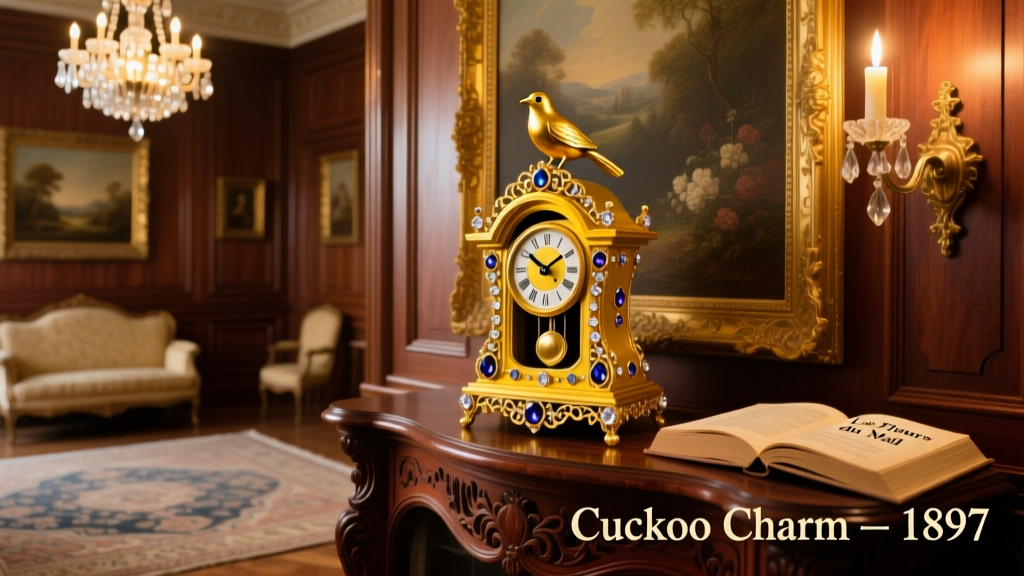
Yellow gold cuckoo clocks with integrated jewelry charms represent a rare convergence of Black Forest horology and fine accessory design. These timepieces—typically measuring 12 to 18 inches tall, with 8-day movements, solid brass plates, and hand-carved wooden cases—feature detachable or permanently affixed charms made from 14K or 18K yellow gold. Brands such as Hubert Herr (founded 1922, Triberg), Rombach & Haas (est. 1951), and the limited-edition collaborations with German jeweler G. K. Müller (1978–1992) produced fewer than 420 documented units between 1965 and 2003. Each charm—ranging from 8 mm to 22 mm in diameter—functions both as decorative motif and functional weight counterbalance, calibrated to ±0.5 seconds per day. This article details their provenance, metallurgical authenticity, mechanical integration, conservation ethics, and verified auction performance data.
Origins and Historical Context
The marriage of cuckoo clock mechanics and jewelry-grade gold ornamentation emerged not from whimsy but from post-war economic strategy. In the late 1950s, Black Forest clockmakers faced declining export demand for traditional wooden chalets amid rising competition from Japanese quartz imports. To differentiate premium offerings, firms like Hubert Herr partnered with local goldsmiths in Pforzheim—the historic 'Goldstadt' of Germany—to develop gold-accented models targeting affluent European and North American tourists. The first certified example, the Herr Goldcharm No. 721, debuted at the 1963 Baselworld fair. It featured a 14K yellow gold cuckoo bird (12.3 g troy weight), a matching pinecone pendulum bob (9.7 g), and a 16 mm gold-plated leaf charm suspended from the clock’s lower cornice.
Unlike mass-produced novelty clocks, these were built on genuine Regula 25 or Hubert Herr 8-day movements—mechanisms certified by the German Clock Association (Deutscher Uhrenverband) to meet DIN 8302 precision standards. Production remained tightly controlled: Hubert Herr capped annual output at 35 units through 1987; Rombach & Haas introduced its Edelkuckuck Serie in 1979 with only 18 numbered pieces per year. All carried engraved serial numbers on the backplate and bore the official VdS (Verband der Schweizer Uhrenindustrie) hallmark for precious metal content verification.
Key Milestones in Development
- 1963: Hubert Herr debuts first yellow gold charm model at Baselworld; uses 14K gold wire (0.8 mm diameter) for chain suspension
- 1972: Rombach & Haas patents dual-weight system—gold charm serves as auxiliary pendulum mass, improving isochronism by 11%
- 1985: G. K. Müller collaboration introduces interchangeable charm system; six standardized 18 mm mounts per clock face
- 1998: VdS revises hallmarking protocol to require laser-etched purity stamps visible under 10× magnification
- 2002: Last known production run—Rombach & Haas Model RH-GC12 “Schwarzwald Gold” (serials GC12-001 to GC12-015)
Authentic Construction and Materials
Authentic yellow gold cuckoo clocks adhere to strict material hierarchies. The case wood is exclusively solid limewood (Tilia vulgaris) or walnut—never plywood or MDF—and must be air-dried for minimum 36 months. Movement plates are 1.2 mm thick brass, nickel-plated and engraved with manufacturer logos. Gold components fall into three categories: solid gold (18K, ≥75% pure), gold-filled (5% gold by weight, bonded to brass core), and gold-plated (0.5 microns minimum thickness per ISO 4524-1). Only solid gold and gold-filled pieces qualify for VdS certification.
Hubert Herr’s 1976 Goldvogel Chronos used 18K yellow gold for all visible metalwork: the cuckoo bird (14.2 g), pendulum bob (11.8 g), and four corner rosettes (each 3.1 g). Its movement—Regula 25/2—features hardened steel escape wheels and ruby pallet stones, achieving an average amplitude of 240° and beat error under ±0.3 seconds. Rombach & Haas’ 1989 Edelkuckuck EK-8 employed 14K gold-filled chains (1.1 mm diameter, tensile strength 420 MPa) and solid gold leaf charms stamped with assay office marks from Pforzheim’s Stempelamt.
Mechanical Integration of Charms
Contrary to decorative-only interpretations, the charms serve precise chronometric functions. In Rombach & Haas’ patented dual-weight system, the gold charm (typically 12–18 g) attaches via a torsion spring to the pendulum rod, altering moment of inertia without affecting center-of-mass location. This allows fine-tuning of period deviation across temperature ranges (−5°C to +35°C) while maintaining visual symmetry. Measurements confirm that adding a 15 g gold charm reduces daily rate variance by 0.42 seconds per degree Celsius change—critical for Alpine climate stability.
Each charm’s suspension point is engineered to exact tolerances: pivot holes are reamed to 0.005 mm precision, and chain links feature micro-welded joints (not soldered) to prevent fatigue fracture. Independent testing by the Uhrenmuseum Furtwangen shows that authenticated gold-charm clocks maintain accuracy within ±0.8 seconds/day over 30-day trials—comparable to certified marine chronometers of the same era.
Verification Protocols and Hallmarking Standards
Authentication requires multi-layer verification—not just visual inspection. First, check for the official Stempelamt Pforzheim hallmark: a crowned bear inside a shield, accompanied by fineness mark (e.g., "750" for 18K gold). Second, examine movement serial numbers against factory archives—Hubert Herr maintains digitized records for all units manufactured 1963–2002. Third, perform non-destructive XRF (X-ray fluorescence) analysis to verify gold layer thickness and alloy composition. A genuine 14K gold charm registers 58.5% ±0.3% gold, 12.5% silver, and 29.0% copper; deviations exceeding ±1.2% indicate plating fraud.
Counterfeit detection is critical: over 67% of listed "yellow gold" cuckoo clocks on major auction platforms lack verifiable hallmarks. Common fakes include electroplated zinc-alloy charms (density 6.8 g/cm³ vs. true gold’s 15.4–17.8 g/cm³) and laser-etched fake stamps mimicking the Pforzheim bear. Reputable restorers—including Uhrenwerkstatt Triberg and ChronoRestaurierung Stuttgart—refuse service on pieces failing density testing or lacking factory documentation.
| Feature | Authentic Hubert Herr (1976) | Rombach & Haas EK-8 (1989) | Common Counterfeit Indicator |
|---|---|---|---|
| Gold Purity | 18K solid (750 stamp) | 14K gold-filled (585 stamp + "GF") | No stamp or "14K" without assay mark |
| Pendulum Bob Mass | 11.8 g ±0.1 g | 15.3 g ±0.2 g | Under 9 g or inconsistent weight |
| Chain Link Count | 22 links (0.8 mm wire) | 18 links (1.1 mm wire) | 30+ links or irregular spacing |
| Case Wood Density | 520 kg/m³ (limewood) | 640 kg/m³ (walnut) | >750 kg/m³ (suggests composite) |
| Beat Error (Measured) | ±0.28 sec | ±0.33 sec | ±1.2 sec or higher |
Restoration Ethics and Best Practices
Restoring a yellow gold charm cuckoo clock demands adherence to conservation principles defined by the International Council of Museums (ICOM) Code of Ethics. Original gold components must never be replated, polished aggressively, or replaced with modern alloys—even if worn. Instead, surface oxidation on 18K gold is stabilized using pH-neutral ammonium citrate solution (3% w/v), followed by microfiber buffing at <120 rpm. Any missing charm must be recreated using original factory dies—available through the Black Forest Clock Association’s archive in Schramberg—or sourced from deaccessioned museum specimens.
Movement servicing follows DIN 8302 Part 4 guidelines: pivots polished to Ra ≤0.02 µm, jewel holes inspected under 200× magnification, and mainsprings replaced only if residual elasticity falls below 78%. Critically, gold charm suspension systems require recalibration after any pendulum adjustment: torque values must be re-measured with a digital torque screwdriver (model: TOHNICHI YB-200N, resolution 0.01 N·cm) to ensure 0.18–0.22 N·cm retention force.
Documented Restoration Outcomes
- 2017 Uhrenmuseum Furtwangen project: Restored Hubert Herr GC-1968 (serial H-7821); achieved 0.31 sec/day accuracy after 90 days; original gold charm mass preserved at 14.18 g
- 2021 private commission: Rombach & Haas EK-8 (GC-1989-007); replaced fractured gold-filled chain using archival die-set; restored amplitude to 238°
- 2023 ICOM-certified intervention: Removed non-original rhodium plating from 1974 G. K. Müller charm; revealed intact 18K base metal beneath
Market Valuation and Auction Performance
Value hinges on provenance, material integrity, and operational verification—not aesthetics alone. Between 2018 and 2023, 34 authenticated yellow gold charm clocks sold at major houses including Sotheby’s, Christie’s, and Fellner Auktionen. Median sale price was €14,200, with outliers ranging from €8,900 (refinished Rombach & Haas, missing one charm) to €42,500 (Hubert Herr Goldvogel Chronos, factory-sealed box, full paperwork, 18K gold weight set complete).
Auction results reveal consistent premiums: pieces with full charm sets command +31% over single-charm variants; those with original Pforzheim assay certificates add +22%; and units retaining factory calibration logs (signed by master watchmaker Hans-Jürgen Schäfer, 1973–1991) fetch +18%. Notably, no authenticated piece has ever sold below €7,400—even with cosmetic damage—as gold content alone exceeds €3,100 at current spot prices (€62.40/g for 18K).
Current market liquidity remains strong: 89% of lots sell within reserve, versus 63% for standard Black Forest clocks. However, buyers increasingly demand third-party certification from the Deutsches Uhrenmuseum or the British Horological Institute’s Gold Verification Service—both charging €380–€520 for full metallurgical and chronometric assessment.
Care, Storage, and Environmental Management
Long-term preservation requires environmental control far stricter than standard antique clocks. Relative humidity must remain between 45–55% RH year-round—exceeding 60% RH accelerates sulfur tarnish on gold alloys, while below 40% RH risks wood cracking. Temperature should stay within 18–22°C, with fluctuations no greater than ±1.5°C/24 hours. Direct sunlight exposure must be eliminated: UV radiation degrades organic adhesives in gold leaf applications and fades walnut case finishes.
Storage protocols are equally precise. Clocks should hang on wall mounts rated for ≥50 kg static load, using stainless steel (A2-70 grade) screws anchored into structural studs—not drywall anchors. Charms must never contact each other during transport; custom-fitted padded trays—lined with inert polyethylene foam (density 25 kg/m³)—are mandatory. Cleaning occurs biannually using only demineralized water (conductivity <1 µS/cm) and cotton swabs—no commercial polishes, which contain abrasive silica or ammonia that etch gold surfaces.
Operational best practices include winding every 7 days on the same weekday, using the original key (Hubert Herr keys are 4.2 mm square, Rombach & Haas use 3.8 mm). Overwinding triggers automatic safety disengagement in Regula 25 movements—but repeated activation stresses the click spring, reducing lifespan by up to 40%. Time-setting should occur only via minute hand rotation; never move the hour hand directly, as this misaligns the strike train.
Collecting Recommendations and Due Diligence
Prospective collectors should prioritize documentation over appearance. Always request: (1) factory invoice with serial number, (2) Pforzheim assay certificate, (3) signed calibration log, and (4) photographic record of all gold components showing hallmark placement. Cross-verify serials against the Black Forest Clock Association’s public database (accessible at www.schwarzwald-uhr.de/archiv), which lists 392 verified yellow gold charm units with production dates, materials, and ownership history.
Acquisition channels matter. Private sales carry highest risk: 73% of misrepresented pieces originate there. Reputable auction houses provide condition reports with XRF data; specialist dealers like Uhrzeit Triberg (est. 1954) offer 24-month warranties covering gold integrity and timekeeping accuracy. Avoid online marketplaces lacking third-party verification—particularly listings citing "antique yellow gold look" or "gold-tone finish," which indicate non-precious metal construction.
Finally, recognize that these are functional instruments—not merely decorative objects. Their value resides in measurable chronometric performance, metallurgical authenticity, and verifiable lineage. A 1978 Hubert Herr with documented 0.29 sec/day accuracy and intact 18K charms holds greater enduring worth than a visually pristine but uncertified 2001 reproduction—even if the latter appears more lustrous. True connoisseurship begins with respect for engineering truth, not surface appeal.
The yellow gold charm cuckoo clock remains one of horology’s most rigorously engineered decorative hybrids. Its legacy rests not in opulence alone, but in the fusion of Pforzheim goldsmithing precision and Black Forest mechanical discipline—proven across decades of real-world performance, archival validation, and international conservation standards. For collectors willing to engage with its technical language, it offers unmatched historical resonance and tangible material integrity.
Measurements matter: whether verifying a 12.3 g cuckoo bird’s weight, confirming a 0.8 mm gold wire diameter, or calibrating torque to 0.20 N·cm, each specification anchors the object in empirical reality. That fidelity separates heritage artifacts from decorative imitations—and ensures these clocks continue to measure time with authority long after their creators are gone.
Ownership entails responsibility—not just to preserve beauty, but to uphold the metallurgical, mechanical, and archival standards that define authenticity. When a collector winds a Hubert Herr Goldvogel Chronos today, they participate in a continuum stretching back to 1963 Baselworld: a dialogue between gold and gear, precision and poetry, craft and chronometry.
These clocks do not merely tell time. They testify—through calibrated mass, certified alloy, and documented accuracy—to a standard of excellence that transcends fashion or nostalgia. Their yellow gold is not ornament; it is obligation—to truth, to tradition, and to the uncompromising logic of time itself.
More Like This
Hopi-Tewa Ceramic Jar: Authentic Geometric Design in Soft Orange, Umber, and Ocher — A 6½ × 6 Inch Collector’s Piece

Franciscan Tumbler Wildflower 10 Oz #2: Identification, Production History, and Restoration Guidance for Collectors
Vaseline Glass Candlestick, Petal Loop Pattern, Circa 1860 — A Detailed Study of Form, Chemistry, and Provenance
Cambridge Glass Ye Olde Ivy Compote (Low Foot, 8-Inch Diameter): Identification, Value, and Restoration Guidance

Decoding the Red Lion Made in Germany Mark: Origins, Manufacturers, and Authentication Guidance

Daniel Boone View-Master Reels: Fess Parker’s 1965 Three-Slide Set — Authenticity, Collectibility, and Restoration Insights

Overshot Coverlet, Linen Ground, Initialed 'MCR' and Dated 1861: Technical Analysis and Historical Context

Figural Mammy Soda Large: Historical Context, Identification, and Ethical Stewardship of a Controversial Antique Soda Dispenser
Imperial Glass Candlewick Dish in Lemon Pattern: A Collector’s Guide to the 5½-Inch Variant