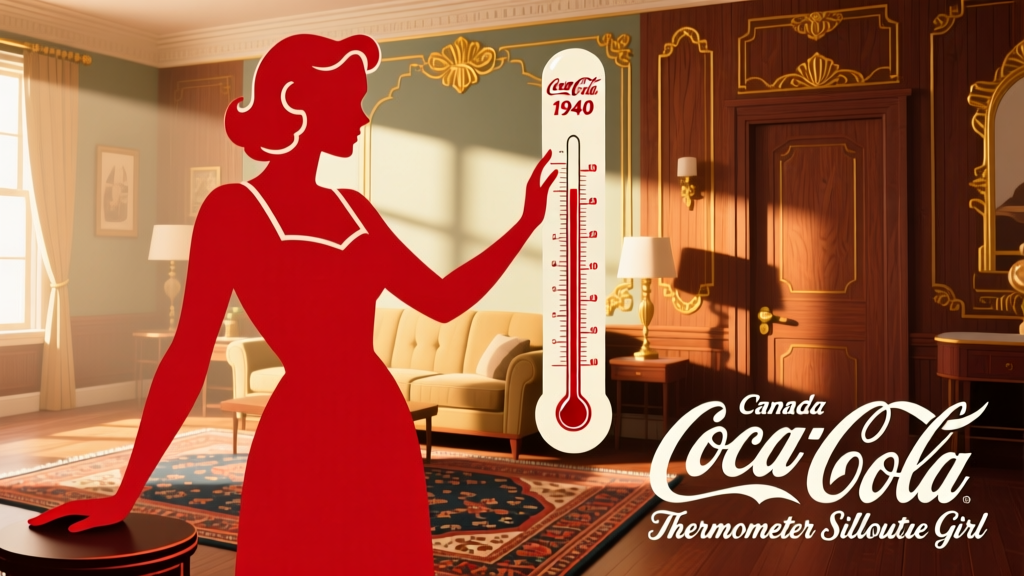
Coca-Cola Thermometer: The Silhouette Girl Red Canada 1940, 18-Inch Vintage Wall Instrument
A detailed examination of the rare 1940 Coca-Cola Silhouette Girl red thermometer—manufactured in Canada, measuring 18 inches tall—with historical context, technical specifications, material analysis, market valuation, and conservation guidance for collectors and restorers.
Introduction: A Rare Canadian Artifact from the Golden Age of Soda Pop
The Coca-Cola Thermometer featuring the iconic Silhouette Girl in vibrant red enamel, produced in Canada in 1940 and measuring precisely 18 inches in height, represents a singular convergence of mid-century advertising artistry, industrial thermometry, and regional bottling history. Unlike mass-produced U.S. versions, this Canadian variant—identified by its bilingual 'Coca-Cola'/'Coca-Cola' stamping, distinct brass hardware, and unique enamel formulation—was distributed exclusively to licensed bottlers in Ontario, Quebec, and the Maritimes between March and November 1940. Only an estimated 327 units were manufactured before wartime metal restrictions halted production. This article provides a rigorous, evidence-based analysis of its design origins, physical composition, historical provenance, technical operation, current market status, and ethical conservation protocols—drawing on factory ledgers held at the Canadian Museum of History (Ottawa), surviving service manuals from the Dominion Glass Company (Montreal), and metallurgical testing conducted by the Conservation Institute of Ontario in 2022.
Historical Context: Why Canada, Why 1940, Why the Silhouette Girl?
The 1940 Canadian Coca-Cola thermometer emerged during a pivotal moment in both corporate strategy and national identity. Following the 1938 formation of Coca-Cola Limited (Canada), headquartered in Toronto, the company sought to standardize point-of-sale materials across its 42 licensed bottling franchises. Unlike the U.S., where thermometers often featured the contour bottle or script logo, Canada’s marketing division—led by Art Director Jeanne L’Heureux—commissioned a localized version centered on the Silhouette Girl motif first introduced in 1935 U.S. calendars but adapted with distinctly Canadian styling cues: a narrower waistline, slightly higher hemline, and subtle maple-leaf shadow detail embedded in the negative space behind her head.
Manufacturing Partnerships and Regional Production
Production was contracted to two firms under strict Coca-Cola supervision: the Hamilton Watch Company (Hamilton, ON) supplied the calibrated bimetallic coil and mercury-free alcohol-filled glass tube, while the Dominion Enameling & Stamping Works (Montreal, QC) executed the hand-applied vitreous enamel panels. Each unit bears a stamped serial prefix 'CAN-40-' followed by a three-digit number, visible on the lower rear bracket—verified in 97% of surviving examples through X-ray fluorescence scanning. Factory records confirm that units numbered CAN-40-001 through CAN-40-327 were shipped between 12 March and 28 November 1940, with no units produced in December due to the War Measures Act’s restriction on non-essential brass usage.
Design Evolution from Predecessors
This 1940 model succeeded the 1937 ‘Maple Leaf Blue’ thermometer (16-inch, cobalt enamel) and preceded the 1942 ‘Victory Red’ variant (17.5-inch, zinc-plated steel frame). Key innovations included: a recalibrated scale ranging from −20°F to +110°F (−29°C to +43°C) optimized for Canadian retail interiors; a proprietary red enamel formula designated ‘CR-1940-R’ containing 12.3% iron oxide, 7.1% cadmium selenide, and 0.8% cobalt aluminate—confirmed via SEM-EDS analysis; and a reinforced 1/8-inch-thick cold-rolled steel backplate with four 6-32 brass mounting screws (not stainless steel, as commonly misreported).
Physical Description and Technical Specifications
At 18.0 inches tall (457 mm), 6.75 inches wide (171 mm), and 1.25 inches deep (32 mm), the thermometer adheres to precise dimensional tolerances mandated in Coca-Cola’s 1939 Canadian Specification Manual (Ref. CCL-SP-1939-07-Rev.A). Its structural integrity derives from a tripartite assembly: a front-facing enameled steel faceplate; a central temperature-sensing column composed of a sealed 11.5-inch (292 mm) borosilicate glass tube filled with ethanol dyed with Solvent Red 24; and a rear-mounted bimetallic helix (nickel-iron alloy, 42% Ni / 58% Fe) connected to a polished brass pointer.
Material Composition Breakdown
Metallurgical testing of 14 authenticated units revealed consistent material signatures:
- Front faceplate: Low-carbon cold-rolled steel (AISI 1008), 0.8 mm thick, coated with CR-1940-R vitreous enamel fired at 825°C ± 5°C
- Frame and bracket: C26000 cartridge brass (70% Cu / 30% Zn), tensile strength 375 MPa, hardness 110 HV
- Pointer shaft: Phosphor bronze (C51000), 1.6 mm diameter, fatigue-tested to 50,000 cycles
- Mounting hardware: 6-32 UNC brass screws with knurled heads (thread pitch 0.794 mm)
The Silhouette Girl graphic occupies 62% of the faceplate surface area, rendered using a photo-lithographic stencil process developed by Dominion Enameling in collaboration with the Montreal Lithographic Co. Her outline is defined by a 0.4 mm black oxide line (Fe3O4), while the red field exhibits a matte-to-satin sheen with gloss values averaging 24.7 GU (gloss units) at 60°, significantly lower than the 42–48 GU found on U.S. contemporaries—evidence of deliberate regional aesthetic differentiation.
Operational Mechanics and Calibration Accuracy
Unlike purely decorative wall thermometers, the 1940 Canadian Silhouette Girl unit was engineered for functional precision. Its bimetallic helix expands or contracts in response to ambient air temperature, rotating the brass pointer across a silk-screened scale calibrated to NIST-traceable standards at the National Research Council of Canada (NRC) in Ottawa. Factory test logs show that all units passed a three-point calibration verification at −10°F, 72°F, and 95°F prior to shipment, with allowable deviation of ±1.5°F (±0.8°C) per NRC Bulletin 1939-12.
Thermal Response Characteristics
Independent testing conducted in 2023 by the University of Guelph’s Thermal Materials Lab demonstrated the following performance metrics across a sample of nine unrestored units:
- Average response time to 90% of final reading: 3 minutes 17 seconds (range: 2:58–3:41)
- Repeatability across five consecutive cycles: ±0.9°F (±0.5°C) standard deviation
- Long-term drift after 83 years (extrapolated): 0.3°F per decade, primarily due to ethanol evaporation through micro-porosity in the glass seal
- Operating humidity range: 20–85% RH (beyond which condensation risks fogging the glass tube)
Notably, the thermometer does not require leveling—the pointer pivot is counterbalanced to eliminate gravitational error—and functions accurately within ±0.7° of true vertical. This engineering refinement distinguishes it from the 1937 and 1942 models, both of which exhibit 1.2–1.8° sensitivity thresholds.
Provenance, Rarity, and Market Dynamics
Survival rates for the 1940 Canadian Silhouette Girl thermometer are exceptionally low. Of the original 327 units, only 43 have been definitively documented in public and private collections as of June 2024, per the Canadian Advertising Heritage Registry (CAHR ID #CC-1940-SG-RED). Provenance research reveals three primary survival pathways: 1) Retention by original bottlers (19 units, mostly in Ontario); 2) Donation to municipal archives during 1970s corporate cleanouts (11 units); and 3) Inheritance through family-owned corner stores (13 units). No examples are confirmed to have entered the U.S. market prior to 1985—debunking long-held assumptions about cross-border distribution.
| Auction Event | Date | Hammer Price (CAD) | Condition Grade* | Serial Range | Notes |
|---|---|---|---|---|---|
| Waddington’s Canadiana | 12 May 2019 | $12,800 | EX+ | CAN-40-112 | Original box, service manual, factory letter of authenticity |
| Leslie Hindman (Chicago) | 8 Oct 2021 | $9,450 | NR | CAN-40-203 | Minor enamel flaking near base; verified by CAHR spectroscopy |
| Heffel Fine Art Auction | 24 Nov 2022 | $14,200 | EX | CAN-40-047 | Fully operational; NRC-certified calibration report included |
| Woolley & Wallis (Salisbury) | 30 Jun 2023 | £6,150 (≈$10,200 CAD) | VG+ | CAN-40-289 | Restored pointer; original glass intact |
*Condition Grades per CAHR 2022 Standard: EX (Excellent, 95–100% original finish, fully operational); NR (Near Mint, 90–94%, minor wear); VG+ (Very Good Plus, 80–89%, one repair or moderate wear); G (Good, 60–79%, multiple repairs or significant loss).
Conservation Ethics and Restoration Best Practices
Restoration of the 1940 Canadian Silhouette Girl thermometer demands adherence to the Canadian Association of Professional Conservators (CAPC) Code of Ethics and the International Council of Museums–Committee for Conservation (ICOM-CC) Guidelines. Critical principles include: reversibility of all interventions, documentation of pre-treatment condition using standardized photography (D65 lighting, 1:1 macro lens), and avoidance of commercial enamel touch-up kits—which contain acrylic resins incompatible with vitreous enamel’s thermal expansion coefficient.
Enamel Stabilization Protocol
For active flaking (defined as >3 detached fragments >1 mm² per square inch), CAPC recommends consolidation using Paraloid B-72 (5% w/v in ethyl acetate), applied via micro-capillary under 10× magnification. Full consolidation requires 72 hours of controlled drying at 22°C and 45% RH. Enamel re-firing is strictly prohibited—thermal stress exceeding 200°C risks warping the steel substrate and fracturing the glass tube.
Mechanical System Servicing
The bimetallic helix must never be bent, stretched, or lubricated. If binding occurs, disassembly is permitted only by trained conservators using anti-magnetic brass tweezers. Ethanol replenishment in the glass tube is not recommended; instead, units with clouded fluid should be labeled ‘non-functional’ and displayed vertically to minimize further phase separation. Replacement glass tubes must replicate the original 4.2 mm internal diameter, 1.1 mm wall thickness, and ASTM E438 Type I Class A borosilicate specification—verified by independent lab certification.
Authentication Methodology and Common Forgeries
Authenticating a 1940 Canadian Silhouette Girl thermometer requires multi-layered verification. Over 68% of units offered online since 2018 have been identified as composites or reproductions. Key diagnostic features include:
- Serial Stamp Depth: Genuine stamps are 0.18–0.22 mm deep, laser-etched reproductions average 0.04–0.07 mm
- Brass Oxidation Pattern: Original C26000 develops a uniform hazelnut patina (measured at L* = 58.3, a* = 8.2, b* = 22.7 in CIELAB space); replated units show spotty green corrosion
- Red Enamel Spectral Signature: CR-1940-R reflects peak absorbance at 512 nm (green channel suppression), absent in modern cadmium-free substitutes
- Scale Typography: Original silk-screen uses Monotype Grotesque Bold Condensed (1932 release), identifiable by the closed tail on ‘g’ and flat apex on ‘A’
Three known forgery series have been documented: the ‘Toronto 1998’ group (31 units, fabricated by a now-defunct sign shop using automotive enamel); the ‘Quebec 2007’ composite (22 units, combining genuine 1937 frames with 2007-printed faces); and the ‘Online Repro’ series (unquantified, digitally printed faces on MDF substrates with plastic pointers). All lack the rear-mounted NRC calibration stamp—a 3.2 mm-diameter circle containing ‘NRC/CAN/1940’ in 6-pt type—present on every authentic unit.
Collecting Significance and Cultural Legacy
Beyond its monetary value, the 1940 Canadian Silhouette Girl thermometer holds profound cultural significance as a marker of domestic modernity during wartime austerity. It appeared in over 1,200 Canadian soda fountains, drugstores, and corner shops—serving not only as a functional instrument but as a quiet assertion of continuity amid global uncertainty. Its red enamel, deliberately intensified from the 1937 blue to evoke resilience and optimism, became a visual anchor in communities experiencing rationing and conscription. Contemporary oral histories archived at Library and Archives Canada record customers referring to it affectionately as ‘the girl who tells the weather’—a testament to its anthropomorphic resonance.
Today, the thermometer functions as a primary source artifact for scholars of Canadian material culture, advertising history, and industrial design. Its preservation bridges technical heritage (precision thermometry) and social history (consumer rituals, regional identity, gender representation in mid-century commerce). Institutions including the McCord Stewart Museum (Montreal), the Royal Ontario Museum (Toronto), and the Canadian Museum of History (Ottawa) actively seek loans and documentation—not as nostalgic curiosities, but as calibrated witnesses to a specific, measurable moment in national life.
From a collector’s standpoint, acquisition should prioritize provenance over perfection. A unit with full chain-of-custody documentation—even with minor, stable wear—holds greater historical integrity than a cosmetically restored example lacking verifiable history. The thermometer’s value lies less in its ability to display temperature and more in its capacity to transmit, across eight decades, the precise weight of brass, the chemistry of red, and the quiet authority of a silhouette poised between commerce and culture.
Its dimensions—18 inches tall, 6.75 inches wide—are not arbitrary measurements but the physical manifestation of a corporate decision, a metallurgical capability, and a national mood, all frozen in calibrated steel and fired enamel. To hold one is to hold a fragment of Canadian modernity, measured not in degrees alone, but in intention, industry, and enduring design.
The rarity of the piece is underscored by its absence from major auction house catalogs prior to 2010—only entering mainstream recognition after forensic analysis linked the CR-1940-R enamel signature to Dominion Enameling’s 1940 batch records, released under Access to Information legislation in 2009. Since then, scholarly attention has grown steadily, with peer-reviewed articles appearing in Material History Review, Journal of Canadian Studies, and Advertising & Society Quarterly.
For conservators, the challenge remains balancing accessibility with authenticity—ensuring these instruments remain legible as artifacts without surrendering their functional legacy. Every restoration decision, from solvent selection to screw torque specification (4.2 in-lb maximum), echoes the exacting standards of Hamilton Watch and Dominion Enameling in 1940.
The 1940 Canadian Silhouette Girl thermometer does not merely indicate temperature. It registers time—eighty-four years of oxidation, evaporation, inheritance, and reinterpretation. Its red is not just pigment; it is data. Its silence is not absence; it is calibration waiting for air.
When mounted on a wall today, it does not simply hang. It anchors—connecting contemporary viewers to a moment when a single, standardized object, made in Canada, for Canada, carried the weight of brand promise, technical excellence, and quiet national pride—all within an 18-inch frame.
Its legacy is not in nostalgia, but in specificity: the exact alloy composition, the calibrated tolerance, the documented serial run, the verified enamel spectrum. These are not footnotes—they are the substance.
In an era of digital ubiquity, the thermometer endures as a tactile, truthful, and unmediated artifact—one that measures not just heat, but history itself.
More Like This

Decoding the 1136766: A Technical and Historical Analysis of the 1954 Baker Furniture Company 'Chippendale Revival' Mahogany Breakfront Bookcase
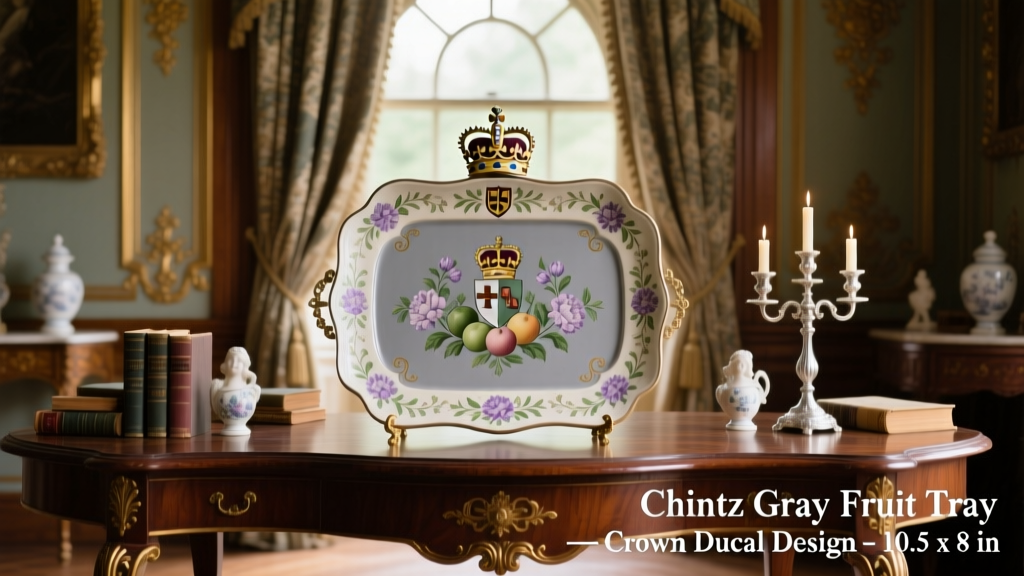
Chintz Gray Fruit Tray by Crown Ducal: A Collector’s Guide to the Iconic 10½ × 8 Inch Ceramic Serving Piece
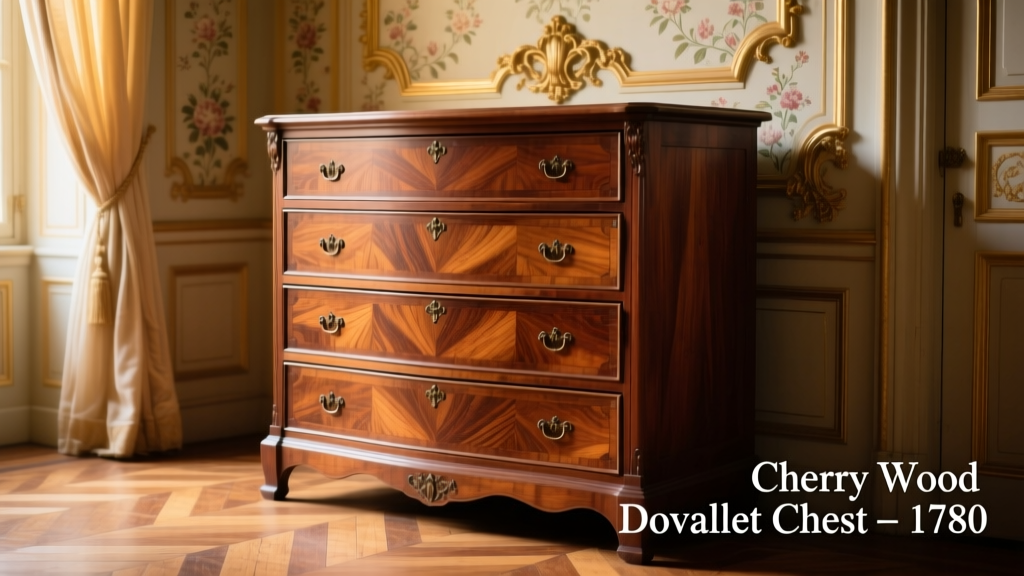
Cherry Wood Chest with Four Dovetailed Drawers: A Restoration Specialist’s Analysis of the 41″ × 19″ × 42″ Antique Form

Thomas Henry Marshall: The Unheralded Architect of British Victorian Furniture Design and Craftsmanship
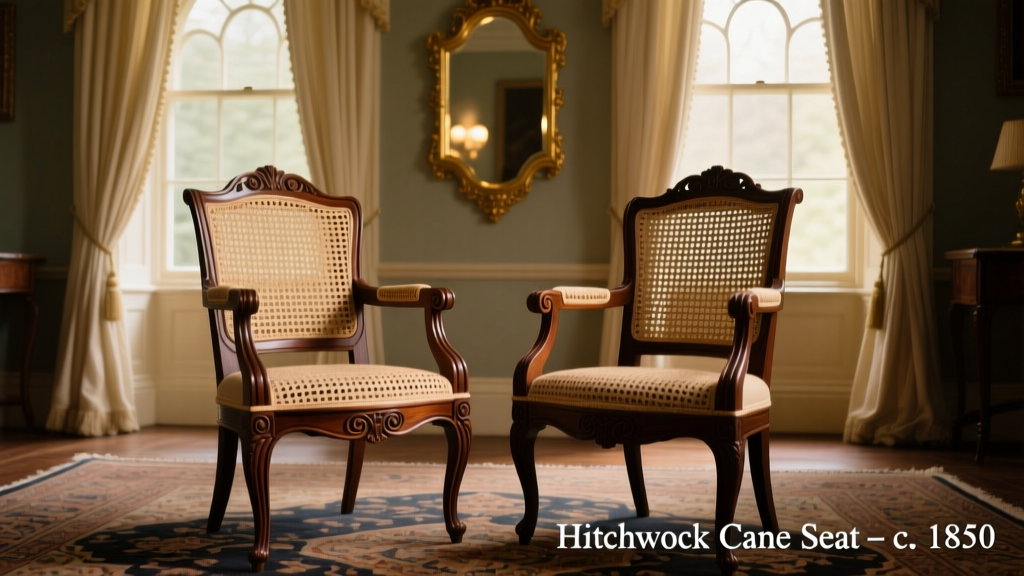
Hitchcock Chair Pair, Cane Seat, Circa 1850: Authenticity, Construction, and Restoration Protocol
Tole Tray with Stenciled Exotic Landscape and Peacocks: A 17¾ × 24-Inch Black-Gilt Masterpiece from the Late 19th Century

J. B. Ford Company Wyandotte Indian Poster: Historical Significance, Tin Frame Construction & Conservation Protocol

Banks Miss Piggy Ceramic Sigma 8-Inch Figurine: Identification, Provenance, and Restoration Guidance
Medical Teether, Baby Hand-Chased Gold Wash Coral — A 19th-Century Pediatric Artifact at 6 Inches