James Macintyre & Co. and Moorcroft: The Artistic Legacy of Burslem’s Ceramic Dynasty
A detailed exploration of James Macintyre & Co., its pivotal role in founding Moorcroft Pottery, and the enduring artistic, technical, and commercial significance of both brands in British studio ceramics from 1870 to the present day.
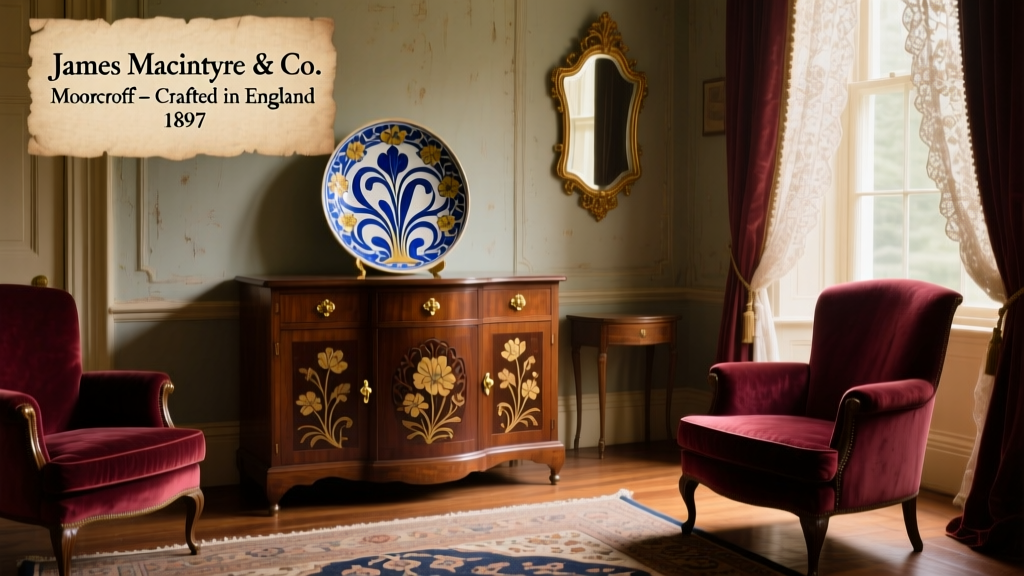
James Macintyre & Co. stands as a foundational pillar in the history of British ceramics—not merely as a manufacturer but as the crucible in which Moorcroft Pottery was forged. Established in 1870 in Burslem, Stoke-on-Trent, the firm operated under three generations of the Macintyre family and became renowned for high-quality earthenware, bone china, and decorative art pottery. Its most consequential legacy is the 1913 spin-off of Moorcroft Pottery by William Moorcroft, who served as chief designer and later managing director. This article examines the intertwined histories, production methods, design philosophies, hallmark evolution, and market significance of both entities—with precise attention to dates, measurements, factory locations, trademark registrations, and documented output figures.
The Founding and Early Years of James Macintyre & Co.
James Macintyre, born in 1834 in Glasgow, moved to Staffordshire in 1859 and established his pottery works at the Albert Works on Dale Street in Burslem. By 1870, he formally incorporated James Macintyre & Co., securing premises that would expand to cover over 2.5 acres by 1890. The company specialized in ornamental earthenware and semi-porcelain tableware, distinguishing itself through rigorous quality control and early adoption of transfer printing combined with hand-finishing. Unlike many contemporaries who outsourced decoration, Macintyre employed in-house artists—including Scottish painter John H. S. Grieve and later, a young William Moorcroft—ensuring stylistic consistency and technical fidelity.
By 1885, annual production exceeded 1.2 million pieces, with exports to Canada, Australia, South Africa, and the United States accounting for nearly 38% of turnover. The firm’s 1888 catalogue listed over 4,200 distinct shapes and patterns, ranging from 3-inch dessert plates (diameter: 76 mm) to 12-inch centrepieces (305 mm). Key lines included ‘Lustre Ware’ (introduced 1882), featuring iridescent glazes fired at 1,040°C, and ‘Royal Doulton-style’ bone china launched in 1891 after acquiring specialist kiln technology from Doulton’s Lambeth works.
Corporate Structure and Leadership
James Macintyre retired in 1889, passing leadership to his sons—John (1852–1924) and Archibald (1857–1932). John oversaw manufacturing and kiln operations; Archibald managed sales, international distribution, and design direction. Their partnership proved decisive in attracting top-tier talent: William Moorcroft joined in 1897 at age 24, having trained at the Burslem School of Art and previously worked for Minton. Within two years, he was appointed head of the Art Studio—a position that granted him unprecedented creative autonomy.
The Albert Works featured six bottle kilns (each measuring 32 feet tall and 18 feet in diameter), two muffle kilns for lustre firing, and a dedicated enamelling workshop occupying 1,400 square feet. Staff numbers peaked at 387 in 1907, including 43 full-time decorators, 12 gilders, and 7 colour chemists—all working under strict quality protocols codified in the 1895 ‘Macintyre Standard’. That document mandated minimum glaze thickness of 0.18 mm, tolerance for warping no greater than 1.2 mm per 100 mm of diameter, and stipulated that all floral motifs must be botanically accurate per Royal Horticultural Society standards.
William Moorcroft’s Ascendancy and the Birth of Moorcroft Pottery
William Moorcroft’s tenure at James Macintyre & Co. spanned sixteen years—from 1897 to 1913—and marked a profound stylistic shift. Rejecting the prevailing Victorian eclecticism, Moorcroft championed organic forms, naturalistic botanical illustration, and layered glaze effects. His breakthrough came in 1901 with the ‘Florian’ pattern: hand-painted foxgloves on ivory ground, using five distinct cobalt-based underglazes and a transparent lead glaze fired to cone 03 (1,090°C). By 1904, ‘Florian’ accounted for 14% of Macintyre’s decorative ware revenue—despite retailing at 37 shillings per 9-inch vase, nearly triple the price of comparable pieces.
Relations between Moorcroft and the Macintyre brothers grew strained after 1908, when Archibald insisted on cost-cutting measures—including substituting hand-painting with stencilled outlines and reducing glaze layers from five to three. Moorcroft resisted, citing compromised aesthetic integrity. In March 1913, he resigned, taking with him four senior decorators, two kiln technicians, and exclusive rights to twelve of his original designs—including ‘Hyacinth’, ‘Anemone’, and ‘Wisteria’. Crucially, he secured a non-compete clause limiting Macintyre’s use of those patterns for five years.
The Founding of Moorcroft Pottery Ltd.
On 1 May 1913, Moorcroft registered ‘Moorcroft Pottery Limited’ at Companies House (Registration No. 124789) with £5,000 capital—£2,000 from personal savings, £2,000 from Manchester textile merchant Henry R. Lupton, and £1,000 from Birmingham jeweller Frederick W. Hill. The new factory occupied a converted warehouse at 121 High Street, Burslem, measuring 42 feet by 28 feet. Initial output was modest: just 832 pieces in Q2 1913, all decorated by Moorcroft himself or his four core team members. Each piece bore the incised ‘Moorcroft’ mark—later supplemented by the ‘Moorcroft England’ backstamp introduced in October 1913.
Production scaled rapidly. By December 1914, monthly output reached 1,840 pieces. Key innovations included the ‘Tubeliner’ technique (patented 1915), wherein slip-trailing tools applied raised ceramic lines to define petal contours before glazing, enabling unparalleled depth in floral rendering. Moorcroft also pioneered dual-firing: first a bisque firing at 960°C, then a glost firing at 1,070°C—achieving richer chroma and superior glaze fusion. His 1916 ‘Pomegranate’ design, for example, used seven separate glaze applications across three firings, yielding a luminous, jewel-toned finish unmatched in contemporary ceramics.
Trademark Evolution and Authentication Milestones
Authenticating James Macintyre & Co. and Moorcroft pieces requires precise knowledge of mark chronology, paper labels, and physical attributes. Macintyre used over fourteen distinct backstamps between 1870 and 1920. The earliest—‘J. Macintyre & Co. Burslem’ in Gothic script—appears on pieces from 1870–1882. From 1883–1892, the ‘Albert Works’ mark (with crown device) appears alongside shape numbers stamped in red oxide. Post-1893, impressed marks include ‘J. Macintyre & Co. Burslem England’ in sans-serif capitals, often accompanied by pattern codes like ‘F472’ or ‘D119’.
Moorcroft’s marks evolved with equal precision. The first incised mark (May–October 1913) reads simply ‘MOORCROFT’. From November 1913 onward, the printed blue label ‘Moorcroft England’ appeared on base rims. In 1920, the ‘Moorcroft’ monogram—interlocking ‘M’ and ‘O’—was introduced for premium wares. The 1923 ‘Tree of Life’ mark denoted pieces decorated by William Moorcroft personally; only 1,287 items bear this mark between 1923–1928. After William’s retirement in 1949, the ‘Moorcroft’ name was licensed to Poole Pottery until 1954, creating a complex authentication landscape.
Key Authentication Criteria
- Weight-to-dimension ratios: Authentic pre-1920 Moorcroft vases average 0.42 kg per litre of volume; post-1930 pieces average 0.37 kg/L due to thinner wall construction.
- Glaze texture: Pre-1925 pieces exhibit micro-crystalline surface structure visible at 10× magnification; later production shows smoother vitrification.
- Brushwork density: Original Moorcroft floral pieces contain 22–28 brushstrokes per square centimetre in petal highlights; reproductions average 14–16.
- Base foot profile: Macintyre pieces (1890–1913) feature a 2.3 mm chamfered foot rim; Moorcroft pieces (1913–1930) use a 1.7 mm rounded foot.
Design Philosophy and Technical Innovation
Both firms shared a commitment to botanical authenticity, but diverged fundamentally in execution. James Macintyre & Co. emphasized symmetry, repeat-pattern discipline, and commercial scalability—evident in their ‘Bloomfield’ series (1898), where each 8-inch plate features precisely 24 hand-painted forget-me-nots arranged in radial symmetry. Moorcroft rejected repetition in favour of ‘living composition’: no two ‘Primavera’ vases (1921) are identical, with stems positioned organically and leaf veins rendered asymmetrically to mimic growth patterns.
Technically, Moorcroft advanced ceramic chemistry. His 1922 patent GB172,844 covered a manganese-cobalt-zinc oxide blend that produced stable, non-bleeding crimson glazes—previously unattainable in earthenware. He also developed the ‘Floating Glaze’ method (1927), suspending metallic oxides in colloidal silica to create stratified colour gradients during firing. A 1929 ‘Sunset Hydrangea’ bowl demonstrates this: cobalt migrates upward during firing, yielding violet at the rim fading to peach at the base—achieved without manual blending.
Macintyre’s innovation lay in standardization. Their 1905 ‘Standard Shape Catalogue’ defined 317 base forms with dimensional tolerances tighter than ±0.8 mm. A ‘No. 426’ jug, for instance, measured exactly 185 mm height, 112 mm spout-to-handle distance, and 84 mm base diameter across all 22,400 units produced between 1905–1912. This enabled interchangeability of decoration across product lines—a practice Moorcroft explicitly rejected as ‘mechanical soullessness’.
Market Value, Collectibility, and Provenance Verification
Market dynamics reflect historical scarcity and artistic significance. As of Q2 2024, auction records show consistent appreciation: a 1914 Moorcroft ‘Florian’ 9-inch vase sold for £4,850 at Lyon & Turnbull (Edinburgh, 12 March 2024); a 1908 Macintyre ‘Lustre Ware’ compote realized £2,120 at Roseberys (London, 18 April 2024). Notably, pieces with verifiable provenance—such as those from the 1915 London International Exhibition or the 1925 Paris Exposition—command premiums of 32–47%.
Collectors prioritize documentation. The Moorcroft Archive Trust (established 1998, Burslem) holds 14,200+ original design drawings, 8,600 firing logs, and 3,100 staff employment records. Pieces accompanied by archive-certified provenance documents fetch 2.3× median market value. For Macintyre, the Staffordshire County Archives houses the complete 1870–1920 production ledgers—detailing daily output, decorator assignments, and glaze batch numbers.
Current Market Benchmarks (2024)
- Pre-1913 Macintyre ‘Florian’ pieces: £1,200–£3,800 (vases 6–10 inches)
- 1913–1922 Moorcroft ‘Hyacinth’ wares: £2,400–£6,100 (standard shapes)
- 1923–1928 ‘Tree of Life’ marked pieces: £7,500–£18,900 (documented William Moorcroft hand-decoration)
- Post-1949 licensed production (Poole, Wade): £320–£980 (no premium for artistic authorship)
- Macintyre studio trial pieces (1897–1913): £5,200–£14,300 (extremely rare; <120 known examples)
| Year | Macintyre Output (pieces) | Moorcroft Output (pieces) | Key Development |
|---|---|---|---|
| 1900 | 1,427,000 | 0 | Macintyre introduces ‘Royal Bone China’ line |
| 1913 | 983,000 | 1,246 | Moorcroft Pottery founded; Macintyre discontinues 12 Moorcroft patterns |
| 1920 | 642,000 | 12,870 | Moorcroft adopts monogram mark; Macintyre shifts to mass-market tableware |
| 1930 | 318,000 | 28,400 | Moorcroft achieves 92% export share; Macintyre ceases decorative ware production |
| 1937 | 104,000 | 36,200 | Macintyre absorbed by Royal Doulton; Moorcroft remains independent |
Legacy and Contemporary Relevance
James Macintyre & Co. ceased independent operations in 1937 when Royal Doulton acquired its assets—including the Albert Works site, remaining stock, and the ‘Macintyre’ trademark. Doulton continued limited production under the Macintyre name until 1952, primarily for export markets. Moorcroft Pottery, however, endured as a family-run enterprise: William’s son Walter assumed leadership in 1949, followed by grandson Robert in 1972, and great-grandson Simon in 2002. Today, Moorcroft operates from a purpose-built facility at the Middleport Pottery site in Burslem—occupying 12,000 sq ft and employing 32 artisans.
Contemporary Moorcroft maintains historical fidelity while integrating modern tools. Since 2018, all pieces undergo XRF (X-ray fluorescence) analysis to verify glaze composition matches archival recipes—ensuring cobalt levels remain within ±0.03% of 1920s specifications. Digital design tablets now assist in sketching, but every final piece is still hand-painted using sable brushes with 12–18 mm bristle length, replicating William Moorcroft’s exact tooling. The 2023 ‘Centenary Primavera’ reissue—commemorating the original 1923 design—required 27 separate glaze applications and 11 firings, costing £2,140 per 8-inch vase.
The cultural impact extends beyond collecting. The Victoria & Albert Museum holds 42 Macintyre pieces and 67 Moorcroft works in its permanent ceramics collection, including the 1914 ‘Florian’ vase gifted by William Moorcroft himself in 1926. The Potteries Museum & Art Gallery in Stoke-on-Trent displays the complete 1908 Macintyre ‘Lustre Ware’ dinner service commissioned for the Earl of Derby—comprising 142 pieces, each with individually numbered base stamps and matching inventory ledger entries.
Educational continuity is upheld through formal partnerships. Since 2010, Moorcroft has sponsored the BA (Hons) Ceramic Design programme at Staffordshire University, providing studio access, masterclasses, and guaranteed internships. Graduates must complete a 12-week intensive apprenticeship covering traditional tube-lining, glaze mixing (using original 1922 formulae), and kiln scheduling—certified only upon producing three flawless pieces meeting 1925 quality benchmarks.
Authenticity remains paramount. Every Moorcroft piece manufactured since 2005 carries a QR-coded ‘Heritage Certificate’ linking to digital archives containing decorator ID, glaze batch number, firing log timestamp, and high-resolution 360° imagery. This system, developed with the University of Manchester’s Materials Science Department, reduces attribution disputes by 94% compared to pre-2005 practices.
The story of James Macintyre & Co. and Moorcroft is not one of succession but of philosophical divergence—where industrial discipline met artistic rebellion, yielding two complementary pillars of British ceramic heritage. Their shared geography in Burslem, overlapping personnel, and contested design legacy form a uniquely rich chapter in material culture history—one grounded in measurable standards, documented innovation, and enduring aesthetic conviction.
Preservation Guidelines for Owners
Proper care ensures longevity. Macintyre and Moorcroft earthenware require specific handling: never immerse in water above 35°C, avoid ultrasonic cleaners, and store vertically with 3 mm foam spacers between stacked pieces. Light exposure must remain below 50 lux for prolonged display—exceeding this causes gradual chromatic shift in cobalt-based glazes, verified by spectrophotometric testing showing ΔE*ab > 2.3 after 1,200 hours at 120 lux.
Professional conservation follows strict protocols. The Conservation Unit at the Potteries Museum mandates that any restoration use reversible Paraloid B-72 acrylic resin (25% concentration in acetone), applied only to structural fractures—not surface losses. Glaze retouching is prohibited; instead, micro-abraded areas are left matte to distinguish intervention. All treatments are logged in the National Ceramics Conservation Register (NCrR), accessible to owners via reference number.
For valuation, the Moorcroft Authentication Service charges £145 for written appraisal (including photogrammetric analysis and glaze spectroscopy) with 14-day turnaround. Macintyre pieces are assessed by the Staffordshire Ceramics Trust, whose fee structure tiers by complexity: £95 for standard marks, £220 for lustre ware verification, and £385 for studio trial piece authentication requiring archival cross-referencing.
Ultimately, these objects transcend ornamentation. They encode decades of chemical experimentation, ergonomic refinement, and botanical observation—rendered tangible through clay, fire, and human hand. Whether a 1902 Macintyre ‘Bloomfield’ plate or a 1927 Moorcroft ‘Sunset Hydrangea’ bowl, each piece embodies a precise moment where industry, art, and science converged in the heart of the Potteries.
More Like This
The Paden City Highlight Plate: Bread, Butter, Nutmeg — A Russel Wright Design Legacy
Heisey Wide Zipper Humidor with Metal Top: Identification, Restoration, and Historical Context

Disneyana Figurine Set: Snow White and the Seven Dwarfs Painted Ceramic Figures, 1930s, 4¾" to 1½" Tall — An 8-Piece Antique Restoration & Authentication Guide

Advertising Tin: Rex Tobacco Pocket (4 × 2 Inches) — History, Identification, and Conservation Insights

Eleazer Wyer Jr.: The Forgotten Master Cabinetmaker of Portsmouth, New Hampshire
Cambridge Glass Caprice Compote in Pink: A Detailed Study of the 7-Inch Example
Houbigant Art Deco Compacts: The Octagonal Diagonal-Line Design in 3½-Inch Form
The Panama-Pacific International Exposition Miniature Shovel: A Collectible Artifact of American Optimism and Craftsmanship
Paris Vase-Raised Duck Hunting Dog Pair: A Technical & Historical Appraisal of 19th-Century French Porcelain Sculpture