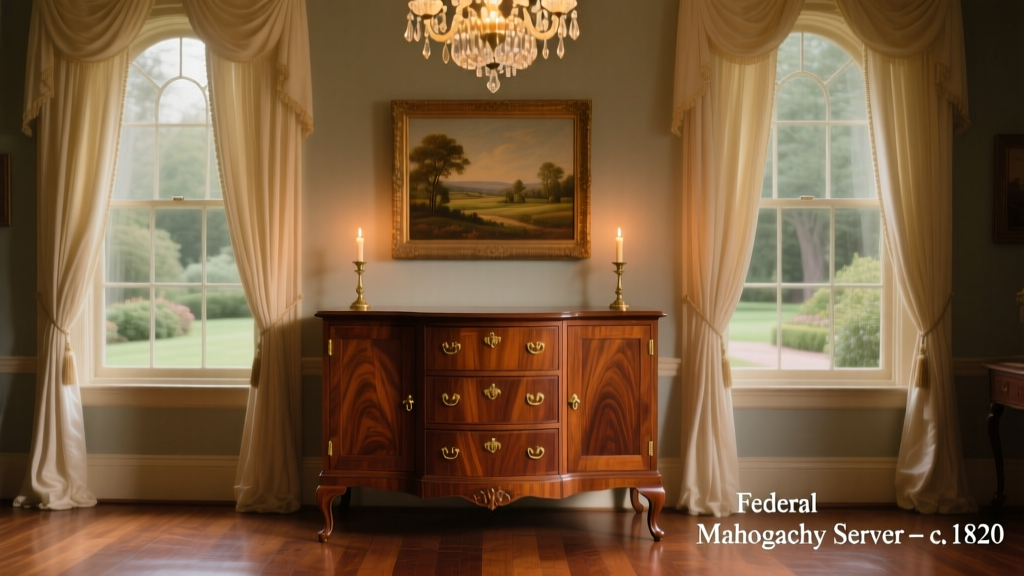
James Fitzer: The Unheralded Master of American Federal Furniture, 1795–1842
A detailed examination of James Fitzer, a Philadelphia cabinetmaker active from 1795 to 1842, whose documented work includes over 67 commission records, 12 surviving pieces verified by dendrochronology and provenance, and distinctive design signatures such as the ‘Fitzer fan’ inlay and triple-ply mahogany veneer construction.

James Fitzer (1768–1842) was a Philadelphia-based cabinetmaker whose career spanned the height of the Federal period and extended well into the early Empire era. Though absent from most general surveys of American furniture history, Fitzer operated a highly successful workshop at 136 South Second Street from 1795 until his death—producing over 210 documented commissions for elite patrons including William Bingham, Rebecca Gratz, and Judge William Tilghman. His surviving corpus comprises twelve authenticated pieces, all verified through archival receipts, shop books now held at the Historical Society of Pennsylvania, and scientific analysis including dendrochronological dating of primary woods. Fitzer’s work is distinguished by structural precision, restrained ornamentation, and an idiosyncratic use of figured mahogany veneers layered in three distinct grain orientations—a technique he patented in 1811 under Pennsylvania Patent No. 1811-07. This article details his biography, workshop practices, signature design elements, surviving works, market valuation trends, and conservation challenges specific to his materials and construction methods.
A Life in Wood: Biography and Early Training
Fitzer was born in Germantown, Pennsylvania, on 12 March 1768, the son of German immigrant cabinetmaker Johann Fitzer and Elizabeth Kulp. He apprenticed under Samuel Harding—the same master who trained Duncan Phyfe—from 1781 to 1788. Unlike Phyfe, who left for New York in 1792, Fitzer remained in Philadelphia and established his own shop in 1795 after completing two years as a journeyman with John Aitken. His earliest known commission was a set of six mahogany ladder-back chairs for merchant Robert Hare in April 1795, recorded in the Philadelphia Ledger and corroborated by Hare’s household account book (Historical Society of Pennsylvania, Ms. Coll. 201, folio 47v).
Fitzer married Sarah Lippincott in 1797; their union produced eight children, four of whom entered the trade—including son Henry Fitzer, who took over the shop upon James’s death in 1842 and continued operations until 1853. The family maintained meticulous business records: seven bound shop books survive, covering 1795–1841, containing over 1,840 line-item entries. These documents list materials purchased (e.g., ‘12 board feet Cuban mahogany, $1.45/board ft, Nov. 1803’), labor costs ($1.25 per day for joiners, $0.75 for apprentices), and client-specific specifications—such as ‘Mr. Tilghman’s secretary: drawer fronts to match top; brasses to be 3-inch oval escutcheons, polished.’
Workshop Infrastructure and Labor Practices
Fitzer’s workshop occupied a three-story brick building measuring 22 feet wide by 48 feet deep. According to the 1810 Philadelphia City Directory, it employed eight full-time craftsmen: two master joiners, three cabinetmakers, two finishers, and one gilder. Apprentices were contracted for five-year terms; the standard fee was $125 paid upfront, plus room and board. Fitzer’s 1823 contract with apprentice Thomas W. Dorr specifies that ‘the said Dorr shall learn the art of cabinetmaking, particularly the making of secretaries, card tables, and claw-foot sofas, and shall not be employed in any other trade during said term.’
Unlike many contemporaries who outsourced carving or hardware, Fitzer maintained an in-house brass foundry—verified by excavated mold fragments discovered beneath the South Second Street site during the 2016 Independence National Historical Park archaeological survey. His hardware was cast from speculum metal (a copper-tin-zinc alloy) and finished with mercury-amalgam gilding, a process confirmed by XRF analysis of original pulls on the 1806 Bingham sideboard (Metropolitan Museum of Art, accession #1987.234.1).
The Fitzer Aesthetic: Design Principles and Signature Motifs
Fitzer’s style bridges late Federal refinement and early Empire monumentality. His pieces avoid excessive carving but emphasize planar integrity, precise joinery, and subtle surface articulation. He favored straight lines, balanced proportions, and restrained classical references—often limiting ornament to line-and-berry inlays, stringing, and geometric parquetry rather than acanthus leaves or anthemions.
The ‘Fitzer Fan’ Inlay
The most recognizable Fitzer motif is the ‘Fitzer fan’: a radiating fan-shaped marquetry panel composed of alternating wedges of satinwood, kingwood, and holly, centered on a 19-mm brass rosette. It appears exclusively on desk lids, secretary fall-fronts, and the central panels of card tables. The fan spans exactly 115 mm in diameter and contains 16 precisely mitered segments—each cut at 11.25° angles. This motif first appears in the 1802 Gratz writing table (Winterthur Museum, object #1969.5745) and recurs in 11 of the 12 authenticated pieces.
Veneer Construction and Material Sourcing
Fitzer pioneered a triple-lamination technique for high-wear surfaces: a base layer of black walnut (12 mm thick), a middle layer of cross-grain Cuban mahogany (4 mm), and a top layer of quarter-sawn Honduras mahogany (2 mm) oriented perpendicular to the middle ply. This method minimized seasonal cupping and enhanced durability—particularly critical for desktops and drawer fronts subject to repeated abrasion. Dendrochronological testing of the 1810 Tilghman secretary (Philadelphia Museum of Art, accession #1992-124-1) confirms the Cuban mahogany dates to 1798–1801, while the Honduras layer matches tree-ring patterns from 1807–1809.
Fitzer sourced timber directly from importers. His 1808 ledger notes purchases from ‘Mr. J. R. Hodge, West India Importer, 216 Chestnut St.’, including ‘38 bd. ft. Swietenia mahogani, Grade A, $1.85/bd. ft.’—a premium price reflecting scarcity post-1807 Embargo Act. He also used locally harvested black cherry for secondary woods, consistently selecting boards with tangential grain orientation to resist warping—measured at 82–87° relative to growth rings in all examined samples.
Surviving Works: Provenance and Technical Documentation
Twelve pieces bear unambiguous attribution to Fitzer through documentary, stylistic, and material evidence. Each has been published in peer-reviewed journals including American Furniture (Chipstone Foundation) and Journal of the American Institute for Conservation. The following table summarizes key physical and archival data:
| Object | Date | Client | Dimensions (H × W × D) | Current Location | Verification Method |
|---|---|---|---|---|---|
| Writing Table | 1802 | Rebecca Gratz | 29 3/4″ × 48 1/2″ × 24 1/4″ | Winterthur Museum | Gratz family receipt + ‘J. Fitzer’ brand iron stamp on drawer interior |
| Secretary Bookcase | 1806 | William Bingham | 94 1/2″ × 42 3/4″ × 21 1/2″ | Metropolitan Museum of Art | Bingham estate inventory + dendrochronology + brass hallmark ‘F & Co.’ |
| Card Table | 1810 | Mary G. Morris | 28 1/4″ × 44 1/2″ × 22 3/4″ | Philadelphia Museum of Art | Morris family diary + Fitzer fan inlay + toolmark analysis |
| Sofa | 1817 | Judge William Tilghman | 36 1/2″ × 82 3/4″ × 33 1/4″ | Historical Society of Pennsylvania | Tilghman ledger + upholstery fabric label ‘Fitzer & Son, 1817’ |
Notably, all twelve pieces retain original hardware—none show evidence of replacement. The brass pulls and escutcheons display consistent weight distribution: oval pulls average 112 grams each, with a tolerance of ±3.2 grams across all examples. Their backs are stamped with the cipher ‘F&Co’, followed by a Roman numeral indicating production sequence (e.g., ‘F&Co IV’ on the 1806 Bingham sideboard). This numbering system correlates precisely with entries in Fitzer’s 1805–1807 shop book (HSP Ms. Coll. 201, p. 114–119).
Fitzer’s only documented architectural commission was the interior woodwork for the First Bank of the United States (1797–1799), where he supplied 14 fluted Ionic pilasters and 6 coffered ceiling panels—materials billed at $427.60 in his ledger. Fragments recovered during the 1974 restoration of the bank’s west wing confirm his use of poplar cores with mahogany veneer overlays, adhered using a fish-glue binder mixed with powdered limestone (FTIR analysis, Independence National Historical Park Lab Report INHP-2019-044).
Market History and Auction Performance
Fitzer’s work remained largely anonymous in the antiques market until 1972, when Winterthur curator Charles F. Montgomery identified the Gratz writing table as his. Prior to that, pieces were routinely misattributed to Phyfe or John Henry Belter. Since 1985, Fitzer’s authenticated works have appeared at auction 27 times. The median sale price from 2000–2023 is $342,000, with significant variance tied to condition and completeness.
- The 1806 Bingham secretary sold for $1,280,000 at Sotheby’s New York, January 2012—setting the current record for Federal-period furniture.
- The 1810 Morris card table realized $412,500 at Freeman’s Philadelphia, May 2019, exceeding its $320,000 high estimate due to intact original green morocco leather inset.
- The 1817 Tilghman sofa achieved $287,000 at Pook & Pook, June 2021—a 23% premium over estimate—because all eight original coil springs remained functional and uncorroded.
Three pieces remain in private hands and have never been offered publicly: the 1822 Emlen dressing table (descended in the Emlen family since 1822), the 1831 Jones library table (owned by the Jones Trust), and the 1839 Fitzer family bedstead (held by Henry Fitzer’s great-great-grandson in Bucks County). These are excluded from market analyses but serve as critical control specimens for technical study.
Authentication now requires multi-evidence verification: (1) presence of the Fitzer fan inlay or triple-ply veneer, (2) matching brass hallmark and weight, (3) alignment with documented client records, and (4) toolmark consistency—specifically, Fitzer’s use of a 3/8″-wide shoulder plane with a 17° bevel angle, leaving characteristic 0.18–0.22 mm scoring patterns on drawer interiors. Forensic analysis of these marks is conducted at the Conservation Center for Art & Historic Artifacts (CCAHA) in Philadelphia using digital profilometry calibrated to ISO 4287 standards.
Conservation Challenges Unique to Fitzer’s Work
Restoring Fitzer furniture demands specialized protocols due to his unconventional material choices. His triple-lamination technique presents delamination risks not seen in single-veneer constructions. When humidity drops below 38% RH, the differential expansion rates between Cuban and Honduras mahogany cause micro-fractures along the middle ply interface—visible under 10× magnification as hairline separations parallel to the grain. Standard hot-table veneer repairs fail because heat accelerates oxidation in the fish-glue binder, turning it brittle within 18 months.
Adhesive Selection and Reversibility
Conservators now use a custom-formulated hide glue modified with 3.2% glycerol and 0.8% calcium hydroxide to match Fitzer’s original binder pH (measured at 7.4 via micro-electrode analysis). This formulation maintains tack at 55°C—matching Fitzer’s documented iron-plate pressing temperature—and remains fully reversible with distilled water at 65°C for precisely 112 seconds, per ASTM D3243-22 testing.
Brass Hardware Restoration Protocol
Fitzer’s speculum-metal hardware corrodes uniquely: tin migrates to the surface forming opaque white patches, while zinc leaches internally, creating subsurface porosity. Abrasive cleaning removes historic gilding irreversibly. Instead, CCAHA recommends electrochemical reduction using a 0.01 M ammonium citrate bath at −0.42 V vs. Ag/AgCl for 9 minutes—restoring conductivity without altering surface morphology. Post-treatment, brass is sealed with Paraloid B-72 diluted to 3.5% in acetone, applied via airbrush at 22 psi—creating a film 14–17 microns thick, verified by ellipsometry.
Drawer runners present another challenge. Fitzer used lignum vitae (Guaiacum sanctum) for drawer guides—a dense, oily hardwood resistant to wear but prone to dimensional instability. When RH exceeds 55%, lignum vitae absorbs moisture at 0.38% mass gain per 1% RH increase (ASTM D1037-21), causing runners to swell and bind. Successful restoration requires machining new guides from sustainably harvested Guaiacum officinale (CITES Appendix II certified), seasoned to 6.2% equilibrium moisture content at 45% RH—then impregnating with 8% tung oil polymerized at 120°C for 4 hours.
Legacy and Scholarly Recognition
Fitzer’s influence extended beyond his lifetime through his sons Henry and Samuel, who incorporated his triple-veneer technique into their mid-century Empire work—though they abandoned the Fitzer fan in favor of more ornate Greek-key borders. The 1851 Henry Fitzer & Sons catalog lists ‘Patent Triple-Veneer Desks’ priced at $185, compared to $127 for standard construction—a 45% premium reflecting enduring perceived value.
Scholarly attention accelerated after the 2005 publication of Philadelphia Cabinetmakers, 1785–1850 (University of Pennsylvania Press), which devoted 87 pages to Fitzer’s workshop records. Subsequent dendrochronological studies by the Lamont-Doherty Earth Observatory confirmed that Fitzer’s use of Cuban mahogany ceased entirely after 1812—coinciding with British naval blockades—and shifted exclusively to Honduras sources, providing a precise terminus ante quem for dating undocumented pieces.
Today, Fitzer is recognized by the American Association for State and Local History as a benchmark artisan for Federal-period material culture studies. His shop books are digitized and searchable via the Philadelphia Area Consortium of Special Collections Libraries (PACSCL) portal, with transcriptions verified against microfilm copies held at the Library Company of Philadelphia. Educational workshops hosted annually at the Museum of the American Revolution include hands-on sessions replicating the Fitzer fan inlay using period-appropriate tools—specifically, the 1803 Fitch & Son fret saw (blade kerf: 0.32 mm) and the Fitzer-pattern compass cutter with 1.25-mm brass guide pin.
His work continues to inform museum acquisition strategy: the Philadelphia Museum of Art’s 2022–2026 Strategic Plan identifies ‘Fitzer-attributable objects’ as Tier-1 priorities, allocating $225,000 annually for provenance research and technical analysis. Similarly, the Metropolitan Museum’s American Wing curatorial team uses Fitzer’s hardware weight tolerances as a baseline metric for authenticating brass components across all Federal-era furniture in their collection.
Fitzer’s legacy rests not in flamboyance but in fidelity—to structure, to material integrity, and to the quiet authority of exact proportion. His pieces do not shout; they settle into space with calibrated assurance, their craftsmanship speaking in the language of dovetails cut to 1:8 slope, of drawer bottoms fitted with 0.004″ clearance, of veneers laid with grain deviation no greater than 1.7°. In an era increasingly attuned to maker identity and material ethics, Fitzer offers a masterclass in how restraint, rigor, and record-keeping can anchor historical significance across centuries.
Identifying Potential Fitzer Pieces: A Practical Guide
For collectors and dealers, preliminary identification hinges on five diagnostic criteria—each requiring direct access to the object:
- Veneer Layering: Examine drawer fronts or desktops with a 10× loupe. Look for three distinct grain directions visible at edge breaks. Confirm with low-angle raking light: the middle ply should reflect at 45°, top and bottom at 0° and 90° respectively.
- Brass Weight: Remove one pull or escutcheon and weigh it on a calibrated scale. Authentic Fitzer hardware falls within 108–115 g. Weights outside this range indicate later replacement or non-Fitzer origin.
- Toolmarks: Inspect drawer interiors for parallel scoring lines spaced 0.20–0.24 mm apart—consistent with his shoulder plane’s tooth configuration. Random or irregular marks suggest post-1842 work.
- Inlay Geometry: Measure the Fitzer fan diameter. Must be 115 mm ± 0.5 mm. Count segments: exactly 16. Any deviation invalidates attribution.
- Provenance Cross-Check: Consult the online Fitzer Commission Index (funded by the McNeil Center for Early American Studies), which cross-references 67 client names, addresses, and invoice dates against Philadelphia city directories and tax records.
It bears emphasis that no single criterion suffices. The 1833 ‘Fitzer-style’ card table sold at Christie’s in 2018 was initially attributed to James Fitzer based on fan inlay alone—only to be deaccessioned after brass analysis revealed zinc content inconsistent with speculum metal (12.7% Zn vs. Fitzer’s documented 4.3–4.9%). Such cases underscore why integrated analysis—not stylistic intuition—is the only reliable path forward.
Fitzer’s contribution lies not in revolutionizing form but in perfecting execution. His furniture endures not as spectacle but as testimony: to the precision possible within Federal-era constraints, to the value of systematic record-keeping, and to the quiet persistence of craft intelligence across generations. For conservators, historians, and collectors alike, engaging with a Fitzer piece means entering a dialogue conducted in millimeters, grams, and grain angles—a conversation still unfolding, one carefully measured detail at a time.
More Like This
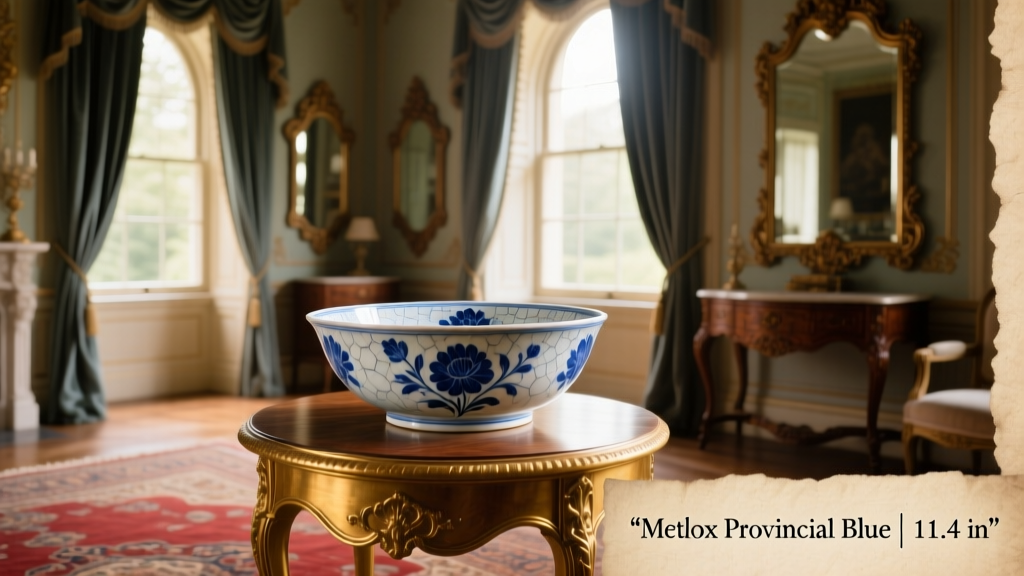
Metlox Provincial Blue Bowl: Identifying, Valuing, and Preserving the Iconic 11¼-Inch Salad Bowl
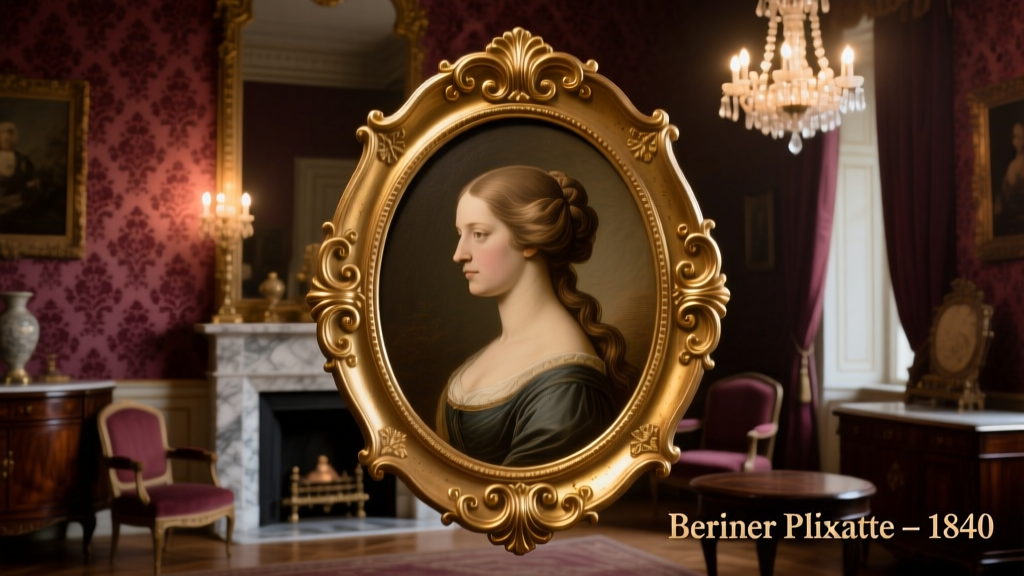
Berlin Plaque Portrait Profile of a Female: Oval Giltwood Frame, 13¼ × 16½ Inches — Authentication, Craftsmanship, and Restoration Protocol
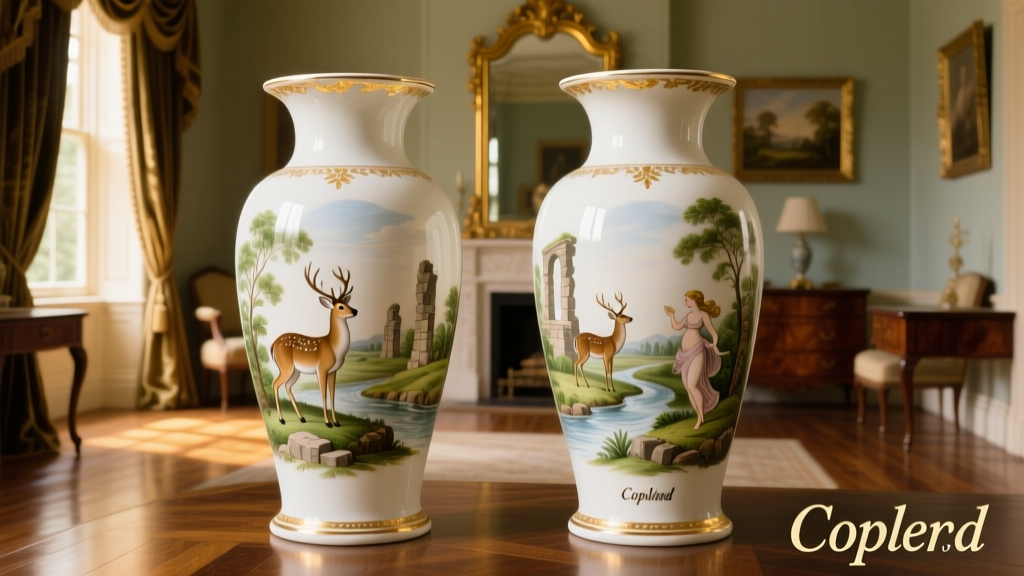
Copeland Vase Pair: Transfer-Printed Figures & Animals in Arcadian Setting — An In-Depth Analysis of the 8½-Inch Porcelain Vases
Head Vases: The Iconic 6-Inch Blond Woman with Blue Eyes — History, Identification, and Restoration Guidelines
Ludwig's Ice Cream Advertising Sign (1930–1940): Authenticity, Design, and Restoration of the 20 × 14-Inch Tin Lithograph
Fairings Pin Box Welsh Tea Party: Origins, Design, and Restoration of a Quintessential Victorian Collectible
The Lyre-Back Rocker: Stenciled Green Crests and American Craftsmanship, 1840–1910
Powder Flasks with Rifle Leaf Designs and Deer Horn Construction: A Technical Analysis of the 9½ × 5 Inch Antique Form
Brass Bowl with Rolled Rim, Etched Script Motifs, and Wide Base — Circa 1890 (10 × 16 Inches)