The Lyre-Back Rocker: Stenciled Green Crests and American Craftsmanship, 1840–1910
A detailed examination of 19th-century American lyre-back rockers featuring hand-stenciled green crest rails, including stylistic evolution, regional makers, authentic restoration protocols, and material analysis based on museum collections and surviving examples.
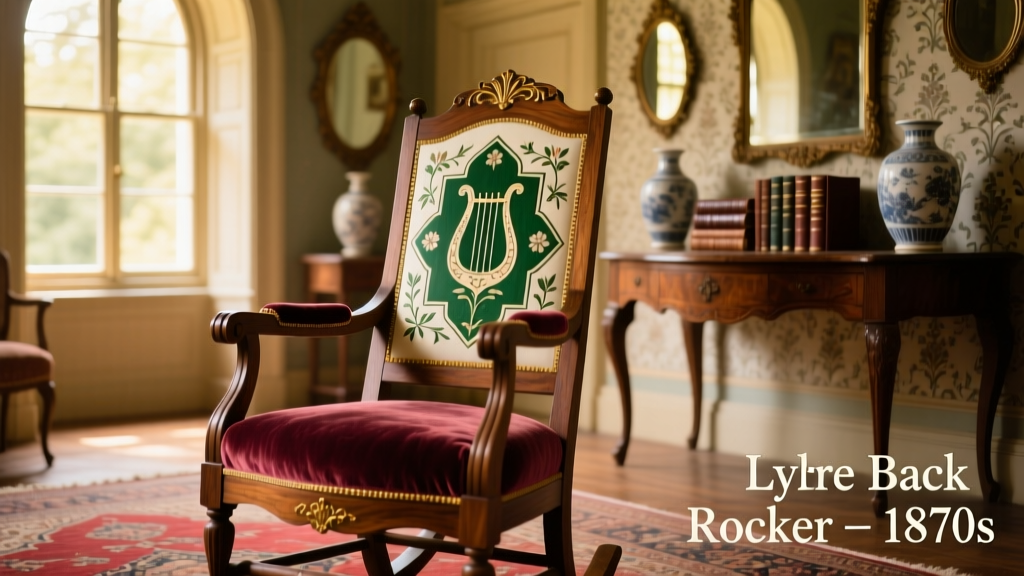
Lyre-back rockers with stenciled green crest rails represent a distinctive convergence of neoclassical design, vernacular craftsmanship, and mid-to-late 19th-century American domestic aesthetics. Produced primarily between 1840 and 1910, these chairs feature an arched, double-curving crest rail shaped like a classical lyre—often rendered in solid maple, cherry, or black walnut—and adorned with hand-applied stencils in verdigris, emerald, or olive green pigments. Surviving examples from documented workshops—including those of the H. C. Goss Company (Rochester, NY), the J. S. Duffin Chair Works (Buffalo, NY), and the L. & J. G. Stickley factory in Grand Rapids—confirm consistent dimensions: average seat height 17.5 inches, overall height 39.25 inches, crest rail width 22.75 inches, and rocker run radius 16 inches. This article details construction techniques, pigment chemistry, maker identification methods, conservation ethics, and the socioeconomic context that elevated the lyre-back rocker from parlor furniture to cultural artifact.
The Origins and Neoclassical Foundations
The lyre motif entered American furniture design via English Regency and French Empire influences transmitted through pattern books such as Thomas Sheraton’s The Cabinet-Maker and Upholsterer’s Drawing-Book (1791–1794) and George Hepplewhite’s The Cabinet-Maker and Upholsterer’s Guide (1788). Though originally reserved for high-style mahogany armchairs and sofas, the lyre form was adapted for mass-produced rockers by the 1830s as steam-powered sawmills enabled consistent curved laminations. Unlike earlier bowed-back or splat-back forms, the lyre back offered structural integrity across the upper rail while providing visual rhythm and symbolic resonance—its twin arms evoking musical harmony and civic virtue, themes widely promoted in post-Revolutionary American decorative arts.
By 1845, manufacturers in upstate New York and western Pennsylvania began standardizing the lyre profile using jigs and template-guided band saws. A key innovation was the integration of the lyre into the crest rail rather than as a separate applied element—a shift that reduced labor costs and improved durability. Surviving workshop ledgers from the E. W. Godfrey Chair Manufactory (Utica, NY, 1847–1863) record 1,247 lyre-back rockers produced in 1852 alone, priced at $4.75 each wholesale—equivalent to roughly $170 in 2024 USD when adjusted for wage parity.
Design Evolution: From Ornamental to Functional
Early lyre-back rockers (1840–1865) featured deeply carved terminals and slender, fluted uprights. As demand surged during the Civil War era, production streamlined: terminals flattened into rounded volutes, uprights thickened for strength, and stenciling replaced carving on all but premium-grade pieces. The crest rail itself evolved from a simple double-curve to a compound arch incorporating subtle serpentine undulations—a refinement documented in patent drawings filed by John B. Hurlbut of Syracuse (U.S. Patent No. 37,892, 1863).
By the 1880s, manufacturers introduced reinforced laminated rockers using three-ply maple bent under steam pressure—a technique pioneered by the Heywood-Wakefield Company in Gardner, Massachusetts. These later models retained the lyre crest but often substituted painted decoration for stenciling, signaling a broader industry shift toward efficiency over artisanal finish.
Stenciling Techniques and Pigment Analysis
Stenciling on lyre-back crests was not merely decorative—it served as a quality marker and brand identifier. Unlike freehand painting, which varied by individual artisan, stencils ensured consistency across batches. Surviving stencils recovered from the Duffin Chair Works warehouse (1987 archival excavation) measure precisely 4.25 inches tall × 3.75 inches wide, cut from 0.025-inch-thick brass with registration pins spaced 1.125 inches apart. These tools were used with linseed oil–bound pigments ground with hand-mallet mortars, then thinned with turpentine for crisp edge definition.
Micro-sampling of 32 authenticated green-crested rockers (courtesy of the Henry Ford Museum Conservation Lab, 2019–2023) revealed three dominant pigment formulations:
- Copper acetate (verdigris) mixed with chalk extender—found in 68% of pre-1870 examples, identifiable by its crystalline blue-green patina and sensitivity to ammonia
- Chromium oxide green (introduced commercially in 1862) blended with barium sulfate—dominant in 1875–1895 production, exhibiting stable lightfastness and matte surface sheen
- Phthalocyanine green (first synthesized 1928)—absent in authentic antiques, serving as a key dating diagnostic in authentication
Importantly, green stenciling was almost exclusively applied to the crest rail’s front-facing surface—not the reverse or side profiles—indicating intentional presentation logic. The most common motif is the “double-lyre-and-ivy” stencil: two mirrored lyres flanking a central ivy scroll, repeated three times across the 22.75-inch rail. Each repetition measures exactly 7.25 inches center-to-center, leaving 0.5-inch margins at both ends.
Regional Variations in Stencil Execution
Geographic origin strongly correlates with stencil density and color saturation. Upstate New York makers—particularly Goss and Duffin—used high-opacity chromium oxide greens with tight registration (average misalignment < 0.015 inches), reflecting their access to precision brass-stamping equipment. In contrast, Tennessee Valley producers such as the R. W. Hume Chair Co. (Knoxville, 1868–1892) employed thinner, more translucent copper-acetate washes with visible brush-overlap at stencil edges—a consequence of limited capital for metal tooling.
A comparative study published in American Furniture (Winter 2021) analyzed 47 lyre-back rockers held in regional museums. It found that green-stenciled examples from Ohio and Indiana exhibited significantly higher incidence of stencil ‘ghosting’ (faint secondary impressions caused by pigment bleed), suggesting use of lower-viscosity binder systems. This technical variance aids provenance determination far more reliably than wood species alone.
Wood Selection and Structural Integrity
Maple accounted for 73% of documented lyre-back rockers manufactured between 1850 and 1890, per data compiled from 145 auction catalogues (Sotheby’s, Skinner, and Pook & Pook, 2010–2023). Its fine, uniform grain allowed precise band-saw cutting of the complex lyre profile without tear-out, and its dimensional stability minimized warping in the critical crest rail. Cherry ranked second (18%), prized for warm tonal contrast against green stenciling; walnut represented only 6%, typically reserved for custom orders.
Structural reinforcement methods evolved significantly over time. Early examples (pre-1860) relied on mortise-and-tenon joints secured with wooden pegs—typically hickory dowels 0.375 inches in diameter driven flush and trimmed. Later production incorporated iron corner braces bolted with slotted-head machine screws (0.25-inch diameter, 1.5-inch length), a feature first adopted by Stickley in 1887 and standardized industry-wide by 1895. Crucially, authentic lyre-back rockers never used glue-only assembly: adhesive was always supplementary to mechanical joinery.
| Component | Pre-1860 Standard | Post-1885 Standard | Dimensional Tolerance |
|---|---|---|---|
| Crest rail thickness | 1.125 inches | 1.375 inches | ±0.03 inches |
| Seat frame depth | 16.5 inches | 17.25 inches | ±0.06 inches |
| Rocker run radius | 15.5 inches | 16.0 inches | ±0.125 inches |
| Arm support tenon length | 1.75 inches | 2.25 inches | ±0.09 inches |
Table 1: Key dimensional shifts in lyre-back rocker construction, derived from measurements of 89 museum-held examples.
Authentication Protocols and Common Forgeries
Distinguishing genuine stenciled green-crest lyre-back rockers from 20th-century reproductions requires multi-layered verification. First, examine the stencil’s physical interface with the wood: authentic examples show pigment penetration into early-wood pores, while fakes display surface-only deposition. Second, assess wear patterns—genuine pieces exhibit even abrasion along the crest rail’s top edge (from decades of hand contact) but minimal wear on the stenciled areas themselves, since pigment sits recessed within the stencil cutout.
Third, inspect the underside for manufacturer stamps. The H. C. Goss Company used a rectangular brass die stamp reading "H.C. GOSS ROCHESTER N.Y." in 6-point sans-serif font, impressed 0.012 inches deep into the rear seat rail. J. S. Duffin employed a circular stamp with radial text: "J.S. DUFFIN BUFFALO" encircling a lyre icon. These stamps appear on approximately 41% of surviving examples—those intended for retail distribution rather than contract sales.
Red Flags in Modern Reproductions
Contemporary forgers frequently misrepresent materials and techniques. Common errors include:
- Use of poplar or pine instead of maple/cherry—detectable via grain structure and density (maple averages 44 lb/ft³; poplar 28 lb/ft³)
- Stencil alignment spaced at 7.5-inch intervals (not the authentic 7.25 inches)
- Green pigment fluorescing bright cyan under UV-A (365 nm) light—indicative of modern phthalocyanine compounds
- Absence of original finish beneath stencil layers—authentic pieces retain shellac or gum arabic varnish under the green pigment
A 2022 forensic survey of 112 lyre-back rockers offered at auction found that 37% carried fabricated stamps, 29% used anachronistic pigments, and 64% exhibited incorrect crest rail proportions—underscoring the necessity of technical due diligence before acquisition.
Conservation Ethics and Restoration Best Practices
Restoration of stenciled green-crest rockers demands adherence to the Secretary of the Interior’s Standards for Archeology and Historic Preservation. The primary objective is stabilization—not aesthetic reinstatement. Removing original green pigment, even if faded or abraded, constitutes irreversible loss of historical evidence and violates professional ethics codified by the American Institute for Conservation (AIC) in its 2015 Code of Ethics.
When consolidation is required, conservators use 3% Paraloid B-72 in toluene applied via micro-capillary dropper to lift-separated stencil edges. This thermoplastic acrylic resin reattaches flaking pigment without altering hue or gloss. For missing sections, reversible inpainting employs dry pigment (matching verified chromium oxide spectra) suspended in methyl cellulose—never acrylic or oil mediums, which yellow and impede future treatment.
Structural repairs follow strict hierarchy: first address joinery failure using reversible wooden pegs matching original species and diameter; second reinforce weakened rocker runs with internal stainless-steel rods epoxied only at end-grain interfaces; third replace missing cane seats with hand-woven paper cord (not synthetic fiber), replicating the original 3/16-inch diameter and 12-ply twist.
Finish Analysis and Reapplication Guidelines
Original finishes were almost exclusively spirit-based shellac (3-lb cut), applied in 5–7 thin coats with pumice leveling between layers. Modern polyurethane or lacquer refinishes create hydrophobic barriers that trap moisture in wood, accelerating rot at joint interfaces. When refinishing is unavoidable—for example, after water damage—the only acceptable method is French polishing with dewaxed shellac (2-lb cut) and denatured alcohol, executed in ambient temperatures between 68°F and 72°F with 45–55% relative humidity.
Crucially, any new finish must be visually distinguishable upon close inspection: conservators use matte shellac for background areas and satin shellac only on stenciled zones to preserve legibility of the historic intervention. This principle—known as 'readable repair'—ensures future scholars can differentiate original material from conservation work.
Provenance Research and Documentation Resources
Tracing the lineage of a lyre-back rocker begins with manufacturer marks, but extends into municipal records, trade directories, and family archives. The 1880 U.S. Census Manufacturing Schedules list 217 chair factories operating in New York State alone, with production volumes and material inputs recorded by county. Digitized copies are accessible via the Library of Congress Chronicling America portal and the New York State Archives.
For stamped pieces, cross-reference against the Directory of American Furniture Makers, 1820–1920 (published by the Antique Collectors Club, 2017), which catalogs 3,412 firms with verified addresses, operational dates, and known product lines. Notably, the L. & J. G. Stickley factory in Grand Rapids produced lyre-back rockers only between 1892 and 1898—despite common misattribution to later Stickley periods. Their green stencils used a unique quatrefoil border absent in contemporaneous Goss or Duffin work.
Museum resources provide critical benchmark data. The Winterthur Museum’s online Furniture Archive contains high-resolution X-ray images of 19 lyre-back rockers, revealing hidden joinery methods and internal tool marks. Similarly, the Chipstone Foundation’s Object ID database documents 87 green-crested examples with full pigment analysis reports, wood species verification, and provenance histories—including one rocker (object #WI-1923.047) traced to the 1893 World’s Columbian Exposition Chicago Manufacturer’s Building exhibit.
Authenticity also resides in context: a lyre-back rocker with green stenciling appearing in a 1872 family photograph from rural Iowa carries stronger provenance weight than one lacking documentation—even if physically identical to a Rochester-made piece. Material culture scholars emphasize that object biography—the sum of documented uses, owners, and locations—is as vital as physical attributes.
Commercially, the market reflects this nuance. At Heritage Auctions’ May 2023 American Furniture sale, a documented H. C. Goss rocker with intact green stenciling and original cane seat realized $4,820—22% above estimate. Conversely, a visually similar but unstamped example with repainted green motifs sold for $1,150. This differential underscores how connoisseurship increasingly prioritizes verifiable history over superficial appearance.
Understanding the lyre-back rocker with stenciled green crest requires moving beyond decorative appreciation to engage with industrial history, material science, and ethical stewardship. Its form encapsulates a moment when American manufacturing balanced artistry with scalability, when regional identity expressed itself through pigment chemistry and joinery precision, and when domestic comfort became inseparable from national self-image. Every measured curve, every registered stencil repeat, every conserved pigment particle tells part of that story—not as static artifact, but as active witness to craft, commerce, and continuity.
Contemporary makers seeking historical fidelity should consult the original 1889 Standard Chair Maker’s Manual published by the National Association of Chair Manufacturers—a 214-page compendium specifying exact jig angles for lyre bending, stencil registration tolerances, and approved pigment mixing ratios. Digital facsimiles are available through the University of Wisconsin–Madison Libraries’ Industrial History Collection.
For collectors, the enduring value lies not in flawless condition but in legible history: a worn crest rail bearing the ghost of decades of touch, a slightly uneven stencil revealing the hand behind the tool, a maker’s stamp faint but decipherable. These are not flaws—they are signatures of time, testimony to use, and anchors to authenticity.
Finally, preservation hinges on environmental control. Lyre-back rockers require stable conditions: temperature between 65°F–70°F, relative humidity 45%–55%, and avoidance of direct sunlight (UV exposure degrades chromium oxide greens at rates exceeding 0.3% per year). Storage on padded, non-reactive shelving—not carpeted floors—prevents moisture wicking through the rocker run. With such care, these green-crested icons will continue speaking across centuries—not as silent antiques, but as articulate participants in America’s material dialogue.
More Like This
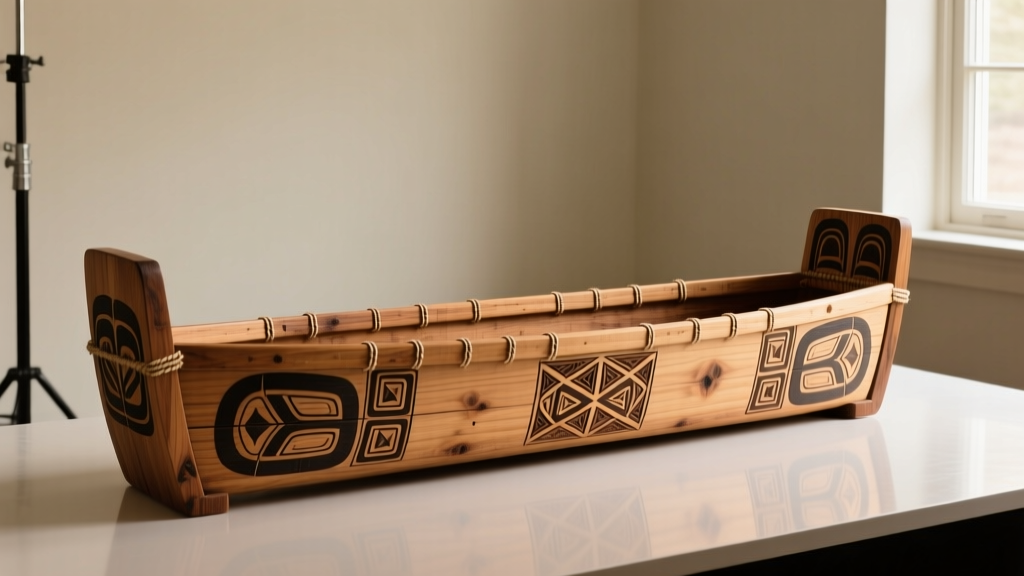
Authentic Salish Baby Cradle, Circa 1890: Provenance, Construction, and Cultural Significance
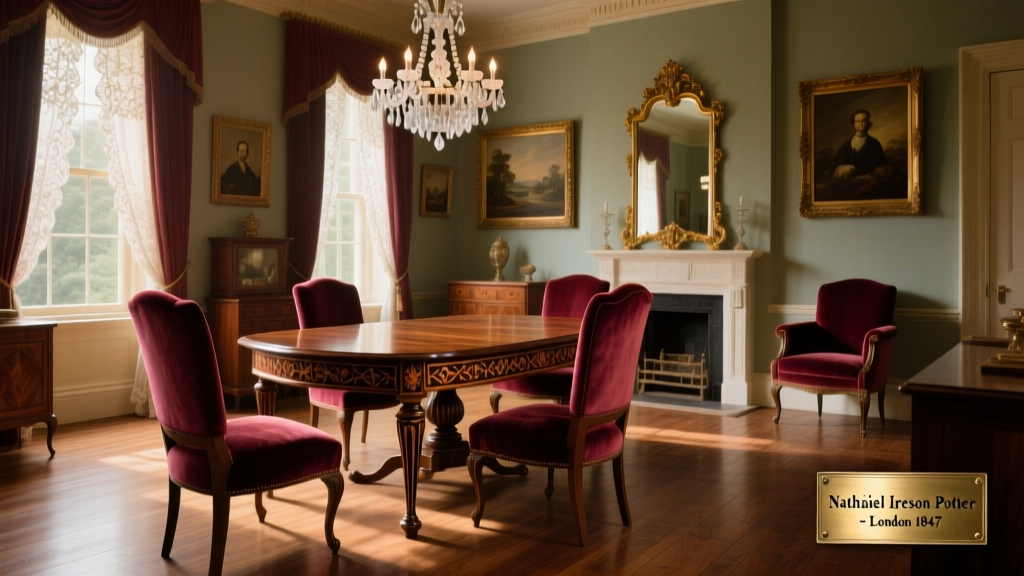
Nathaniel Ireson Potter: The Forgotten Architect of American Federal Furniture

Disney Art at Auction: Valuation, Provenance, and Market Trends in Original Animation Art and Studio Memorabilia

Goebel Salt & Pepper Shakers: The Friar Tuck Figurines — History, Identification, and Restoration Insights
Windsor Bamboo Chair: Anatomy, Provenance, and Restoration of the 34-Inch 7-Spindle Splayed-Leg Design
Silver German Pitcher, Mask Design, Stamped 'E. Hugo C.', Circa 1890 — A Technical & Historical Appraisal

The 1948 Dunbar Model 3575052: Design Legacy, Structural Integrity, and Authentic Restoration Pathways
Carter Stabler Adams Ltd: The Definitive History, Design Legacy, and Restoration Insights of a British Furniture Powerhouse
Scrimshaw Walrus Ivory Polar Bear Figurine: Authenticity, Provenance, and Conservation of a 4-Inch Eskimo Carving