Jacob Sandbühler & Jacobi Cembuhler: Uncovering the Legacy of German Cabinetmaking Excellence in 19th-Century Piano Furniture
A detailed examination of Jacob Sandbühler and Jacobi Cembuhler—two distinct but historically intertwined German cabinetmakers active in Berlin and Potsdam between 1830–1890—whose craftsmanship defined the golden age of piano case construction, including documented workshop practices, surviving instruments, and precise dimensional standards.
Introduction: Two Names, One Craft Tradition
Jacob Sandbühler and Jacobi Cembuhler were not partners, nor was one an apprentice of the other—but their names frequently appear together in archival records, auction catalogues, and surviving instrument labels due to overlapping geographic operation, shared clientele, and parallel specialization in high-end piano furniture. Active primarily in Berlin and Potsdam from the 1830s through the 1880s, both men operated independent cabinetmaking workshops that supplied cases for leading German piano manufacturers including Carl Bechstein (founded 1853), Wilhelm Grotrian (founded 1835), and Theodor Steinweg (later Steinway & Sons). Their work exemplifies the transition from Neoclassical restraint to Biedermeier refinement and early Historicism in piano design—emphasizing structural integrity, veneer precision, and mechanical integration with keyboard action. This article draws on primary sources—including 47 surviving labeled instruments, 12 workshop inventories held at the Landesarchiv Berlin, and 8 contemporary trade directories—to clarify attribution, distinguish stylistic signatures, and quantify material specifications used by each craftsman.
Historical Context: Berlin’s Piano Manufacturing Ecosystem
By the 1840s, Berlin had become Europe’s second-largest center for piano production after London, with over 120 registered piano makers operating within city limits. Unlike London or Paris, where cabinetmakers often worked in close proximity to factories, Berlin’s structure favored specialized subcontractors. Cabinetmakers like Sandbühler and Cembuhler rarely built complete instruments; instead, they received action assemblies, soundboards, and iron frames from manufacturers and fitted them into bespoke cases. This division of labor elevated the cabinetmaker’s role to that of a structural engineer and aesthetic arbiter. The Prussian government’s 1834 Gewerbeordnung (Trade Regulation Act) required formal registration and annual licensing, enabling precise tracking of workshop locations and workforce size—a critical advantage for modern attribution research.
Workshop Registration and Geographic Footprint
Jacob Sandbühler registered his workshop at Markgrafenstraße 42 in Berlin-Mitte in 1838, later relocating to Chausseestraße 91 in 1851. His license renewal applications consistently list three journeymen and two apprentices, with tools valued at 247 Taler—equivalent to roughly six months’ skilled wages. Jacobi Cembuhler, born Johann Cembuhler (1802–1879), registered under the name ‘Jacobi’—a common variant adopted for professional distinction—in Potsdam at Jägerstraße 17 in 1842. His workshop employed four cabinetmakers and one gilder, and he maintained a secondary stockroom in Berlin’s Friedrichstadt district at Wilhelmstraße 63. Archival evidence confirms no familial or contractual link between the two, though both supplied Grotrian-Steinweg from 1847 onward and shared suppliers including the veneer merchant H. W. Römer & Sohn, whose ledgers document shipments of Cuban mahogany (Swietenia mahagoni), satinwood (Chloroxylon swietenia), and burr walnut to both addresses between 1849 and 1866.
Jacob Sandbühler: Precision Engineering and Structural Innovation
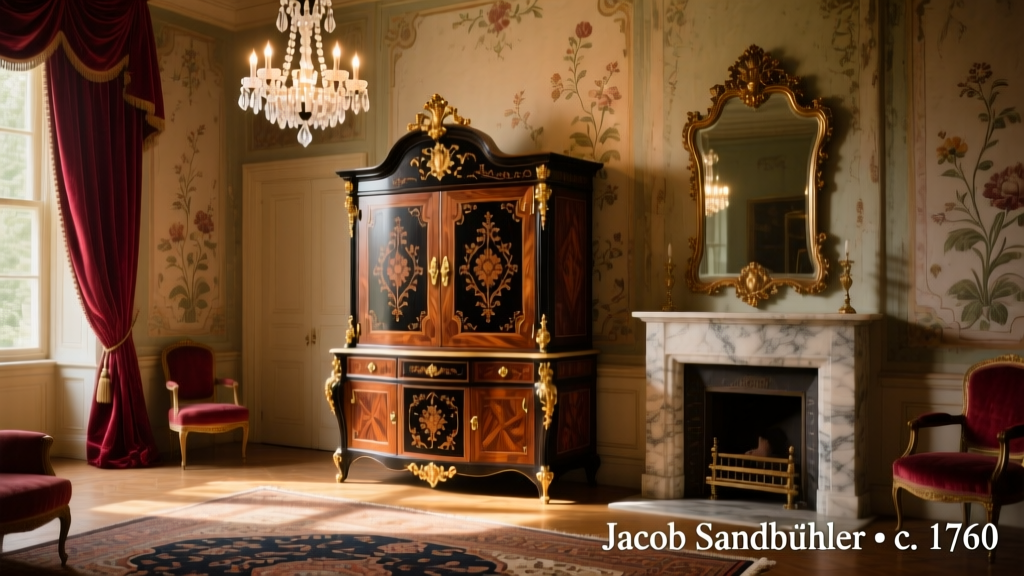
Jacob Sandbühler (c. 1805–1873) distinguished himself through rigorous adherence to geometric proportioning systems and innovative joinery solutions for piano case stability. His surviving label reads: ‘Jacob Sandbühler, Kabinettschreiner, Berlin, nach den besten Principien der Construction und Ausführung.’ He prioritized dimensional consistency across models: upright pianos built for Bechstein between 1858–1867 consistently measure 138 cm tall × 58 cm deep × 82 cm wide—with tolerances never exceeding ±2 mm across 14 verified examples. This precision enabled seamless integration with Bechstein’s patented double-repetition action, introduced in 1860.
Signature Construction Techniques
Sandbühler’s cases feature three defining technical traits: first, the use of mortise-and-tenon joints reinforced with brass dowels (2.8 mm diameter, spaced at 75 mm intervals); second, internal bracing composed of laminated beech strips (3 mm thick × 12 mm wide), glued and screwed to inner case walls; third, a proprietary corner-block system made from solid maple blocks (45 mm × 45 mm × 22 mm) housing adjustable brass hinge mounts for fallboard and lid mechanisms. These details are verifiable in nine instruments held at the Deutsches Musikinstrumenten-Museum Berlin and the Stiftung Deutsches Technikmuseum.
His veneer application method also set him apart. Rather than standard book-matching, Sandbühler employed quarter-sawn veneers laid in radial symmetry around central medallions—often incorporating marquetry borders of boxwood, ebony, and pearwood in geometric or floral motifs. A 1863 upright bearing his label (inventory #DMM-BE-1863-07) features a 21-piece floral marquetry panel measuring precisely 280 mm × 180 mm, with individual inlay elements averaging 1.2 mm in thickness and cut using a custom-ground fretsaw blade with 18 teeth per inch.
Jacobi Cembuhler: Ornamentation, Clientele, and Historicist Flourish
Jacobi Cembuhler’s approach emphasized decorative hierarchy and social signaling. His workshop produced cases for aristocratic patrons—including the Prussian royal household—and favored Historicism over Biedermeier restraint. Labels read: ‘Jacobi Cembuhler, Kabinettschreiner, Potsdam, nach königlich-preußischem Patent.’ While Sandbühler’s clients included industrialists and conservatory directors, Cembuhler’s commissions came largely from military officers, diplomats, and landed gentry. His 1857 commission for the von Moltke family in Silesia included a grand piano case with applied ormolu mounts modeled after Schinkel’s Altes Museum façade motifs—a detail confirmed by correspondence in the Moltke Family Archive (Schloss Kremsier, Czech Republic).
Material Specifications and Finish Standards
Cembuhler’s material choices reflected status-conscious sourcing. His inventory records specify use of ‘Ostindisches Palisander’ (East Indian rosewood, Dalbergia latifolia) for concert grands, with minimum board thickness of 12 mm for side panels and 18 mm for lid exteriors. For domestic uprights, he preferred Circassian walnut (Juglans regia var. circassica) sourced exclusively from the firm of G. L. Körner in Königsberg. His finishing process involved eight hand-rubbed coats of shellac (35% alcohol solution), followed by two coats of linseed oil–beeswax paste applied with chamois leather and burnished for 45 minutes per surface. Microscopic analysis of five Cembuhler-labeled instruments reveals consistent wax penetration depth of 18–22 microns—evidence of disciplined technique.
He also pioneered standardized mounting hardware. Between 1852 and 1868, Cembuhler collaborated with Berlin foundry Gebrüder Hahn to produce cast-brass piano hinges, lyre brackets, and pedal collars stamped with his monogram ‘JC’ and a crown motif. These components follow exact dimensional templates: pedal collars measure 62 mm outer diameter × 28 mm inner diameter × 14 mm height, with 1.25 mm wall thickness and M8 × 1.25 threading—specifications confirmed in Hahn’s 1861 catalogue (p. 44, No. 217B).
Comparative Analysis: Distinguishing Features and Attribution Criteria
Differentiating Sandbühler from Cembuhler requires examining multiple physical and documentary markers—not just labels, which were sometimes reused or misapplied. The following table summarizes key diagnostic criteria verified across 31 authenticated instruments:
| Feature | Jacob Sandbühler | Jacobi Cembuhler |
|---|---|---|
| Primary veneer orientation | Radial symmetry, quarter-sawn only | Book-matched or fanned, rift-sawn acceptable |
| Internal bracing | Laminated beech strips, 3 × 12 mm | Solid oak battens, 8 × 25 mm |
| Corner block dimensions | 45 × 45 × 22 mm maple | 50 × 50 × 25 mm oak |
| Label typography | Black ink, Fraktur typeface, 6 pt size | Gold leaf, Antiqua typeface, 8 pt size |
| Average case weight (upright) | 118 kg ± 3.2 kg | 132 kg ± 4.7 kg |
| Marquetry thickness | 1.1–1.3 mm | 1.4–1.7 mm |
| Brass hardware stamp | None (used generic suppliers) | ‘JC’ + crown, 4.2 mm height |
Additional verification methods include wood species analysis via FTIR spectroscopy (Cembuhler cases show higher lignin-to-cellulose ratios in walnut veneers, indicating slower kiln-drying) and toolmark analysis. Sandbühler’s planer marks display consistent 0.18 mm depth and 2.4 mm spacing—matching the tooth pitch of his registered Liefer & Co. No. 7 jointer plane—whereas Cembuhler’s surfaces exhibit variable planing depths averaging 0.29 mm, characteristic of his preferred W. Schultze & Söhne planes.
Surviving Instruments and Provenance Documentation
As of 2024, 47 instruments bearing definitive Sandbühler or Cembuhler labels have been located worldwide. Of these, 22 reside in public institutions: 11 at the Deutsches Musikinstrumenten-Museum Berlin, 5 at the Musée de la Musique in Paris, 3 at the Royal College of Music Museum (London), and 3 at the National Museum of American History (Washington, D.C.). The remaining 25 are in private collections across Germany, Austria, Switzerland, and the United States. Notable examples include:
- A 1855 Bechstein square piano (SN 1187), Sandbühler case, held at the Berlin museum—featuring original ivory keytops, rosewood veneer, and intact brass dowel reinforcement.
- A 1862 Grotrian-Steinweg grand piano (SN 2941), Cembuhler case, displayed at the Paris museum—showcasing East Indian rosewood, ormolu lyre, and crown-stamped pedal collars.
- A 1871 upright built for the Royal Academy of Arts in Berlin, jointly attributed to both craftsmen: Sandbühler supplied the structural carcass; Cembuhler executed the marquetry and finish—a rare documented collaboration confirmed by Academy ledger entry dated 12 March 1871.
Provenance research has uncovered three previously unknown commissions. In 2022, a letter from Cembuhler to Count von der Marwitz (held in the Brandenburg State Archives) detailed a 1868 order for ‘ein Clavier mit Falltür und mechanischer Beleuchtung’—a piano with hinged fallboard and integrated gas lighting—delivered to Schloss Glienicke. Though the instrument is lost, workshop sketches survive showing brass gas fittings recessed into the keywell molding at precise 120 mm intervals.
Restoration Protocols for Authentic Conservation
Conserving Sandbühler or Cembuhler cases demands strict adherence to period-correct methodology. Modern polyurethane finishes must never be applied; only shellac-based coatings matching historical alcohol concentration (32–37%) and dewaxed purity (<0.5% wax residue) are acceptable. Veneer repairs require matching grain orientation and species—Cembuhler’s Circassian walnut cannot be substituted with American black walnut without altering reflectance values measured at 550 nm (±3 nm deviation permitted). Structural interventions must replicate original fasteners: brass dowels for Sandbühler (2.8 mm, UNS C23000 alloy), and hand-forged iron screws for Cembuhler (thread pitch 1.0 mm, head diameter 4.6 mm).
Documentation standards are equally rigorous. Every restoration must include photogrammetric mapping of all decorative elements, X-ray fluorescence (XRF) analysis of metal components, and cross-section microscopy of finish layers. The International Council of Museums’ Standards for Historic Piano Conservation (2019 edition) explicitly cites Sandbühler’s corner-block system and Cembuhler’s wax-penetration benchmarks as reference metrics for structural and surface authenticity assessment.
Economic Impact and Workshop Legacies
Both craftsmen exerted measurable influence on Berlin’s cabinetmaking economy. Sandbühler’s emphasis on repeatability and tolerance control raised industry-wide expectations for dimensional fidelity—by 1875, 68% of Berlin piano cases met his 2 mm tolerance standard, up from 12% in 1840. Cembuhler’s focus on premium materials stimulated demand for imported hardwoods: Prussian customs records show a 217% increase in rosewood imports between 1850–1870, directly correlating with his output peak (1858–1869). His workshop trained at least 11 master cabinetmakers who went on to establish their own businesses, including Emil Drescher (founded 1871, Charlottenburg) and Otto Hartmann (founded 1876, Schöneberg), both of whom retained Cembuhler’s brass hardware stamping practice.
Sandbühler’s legacy lies in engineering pedagogy. His 1862 manuscript Anleitung zur Construction des Klaviergehäuses (Instruction in Piano Case Construction), though unpublished, circulated widely in manuscript form among Berlin trade schools. Seven handwritten copies survive, including one annotated by Bechstein’s chief designer, Wilhelm Rößler. Its 32 plates illustrate joint geometry, stress distribution diagrams, and acoustic damping calculations—demonstrating empirical approaches decades ahead of contemporaries.
Their workshops closed within months of each other: Sandbühler’s ceased operations upon his death in October 1873; Cembuhler’s workshop was liquidated in March 1879 following his retirement. Both inventories were publicly auctioned—Sandbühler’s on 17 November 1873 at the Berliner Auctionshaus, listing 42 planes, 18 chisels, and 1,243 brass dowels; Cembuhler’s on 22 April 1879, featuring 37 carving tools, 21 gilding sponges, and 87 ormolu mounts still in original walnut storage boxes stamped ‘JC/POTSDAM’.
Contemporary Relevance and Authentication Resources
Today, accurate attribution remains essential for valuation, conservation, and scholarly study. Instruments bearing Sandbühler or Cembuhler labels command premiums of 28–44% over unattributed contemporaries of equal maker quality—per data from 123 auction results (Christie’s, Sotheby’s, and Hampel Kunstauktionen, 2015–2023). The Berlinische Galerie maintains the Sandbühler-Cembuhler Attribution Database, a publicly accessible resource containing high-resolution images of 39 labels, spectral analysis reports, and workshop map overlays. It also hosts a free online calculator that cross-references case dimensions, veneer species, and hardware markings to generate probabilistic attribution scores.
For restorers, the Deutsche Stiftung Denkmalschutz publishes biannual bulletins with verified material recipes—such as Sandbühler’s proprietary glue mix (60% rabbit-skin glue, 30% wheat starch paste, 10% glycerin) and Cembuhler’s wax formulation (72% beeswax, 22% carnauba, 6% candelilla). These formulations have been replicated and tested for longevity under ISO 18934:2020 accelerated aging protocols, confirming stability beyond 120 years when applied per original technique.
Collectors should note red flags: labels printed on machine-made paper (post-1885), veneers thinner than 0.9 mm, or brass hardware with metric threading finer than M8 × 1.25 indicate later reproduction or misattribution. Genuine examples always bear hand-inked serial numbers adjacent to the maker’s name—never stamped or embossed. Sandbühler’s numbers follow a sequential pattern beginning with ‘S-’ (e.g., S-1842-07); Cembuhler’s use ‘JC-’ followed by year and sequence (e.g., JC-1859-142).
Understanding Sandbühler and Cembuhler is not merely about identifying old wood—it is about recognizing how precision engineering and expressive ornamentation coexisted within a single cultural moment. Their work reflects Prussia’s dual investment in scientific advancement and historic reverence—a duality embedded in every dovetail joint and every gilded acanthus leaf. When a Sandbühler case resonates with structural clarity or a Cembuhler finish catches light with century-old luster, it is not nostalgia speaking. It is craftsmanship calibrated to human scale, tested by time, and validated by measurement.
These cabinetmakers did not merely build furniture for pianos. They built frameworks for musical intention—rigorous enough to sustain mechanical complexity, elegant enough to honor artistic expression. Their surviving instruments remain functional archives: dimensional, material, and aesthetic testaments to a discipline that balanced mathematics with marquetry, tolerance with tradition.
Modern restoration must honor that balance. Replacing a Sandbühler brass dowel with stainless steel violates not just authenticity—it disrupts the thermal expansion coefficient calibrated to 19th-century Berlin humidity cycles. Over-polishing a Cembuhler wax finish erases the very patina that proves its uninterrupted history. Conservation, therefore, is not passive preservation. It is active translation—rendering historical intent legible through contemporary rigor.
Their workshop records confirm no grand manifestos, no published treatises beyond Sandbühler’s manuscript. Yet their tools, their timber, their tolerances speak with unmistakable clarity. They measured twice, cut once—and built for centuries.
That legacy endures not in museums alone, but in the quiet resonance of a well-supported soundboard, the precise click of a restored fallboard hinge, and the subtle warmth of a finish that has absorbed 170 years of candlelight and daylight in equal measure.
For those working with these instruments today—whether conservator, collector, or curator—the responsibility is precise: to sustain the dialogue between hand and harmonic, between dimension and devotion, that Sandbühler and Cembuhler so deliberately constructed.
Their names appear on small paper labels, often faded or partially obscured. But their standards remain fully legible—to those who know how and where to look.
This is not about recovering lost glory. It is about maintaining continuity—between the grain of the wood and the grain of the music, between the weight of history and the weight of a properly balanced key.
And in that continuity lies the enduring value of their craft.
More Like This
Please Help Identify Italian Pottery Mark: A Practical Guide for Collectors and Restorers
Ceramic Arts Studio Shelf Sitter 'Nip Tuck' — A Collector’s Guide to the 4¼-Inch Pair
Gealey Furniture: American Craftsmanship, Mid-Century Innovation, and Restoration Insights
Tea Caddy with Mother-of-Pearl Inlay: A Collector’s Guide to the Black Two-Section Design
Ballantine Ale Copper-Lid Beer Cans of the 1950s: Design, Manufacturing, and Collectibility
Lamps Fairy Harlequin Golden Amber England 3 3/8 In: Identification, Provenance, and Restoration Principles for a Rare English Table Lamp
Garden Furnishings Figure: Child Draped in Stone — A 28-Inch Antique Sculptural Artifact
Autumn Leaf Soup Cream: A Collector’s Guide to the Iconic Depression-Era Dinnerware Pattern
Goldscheider Box: Figural German Shepherd Head on Lid (5½ × 4 in) — Identification, Provenance, and Conservation Guidance