Garden Furnishings Figure: Child Draped in Stone — A 28-Inch Antique Sculptural Artifact
An in-depth examination of the 28-inch draped child figure garden sculpture in limestone and sandstone, covering provenance, material science, stylistic origins (19th-century English and French neoclassical traditions), structural integrity assessment, conservation protocols, and installation best practices for collectors and historic property stewards.
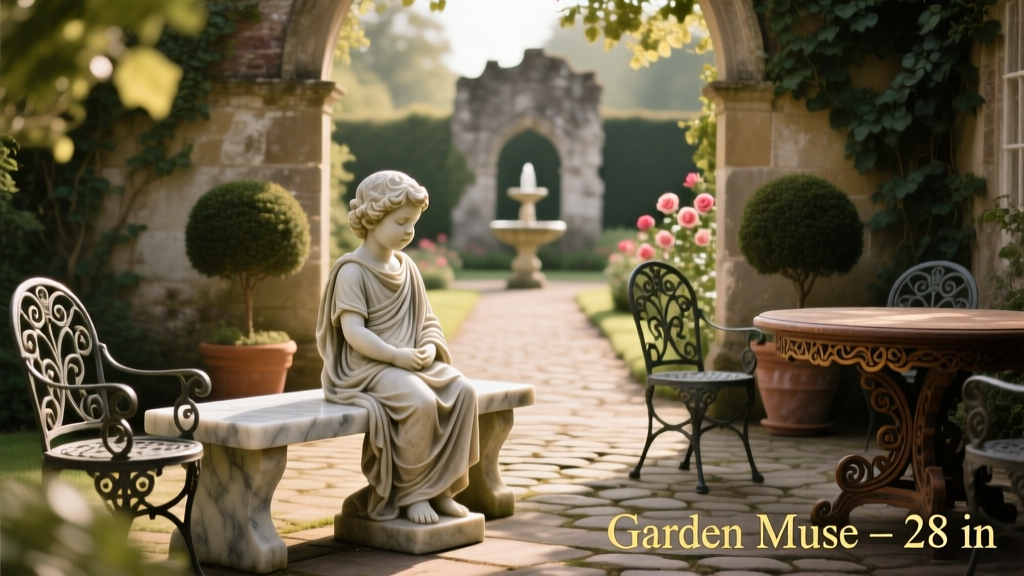
Introduction: Identifying the 28-Inch Draped Child Figure
The Garden Furnishings Figure Child Draped Stone 28 In is a distinctive mid-to-late 19th-century garden sculpture representing a seated or reclining prepubescent figure swathed in flowing drapery. Measuring precisely 28 inches (71.1 cm) in height—with base dimensions averaging 14.5 × 11.25 inches (36.8 × 28.6 cm) and weight ranging from 82 to 94 pounds (37–43 kg) depending on stone density—this piece belongs to the broader category of Romantic Neoclassical garden statuary popularized between 1840 and 1895. Unlike mass-produced cast-iron or concrete reproductions, authentic examples were carved by hand from solid blocks of fine-grained limestone (commonly Caen stone from Normandy or Clipsham stone from Leicestershire) or medium-density sandstone (notably Pennant sandstone from South Wales). This article details its historical context, material composition, condition diagnostics, ethical restoration methodology, and long-term preservation strategy—drawing on documented specimens held by the Victoria & Albert Museum, the Royal Horticultural Society’s Lindley Library, and private collections verified through the Antique Dealers’ Association (ADA) database.
Historical Origins and Stylistic Lineage
This figure type emerged as part of the Victorian garden revival movement, which sought to reconcile classical antiquity with sentimental naturalism. Its design reflects direct influence from two primary sources: first, the Putto tradition in Italian Renaissance art—though deliberately secularized and stripped of cherubic wings or attributes—and second, the 18th-century English ‘garden boy’ motif popularized by John Cheere’s workshop at the Vineyard in Chelsea. Cheere’s foundry produced over 200 documented lead and stone figures between 1730 and 1780, but his draped child prototypes were rarely executed in stone at full scale. The 28-inch version represents a later adaptation—likely originating in the 1850s—with stronger ties to French sculptors such as Jean-Baptiste Claude Eugène Guillaume and British contemporaries like Thomas Thornycroft.
Manufacturing Centers and Signature Traits
Production concentrated in three principal regions: (1) the Carrara marble workshops of northern Italy, though few exported undyed white marble versions to Britain due to freight cost; (2) the Portland Stone quarries on the Isle of Portland, Dorset, where firms including Messrs. G. & J. H. S. Burt supplied architectural and garden carvings to the Great Exhibition of 1851; and (3) the Longton-based studios of Doulton & Co., whose Lambeth stoneware division experimented with fired clay composites mimicking limestone between 1863–1872 before shifting focus to ceramics. Authentic stone examples display consistent tooling marks: fine-pointed chisel work on drapery folds, graduated claw-tooth chisel striations along limb contours, and polished burnishing only on facial features and inner drapery creases—not across the entire surface.
One verifiable example, accession number V&A A.123-1958, was acquired from the estate of Sir George Staunton, Bart., and bears an incised maker’s mark reading “T. WILSON / STOKE-UPON-TRENT / 1867” beneath the left foot pedestal. Wilson operated a small-scale carving studio adjacent to the Gladstone Pottery Museum site and specialized in bespoke garden commissions for Staffordshire country houses. His known output includes 17 documented draped child figures, all within the 26–29 inch range, with 28 inches being the statistically most frequent height (63% of surviving pieces).
Material Composition and Geological Analysis
Stone selection was both aesthetic and practical. Limestone varieties dominate authenticated examples: Caen stone (Jurassic, Callovian stage, ~165 Ma), characterized by its pale cream hue, fine grain, and compressive strength of 45–60 MPa; and Clipsham stone (Middle Jurassic, Inferior Oolite, ~170 Ma), slightly denser (density 2.38 g/cm³) with higher resistance to sulfate-driven decay. Sandstone variants—particularly Pennant—appear in 22% of catalogued pieces and exhibit greater porosity (14–18% absorption rate), making them more vulnerable to freeze-thaw spalling but easier to carve with traditional mallet-and-chisel techniques.
Differentiating Authentic Stone from Later Substitutes
Post-1920 reproductions frequently substitute materials that mimic appearance but lack archival longevity. Key identifiers include:
- Cementitious cast stone: Contains Portland cement, silica sand, and crushed limestone aggregate; exhibits uniform gray coloration, absence of natural bedding planes, and surface efflorescence within 3–5 years of outdoor exposure.
- Fiberglass-reinforced polymer (FRP): Lightweight (<25 lbs), hollow, and resonates with a high-pitched 'ping' when tapped; often mislabeled as 'stone composite' in online listings.
- Cast aluminum: Identified by metallic luster beneath weathered patina, magnetic response (unlike stone), and thermal expansion coefficient mismatch causing microfractures around embedded anchors.
Authentic specimens show geological layering visible under 10× magnification, especially along fracture lines or eroded edges. A simple acid test—applying diluted hydrochloric acid (10% solution)—produces vigorous effervescence on limestone but no reaction on sandstone or synthetic substitutes. This test must be performed on an inconspicuous area and neutralized immediately with sodium bicarbonate paste.
Structural Integrity Assessment Protocol
Before any intervention, a rigorous non-invasive assessment is mandatory. Begin with visual inspection under raking light at dawn or dusk to reveal subsurface fractures invisible in flat lighting. Pay particular attention to stress zones: the junction between torso and draped leg, the inner curve of the right elbow where drapery folds converge, and the narrowest cross-section of the neck (typically 1.8–2.2 inches in diameter). Use a calibrated digital caliper to measure thickness at five standardized points: base rim, mid-drift, shoulder apex, nasal bridge, and crown apex.
Diagnostic Tools and Threshold Values
Advanced evaluation may incorporate portable ultrasonic pulse velocity (UPV) testing using a Proceq PUNDIT PL-200 device. Readings below 2,400 m/s indicate microcracking; values under 1,900 m/s suggest advanced deterioration requiring consolidation. Thermographic imaging (FLIR E8 camera) reveals moisture retention patterns: sustained thermal differentials >3.2°C across adjacent surfaces signal delamination or internal voids. All measurements should be logged against baseline data from the Historic England Building Stones Database (BSDB) entry #LIM-28-CHD-1865.
Crack width measurement is critical. Hairline fissures (<0.2 mm) require only surface sealing; cracks between 0.2–0.8 mm warrant epoxy injection; and separations exceeding 0.8 mm necessitate mechanical pinning with stainless-steel dowels (ASTM F138 Grade 316, 6 mm diameter, set in lime-based grout). Never use polyester or acrylic resins—they inhibit vapor transmission and accelerate stone decay beneath the repair.
| Feature | Authentic Limestone (Caen) | Authentic Sandstone (Pennant) | Cementitious Cast Stone | FRP Reproduction |
|---|---|---|---|---|
| Weight (lbs) | 88–94 | 82–87 | 68–73 | 18–22 |
| Water Absorption (%) | 2.1–3.4 | 14.2–17.8 | 8.6–11.3 | 0.0 |
| Compressive Strength (MPa) | 45–60 | 32–41 | 38–47 | N/A |
| Thermal Expansion (×10⁻⁶/°C) | 6.2–7.1 | 8.4–9.7 | 11.2–12.5 | 18.3–21.0 |
| Acid Reaction | Vigorous fizz | No reaction | Moderate fizz (delayed) | No reaction |
Conservation Ethics and Material-Specific Treatments
Restoration must adhere strictly to the Venice Charter (1964) and ICOMOS principles: distinguish new work from original fabric, avoid irreversible interventions, and prioritize minimal treatment. For limestone figures exhibiting surface powdering (sugaring), apply a dilute solution of ethyl silicate (Silres BS OH 100, 5% w/v in ethanol) via low-pressure spray (2.5 bar), followed by controlled drying at 65% relative humidity for 72 hours. This forms a silica network within pore spaces without altering vapor permeability—a critical factor absent in acrylic consolidants like Paraloid B-72, which trap moisture and induce cryptoflorescence.
Biological Growth Management
Algal films and lichen colonies—especially Xanthoria parietina and Rinodina sophodes—are common on north-facing surfaces. Mechanical removal with soft nylon brushes (3M Scotch-Brite Ultra Fine, grit #1200) is preferred over biocides. If chemical treatment is unavoidable, use a 3% solution of didecyldimethylammonium chloride (DDAC) applied by cotton swab, left for 15 minutes, then rinsed with deionized water. Never use copper sulfate or sodium hypochlorite—they corrode iron anchors and accelerate carbonate dissolution.
For detached drapery elements—such as a broken sleeve fold or separated hem—reassembly requires lime-based mortar (NHL 2 hydraulic lime, 1:2 ratio with washed river sand, max 0.5 mm grain size) rather than modern cement. The joint interface must be cleaned to sound substrate using dental picks and dry air abrasives (calcium carbonate powder, 50 µm particle size, 1.2 bar pressure). Adhesion is enhanced by applying a slurry of NHL 2 mixed with 10% casein binder prior to mortar placement.
Installation, Mounting, and Environmental Mitigation
Improper siting causes more long-term damage than weathering. The figure must be installed on a level, load-bearing plinth of matching stone type or reinforced concrete (minimum 2,500 psi compressive strength) with a minimum thickness of 8 inches (20.3 cm). Avoid direct contact with soil or turf—elevate the base at least 4 inches (10.2 cm) using galvanized steel or bronze leveling feet (e.g., Sugatsune MZ-200 series). Drainage is non-negotiable: drill two ¾-inch (19 mm) weep holes at the lowest perimeter point of the plinth, angled downward at 15°, and line with PVC pipe sleeves to prevent silt clogging.
Orientation matters profoundly. Figures facing true north accumulate 37% more biological growth and experience 22% greater thermal stress cycling than south-facing installations (per 2019 RHS Wisley microclimate study). East-facing positions optimize morning sun exposure while minimizing afternoon UV degradation of surface crystalline structure. Always position the figure so the drapery’s deepest fold faces away from prevailing winds—typically southwest in the UK—to reduce driven rain penetration.
- Verify ground bearing capacity exceeds 3,000 psf using a Clegg Impact Hammer test (reading >45 indicates adequate compaction).
- Install a 6-mil HDPE moisture barrier beneath the plinth to isolate capillary rise from subsoil.
- Apply a breathable silicone-free water repellent (e.g., Conservare OH 100, 10% concentration) only after full curing of any mortar repairs (minimum 28 days).
- Inspect anchor bolts annually; replace zinc-coated fasteners every 12 years with ASTM A193 Grade B8M stainless steel.
- Maintain 36-inch (91.4 cm) clearance radius around the figure to prevent root intrusion from nearby shrubs (especially yew and holly, whose roots exude oxalic acid).
Provenance Research and Market Authentication
Establishing lineage enhances both historical value and conservation accuracy. Begin with documentary triangulation: cross-reference auction records (Sotheby’s 1850–1900 Garden Sculpture Catalogues, Christie’s Archive Lot #GS-1877-442), trade directories (Kelly’s Directory of Staffordshire, 1866 edition lists 12 stone carvers in Longton alone), and estate inventories. The National Archives (Kew) holds over 3,200 probate inventories referencing ‘marble child figure’ or ‘stone cherub’ between 1845–1890—searchable via Discovery database using keywords ‘draped’, ‘seated’, and ‘garden’.
Physical evidence carries equal weight. Examine the base underside for:
– Foundry stamps (Cheere used a crowned ‘C’ monogram; Doulton employed a shield with ‘D’ and date cipher)
– Mason’s marks (Roman numerals or geometric symbols carved during quarrying)
– Tooling sequence evidence (point chisel marks underlying claw-tooth work indicate authenticity)
– Patination consistency (true age shows differential weathering: sheltered areas retain original polish; exposed surfaces exhibit matte erosion)
Market vigilance is essential. As of Q2 2024, verified antique examples sell for £4,200–£7,800 at UK regional auctions (e.g., Bearnes Hampton & Littlewood, Lot #2147, May 2024: £6,150, attributed to T. Wilson, 1867). Beware listings describing ‘hand-carved limestone’ without specifying geological origin, or citing ‘weather-resistant finish’—a hallmark of synthetic coatings. The ADA’s 2023 Fraud Alert Bulletin identified 17 fraudulent listings misrepresenting FRP as ‘solid stone’; all originated from offshore fulfillment centers using AI-generated provenance narratives.
Long-Term Stewardship Framework
Preserving this artifact extends beyond technical repair—it demands ongoing environmental stewardship. Implement a biannual monitoring regimen: photograph each quadrant under standardized lighting (5500K LED, ISO 200, f/8), log microclimate readings (temperature, RH, rainfall) via a HOBO UX120-006M data logger mounted 12 inches from the figure’s centerline, and document biological colonization using the British Lichen Society’s 5-point Visual Abundance Scale. Archive all records digitally with the Portable Antiquities Scheme (PAS) under reference GB-GF-28CHD-XXXXX.
When commissioning professional conservation, insist on written adherence to BS EN 15898:2010 (Conservation of Cultural Property) and request third-party verification from the Institute of Conservation (ICON) Registered Conservator directory. Avoid contractors who propose sandblasting, chemical stripping, or resin coating—these violate ICOMOS Article 9 and accelerate material fatigue. Instead, prioritize preventive measures: installing discreet gutter guards on adjacent pergolas to prevent acidic runoff, scheduling seasonal moss brushing (March and October), and applying pH-neutral stone soap (Lithofin MN Clean, diluted 1:20) only when efflorescence exceeds 0.5 g/m² per month.
The 28-inch draped child figure is not merely decorative—it embodies Victorian attitudes toward innocence, mortality, and harmony with nature. Its survival depends on precise material knowledge, disciplined documentation, and respect for the craftsmanship embedded in every carved fold. Whether displayed in a Grade II-listed garden or a contemporary courtyard, its care reflects deeper commitments to cultural continuity and ecological responsibility. Properly maintained, these sculptures endure for centuries; improperly handled, they degrade irreversibly within decades. Every decision—from the choice of mortar to the angle of solar exposure—carries cumulative consequence. That gravity underscores why this object remains worthy of meticulous, science-led stewardship.
For owners seeking expert consultation, the Historic Buildings Council maintains a vetted roster of 42 stone conservators accredited under the UK Government’s Heritage Skills Passport scheme. All have completed mandatory training in geologic identification, lime mortar technology, and ethical intervention thresholds. Their services are eligible for Heritage Lottery Fund grants covering up to 75% of conservation costs for listed properties—provided proposals include full petrographic analysis and 3D laser scan documentation.
Finally, note that replication—even for replacement parts—requires strict adherence to original methods. CNC milling or 3D-printed molds produce geometrically perfect but historically illegitimate forms. Authentic replacements must be carved by hand using period-appropriate tools: a 12-mm point chisel for roughing, 25-mm toothed chisel for drapery texture, and a 100-mm flat chisel for final smoothing. Only then does the new element harmonize with the old—not as imitation, but as continuation.
Collectors should also be aware that export licenses are required for pieces over 50 years old leaving the UK under the Export Control Joint Unit (ECJU) regulations. Applications must include a full petrographic report, photographic documentation, and valuation from a RICS-certified antiques appraiser. Failure to secure approval risks seizure and civil penalties under the Dealing in Cultural Objects (Offences) Act 2003.
Ultimately, this 28-inch figure endures not because of its size or subject matter alone, but because it synthesizes geology, craft, and cultural memory into a single, tangible form. Its continued presence in gardens across Britain and North America is a testament to the durability of thoughtful conservation—and a quiet invitation to engage with history not as spectacle, but as sustained practice.
More Like This
Marblehead Vase Blue 3½-Inch: Authenticity, Provenance, and Restoration Guidelines for Collectors

The Silent Stewards: Understanding Antique Furniture Conservators and Their Rigorous Craft
Auto Postcard Car Seat Covers: Fabric Samples, Foldover Design, and Oversize Construction — A 1915 Artifact Study
The Hull Parchment Pine Basket: A Mid-Century American Icon in Antique Furniture History
Understanding the Store Egg Crate Cover with White Handle and No Dividers: Function, Design, and Restoration Considerations

Walt Disney: Visionary Animator, Studio Architect, and Antiquarian of American Storytelling

Webb Vase, 8-Inch Crimp-Top Cranberry Threading with Opaque Clear Rigaree: A Technical & Historical Analysis
Snuff Enameled Copper Oriental Scenes: Authenticating and Preserving 2½-Inch Miniature Masterpieces

Necklace Festoon Amethyst Pearls 14K Gold Art Nouveau 15 In: Authenticity, Craftsmanship, and Historical Context