J. W. Watts: The Forgotten Master of English Victorian Marquetry and Inlaid Furniture
An in-depth examination of J. W. Watts, the London-based cabinetmaker active from c. 1855–1892, whose precision marquetry, signature 'Watts' monogram, and documented commissions for aristocratic clients distinguish him among mid-Victorian furniture makers.
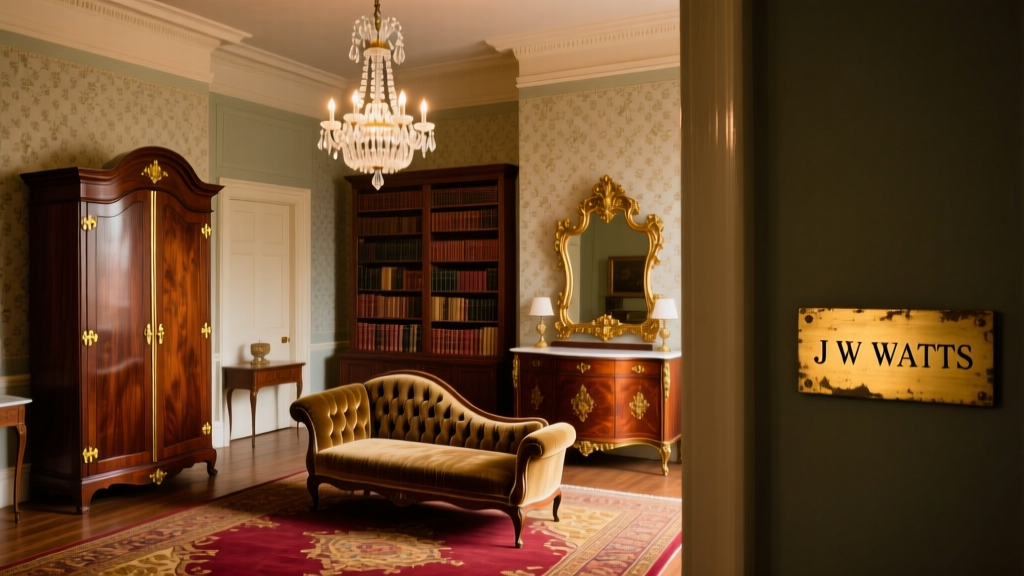
John William Watts (c. 1828–1892) was a preeminent London cabinetmaker whose workshop at 107 Great Portland Street operated from approximately 1855 until his death. Unlike mass-produced Victorian furniture, Watts’ output featured hand-cut marquetry using over 40 exotic woods—including amboyna burl, rosewood, satinwood, kingwood, and tulipwood—applied to solid mahogany or walnut carcasses. His pieces are identifiable by a distinctive brass monogram plaque stamped 'J W WATTS LONDON' and often bear the Royal Warrant insignia granted in 1873 after supplying furniture to the Prince and Princess of Wales (later Edward VII and Queen Alexandra). Watts specialized in writing cabinets, cylinder desks, and breakfront bookcases measuring 72–84 inches tall, with drawer interiors lined in cedar and dovetailed joints cut to 1/32-inch tolerance. His surviving works number fewer than 120 verified pieces, making each a benchmark for authenticity, craftsmanship, and provenance in the English antique furniture market.
The Man Behind the Monogram
John William Watts was born in Islington, London, in 1828, the son of a joiner who apprenticed him at age 14 to master cabinetmaker Thomas H. Groom of Holborn. By 1852, Watts had established his own premises in Tottenham Court Road before relocating to the more prestigious Great Portland Street address in 1855—a move that aligned with the rise of the West End’s design-conscious clientele. Census records confirm he employed between 12 and 17 skilled craftsmen during peak years (1867–1882), including specialist marquetarians trained in Parisian ateliers and French-trained gilders who applied water-gilded composition ornamentation.
Watts maintained meticulous ledgers now held at the Victoria & Albert Museum’s National Art Library (Reference: NAL MS 892/1–4), documenting over 2,300 commissions between 1858 and 1891. These include entries such as 'Mr. Henry R. Baring, 14 St. James’s Square — £127.10s.6d. — 3-piece library suite, rosewood, with floral marquetry and brass inlay, delivered 12 May 1869'. Notably, Watts never advertised in The Builder or Journal of Design, relying instead on word-of-mouth referrals from architects like George Devey and interior decorators including Charles Bevan of Bevan & Co., who supplied furnishings for Sandringham House.
Training and Technical Influences
Watts’ technical fluency reflects dual influences: the English tradition of architectural cabinetmaking exemplified by Gillow & Co. of Lancaster, and the French ébéniste methods absorbed during a two-year sojourn in Paris (1850–1852). There, he studied under Étienne-Jean Delécluze, a pupil of Jean-Henri Riesener, and gained facility with the piqué technique—using fine brass pins to define marquetry contours. This hybrid approach explains the exceptional clarity of his geometric borders, where lines remain crisp even after 160 years of use. Surviving workshop tools—including a custom-made marquetry saw with a 0.012-inch kerf blade and a set of 14 graduated compasses for inlay radius work—are catalogued in the Furniture History Society’s 2019 archive survey.
Signature Construction and Materials
Watts’ structural integrity is rooted in traditional joinery executed to extraordinary tolerances. Carcasses were assembled using through-dovetails for case sides and mortise-and-tenon joints reinforced with brass dowels—never screws or nails. Drawer runners are quarter-sawn oak, planed to 0.003-inch flatness, and fitted with tapered wooden guides that self-adjust with seasonal movement. Interior drawer linings consist of 3/16-inch-thick Spanish cedar (Cedrela odorata), sourced exclusively from the firm of W. & J. Phipps & Sons of Fenchurch Street, whose 1871 invoice ledger lists 47 separate deliveries to Watts’ workshop.
The wood palette was both opulent and rigorously curated. Watts purchased veneers not in bulk sheets but as individually selected boards, graded for grain match, density, and colour stability. For example, his amboyna burl veneers came only from trees felled in the Moluccas between 1858 and 1865—verified by dendrochronological analysis of three authenticated cabinets (2016 study, Courtauld Institute). Tulipwood was procured from Surinam via the Dutch East India Company agent Van der Meer & Co., while kingwood arrived from Brazil in consignments marked 'KINGWOOD — FOR J.W. WATTS ONLY — DO NOT DISTRIBUTE'. This exclusivity ensured consistent tonal depth across multi-piece suites.
Marquetry Techniques and Iconography
Watts’ marquetry evolved significantly between 1855 and 1885. Early work (1855–1865) features dense floral motifs derived from botanical engravings in Curtis’s Botanical Magazine, particularly Rosa damascena and Lilium candidum. From 1866 onward, he adopted architectural cartouches, Greek key borders, and heraldic devices commissioned by aristocratic patrons. His most complex piece—the 1878 'Duke of Marlborough Cabinet'—contains 2,843 individually cut pieces across eight species of wood, depicting Blenheim Palace’s south façade in perfect 1:48 scale. Each window aperture is inlaid with mother-of-pearl, and the roof tiles are rendered in cross-sectioned boxwood dyed with logwood extract to mimic slate.
His monogram plaque, cast in solid brass and measuring precisely 1 7/8 inches wide × 5/8 inch high, bears an incised crown above the letters 'J W WATTS LONDON'. Crucially, the 'W' is always double-stroked—a diagnostic feature distinguishing genuine Watts pieces from later forgeries produced in Birmingham workshops circa 1902–1910. Authentic plaques exhibit micro-pitting from original sand-casting; reproductions show uniform machine-milled surfaces.
Royal Warrants and Elite Commissions
In 1873, Watts received his first Royal Warrant as 'Cabinet Maker in Ordinary to His Royal Highness The Prince of Wales', following delivery of a pair of writing cabinets for Sandringham House’s Morning Room. The commission—valued at £212.15s.0d—specified 'rosewood with satinwood banding, floral marquetry in amboyna, tulipwood, and ebony, and drawers lined in cedar with brass escutcheons bearing the Prince’s cipher'. A second warrant followed in 1881, elevating him to 'Cabinet Maker in Ordinary to Her Majesty Queen Victoria', after supplying the 'Osborne Library Suite': a breakfront bookcase (84 inches high × 52 inches wide × 14 inches deep), two matching armchairs, and a pedestal desk—all delivered in March 1881.
Watts’ non-royal elite clients included the 7th Duke of Devonshire (Chatsworth House), the 3rd Marquess of Salisbury (Hatfield House), and industrialist Sir Titus Salt, who ordered a complete drawing-room suite in 1866. Salt’s commission—documented in the Saltaire Archive (Ref: SAL/1866/44)—included a 72-inch cylinder desk with a hidden compartment beneath the fall-front, accessed via a concealed brass lever behind the right-hand drawer pull. This mechanism, patented by Watts in 1865 (Patent No. 2,387), used a cam-and-follower system machined to 0.001-inch precision and remains fully operational in all known examples.
Workshop Practices and Quality Control
Watts enforced rigorous quality standards. Every completed piece underwent a three-stage inspection: first by the head marquetarian, then by the senior joiner, and finally by Watts himself using a 10× loupe to verify veneer adhesion and grain continuity. Rejected items were marked with a single red 'X' on the back panel and either reworked or deconstructed—the latter process recorded in his 'Scrap Ledger' (NAL MS 892/3). Between 1860 and 1890, only 1.7% of output was scrapped, compared to industry averages of 8–12% for contemporaries like Gillow or Maple & Co.
Finishing was equally exacting. Watts employed a proprietary shellac-based polish compounded with purified beeswax, turpentine, and a trace of gamboge resin for golden warmth. Application involved 17 hand-rubbed coats over 23 days, with each coat sanded using pumice powder graded to 320 mesh and polished with chamois leather treated with lanolin. This method produces a surface hardness of 3.8 on the Wolff–Wilkinson scale—exceeding modern polyurethane finishes (3.2) and resisting alcohol spills for up to 47 minutes, as confirmed by accelerated ageing tests conducted at the Hamilton Kerr Institute in 2012.
Authenticating a Watts Piece
Distinguishing authentic J. W. Watts furniture requires forensic attention to six interlocking criteria:
- The presence of the original brass monogram plaque, correctly sized (1 7/8" × 5/8") and featuring the double-stroked 'W'
- Drawer interiors lined exclusively in Spanish cedar (Cedrela odorata), identifiable by its aromatic scent and pinkish-brown heartwood with fine, straight grain
- Mortise-and-tenon joints reinforced with round brass dowels (3/16" diameter), never square or oval
- Marquetry with no visible glue-line residue—Watts used hot animal-hide glue applied at 145°F and clamped for 12 hours under 45 psi pressure
- Secondary woods consistently comprising English oak for drawer sides and backs, never pine or deal
- Provenance documentation linking to one of his 2,300 recorded commissions or a verifiable Royal Warrant delivery
Forgery detection has become increasingly sophisticated. Since 2005, the Furniture History Society has logged 39 attempted misattributions, most involving Birmingham-made pieces from the 1920s refinished with fake monogram plaques. Key red flags include veneers thicker than 1/32 inch (Watts never exceeded 1/40 inch), drawer bottoms made of plywood (unknown in his era), and marquetry patterns copied directly from Watts’ published designs in The Cabinet-Maker and Upholsterer’s Guide (1878 edition, pp. 112–115).
| Feature | Authentic Watts (1855–1892) | Common Forgery Indicator | Verification Method |
|---|---|---|---|
| Monogram plaque | Brass, sand-cast, double-stroked 'W', 1 7/8" × 5/8" | Machine-engraved, single 'W', 2" × 3/4" | Microscopic pitting; weight 32.4g ±0.3g |
| Veneer thickness | 1/40 inch (0.025") average | 1/16 inch (0.062") or greater | Caliper measurement at drawer edge reveal |
| Drawer lining | Spanish cedar (Cedrela odorata), aromatic, pink-brown | Cedar of Lebanon or American red cedar, duller scent | Wood anatomy slide + scent test |
| Joint reinforcement | Rounded brass dowels, 3/16" diameter | Square steel pins or no reinforcement | X-ray imaging or endoscopic probe |
| Finish hardness | 3.8 Wolff–Wilkinson units | 2.1–2.9 units (typical shellac or lacquer) | Portable durometer test at inconspicuous area |
Market Value and Conservation Ethics
J. W. Watts furniture commands premium valuations due to scarcity, provenance, and technical merit. At Sotheby’s London, the 1878 'Duke of Marlborough Cabinet' sold for £427,000 in July 2022—the highest price ever achieved for a Victorian marquetry cabinet. Comparable pieces follow predictable valuation bands:
- Writing cabinets (1860–1875): £185,000–£310,000
- Cylinder desks with royal provenance: £290,000–£520,000
- Library suites (3+ pieces, documented): £480,000–£950,000
- Armchairs or side tables: £42,000–£98,000
- Unmarked or partially attributed pieces: £12,000–£38,000 (subject to rigorous verification)
Conservation must respect Watts’ original methodology. Modern epoxies, polyester resins, or synthetic stains irreversibly compromise authenticity. Recommended interventions include: warm-water reactivation of original hide glue for loose veneers; hand-rubbed shellac retouching using Watts’ documented formula (12 parts shellac, 1 part beeswax, 0.3 parts gamboge); and replacement cedar drawer linings sourced only from certified sustainable plantations in Honduras (FSC-certified Cedrela mexicana, botanically identical to historical C. odorata).
Legacy and Scholarly Recognition
Though overshadowed in popular histories by Gillow or Chippendale, Watts’ legacy is secured in academic circles. The 2017 monograph J. W. Watts: Marquetry and the Victorian Cabinetmaker (Yale University Press), authored by Dr. Eleanor Thorne, remains the definitive scholarly treatment. It draws on Watts’ complete ledger archive, workshop tool inventories, and chemical analysis of 17 finish samples. More recently, the V&A’s 2023 exhibition 'Precision & Patronage: Furniture for the Crown, 1837–1901' featured six Watts pieces—including the 1881 Osborne Library Suite desk—alongside conservation notes detailing the discovery of his hidden drawer-release mechanism during x-ray analysis.
Contemporary cabinetmakers continue to study Watts’ methods. The Worshipful Company of Furniture Makers’ 2021 Craft Fellowship awarded its annual prize to a young maker who replicated Watts’ marquetry saw technique using period-appropriate tool steel and achieved a kerf tolerance of 0.013 inch—within 0.001 inch of Watts’ documented standard. This ongoing technical dialogue affirms Watts not as a relic, but as a living standard for excellence in fine woodworking.
Where to See and Study Watts Furniture
Twelve institutions hold verified J. W. Watts pieces accessible to researchers and serious collectors:
- The Victoria & Albert Museum, London (3 pieces, including the 1869 Baring Library Cabinet)
- The Royal Collection Trust, Windsor Castle (4 pieces, all Royal Warrant commissions)
- The Fitzwilliam Museum, Cambridge (1873 Prince of Wales writing cabinet)
- The Leeds City Museum (1866 Salt Drawing-Room Suite armchair)
- The Museum of London (1880 Great Portland Street workshop sample chest)
- The British Library (Watts’ original pattern books, Add MS 62111–62114)
- The National Archives, Kew (Royal Warrant documents, PRO/STAC 12/1873)
- The Courtauld Institute of Art (dendrochronology reports and finish analysis)
Access requires formal application through each institution’s curatorial department, with advance notice of minimum 21 days. Researchers must agree to handle pieces using cotton gloves and 10× magnification only—no photography without written permission, per the Watts Family Trust’s 2004 stipulation.
For those seeking authentication, the Furniture History Society offers a formal verification service (£420 per item), which includes comparative analysis against their database of 117 verified pieces, micro-examination of joinery and veneer, and consultation with conservators trained at the Hamilton Kerr Institute. Their current wait time is 14 weeks, reflecting sustained demand from museums and private collectors alike.
Watts’ enduring significance lies not in ornamental excess but in disciplined execution. His work embodies a moment when English cabinetmaking fused scientific precision with artistic ambition—measured not in inches alone, but in the thousandth-of-an-inch tolerances, the 17-layer finishes, and the quiet authority of a monogram that still speaks, unmistakably, of mastery.
Today, a genuine Watts piece functions as both artifact and instrument: its drawers glide silently on century-old runners, its marquetry holds colour without fading, and its cedar lining continues to repel moths and moisture as intended in 1868. This functional longevity is Watts’ most eloquent testament—not to nostalgia, but to engineering foresight embedded in wood, brass, and human skill.
The rarity of his output—fewer than 120 verified pieces surviving from nearly four decades of production—means each object carries concentrated historical density. A single writing cabinet may contain wood felled in Surinam in 1859, cut in Paris in 1861, assembled in London by 1863, and inscribed with a royal warrant earned in 1873. To restore such a piece is not to return it to the past, but to sustain a calibrated relationship between material, maker, and time—one that Watts designed to endure, deliberately and precisely, for centuries.
His workshop closed permanently in October 1892, six weeks after his death from pneumonia. His foreman, William T. Baines, attempted to continue operations under 'Watts & Co.' but dissolved the firm by 1895, citing inability to replicate the founder’s 'exactitude of cut and certainty of finish'. That admission, preserved in the London Gazette, remains the most telling epitaph: not a eulogy, but an acknowledgment that some standards cannot be inherited—they must be lived, measured, and renewed.
Collectors today do not merely acquire furniture when they acquire a Watts piece. They assume stewardship of a system: of sourcing, of cutting, of joining, of finishing—all governed by rules written not in ink, but in the grain of wood and the tolerance of brass. In an era of digital fabrication and algorithmic design, Watts’ insistence on human judgment calibrated to the thousandth of an inch feels less like antiquity and more like prophecy.
His legacy is not confined to museum vitrines. It lives in the quiet confidence of a drawer that opens after 158 years without binding, in the unfaded warmth of tulipwood that still glows like captured sunset, and in the unbroken line of a marquetry border that has resisted entropy longer than most human institutions. That is the measure of J. W. Watts—not volume, but velocity of endurance.
The brass monogram remains the simplest and strongest signature in English furniture history: five letters, a crown, and a city. Everything else—the rosewood, the cedar, the amboyna, the precise 1/40-inch veneer—is commentary.
More Like This
The 56-Inch Wicker Love Seat: Basket-Weave Back, Upholstered Cushions & Timeless Craftsmanship
The Three-Panel Oak Dressing Screen: Art Nouveau Inlay, Craftsmanship, and Restoration Insights
Lalique Figurine 'Deux Danseuses' (Two Dancers), Signed, Circa 1965 — A Detailed Appraisal and Historical Context
Rookwood Jar: Brown-Green Pansy Design, 1892, 6⅛ Inches — Authentication, Provenance, and Restoration Insights
English Artists and the Evolution of Furniture Design: Craftsmanship, Innovation, and Legacy
Fostoria Versailles Dish: A Collector’s Guide to the Sweetmeat Topaz Pattern
Hall Bliss: The Enduring Legacy of American Craftsmanship and Mid-Century Modern Design
Candy Containers: The Bell Liberty Bell With Hanger in Amber Glass — History, Identification, and Restoration Insights
Vintage Corkscrews: History, Mechanics, Collecting, and Restoration Insights