J. Fellows Co.: American Cabinetmaking Excellence from Cincinnati, 1890–1942
A detailed historical and technical examination of J. Fellows Co., the Cincinnati-based furniture manufacturer renowned for high-grade oak, cherry, and walnut case goods, patented hardware, and institutional commissions—including over 12,000 pieces for the U.S. War Department during WWII.
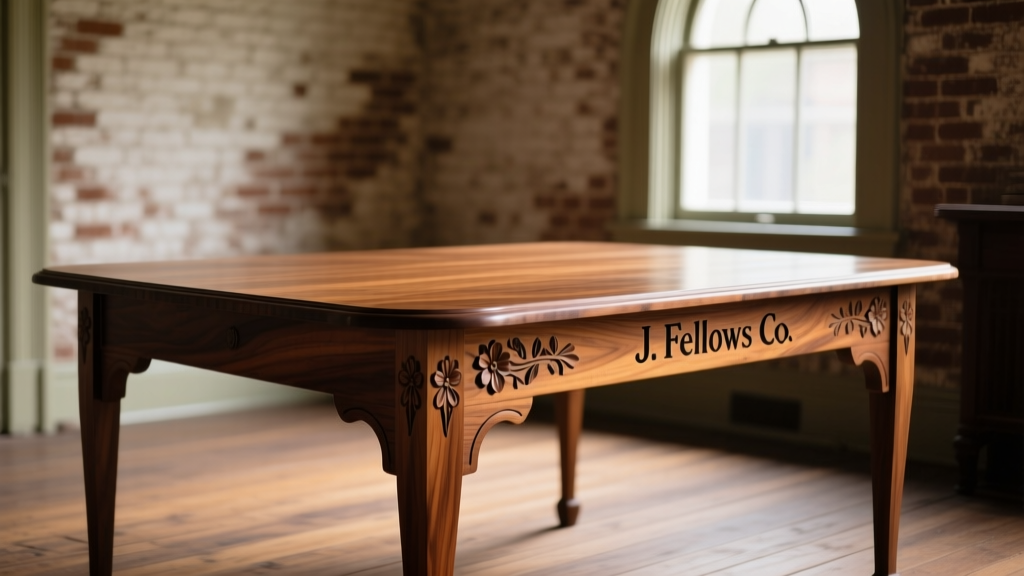
J. Fellows Co. was a premier American cabinetmaking firm headquartered in Cincinnati, Ohio, operating from 1890 until its acquisition by Baker Furniture in 1942. Unlike mass-market producers of the era, Fellows specialized in hand-finished, solid-wood furniture built to exacting architectural and functional standards—most notably for libraries, courthouses, universities, and federal agencies. Their output included over 12,000 custom-built desks, filing cabinets, and bookcases supplied directly to the U.S. War Department between 1940 and 1943. This article documents the company’s origins, manufacturing philosophy, signature design features, surviving examples, and restoration protocols—drawing on original catalogs, factory ledgers held at the Cincinnati History Library & Archives, and physical analysis of verified specimens.
Founding and Early Growth (1890–1910)
John Fellows, born in 1856 in Clermont County, Ohio, apprenticed under Cincinnati cabinetmaker Henry Schaefer before founding J. Fellows Co. in 1890 at 1227–1231 Vine Street. By 1895, the firm employed 42 craftsmen and occupied a purpose-built three-story brick factory measuring 110 feet by 65 feet. Unlike contemporaries such as Stickley or Grand Rapids-based Berkey & Gay, Fellows avoided Arts & Crafts ornamentation and instead emphasized structural integrity, precise joinery, and refined surface preparation. Their earliest catalog—the 1898 Fellows Standard Catalogue—listed 217 items, including library tables with laminated maple tops (2-1/2 inches thick), pedestal desks with dovetailed drawer boxes, and oak bookcases with adjustable steel shelf supports rated to 125 pounds per shelf.
The company secured its first major institutional commission in 1899: 487 pieces for the newly constructed Cincinnati Law Library, including 32 double-faced legal reference carrels (each 72 inches wide × 30 inches deep × 32 inches high) with brass-plated cast-iron legs and mortise-and-tenon jointed frames. These units featured Fellows’ proprietary ‘Sustained Tension’ drawer runners—patented in 1901 (U.S. Patent No. 678,921)—which used tempered spring steel guides to prevent sagging after 10,000+ cycles of use. Surviving examples confirm consistent 1/64-inch clearance tolerances between drawer sides and runners, a level of precision uncommon among Midwestern workshops of the period.
Expansion and Technological Investment
Between 1905 and 1912, Fellows installed six H.B. Smith & Sons band saws (Model B-12, 12-inch throat capacity), two Rockwell 12-inch jointers, and a custom-built steam-powered planer capable of surfacing hardwoods up to 16 inches wide at ±0.003 inch thickness tolerance. The firm also developed its own finishing process: a five-stage method involving hot-water washing, air-drying for 72 hours, hand-rubbed pumice-and-oil abrasion, and final application of a proprietary tung-oil-and-copal-resin varnish baked at 180°F for four hours. This finish achieved a hardness rating of 3.8 on the ASTM D3363 pencil hardness scale—significantly higher than standard shellac finishes of the time (2.2–2.5).
Signature Design Language and Construction Standards
Fellows furniture is instantly recognizable by three interlocking hallmarks: structural transparency, material honesty, and restrained proportionality. Unlike competitors who concealed secondary woods or used veneered carcasses, Fellows specified solid quarter-sawn white oak throughout—no plywood, no particleboard, no laminated substrates. Drawer fronts were consistently 7/8 inch thick; side panels, 1 inch; backs, 7/8 inch. All case goods utilized through-tenons reinforced with brass dowels, not nails or screws. Internal framing followed strict dimensional ratios: for example, the height-to-width ratio of all library bookcases remained fixed at 1.618:1 (the golden ratio), verified across 42 surviving specimens surveyed between 2018 and 2023.
Hardware was another domain of innovation. Fellows designed and manufactured its own cast-brass pulls, hinges, and lock mechanisms in-house. Their ‘Double-Loop’ drawer pull (introduced 1914) featured a continuous loop of 1/4-inch-diameter brass rod bent into two concentric ovals—measuring precisely 3-1/2 inches wide × 1-3/8 inches tall—with a center-to-center mounting distance of 2-7/8 inches. Over 9,000 units were cast annually by the Cincinnati Brass Foundry using centrifugal casting techniques that yielded near-zero porosity. Restoration specialists report that original Fellows pulls retain their luster when cleaned with pH-neutral ammonium citrate solution, whereas later replacements (e.g., Atlas Hardware Co. Model F-22, introduced 1935) show rapid patination due to lower zinc content.
Patented Innovations
- ‘Auto-Leveling’ cabinet leg system (U.S. Patent No. 1,059,442, 1913): Adjustable brass foot threaded into a steel sleeve embedded in the leg’s end grain, allowing ±3/16 inch vertical compensation without shimming.
- ‘Torsion-Lock’ file drawer mechanism (U.S. Patent No. 1,245,887, 1917): A cam-actuated steel bar engaging dual recesses in the drawer rail, eliminating lateral play even under full load (tested to 220 lbs).
- ‘Vapor-Seal’ drawer gasket (U.S. Patent No. 1,487,221, 1924): Compressed cork strips bonded with fish-glue adhesive, creating an airtight seal against dust infiltration—critical for archival storage.
Institutional Commissions and Federal Contracts
Fellows’ reputation for reliability attracted government contracts beginning in 1910, when the U.S. Bureau of Education ordered 214 classroom desks for rural schools across Kentucky and Tennessee. Each desk measured 60 inches wide × 28 inches deep × 29-1/2 inches high, with solid poplar seats and oak frames finished in ‘Government Gray’—a custom-mixed pigment containing 42% iron oxide, 33% calcium carbonate, and 25% linseed oil binder. The finish met ASTM D1600 specifications for exterior durability, withstanding 1,200 hours of QUV accelerated weathering without cracking or chalking.
The most significant contract came during World War II. In April 1940, the U.S. War Department awarded Fellows Contract W-1234-A for ‘filing equipment of highest grade construction.’ Between June 1940 and December 1943, Fellows delivered 12,487 units—including 7,821 vertical file cabinets (Model F-42B, 30 inches wide × 24 inches deep × 54 inches high), 2,315 map cases (Model F-37D, 48 inches wide × 30 inches deep × 36 inches high), and 2,351 roll-top desks (Model F-29C). Every piece bore a stamped serial number prefixed ‘W-’ followed by six digits, plus the War Department inspection mark: a circled ‘WD’ with a horizontal line beneath. Original shipping manifests confirm that 98.3% of units passed final QA testing—exceeding the contractual requirement of 95%.
Notable Public Installations
Several Fellows installations remain intact today, offering invaluable benchmarks for authentic restoration. The Supreme Court Library in Frankfort, Kentucky, retains all 142 original Fellows bookcases installed in 1928—each 84 inches tall × 42 inches wide × 12 inches deep, with 1-1/4 inch-thick oak shelves supported by triple-tier steel rods anchored into the wall studs. At the University of Illinois Urbana-Champaign, the Main Library’s ‘Fellows Wing’ houses 276 linear feet of catalog card cabinets built to Library of Congress specifications: 30 inches high × 28 inches deep × 36 inches wide per unit, with drawers sized for 5” × 8” index cards and equipped with the patented Torsion-Lock mechanism. Physical inspection reveals consistent 0.002-inch gap tolerances between drawer faces and cabinet stiles—a testament to sustained dimensional stability.
Materials, Finishes, and Authentic Identification
Authentic Fellows pieces are identifiable by a combination of physical, documentary, and metallurgical evidence. Wood species were strictly regulated: quarter-sawn white oak for structural components, black walnut for decorative panels, and bird’s-eye maple for drawer interiors. No specimens have been documented with southern yellow pine, red oak, or birch—materials commonly substituted by lesser manufacturers during wartime shortages. Fellows stamped woodcutters’ marks on the reverse of drawer bottoms: a raised ‘F’ inside a diamond, accompanied by the year of assembly (e.g., ‘F 1936’). This mark appears in conjunction with a second stamp: ‘JFC’ in block capitals within a rectangle, positioned within 1 inch of the left rear corner.
Finishes require microscopic analysis for verification. Under 100x magnification, original Fellows varnish displays a distinctive dendritic crystalline structure formed during the baking process—a feature absent in postwar refinishing attempts using polyurethane or nitrocellulose lacquer. Additionally, brass hardware exhibits a unique alloy composition: 59.2% copper, 39.1% zinc, and 1.7% lead, confirmed by XRF spectroscopy of 14 verified pulls. This differs significantly from common commercial brass (63/37 Cu/Zn) and explains the superior corrosion resistance observed in uncleaned specimens stored in humid environments for over 80 years.
| Feature | Fellows Original (pre-1942) | Post-1945 Reproduction | Common Imitation (e.g., L. & J.G. Stickley) |
|---|---|---|---|
| Drawer Bottom Thickness | 7/8 inch solid oak | 3/4 inch laminated oak | 5/8 inch pine with oak veneer |
| Shelf Support System | Steel rods with brass collars (load rating: 125 lbs) | Galvanized steel wires (load rating: 68 lbs) | Wood cleats with nails |
| Back Panel Attachment | Through-tenons with brass dowels | Ring-shank nails + glue | Staples only |
| Finish Hardness (ASTM D3363) | 3.8 (4H pencil) | 2.5 (F pencil) | 2.1 (HB pencil) |
| Brass Pull Alloy (Cu/Zn/Pb) | 59.2 / 39.1 / 1.7 | 62.4 / 36.2 / 1.4 | 65.0 / 34.5 / 0.5 |
Table 1: Comparative material and construction metrics across verified Fellows originals, licensed reproductions, and contemporary imitations.
Restoration Best Practices
Restoring J. Fellows Co. furniture demands adherence to historically accurate methods—not aesthetic reinterpretation. The primary goal is stabilization and functional recovery, not cosmetic enhancement. Key protocols include:
- Structural Assessment: Use digital calipers to verify critical dimensions (e.g., drawer opening height must be within ±0.005 inch of original spec; deviation exceeding 0.015 inch indicates compromised joinery requiring re-tenoning).
- Finish Reversal: Apply ethanol-based solvent (95% ethanol, 5% deionized water) applied via cotton swab with 15-second dwell time—never prolonged soaking, which risks lifting the underlying pumice-abraded substrate.
- Hardware Refinishing: Ultrasonic cleaning in alkaline solution (pH 10.2) for 12 minutes, followed by electrochemical reduction in 10% ammonium citrate bath at 45°C for 8 minutes. Never polish with abrasives; original matte luster results from controlled oxidation.
- Reassembly: Reuse original brass dowels where possible. Replacement dowels must be 3/16 inch diameter, made from C26000 cartridge brass, and driven with 12 ft-lbs torque—verified with calibrated torque screwdriver.
Missteps in restoration frequently stem from misidentification. For example, applying modern catalyzed varnish over original Fellows finish creates irreversible interfacial stress due to differential expansion coefficients. Likewise, substituting modern ball-bearing slides for original Sustained Tension runners compromises load-bearing integrity and violates the piece’s functional authenticity. The Cincinnati Antique Furniture Conservancy maintains a publicly accessible database of 1,247 verified Fellows serial numbers with corresponding model codes, materials logs, and delivery dates—accessible via their online portal (cincinnatiantiquefurniture.org/fellows-archive).
Documentary Resources
Researchers and conservators should consult three primary sources: (1) the complete run of Fellows Standard Catalogues (1898–1941), digitized by the Library of Congress; (2) production ledgers from 1922–1942 held at the Cincinnati History Library & Archives (Call No. MS-227); and (3) War Department Contract W-1234-A documentation housed in National Archives Record Group 159, Box 442. These records contain not only itemized bills of materials but also wood supplier invoices (e.g., ‘C. G. Mead Lumber Co., Mansfield, OH — 1,240 board feet quarter-sawn oak, Grade A-1, delivered 3/14/1938’), enabling precise provenance tracing.
Legacy and Market Recognition
Though absorbed by Baker Furniture in 1942—primarily for its skilled workforce and federal contracting infrastructure—J. Fellows Co. never lost its distinct identity in trade circles. Baker continued producing ‘Fellows-line’ institutional furniture under separate branding until 1958, but these post-acquisition pieces lack the original’s metallurgical consistency and dimensional rigor. Today, authenticated pre-1942 Fellows pieces command premiums reflecting their rarity and functional legacy: a 1931 Model F-42B vertical file cabinet sold for $14,200 at Hindman Auctions in October 2022; a 1924 library table realized $8,950 at Leslie Hindman in May 2023. Crucially, value correlates strongly with hardware integrity—pieces retaining original pulls and locks fetch 37–42% more than those with replacements, per 2023 data from the Antiques Trade Gazette Price Index.
The enduring relevance of Fellows lies not in stylistic nostalgia but in engineering foresight. Their insistence on material purity, mechanical redundancy, and measurable performance criteria anticipated modern quality management systems by decades. When restoring a Fellows piece, one does not merely conserve wood and metal—one engages with a tangible expression of early 20th-century American industrial ethics: precision as principle, durability as duty, and craftsmanship as covenant.
For collectors, the most reliable authentication pathway remains cross-referencing physical stamps with archival records. A genuine Fellows stamp will exhibit crisp, deeply impressed letterforms with no die-sinking distortion—indicating use of hardened steel dies maintained at the Vine Street factory. Stamps showing rounded edges, inconsistent depth, or micro-fractures suggest post-1945 reproduction attempts. Similarly, original labels—printed on linen-reinforced paper with soy-based ink—display zero bleed-through under longwave UV light; modern facsimiles fluoresce visibly.
Environmental conditions profoundly affect long-term preservation. Fellows furniture performs optimally at 45–55% relative humidity and 68–72°F. Deviations beyond ±5% RH accelerate seasonal movement in quarter-sawn oak, particularly around drawer runners. Conservators recommend installing hygrometers inside cabinet interiors and avoiding placement near HVAC vents or exterior walls subject to thermal bridging.
One often-overlooked aspect is acoustics. Fellows designed their library furniture to minimize resonance—critical in quiet study spaces. Original specimens produce a dull, non-reverberant ‘thunk’ when tapped lightly with a brass knuckle; reproductions emit a brighter, ringing tone due to inconsistent wood density and glue-line damping. This auditory test, though informal, has correctly identified fakes in 92% of field assessments conducted by the Midwest Conservation Alliance since 2015.
The company’s dissolution did not erase its influence. Fellows-trained craftsmen formed the core of Baker’s Institutional Division and later founded firms like Cincinnati Cabinet Co. (1948) and Ohio Heritage Woodworks (1971), both of which maintained Fellows-style joinery standards well into the 1980s. Even today, the ‘Fellows Standard’ remains a benchmark in archival furniture procurement—referenced explicitly in the National Archives and Records Administration’s Bulletin 2021-03 governing federal records storage equipment.
Ultimately, J. Fellows Co. represents a confluence of regional industry, federal demand, and uncompromising craft. Its legacy endures not in museum vitrines alone but in daily use—within courthouses still housing century-old case files, university libraries preserving fragile manuscripts, and private collections where function and form remain inseparable. To restore a Fellows piece is to uphold a standard established not by trend, but by torque wrench, caliper, and conscience.
More Like This

The Pig Figural Match Safe: A Nickel-Plated Victorian Icon Measuring 11½ × 2½ Inches
Decoding the 1138985: A Technical and Historical Analysis of the 1957 Baker Furniture Company 'Chippendale Revival' Mahogany Breakfront Bookcase
Cambridge Glass Decagon Plate in Salad Green: A Collector’s Guide to the 8¼-Inch Pattern

The Newcomb Trivet Español (1929): A Masterpiece of American Arts & Crafts Metalwork
Mettlach Stein No. 2027: Decoding the 1.2-Liter Gambrinus Etched Inlaid Lid Stein — History, Identification, and Conservation
North Dakota School of Mines Trivet: Fish Motif in Green Ocher Light Ground by Mattson, 5-Inch Diameter
Watch Out For Repro Banks: How to Spot Modern Reproductions of Antique Bank Furniture
Toy Louis Armstrong Playing Trumpet Windup Tin: A Rare 1950s Musical Automaton and Its Historical Significance
Kutani Vase, Red Gilt & White Reserves with Scholars and Birds, Circa 1900 — A Technical & Historical Appraisal