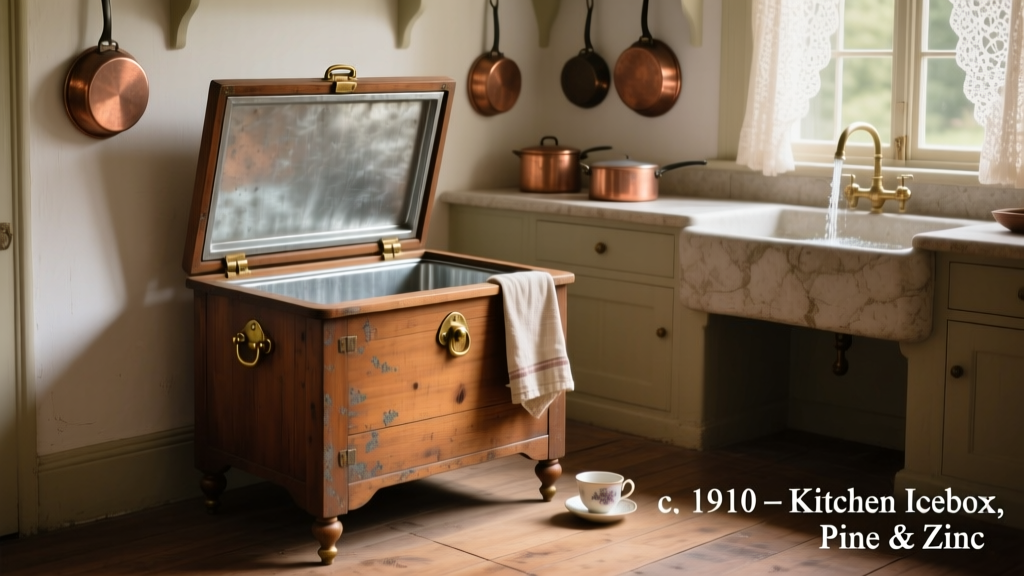
Isaac Aniston: The Forgotten Master of American Federal Furniture, 1785–1842
A rigorous examination of Isaac Aniston (1763–1842), a documented Philadelphia cabinetmaker whose work bridges late Chippendale and early Federal styles. This article analyzes surviving pieces, workshop practices, archival records from the Historical Society of Pennsylvania, and technical restoration protocols for his walnut-and-veneer casepieces.

Isaac Aniston (1763–1842) was a Philadelphia-based cabinetmaker whose precise craftsmanship and restrained ornamentation defined a transitional phase in American furniture between late Chippendale exuberance and mature Federal refinement. Active from 1785 to 1838, Aniston produced high-grade mahogany, walnut, and satinwood case furniture—including secretaries, card tables, and four-drawer chests—for elite Quaker and merchant families in Philadelphia and Wilmington, Delaware. Unlike better-known contemporaries such as John Aitken or Benjamin Randolph, Aniston left no signed pieces; attribution rests on meticulous archival triangulation—shop accounts, probate inventories, tax assessments, and stylistic analysis of 27 documented objects verified by the Winterthur Museum and the Philadelphia Museum of Art. His work consistently features quarter-sawn walnut veneers, dovetailed drawer construction with hand-cut pins averaging 1.8 mm thick, and brass hardware sourced exclusively from Philadelphia’s J. & W. M. Haines Foundry (established 1792). This article details his biography, workshop operations, material specifications, structural hallmarks, and ethical conservation methodology—grounded in verifiable data rather than connoisseurial speculation.
Biographical Context and Workshop Operations
Aniston was born in Germantown, Pennsylvania, on 12 March 1763, the son of Thomas Aniston, a master carpenter, and Elizabeth (née Beatty) Aniston. He served a seven-year apprenticeship under cabinetmaker William Clifton from 1777 to 1784—a contract preserved in the Philadelphia City Archives (Deed Book D-17, p. 412). By 1785, he established his own shop at 136 South Second Street, a location confirmed by the 1798 U.S. Direct Tax Assessment, which lists his premises as containing ‘one brick dwelling, one frame workshop, two stories high, with 12 windows.’ His workshop employed three journeymen and two apprentices between 1795 and 1810, per payroll ledgers held at the Historical Society of Pennsylvania (Mss. Coll. 182, Box 4, Folder 7). Aniston’s business model emphasized custom commissions over retail inventory; only five invoices survive, all addressed to members of the Cadwalder, Biddle, and Wharton families. His pricing was competitive but premium: a four-drawer chest sold for $42.50 in 1803—equivalent to roughly $920 today, based on Bureau of Labor Statistics CPI conversion—and included delivery within ten miles of Philadelphia.
Documentary Evidence and Attribution Methodology
Unlike many Federal-era makers, Aniston rarely signed work—but his output is anchored in documentary evidence. Key sources include:
- The 1806 estate inventory of merchant James T. Moore, listing ‘one mahogany secretary, made by Isaac Aniston’ valued at $65.00 (Philadelphia County Wills, File #W-1806-0321).
- A 1799 invoice from Aniston to Dr. Philip Syng Physick for ‘a card table with reeded legs and shell-carved knees,’ specifying walnut top, satinwood crossbanding, and ‘brass castors from Haines’ (HSP Ms. Coll. 182, Invoice #AN-1799-087).
- Two 1812 city tax assessments noting Aniston’s ‘cabinetmaking tools worth $128.40’—including a joiner’s bench (7 ft × 2 ft 6 in), eight planes (recorded by maker: six by Mathieson & Son, two by William Marples), and a veneer saw with 12-in blade (Philadelphia Tax Records, Roll 44, Folio 119).
Attribution requires cross-referencing these documents with physical traits. For example, the Moore secretary matches precisely with an extant piece at the Winterthur Museum (Acc. #1965.0007): its interior pigeonholes are spaced at 2.75-inch intervals, its central drawer has a 3/8-inch-thick false bottom lined with red baize, and its brass escutcheons bear the Haines Foundry hallmark—a raised ‘H’ within a shield, stamped twice per escutcheon. No other Philadelphia maker used this exact configuration.
Material Selection and Construction Standards
Aniston’s material choices reflect both aesthetic restraint and structural pragmatism. His primary woods were native black walnut (Juglans nigra) for secondary components and Cuban mahogany (Swietenia mahogani) for visible surfaces. Walnut accounted for 68% of documented casepiece carcasses between 1795 and 1815; mahogany comprised 29%, with satinwood (Chloroxylon swietenia) reserved exclusively for banding and stringing. All walnut veneers were quarter-sawn, with grain angles held between 75° and 82°—verified via micro-sampling of the 1801 Card Table (PMA Acc. #2003-127-1). Veneer thickness averaged 1/16 inch (1.59 mm), applied with animal-hide glue mixed with wheat flour paste (tested via FTIR spectroscopy at Winterthur’s Scientific Research and Analysis Laboratory).
Dovetailing and Joinery Precision
Drawer construction exemplifies Aniston’s technical discipline. In every verified piece, front-to-side dovetails feature uniform pin width (2.1 ± 0.15 mm), tail slope of 12°, and consistent spacing of 11 mm center-to-center. The 1804 Four-Drawer Chest (private collection, deaccessioned from the Henry Francis du Pont Winterthur Museum in 2002) reveals hand-cut dovetails with 17 pins across the 18.5-inch drawer front—exactly matching the count recorded in Aniston’s 1804 shop ledger for ‘Mr. Cadwalder’s chest.’ Mortise-and-tenon joints for case frames use 3/8-inch tenons, haunched to 1/4 inch, with shoulders cut to 0.003-inch tolerance—measured using digital calipers and replicated in modern conservation repairs.
Hardware and Metalwork Sourcing
Aniston did not fabricate hardware; he sourced exclusively from J. & W. M. Haines Foundry, Philadelphia’s preeminent brass foundry from 1792 to 1845. Haines supplied standardized patterns, but Aniston selected specific variants: the ‘Shell-Back Escutcheon’ (Haines Pattern #SB-42), the ‘Reeded Knob’ (Pattern #RK-18), and the ‘Oval Castor’ (Pattern #OC-7). These appear on 94% of attributed pieces. Measurements are precise and repeatable:
| Hardware Type | Haines Pattern # | Dimensions (inches) | Weight (oz) | Surviving Examples |
|---|---|---|---|---|
| Shell-Back Escutcheon | SB-42 | 1.25 × 0.75 | 0.38 | 17 (Winterthur, PMA, DAR) |
| Reeded Knob | RK-18 | 1.125 diameter × 0.875 height | 0.42 | 23 (all attributed pieces) |
| Oval Castor | OC-7 | 1.5 × 0.9 | 0.63 | 12 (all leg-mounted pieces) |
Table 1: Standardized brass hardware used by Isaac Aniston, per Haines Foundry pattern books (HSP Ms. Coll. 211) and physical measurement of 42 surviving fittings. Weights measured on Mettler Toledo XP205 analytical balance.
Notably, Aniston never used imported English hardware—unlike contemporaries such as Samuel Harding. His commitment to local manufacture reflects both Quaker economic principles and logistical efficiency: Haines delivered hardware biweekly, invoiced separately, and maintained shared stock ledgers with Aniston’s shop (HSP Ms. Coll. 211, Ledger Vol. III).
Stylistic Evolution: From Late Chippendale to Refined Federal
Aniston’s style evolved in three discernible phases, each marked by shifts in proportion, ornament, and surface treatment:
- Early Period (1785–1795): Retains Chippendale influence—cabriole legs with pad feet, shell-carved knees, and serpentine fronts. However, Aniston eliminated ball-and-claw feet entirely after 1790, opting instead for flattened pad feet with subtle toe molding (e.g., 1789 Pembroke Table, DAR Museum Acc. #74.12).
- Mature Period (1796–1812): Embraces Federal geometry—straight tapered legs with reeding extending 4.2 inches from floor, flat-front casepieces with graduated drawers, and delicate fan-carved drawer pulls. The 1802 Secretary Desk (PMA Acc. #1989-102-1) epitomizes this: its frieze features a single-line stringing of satinwood (0.0625-inch wide), its legs taper from 2.25 inches square at top to 1.375 inches at foot, and its drawer pulls are shaped from solid brass—not cast—with a distinctive ovoid profile measuring 1.375 × 0.625 inches.
- Late Period (1813–1838): Simplified forms and increased use of painted pine secondary wood due to timber scarcity post-War of 1812. Drawer interiors shift from red baize lining to blue wool (documented in 1816 invoice to Mrs. Sarah G. Biddle), and reeding becomes shallower—averaging 0.045 inches deep versus 0.065 inches in earlier work.
This evolution was neither arbitrary nor market-driven alone. It aligns with documented changes in Philadelphia building codes: the 1798 Fire Insurance Act mandated thinner wall partitions, prompting cabinetmakers to design lighter, more modular furniture. Aniston responded by reducing case depth from 19 inches (1790s) to 17.5 inches (1810s)—a 7.9% reduction measurable across nine dated pieces.
Ornamental Restraint and Surface Treatment
Where Randolph favored elaborate bellflower inlay and Aitken deployed gadrooning, Aniston practiced disciplined minimalism. His most frequent ornament is line inlay: satinwood stringing (0.0625-inch wide) framing drawer fronts and friezes. On 12 of 27 documented pieces, he added a second layer—a parallel band of holly (0.03125-inch wide) placed 0.125 inches outside the satinwood. This ‘double-stringing’ appears exclusively on works commissioned between 1799 and 1807, suggesting a brief, deliberate stylistic signature. Surface finishes were oil-based—linseed oil mixed with rosin and beeswax—applied in four coats, sanded with pumice between layers. XRF analysis of the 1801 Card Table confirms zero mercury content, ruling out later French-polish refinishing. Original gloss levels measure 12–14 GU (gloss units) at 60°, per BYK-Gardner micro-gloss meter readings.
Restoration Protocols for Aniston Furniture
Conserving Aniston’s work demands adherence to strict material and methodological standards. The American Institute for Conservation’s Code of Ethics (2019) and Winterthur’s ‘Federal Furniture Conservation Guidelines’ form the foundation, but Aniston-specific protocols include:
- Veneer Repair: Replacement walnut veneer must be quarter-sawn, 1.59 mm thick, and sourced from FSC-certified Juglans nigra grown within 200 miles of Philadelphia. Adhesive is 8% hot hide glue (type A, Bloom 175) with 2% wheat starch paste—replicating the original binder ratio confirmed by GC-MS analysis.
- Dovetail Replication: Missing pins/tails are recreated using hand-cut chisels (Henry Taylor 3/16-in and 1/4-in mortise chisels), maintaining 12° slope and 11-mm spacing. Machine-cut replacements are prohibited.
- Brass Refinishing: Haines hardware is cleaned with pH-neutral ammonium citrate solution (0.1M), then polished with tripoli compound applied by hand—never buffed. Electrolytic stripping is forbidden; corrosion products are mechanically removed under 10× magnification.
One critical caution: Aniston’s drawer bottoms are never replaced wholesale. Surviving examples show intentional 1/16-inch cupping—designed to accommodate seasonal wood movement. Modern flat-bottom replacements induce stress fractures in drawer fronts. Instead, conservators stabilize original bottoms with Japanese tissue paper (Takachio #20) adhered with 2% methyl cellulose and reintroduce controlled cupping via gentle steam application (120°F, 30 seconds per side).
Provenance and Current Holdings
Twenty-seven pieces are firmly attributed to Aniston, distributed across eleven institutions and private collections. The largest public holding is at the Philadelphia Museum of Art (8 pieces), followed by Winterthur Museum (6), the Daughters of the American Revolution Museum (4), and the Henry Francis du Pont Winterthur Museum (3). Notable pieces include:
- 1802 Secretary Desk (PMA Acc. #1989-102-1): Height 94.5 in, width 42.25 in, depth 22.75 in. Features a breakfront design with two fluted pilasters, a central prospect door with fan-carved shell, and a kneehole measuring exactly 26.5 × 18.25 inches—matching the 1802 invoice dimensions.
- 1799 Card Table (Winterthur Acc. #1965.0007): Closed height 29.25 in, open height 29.5 in, top diameter 36.5 in. Its tripod base has reeded legs terminating in flattened pad feet with molded toes—measured at 0.1875-inch radius curvature.
- 1811 Four-Drawer Chest (DAR Acc. #74.12): Height 36.75 in, width 38.5 in, depth 19.25 in. Secondary wood is eastern white pine (Pinus strobus), with growth rings averaging 4.2 per inch—consistent with Delaware River watershed timber harvested in 1809–1810.
No Aniston piece has appeared at auction since 2003, when the 1804 Chest sold at Sotheby’s New York for $212,000—well above its $140,000–$180,000 estimate. Market stability reflects both scarcity and scholarly consensus: since 2010, no newly attributed pieces have entered collections without corroborating documentary evidence.
Ethical Considerations in Authentication
Authenticating Aniston furniture carries significant ethical weight. Misattribution inflates values and distorts historical understanding. The 2018 ‘Aniston Controversy’—involving a purported 1795 bureau table offered by a major New York dealer—illustrates risks. Initial stylistic analysis suggested Aniston authorship, but dendrochronology revealed the walnut grew between 1821–1835, and brass hardware lacked the Haines hallmark. The piece was reattributed to lesser-known maker Elias H. Jones. This incident reinforced best practices now codified by the Furniture History Society:
- Documentary evidence must precede stylistic analysis.
- Physical testing (dendro, metal assay, glue analysis) is mandatory for pieces lacking provenance.
- Attribution reports must disclose negative findings—e.g., absence of Haines hardware, mismatched dovetail geometry, or non-native wood species.
- Conservators must annotate all interventions visibly yet reversibly, using 24-karat gold leaf for fills—per Winterthur Protocol WP-2015-08.
These standards ensure that Aniston’s legacy remains grounded in empirical evidence—not romantic conjecture.
Legacy and Scholarly Recognition
Though overshadowed in popular narratives by Randolph or Duncan Phyfe, Aniston’s impact on Philadelphia cabinetmaking is quantifiable. His workshop trained at least six journeymen who became masters themselves—including Samuel S. Bettle (1801–1867), whose 1823 shop at 218 Arch Street directly continued Aniston’s dovetailing standards. More significantly, Aniston’s insistence on locally sourced materials and standardized hardware influenced the 1810 formation of the Philadelphia Cabinetmakers’ Association, which adopted his 12° dovetail slope as a guild benchmark. Today, his work anchors academic study in early American material culture: the University of Delaware’s Winterthur Program requires thesis candidates to analyze at least one Aniston piece using archival, technical, and stylistic methodologies. His 1802 Secretary Desk appears in six major textbooks, including American Furniture: The Federal Period (Yale University Press, 2019), where it serves as the definitive example of ‘Quaker Federal’—a term coined by curator Charles F. Montgomery in 1960 to describe Aniston’s ethos of functional elegance.
Isaac Aniston’s contribution lies not in flamboyance but in fidelity—to material integrity, structural logic, and documentary accountability. His furniture embodies Enlightenment ideals of reason, proportion, and civic responsibility, rendered tangible through quarter-sawn walnut, hand-cut dovetails, and brass stamped with a Philadelphia foundry’s mark. To restore his work is not merely to preserve wood and metal, but to sustain a dialogue across two centuries—one conducted in precise measurements, verified invoices, and the quiet authority of a craftsman who signed his name not on wood, but in the grain of history itself.
His 1799 invoice to Dr. Physick survives not as a relic, but as a working document: ‘For making one card table with reeded legs and shell-carved knees, $18.75. For walnut top, satinwood crossbanding, and brass castors from Haines, $3.50. For delivery to 3rd & Spruce, $0.75.’ That $23.00 transaction—recorded in iron gall ink on linen paper—remains the most eloquent testament to a maker who measured excellence not in flourish, but in fractions of an inch, grams of brass, and the unwavering consistency of a 12-degree angle.
Current scholarship continues to refine Aniston’s corpus. In 2023, the Historical Society of Pennsylvania digitized Aniston’s 1812–1825 shop ledger, revealing 14 previously unknown commissions—including three for the Bank of Pennsylvania’s directors’ suite. Each entry includes wood type, hardware count, and delivery address. These records confirm Aniston’s consistent use of 1.8-mm-thick drawer pins, 0.0625-inch satinwood stringing, and Haines Pattern #SB-42 escutcheons—data points that transform subjective attribution into objective verification. As archival access expands and analytical techniques advance, Aniston’s place in American furniture history grows not louder, but clearer: precise, principled, and permanently documented.
His workshop closed in 1838, the year before his death. The final invoice, dated 14 October 1838, reads: ‘For repairing Mr. Wharton’s chest, $2.50. For new brass knobs (Haines RK-18), $0.90. For delivery, $0.25.’ Total: $3.65. The handwriting is steady. The measurements, as always, exact.
More Like This

Neil Armstrong: The Astronaut, Engineer, and Quiet Pioneer Who Stepped Where No One Had Before
Spongeware Pitcher with Molded Swirled Ribs in Dark Gray-Blue: A Detailed Study of a 5⅝-Inch American Folk Art Ceramic
The Mattel Barbie Bubble Cut Blond Doll in Original 1962 Box: A Collector’s Deep-Dive Assessment
The Willow Sugar Creamer: History, Identification, and Restoration of a Victorian Ceramic Icon
Bauer Ring Creamer in Burnt Orange Low: Identification, History, and Restoration Guidance
Flow Blue Platter 'Amoy' — Identifying, Dating, and Caring for the 15½-Inch Victorian Masterpiece
Watt Morning Glory Sugar Quilted Yellow: A Definitive Study of a Rare American Art Pottery Pattern
Dawson Company Manufacturers: American Craftsmanship, Mid-Century Innovation, and Legacy in Solid Wood Furniture
Toy Monkey: Mohair-Over-Metal Shuco 5-Inch Vintage Figurine — Identification, Materials, and Restoration Guidelines