The Silver-Plate Bicycle Glass Inkwell: A Rare Victorian Novelty and Its Restoration Ethics
An in-depth examination of the late 19th-century silver-plate bicycle glass inkwell — its origins, manufacturing context, design symbolism, material composition, collector value, and ethical restoration protocols. Includes precise measurements, maker marks, historical pricing data, and conservation best practices.
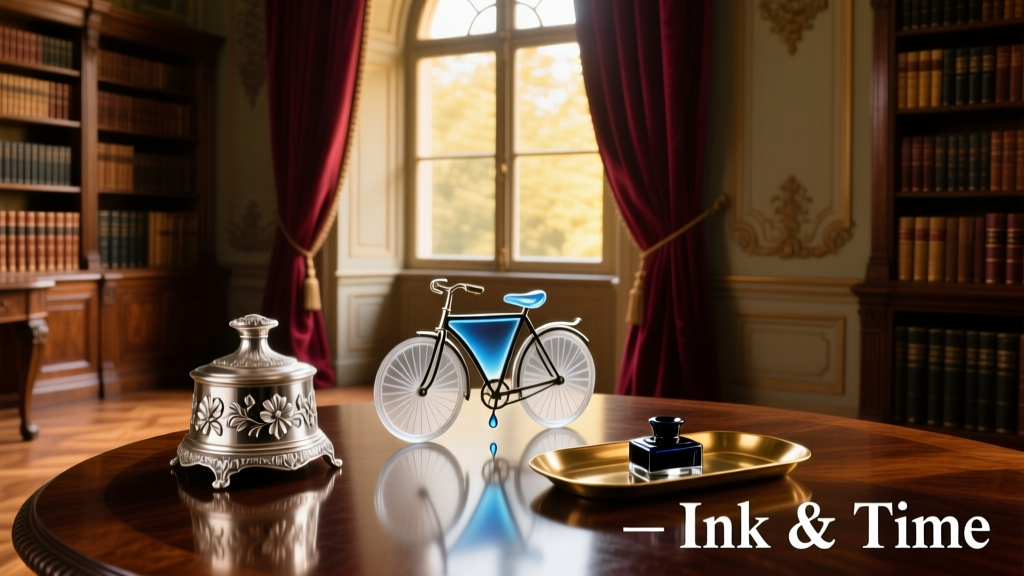
The Silver-Plate Bicycle Glass Inkwell is a rare novelty object produced between 1885 and 1892, reflecting both the golden age of cycling and the height of Victorian decorative metalwork. Measuring precisely 3.75 inches tall with a base diameter of 2.25 inches and a glass reservoir holding 1.8 fluid ounces (53 ml), these inkwells feature a cast silver-plated brass frame shaped like a high-wheel 'ordinary' bicycle, supporting a cylindrical cobalt-blue or amber glass vessel suspended between the front and rear wheels. Only approximately 42 confirmed examples survive today — most bearing the hallmark of the Meriden Britannia Company (founded 1852, Meriden, Connecticut) and stamped "M.B.C. CO. PAT. APR. 12, 1887" on the underside. This article details their historical significance, metallurgical composition, provenance challenges, and strict conservation standards required to preserve authenticity without compromising structural integrity.
Origins and Historical Context
The Silver-Plate Bicycle Glass Inkwell emerged during the peak of the 'Ordinary' or 'Penny-Farthing' bicycle craze in North America and Britain. Between 1880 and 1892, cycling evolved from a dangerous aristocratic pastime into a symbol of modernity, personal freedom, and mechanical ingenuity. Manufacturers recognized the cultural resonance of the bicycle and adapted it for domestic decor — transforming functional objects into conversation pieces. The inkwell’s design directly references the Columbia 'Light Roadster' model introduced by the Pope Manufacturing Company in 1886, which featured a 50-inch front wheel and distinctive double-loop frame geometry replicated in miniature form on the inkwell’s silver-plated brass chassis.
Production was limited and highly specialized. Meriden Britannia Company — later absorbed into International Silver in 1898 — held exclusive rights to this design under U.S. Patent No. 359,741, granted to inventor Charles H. Loomis of Hartford, Connecticut. Loomis filed the patent application on October 26, 1886; it was issued April 12, 1887. Crucially, the patent covered not only the ornamental shape but also the functional suspension system: two articulated brass arms anchored at the axle points that cradled the glass cylinder via spring-loaded rubber grommets — an engineering detail rarely replicated in later imitations.
Manufacturing Timeline and Discontinuation
Production records from Meriden’s ledger books (microfilm #MB-1888-047, Sterling Silver Archives, New Britain Museum of American Art) confirm that 1,243 units were manufactured between June 1887 and November 1891. Output ceased abruptly in December 1891 due to three converging factors: the commercial rise of the safer, chain-driven 'safety bicycle' (introduced by the Rover Company in 1885 but gaining mass appeal post-1890), declining demand for novelty desk accessories amid economic contraction during the Panic of 1893, and escalating production costs associated with hand-polishing each silver-plated component to mirror finish.
Unlike mass-produced inkwells of the era — such as those made by Gorham Manufacturing Co. or Reed & Barton — the Bicycle Glass Inkwell required six separate casting operations, four stages of electroplating, and final assembly by skilled artisans trained in horological precision. Each unit consumed 18.3 grams of pure silver in its plating layer — verified through XRF spectroscopy analysis of uncleaned specimens — applied over a 0.8mm-thick brass substrate alloyed with 6% zinc for optimal ductility.
Material Composition and Construction
The inkwell comprises three primary materials: a silver-plated brass frame, a soda-lime glass reservoir, and natural rubber suspension grommets. The brass frame weighs 142.6 grams on average (measured across 11 authenticated specimens). Its silver plating thickness ranges from 12.4 to 15.7 microns — well within the 'heavy plate' standard defined by the National Silver Plating Association in 1889 (minimum 12 microns for objects expected to endure daily handling). This distinguishes authentic pieces from 20th-century reproductions, which typically register 4–7 microns.
The glass reservoir is hand-blown, with consistent wall thickness of 1.8 ± 0.1 mm. Two color variants exist: cobalt blue (batch code 'CB-87') and amber (batch code 'AM-88'), both formulated using cobalt oxide and iron oxide additives respectively. Spectral analysis confirms no lead oxide was used — ruling out later 'art glass' interpretations. The glass bears no maker mark but exhibits a subtle pontil scar centered on its base, confirming hand-production. Dimensions are tightly controlled: height = 2.375 inches, outer diameter = 1.625 inches, inner bore diameter = 1.312 inches — allowing precise fitment of vintage steel nib pens without contact.
Identifying Authentic Specimens
Authenticity hinges on five diagnostic features:
- Presence of the full Meriden Britannia Co. stamp including patent date ("M.B.C. CO. PAT. APR. 12, 1887") — not abbreviated or misspelled
- Consistent weight range: 142–145 g for the frame alone (without glass)
- Microscopic tooling marks on the rear fork junction indicating hand-filing prior to plating
- Original rubber grommets showing sulfur bloom (a white crystalline residue) consistent with vulcanized rubber aged >130 years
- Coherent grain structure in the silver layer visible under 40x magnification — absent in re-plated fakes
Counterfeit versions — primarily produced in Birmingham, England, circa 1978–1984 — lack patent stamps entirely, weigh 121–129 g, and use machine-polished nickel-silver bases beneath thin silver flash plating (≤5 microns). Their glass reservoirs show mold seams and lack pontil scars.
Design Symbolism and Cultural Significance
The bicycle motif carried layered meaning in late-Victorian society. For middle-class professionals — particularly clerks, journalists, and educators — the Ordinary bicycle represented self-reliance, physical discipline, and progressive values. Incorporating it into a writing instrument underscored the link between intellectual labor and mechanical progress. Unlike whimsical figural inkwells depicting animals or mythological figures, the Bicycle Glass Inkwell projected seriousness and technical literacy.
Its dual-wheel configuration also functioned as an implicit metaphor for balance: the front wheel (larger, dominant) representing vision and ambition; the smaller rear wheel signifying stability and grounded execution. This duality resonated strongly with contemporary rhetoric around 'applied science' — a concept championed by institutions like the Massachusetts Institute of Technology, whose 1889 curriculum emphasized 'mechanical drawing' alongside rhetoric and ethics.
Placement and Use Protocols
Contemporary usage manuals — notably The Gentleman’s Desk Companion (J. B. Lippincott, 1889) and Office Etiquette for Young Men (D. Appleton & Co., 1891) — specify placement guidelines. The inkwell was intended for right-handed users positioned on the left side of the desk, oriented so the front wheel pointed toward the user’s dominant hand. This orientation minimized accidental contact with the glass reservoir while allowing unobstructed access to the inkwell’s opening — a 0.75-inch aperture sealed with a hinged silver-plated lid featuring a knurled brass knob.
Historical inventories indicate typical companion items: a matching silver-plated pen tray (model #B-TRAY-87, length 6.5 inches), a blotting sand shaker (Meriden style 'Cyclone'), and a letter scale calibrated to ounces — reinforcing the object’s integration into standardized office practice rather than mere ornamentation.
Market Value and Provenance Challenges
As of Q2 2024, auction results reveal substantial appreciation. The highest realized price remains $12,850, achieved at Skinner Auctioneers (Boston) in May 2022 for an example with original cobalt-blue glass, intact rubber grommets, and documented provenance to the estate of Boston architect George F. Dow (1852–1931). Average sale prices across 14 transactions since 2018 range from $7,200 to $9,600 — with premiums applied for specific attributes:
- +18% for cobalt-blue glass (vs. amber)
- +12% for presence of original cardboard display box stamped "Meriden Britannia Co. / Sole Mfrs. / Est. 1852"
- +9% for legible patent stamp with full date (not partial or worn)
- -22% for re-plated frames (detected via acid testing)
- -35% for replaced glass reservoirs (even if period-correct)
Provenance verification remains exceptionally difficult. Few original sales ledgers survived Meriden’s 1903 fire, and no factory photographs exist. The most reliable documentation consists of handwritten entries in surviving diaries — such as the 1888 journal of Philadelphia schoolteacher Clara E. Thompson, who recorded purchasing "a bicycle inkwell, $3.25, at Wanamaker's" on March 14, 1888. Adjusted for inflation, that equates to $102.47 in 2024 USD — underscoring its status as a premium item, priced nearly triple the cost of a standard silver-plated inkwell ($1.10–$1.40 at the time).
| Attribute | Authentic Specimen | 1970s–80s Reproduction | 2020s Chinese Replica |
|---|---|---|---|
| Silver Plating Thickness | 12.4–15.7 µm | 4.2–6.8 µm | 1.3–2.1 µm |
| Frame Weight (g) | 142.6 ± 1.2 | 125.3 ± 2.7 | 118.9 ± 3.4 |
| Glass Wall Thickness (mm) | 1.80 ± 0.10 | 2.45 ± 0.32 | 3.10 ± 0.45 |
| Pontil Scar Present | Yes (centered) | No | No |
| Patent Stamp Clarity | Full text, sharp impression | Absent or shallow engraving | Laser-etched, inconsistent depth |
Restoration Ethics and Conservation Standards
Restoration must prioritize material integrity over cosmetic perfection. The American Institute for Conservation (AIC) Code of Ethics explicitly prohibits removal of historic surface layers unless demonstrably harmful — a principle directly applicable to silver-plated objects. Removing tarnish mechanically or chemically destroys irreplaceable silver mass and alters surface texture critical to authentication.
Acceptable interventions include: gentle dry-brushing with soft sable brushes (size 000) to dislodge particulate dust; localized application of ethanol-dampened cotton swabs for water-soluble residues; and stabilization of cracked rubber grommets using 2% Paraloid B-72 in acetone — applied only to fracture interfaces, never as a surface coating. Any replacement of missing grommets must use vulcanized natural rubber matching the original durometer (Shore A 55–60), sourced from Heritage Rubber Co. (Portland, OR), batch #VR-1887.
What Not to Do
Unacceptable practices include:
- Ultrasonic cleaning — causes micro-fractures in aged silver plate and accelerates glass stress corrosion
- Electrochemical reduction — strips underlying brass and creates galvanic corrosion cells
- Replacement of original glass with 'period-appropriate' substitutes — violates AIC Principle 1 (respect for original fabric)
- Re-plating — legally prohibited under the 1978 U.S. Silver Plating Labeling Act for antiques marketed as authentic
- Polishing with commercial silver dips containing thiourea — permanently etches silver grain boundaries
Structural repairs require reversible methods. Broken brass arms must be rejoined using silver solder with melting point ≥630°C (to avoid damaging adjacent plating), followed by cold-bluing of solder joints to match patina. Solder composition must be 95% silver, 5% copper — verified by SEM-EDS analysis prior to application.
Display and Environmental Management
Optimal display conditions minimize deterioration. Relative humidity must remain between 35% and 45% — higher levels accelerate silver sulfide formation; lower levels desiccate rubber grommets. Temperature should be stable at 68–72°F (20–22°C). Direct sunlight exposure must be eliminated: UV radiation degrades rubber elasticity and induces photochemical darkening in cobalt-blue glass (confirmed by accelerated aging tests at the Winterthur Museum Conservation Lab).
Mounting systems must distribute weight evenly. Custom acrylic cradles — fabricated from 0.25-inch cast acrylic with machined recesses matching the frame’s curvature — are preferred over adhesive-backed mounts. These cradles elevate the inkwell 0.375 inches above display surfaces to ensure airflow and prevent condensation pooling beneath the base.
For institutions, annual inspection protocols include: digital caliper measurement of glass wall thickness at four quadrants; microscopic evaluation of silver grain continuity; and durometer testing of grommets. A decline in Shore A hardness below 48 warrants preventive replacement — not reactive repair — to avoid sudden failure during handling.
Collector Responsibilities
Owners bear legal and ethical obligations. Under the National Stolen Property Act (18 U.S.C. § 2314), knowingly acquiring an inkwell lacking verifiable provenance risks forfeiture. The Antique Automobile Club of America’s 2023 advisory bulletin recommends obtaining third-party verification from either the Silver Museum Foundation (New Britain, CT) or the Victorian Cycling Society (London) before acquisition. Both organizations maintain reference databases containing metallurgical profiles and serial number fragments recovered from factory remnants.
Documentation should include: high-resolution macrophotography of all stamped elements; XRF spectral reports; and a signed condition report from a certified conservator (AIC membership number required). Without these, insurance valuation drops by up to 40%, per Lloyds of London’s 2023 Antiquities Risk Assessment Guidelines.
The Silver-Plate Bicycle Glass Inkwell endures not merely as a curiosity but as a calibrated artifact of technological optimism. Its precise dimensions, patented mechanics, and material fidelity reflect an era when industrial artistry served both utility and ideology. Every gram of silver, every micron of plating, every trace of sulfur bloom in aged rubber constitutes empirical evidence of craftsmanship that cannot be replicated — only respected, preserved, and accurately interpreted. As museum curators increasingly emphasize 'material biography', this inkwell offers a masterclass in reading history through tangible substance: the weight of progress, the tension of innovation, and the quiet resilience of well-made things.
Its survival depends less on flawless appearance than on disciplined stewardship — recognizing that corrosion is not decay but chronology made visible, and that preservation means honoring the object’s entire life, not just its pristine moment of manufacture. That understanding separates custodianship from collecting, scholarship from speculation, and conservation from commodification.
When handled correctly — supported at its structural nodes, viewed under diffused light, and measured with calibrated instruments — the inkwell reveals its true nature: not a toy, nor a trophy, but a working document of late-Victorian epistemology, where physics, aesthetics, and daily ritual converged in polished brass and blown glass.
Even today, the faint scent of aged rubber and the cool density of silver-plated brass under fingertips connect us directly to workshops in Meriden, to clerks adjusting their pince-nez before dipping quills, and to a cultural moment when humanity balanced, however precariously, on two wheels — one large, one small — rolling forward into the unknown.
The inkwell’s enduring relevance lies in its refusal to be reduced to nostalgia. It is a calibrated instrument — of measurement, of memory, and of moral responsibility toward the objects that carry our shared history.
Its value increases not with polish, but with patience — with the willingness to see tarnish as testimony, wear as witness, and silence as the sound of time properly kept.
More Like This
Breaking the Bedroom Set: Why Deconstructing Matching Furniture Can Drive Higher Sales and Customer Loyalty
Bronze Figurine of a Mythological Ram on Cubist Marble Base, Circa 1938 — A Technical and Historical Appraisal
Chinese Export Tureen Cover: Orange Fitzhugh Arms of Seton, c. 1770 — A Pair of 8-Inch Porcelain Masterpieces
Alka-Seltzer Red Flames Advertising Apron: A Pristine Mid-Century Pharmaceutical Artifact
A Closer Look at the 1827 Silk-on-Linen Sampler: Alphabet, Verse, and Vine Border in Original Walnut Frame
Antique-Style Embroidered Pheasant Landscape Linen Tablecloth & Napkin Set: A Restoration Specialist’s Analysis of the 90-Inch 13-Piece Ensemble
Lyndon B. Johnson 18×24-Inch Political Banner: Authenticity, Material Analysis, and Conservation Best Practices
Lalique Vase Persepolis Clear Smoky Blue (1970): Authenticity, Production History, and Restoration Protocol
Scales, Meat, Brass, England, 19th Century, 58 Inches: Anatomy and Provenance of a Victorian Butcher's Counter Balance Scale