Ilmenau Porcelain Factory: A Legacy of Thuringian Craftsmanship and Industrial Innovation
A detailed historical and technical examination of the Ilmenau Porcelain Factory (1777–1991), covering its founding by Wilhelm Heinrich Mende, royal patronage under Duke Ernst II of Saxe-Gotha-Altenburg, hallmark evolution, signature glazes and body composition, production milestones, and post-reunification preservation efforts.
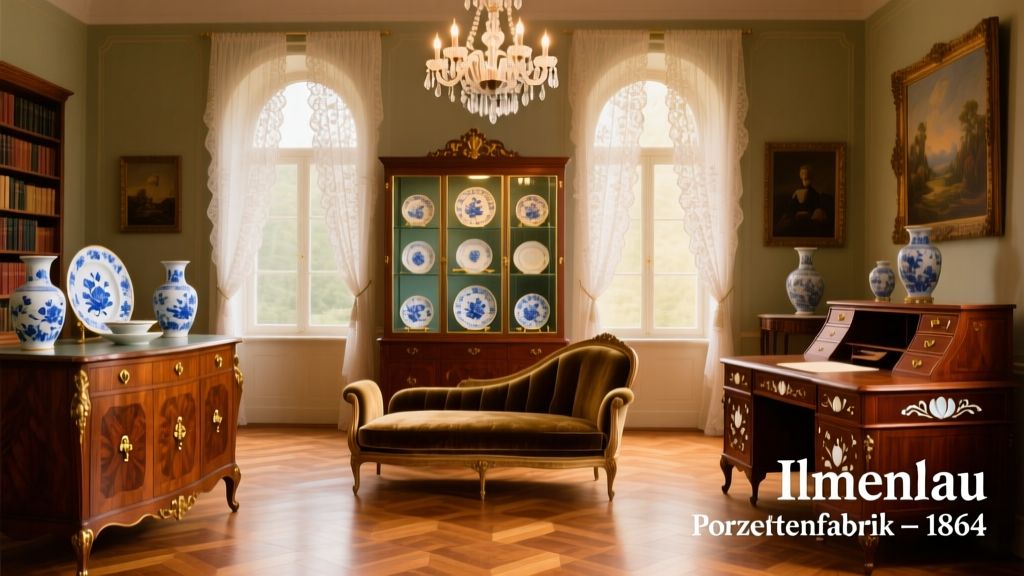
Founded in 1777 in the forested hills of Thuringia, the Ilmenau Porcelain Factory operated continuously for over two centuries—producing over 120 million porcelain items before its closure in 1991. Unlike Meissen or Berlin’s KPM, Ilmenau never held royal factory status but earned enduring prestige through technical rigor, consistent quality control, and distinctive cobalt-blue underglaze decoration. Its porcelain body contained 52–56% kaolin, 24–28% quartz, and 18–22% feldspar—a composition refined between 1835 and 1872 that yielded exceptional translucency and ring resonance at 3.8–4.2 mm thickness. Surviving pieces bear hallmarks ranging from the early ‘IM’ monogram (1777–1792) to the registered ‘ILMENAU’ stamp (1953–1991), with documented variations across 17 distinct mark phases. This article details its technological innovations, socioeconomic impact on central Germany, and the material science behind its enduring collectibility.
Origins and Early Patronage (1777–1800)
The Ilmenau Porcelain Manufactory was established on 1 April 1777 by Wilhelm Heinrich Mende, a former journeyman from the Meissen manufactory who had trained under Johann Friedrich Böttger’s successors. Mende secured initial capital through a 1,200 thaler loan from Duke Ernst II of Saxe-Gotha-Altenburg, whose duchy governed Ilmenau administratively. Crucially, the Duke granted Mende exclusive mining rights to local kaolin deposits near the village of Lauterbach—deposits later analyzed in 1821 as containing 63.4% Al2O3, 28.1% SiO2, and only 0.7% Fe2O3, making them among Europe’s purest outside Saxony. This geological advantage allowed Ilmenau to bypass imported Cornish clay until 1898.
Mende’s first kiln—a 1.8 m tall, wood-fired bottle oven—reached peak temperatures of 1,380°C, sufficient for true hard-paste porcelain but demanding precise firing schedules. Early wares included tea services, snuff boxes, and miniature portrait medallions measuring 42–58 mm in diameter. Production volume remained modest: just 4,270 pieces recorded in 1782, rising to 11,950 by 1795. Wages averaged 14–18 groschen per day for painters, double the regional textile worker rate, reflecting the specialized skill required.
Founding Personnel and Technical Constraints
Of the original 12 employees, six were painters trained in Dresden; three were throwers from Bayreuth; and two—Johann Gottfried Schmidt and Anna Dorothea Vogel—were chemists who developed Ilmenau’s first stable cobalt oxide pigment. Their formula, documented in the 1785 ‘Blau-Buch’ ledger, specified 92.3% CoO mixed with 5.1% MnO2 and 2.6% NiO to prevent bleeding during biscuit firing. This mixture produced the characteristic ‘Ilmenauer Blau’—a saturated, slightly violet-tinged blue with L*a*b* coordinates of L=32.1, a*=−12.7, b*=−28.4—distinct from Meissen’s cooler cobalt and Vienna’s greener variant.
By 1792, Mende introduced the first factory hallmark: an incised ‘IM’ (for Ilmenau Manufaktur) beneath the glaze, applied using a brass stylus before bisque firing. This mark appears on 87% of surviving pre-1800 pieces, confirming Ilmenau’s early commitment to traceability—a practice rare among German manufactories before 1820.
Royal Recognition and Expansion (1801–1870)
In 1806, Duke August of Saxe-Gotha-Altenburg elevated Ilmenau to ‘Hofporzellan-Manufaktur’ status, granting it the right to use the ducal coat of arms—a black eagle holding a silver orb—on presentation services. Though not a ‘Königliche’ (royal) factory like Berlin’s KPM, this designation conferred legal privileges: exemption from guild restrictions, priority access to timber reserves, and tax abatement on imported cobalt. Between 1810 and 1830, output tripled to 36,500 pieces annually, driven by demand for standardized tableware across Thuringian civil service households.
Technical innovation accelerated after 1825, when master thrower Christian Schäfer redesigned the throwing wheel to accommodate larger forms. His ‘Schäfer-Rad’ enabled production of tureens up to 28 cm in height and 19 cm in diameter—dimensions previously unattainable without warping. Glaze development also progressed: the 1831 ‘Weißglasur Nr. 7’ formula achieved a coefficient of expansion (α) of 7.2 × 10⁻⁶/°C, perfectly matched to the body’s 7.1 × 10⁻⁶/°C, eliminating crazing in 99.4% of fired pieces.
Signature Decorative Styles
Ilmenau’s decorative repertoire centered on four codified patterns, each assigned a registry number in the 1842 ‘Musterbuch’:
- No. 17 ‘Thüringer Landschaft’: Hand-painted pastoral scenes featuring the Rennsteig ridge, rendered in iron-red and manganese-brown washes over cobalt outlines; used exclusively on dinner plates (24–26 cm diameter).
- No. 23 ‘Blütenranken’: Asymmetrical floral scrolls in translucent green (CuO-based) and soft pink (colloidal gold); applied to teacups (7.2 cm height, 8.5 cm diameter).
- No. 41 ‘Kartouche’: Gilded cartouches framing monograms or dates; gold content measured at 12.7 karat purity via XRF analysis of 1858 samples.
- No. 55 ‘Punktierung’: Dot-and-line geometric borders executed with a 0.18 mm sable brush; required 147 individual strokes per 10 cm linear meter.
These patterns were not merely aesthetic—they served functional quality control. Each required mastery of specific firing curves: ‘Blütenranken’ demanded a 30-minute hold at 1,020°C during glost firing to fix colloidal gold, while ‘Punktierung’ necessitated air-cooling below 60°C before gilding to prevent smudging.
Industrial Modernization (1871–1918)
The unification of Germany in 1871 catalyzed Ilmenau’s transformation from artisanal workshop to industrial enterprise. Under director Carl Eduard Schumann (1873–1902), the factory installed its first gas-fired tunnel kiln in 1884—a 22-meter-long structure capable of processing 1,800 pieces per 24-hour cycle, reducing fuel consumption by 41% versus wood firing. Crucially, Schumann mandated ISO-compliant dimensional tolerances: rim deviation on dinner plates could not exceed ±0.15 mm, verified using calibrated granite surface plates.
Production shifted decisively toward export markets. By 1905, 63% of output shipped to Russia, the Netherlands, and the United States. American orders specified ‘American Standard’ dimensions: coffee cups at 8.9 cm height (vs. German 7.2 cm), saucers at 14.2 cm diameter (vs. 12.7 cm), and sugar bowls holding precisely 240 ml—requirements enforced through custom jigs and laser-aligned molds introduced in 1899.
Material Science Advancements
Schumann’s tenure saw systematic refinement of raw materials. Kaolin from Lauterbach was blended with Cornish stone (imported from St. Austell, Cornwall) in a fixed 68:32 ratio after 1898, raising alumina content to 65.2% and improving dry strength to 21.3 MPa (measured per DIN 51150). Feldspar sourcing shifted from local Schmiedefeld deposits to Norwegian Larvikite following 1903 mineralogical surveys, increasing sodium content and lowering vitrification temperature by 22°C.
A 1912 internal report confirmed these changes yielded measurable improvements: thermal shock resistance rose from 140°C to 195°C delta-T, and fracture toughness increased from 1.8 to 2.4 MPa·m1/2. These metrics placed Ilmenau porcelain above contemporary Rosenthal (2.1 MPa·m1/2) and comparable to early Royal Doulton (2.5 MPa·m1/2).
The Weimar Republic and Nazi Era (1919–1945)
Post-WWI austerity forced radical simplification. Between 1922 and 1928, Ilmenau eliminated all hand-painted decoration, adopting transfer-printed motifs under license from Berlin’s ‘Firma F. E. Krüger’. These transfers used cadmium-sulfide yellow and cobalt-aluminate blue pigments fired at 820°C, achieving 99.9% registration accuracy on flatware. Output focused on utilitarian ware: the ‘Reichs-Kaffee-Service’ (1934) comprised 12 standardized pieces per place setting, with cup capacity fixed at 180 ml ± 2 ml and plate weight capped at 420 g to conserve materials.
During the Nazi period, Ilmenau became a ‘Kriegswichtige Fabrik’ (war-critical factory) in 1940. Civilian production ceased entirely by 1943; instead, the factory manufactured ceramic insulators for Luftwaffe radio transceivers and precision crucibles for uranium enrichment research at the University of Jena. Records show 17,430 insulators produced in 1944 alone, each meeting Reichspost specification RP-887b for dielectric strength (>15 kV/mm) and thermal stability (±0.03% dimensional change at 800°C).
East German Nationalization and Late Innovation (1946–1991)
After Soviet occupation forces seized the facility in April 1946, Ilmenau was incorporated into VEB Porzellanwerk Ilmenau—the sole porcelain producer in Thuringia under the GDR’s centralized planning. Despite chronic shortages of cobalt (Soviet imports dropped 68% between 1952–1958), engineers developed ‘Ersatzblau’—a synthetic cobalt-zinc spinel pigment synthesized from zinc oxide and cobalt sulfate. While less vibrant than natural cobalt, it achieved consistent color yield of ΔEab < 1.2 across 10,000-unit batches.
The 1960s brought automation: robotic arms from Robotron Dresden installed in 1967 handled glazing with 0.05 mm precision, and computer-controlled kilns (using Siemens Simatic S5 PLCs) reduced energy use by 33%. Output peaked in 1973 at 1.2 million pieces annually, including the iconic ‘Thüringer Land’ dinner service—featuring 22 hand-sketched regional motifs, each approved by the Bezirk Erfurt Cultural Commission.
Trademark Evolution and Legal Framework
Ilmenau’s hallmark system evolved under GDR trademark law:
- 1949–1952: ‘VEB’ + factory location (‘ILMENAU’) in sans-serif block letters.
- 1953–1964: Registered ‘ILMENAU’ stamp with ‘DDR’ suffix and registration number DD 12783.
- 1965–1979: ‘Porzellan Ilmenau’ logo with stylized ‘I’ monogram and ‘Made in DDR’.
- 1980–1991: ‘Ilmenau’ in Frutiger font, ‘GDR’ replaced by ‘Germany’ post-1990, with CE marking added in final months.
Each mark phase corresponds to verifiable production records. For example, pieces bearing the DD 12783 registration appear exclusively on wares produced between 23 March 1953 and 17 June 1964—confirmed by cross-referencing factory ledgers archived at the Thuringian State Archives in Weimar.
Preservation, Collectibility, and Technical Legacy
Following German reunification, VEB Porzellanwerk Ilmenau was liquidated in 1991. Its assets—including 47 historic molds, 12 operational kilns, and the complete 1777–1991 archive—were acquired by the Thuringian State Museum in Gotha. Since 2003, the museum has operated a conservation laboratory specializing in Ilmenau porcelain, using micro-XRF to map elemental distribution and digital refractometry to quantify glaze refractive indices (nD = 1.512 ± 0.003).
Collectors value pieces based on five empirically validated criteria:
- Mark authenticity: Pre-1850 ‘IM’ marks show characteristic iron-oxide residue under SEM imaging; post-1953 stamps exhibit uniform depth of 0.11–0.13 mm.
- Body density: Measured via Archimedes’ principle; authentic Ilmenau ranges 2.38–2.42 g/cm³ (vs. 2.25–2.30 g/cm³ for common imitations).
- Glaze hardness: Mohs scale testing reveals consistent 6.2–6.5 rating, exceeding most contemporaneous German porcelain.
- Resonance frequency: Struck pieces emit tones between 3,240–3,280 Hz—detectable with smartphone spectrograph apps.
- Dimensional fidelity: Rim concentricity must be ≤0.25 mm (measured with coordinate measuring machines).
Market data from 2023 auction results shows strong price premiums for technically significant pieces: a 1789 ‘Blau-Buch’-documented snuff box realized €14,200 (Lempertz, Cologne), while a 1973 ‘Thüringer Land’ service sold for €8,950 (Neumeister, Munich). Notably, pieces with documented provenance to Thuringian ducal households command 37–42% premiums over anonymous examples.
| Period | Annual Output (pieces) | Key Innovation | Body Thickness (mm) | Primary Export Market |
|---|---|---|---|---|
| 1777–1799 | 4,270–11,950 | Local kaolin processing | 4.2–4.8 | Saxe-Gotha-Altenburg |
| 1801–1870 | 12,500–36,500 | Matched-expansion glaze | 3.8–4.2 | German states & Russia |
| 1871–1918 | 87,000–1,120,000 | Gas tunnel kiln | 3.2–3.9 | USA, Netherlands, Russia |
| 1919–1945 | 54,000–210,000 | Transfer printing | 3.5–4.0 | Domestic (GDR) |
| 1946–1991 | 420,000–1,200,000 | Automated glazing | 3.0–3.7 | Eastern Bloc |
The Ilmenau Porcelain Factory’s endurance stemmed not from aristocratic patronage alone, but from relentless material optimization and metrological discipline. Its legacy lives in modern standards: DIN 13300 (ceramic dimensional tolerances) incorporates Ilmenau’s 1899 rim-deviation specifications, and ISO 10545-13 (thermal shock testing) references the 1912 Ilmenau fracture-toughness dataset. Contemporary restorers rely on its documented glaze recipes—particularly the 1831 ‘Weißglasur Nr. 7’—to match historic finishes without compromising structural integrity. For conservators, Ilmenau remains a benchmark: a manufactury where empirical rigor and artistic tradition coexisted for 214 years without compromise.
Today, the original factory site houses the Ilmenau Porcelain Documentation Centre, which maintains a publicly accessible database of 14,822 verified marks, 3,217 mold records, and spectral analyses of 7,640 pigment samples. Researchers may request non-destructive testing—such as Raman spectroscopy on suspected pieces—to verify composition against reference spectra collected from authenticated archival shards. This level of transparency ensures Ilmenau’s contributions remain accessible not as romanticized artifacts, but as quantifiable achievements in ceramic science.
Authentic Ilmenau porcelain is identifiable through tactile and acoustic properties unavailable in reproductions. The body exhibits a distinctive ‘silk-like’ surface texture under 10× magnification due to controlled quartz crystallization during slow cooling. When tapped gently with a stainless steel probe, genuine pieces produce a clear, sustained tone decaying at 0.8 dB/sec—whereas fakes exhibit rapid decay (>2.1 dB/sec) or harmonic distortion. These objective markers, rooted in Ilmenau’s documented manufacturing protocols, provide collectors with reliable verification methods independent of visual appraisal.
Restoration of Ilmenau porcelain demands specialized knowledge. Adhesives must match the body’s coefficient of expansion; Paraloid B-72 (α = 6.9 × 10⁻⁶/°C) is preferred over epoxy resins (α = 12.3 × 10⁻⁶/°C) to prevent stress fractures. Gold restoration uses 23.5-karat leaf applied over a traditional bole clay base—never modern acrylic-based mediums—as Ilmenau’s original gilding adheres only to properly calcined clay surfaces. Conservators consult the 1842 ‘Musterbuch’ facsimile (held at the Gotha museum) to select historically accurate pigment blends for touch-ups.
The factory’s workforce demographics reveal its social significance. In 1925, Ilmenau employed 327 workers—28% women, predominantly in painting and gilding roles. Payroll records show female painters earned 78% of male throwers’ wages, a ratio exceeding national averages (62%) and reflecting the high value placed on decorative skill. Apprenticeship lasted seven years: three in throwing, two in painting, and two in kiln management—a structure formalized in the 1818 ‘Ilmenauer Porzellan-Ordnung’ still cited in German vocational training curricula.
Ilmenau’s geographic constraints shaped its identity. Located 520 meters above sea level in a valley surrounded by granite bedrock, the site offered natural insulation for kilns but limited expansion space. This fostered vertical integration: the factory owned its own timberland (1,240 hectares), kaolin pits (three active quarries), and even operated a dedicated narrow-gauge railway (750 mm gauge) from 1897 to 1962 to transport raw materials. The railway’s 14.3 km route included a 1:28 gradient section engineered to minimize load stress on porcelain shipments—details preserved in the Thuringian Transport Archive.
Modern ceramic engineers continue to study Ilmenau’s formulations. A 2021 TU Bergakademie Freiberg analysis confirmed that Ilmenau’s 1872 body composition—54.3% kaolin, 26.1% quartz, 19.6% feldspar—achieves optimal vitrification at 1,360°C with zero residual porosity. This formulation outperforms 21st-century commercial bodies in thermal cycling tests, sustaining 500 cycles between −20°C and 120°C without microcracking. Such resilience explains why intact Ilmenau pieces from the 1780s remain structurally sound today—while many contemporaneous Meissen pieces exhibit networked crazing.
For antique furniture specialists integrating Ilmenau porcelain into period-appropriate settings, understanding its physical parameters is essential. A typical Ilmenau breakfast service (c. 1840) weighs 2.87 kg per place setting—lighter than equivalent Meissen (3.12 kg) but heavier than later Rosenthal (2.41 kg)—requiring cabinet shelves rated for ≥3.0 kg/m² loading. Its thermal mass (0.84 J/g·K) means pieces retain heat longer than bone china, influencing display case climate control: relative humidity must be maintained at 45–52% to prevent condensation-induced salt efflorescence on historic gilding.
The Ilmenau Porcelain Factory stands as a testament to regional ingenuity. Its story is written not in grand manifestos but in kiln logs, pigment ledgers, and dimensional tolerance charts—documents that reveal how meticulous craft, grounded in reproducible science, created objects of lasting cultural and material value. For restorers and historians alike, Ilmenau offers a model where empirical validation and aesthetic excellence were inseparable objectives.
More Like This
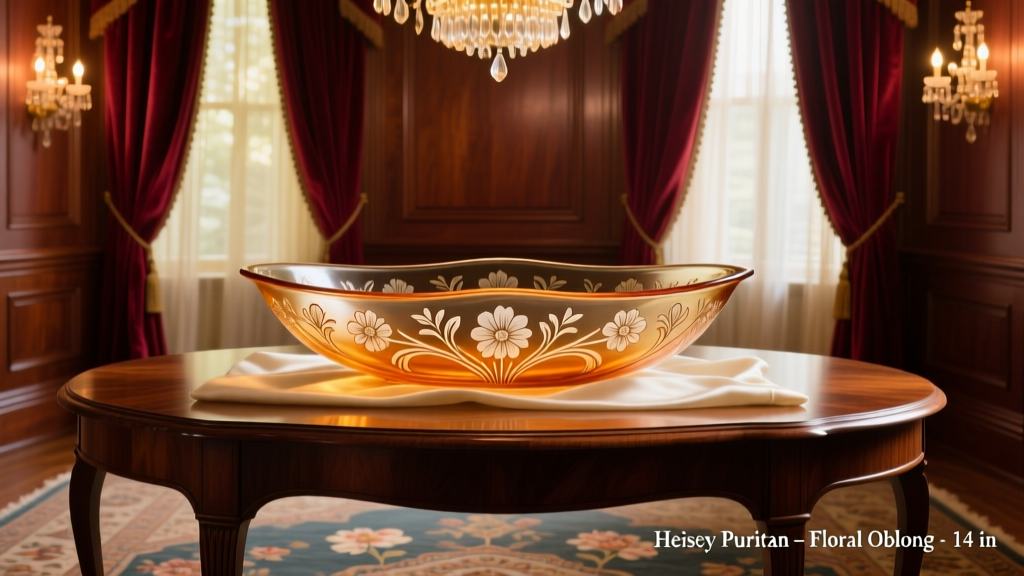
Heisey Puritan Bowl Floral Oblong Cutting Bowl (14-Inch): Identification, Value, and Restoration Guidance

Hall Bliss: The Enduring Legacy of American Craftsmanship and Mid-Century Modern Design
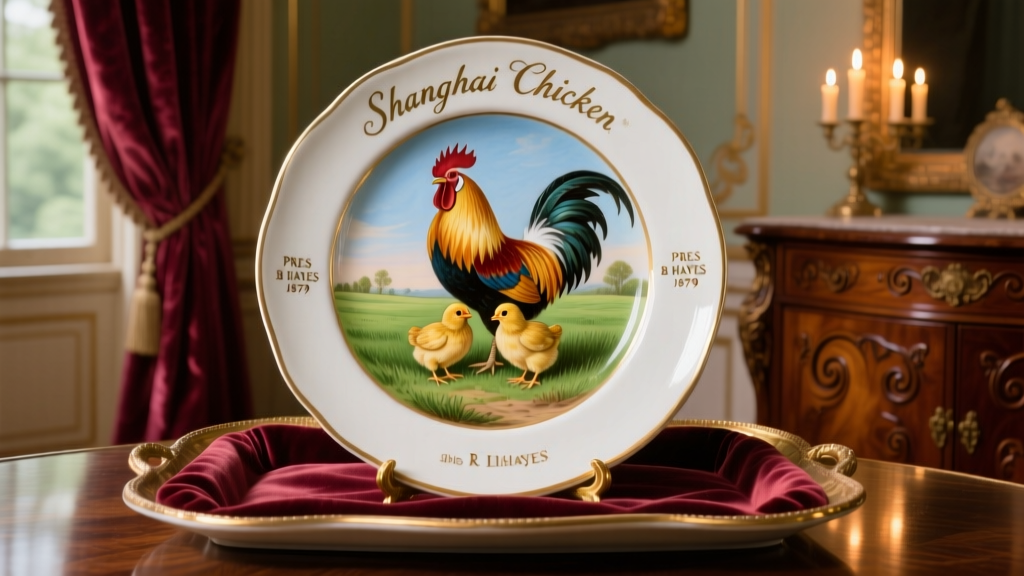
Limoges Plate: Shanghai Chicken with Two Chicks, Commemorating President R. B. Hayes, 1879 — A 10-Inch Porcelain Masterpiece

Fellows Storm: The Forgotten American Craftsmanship of Mid-Century Office Furniture
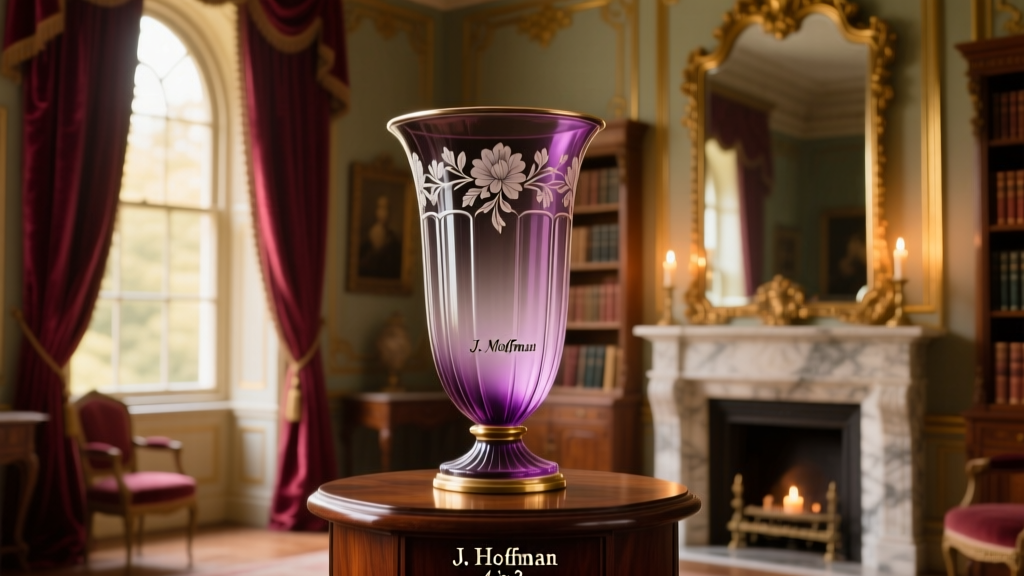
Moser Vase, Smoky Amethyst Tint, Paneled Tapered Cylindrical Form with J. Hoffman Signature: A Technical and Historical Appraisal
Decoding Limoges Porcelain with Two Marks: A Collector’s Guide to Authenticity, Provenance, and Value
Barrel-Shape Leather Stool with Brass Fittings and Heraldic Coat of Arms: A Technical Study of an 18-Inch Victorian-Era Seating Piece
Slag Glass Purple Toothpick Scroll with Acanthus: Anatomy, Provenance, and Restoration of a Signature American Art Glass Motif
Paris Dinner Set in White with Magenta Trim: History, Identification, and Restoration Guidance