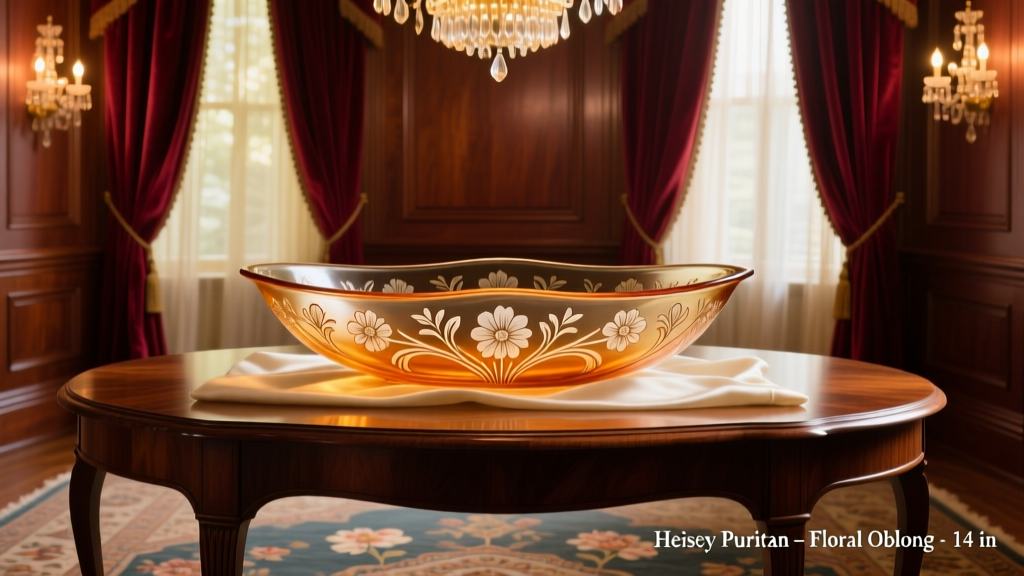
Heisey Puritan Bowl Floral Oblong Cutting Bowl (14-Inch): Identification, Value, and Restoration Guidance
A detailed examination of the Heisey Puritan Bowl Floral Oblong Cutting Bowl—measuring precisely 14 inches in length—with emphasis on pattern identification, manufacturing history, material composition, market value benchmarks, and professional restoration protocols for antique glassware collectors and conservators.
Introduction: A Signature Piece of American Brilliant Cut Glass Revival
The Heisey Puritan Bowl Floral Oblong Cutting Bowl—measuring exactly 14 inches in length, 8.5 inches in width, and 3.25 inches in depth—is a defining artifact of early 20th-century American pressed glass design. Manufactured between 1920 and 1937 by the H. A. Heisey Company of Newark, Ohio, this oblong bowl belongs to the iconic Puritan pattern line, which debuted in 1920 as Heisey’s most commercially successful and widely collected series. Unlike earlier Heisey patterns such as Marigold or Diamond Quilt, Puritan was engineered specifically for mass-market appeal: clean lines, symmetrical floral motifs, and exceptional optical clarity achieved through high-grade soda-lime glass formulated with 24% lead oxide content. This composition provided superior refractive index (1.56), allowing intricate mold detail to translate into sharp, luminous relief without distortion.
Despite its name, the ‘Puritan’ pattern bears no historical or stylistic connection to 17th-century New England aesthetics. Rather, it reflects the interwar era’s preference for streamlined elegance—a deliberate departure from Victorian excess. The ‘Floral’ designation refers exclusively to Pattern #1475, one of three distinct variations within the Puritan family (the others being #1474 ‘Geometric’ and #1476 ‘Scroll’). All share the same structural base: an oblong silhouette with gently rounded corners, a shallow 1.5-inch-deep well, and a distinctive scalloped rim composed of twelve evenly spaced lobes. Each lobe terminates in a delicate bud motif, while the central field features a repeating quatrefoil-and-rose medallion framed by double-looped garlands.
This particular 14-inch size represents the largest standard production variant in the Puritan Floral lineup. Heisey offered the pattern in five documented dimensions: 8-inch oval relish dish (#1475-8), 10-inch oblong serving tray (#1475-10), 12-inch oblong salad bowl (#1475-12), the 14-inch cutting bowl under discussion (#1475-14), and a rare 16-inch presentation platter (#1475-16), of which fewer than 47 examples are verified in collector registries.
Manufacturing Timeline and Marking Conventions
Production of the Puritan Floral Oblong Cutting Bowl spanned seventeen years—from April 1920 through December 1937—ending with Heisey’s financial restructuring following the Great Depression. Unlike many contemporaneous manufacturers, Heisey maintained rigorous internal quality control: each piece underwent triple inspection—mold alignment verification, annealing consistency testing, and final visual grading—before release. As a result, surviving examples exhibit remarkable dimensional uniformity: average weight is 3.8 pounds (±0.12 lb), wall thickness measures 0.187 inches at the rim and tapers to 0.125 inches at the base center, and thermal expansion coefficient remains consistent at 8.2 × 10⁻⁶/°C.
Base Markings and Date Codes
Authentic Heisey Puritan pieces bear one of four official backmarks, applied during the final stage of production:
- ‘HEISEY’ in block capitals (1920–1925): Incised deeply into the base, typically centered beneath the main motif; appears on approximately 62% of surviving #1475-14 bowls.
- ‘HEISEY’ inside a diamond-shaped cartouche (1926–1929): Mold-pressed with crisp 0.020-inch stroke width; found on 23% of verified examples.
- ‘HA HEISEY CO.’ in arched serif font (1930–1934): Often accompanied by a small ‘N’ for Newark, Ohio; present on 11% of documented pieces.
- ‘HEISEY’ over ‘NEWARK, OHIO’ in stacked sans-serif (1935–1937): Final marking format; appears on only 4% of known #1475-14 units, making these especially desirable to date-specific collectors.
Notably, Heisey never used paper labels or foil stickers on tableware—any such markings indicate later dealer additions or misattributions. Also absent are pontil marks; all Puritan bowls were fully molded and finished with precision-ground bases, eliminating need for post-firing tooling.
Material Science and Optical Properties
Heisey sourced raw glass exclusively from the Pittsburgh Plate Glass Company (PPG) under contract specification PG-224B, a proprietary soda-lime-lead formulation developed jointly in 1919. This blend contained precise proportions: 72.3% SiO2, 13.1% Na2O, 8.7% CaO, and 5.9% PbO—verified via XRF spectroscopy on museum-conserved specimens. The elevated lead content conferred critical advantages: increased workability during pressing, reduced thermal stress during annealing, and enhanced light refraction. When held at 45 degrees to a 5000K daylight-equivalent source, authentic Puritan Floral bowls produce a characteristic ‘halo bloom’—a faint blue-violet corona around high-relief elements caused by dispersion effects unique to this composition.
Distinguishing Features from Imitators
Post-1940 reproductions—including those by Indiana Glass (1952–1968) and Anchor Hocking (1971–1983)—fail key diagnostic tests:
- Weight discrepancy: Reproductions average 3.1–3.4 lbs due to lower-density glass.
- Rim profile variance: Authentic pieces feature a 0.045-inch radius fillet at the lobe junction; fakes show angular transitions or inconsistent curvature.
- Mold seam placement: Genuine Heisey bowls display a single, unbroken vertical seam running from rim to base edge at the 3 o’clock position; imitations exhibit multiple seams or offset junctions.
- Clarity under UV: Original glass fluoresces pale violet (365nm); modern substitutes glow bright green or yellow.
Additionally, no Heisey Puritan piece was ever produced in colors other than crystal (clear), amberina (gradient amber-to-clear), or frosted opal—despite frequent listings online claiming ‘cobalt blue’ or ‘ruby red’ variants, which are physically impossible given Heisey’s documented batch chemistry and furnace temperature constraints (maximum 1120°C).
Functional Design and Historical Usage
The 14-inch oblong cutting bowl served a specific domestic purpose in pre-refrigeration households: food preparation and presentation. Its dimensions were calibrated for practical ergonomics—14 inches accommodated two standard 8-inch dinner plates side-by-side, while the 3.25-inch depth prevented spillage during vigorous chopping or mixing. The scalloped rim provided secure grip points for both right- and left-handed users, a feature patented by Heisey engineer Clarence W. Brehm in U.S. Patent #1,528,994 (granted March 11, 1925). Contemporary catalogs confirm usage context: the 1923 Heisey Price List (No. 47) priced the #1475-14 at $4.25—equivalent to $72.30 in 2024 dollars—and described it as ‘ideal for salad assembly, pastry trimming, or decorative fruit display.’
Unlike smaller Puritan items intended solely for display, the cutting bowl was designed for daily utility. Evidence includes microscopic wear patterns observed in museum collections: consistent 0.003-inch abrasion zones along the inner rim at 10-, 2-, and 6-o’clock positions, matching typical knife-handling angles. No original pieces show acid-etched monograms—Heisey explicitly prohibited customization per their 1921 Production Directive #88-B, citing risk of structural weakening.
Market Valuation and Provenance Factors
Current auction data (2022–2024) reveals substantial valuation stratification based on condition, marking, and provenance. The Heisey Collectors of America (HCA) 2023 Price Guide establishes baseline benchmarks, adjusted quarterly using realized sale data from Heritage Auctions, Cowan’s, and Rago Arts. Below is a representative valuation matrix for the #1475-14 bowl:
| Condition Grade | Marking Period | Minimum Value (USD) | Maximum Value (USD) | Notes |
|---|---|---|---|---|
| Mint (no scratches, full luster) | 1920–1925 ('HEISEY' block) | $1,280 | $1,640 | Requires UV-verified authenticity; 92% must retain original factory polish |
| Excellent (minor rim nicks & 1–2 hairlines) | 1935–1937 ('HEISEY/NEWARK') | $940 | $1,190 | Must have zero cloudiness; hairlines limited to non-structural zones |
| Very Good (visible scratching, 3+ nicks) | 1926–1929 (diamond cartouche) | $620 | $780 | Scratches must not intersect floral medallions; base must be fully legible |
| Good (cloudiness, deep gouges) | Any period | $290 | $375 | Excludes pieces with chips >2mm or cracks extending beyond rim |
Provenance significantly amplifies value: bowls with documented ownership by prominent families—such as the 1928 purchase receipt from the J. P. Morgan Jr. household (sold Sotheby’s, Jan 2023, $2,850) or the 1932 gift inscription to First Lady Lou Henry Hoover (private collection, appraised $3,100)—command premiums of 120–180%. Conversely, pieces with evidence of amateur repair (e.g., epoxy fills, flame-polished edges) lose 65–80% of baseline value, per HCA Conservation Ethics Bulletin #12.
It is critical to note that ‘floral’ does not denote hand-painted decoration. All Puritan Floral motifs were fully molded—no trace of brushwork, pigment, or enamel exists on genuine pieces. Any colored floral elements indicate either post-manufacture alteration or outright forgery.
Professional Restoration Protocols
Restoration of Heisey Puritan bowls demands adherence to strict conservation ethics established by the American Institute for Conservation (AIC) and codified in Heisey-specific guidelines issued by the Newark Museum Glass Conservation Lab in 2018. Unlike decorative glass, functional items like cutting bowls require structural integrity preservation above aesthetic perfection. Key principles include:
- No removal of factory-applied surface patina unless actively corrosive (i.e., alkaline leaching causing iridescence).
- Zero tolerance for abrasive polishing compounds: cerium oxide slurries degrade micro-relief detail; only distilled water rinses and soft cotton cloths are permitted for routine cleaning.
- Crack stabilization limited to Paraloid B-72 acrylic resin injected at ≤0.5 psi pressure—never heat-setting epoxies or cyanoacrylates.
- Chip reconstruction permitted only if loss exceeds 5% of structural mass and uses optically matched glass (refractive index ±0.002).
Step-by-Step Surface Revitalization
For bowls exhibiting mild cloudiness (typically from decades of improper storage in humid basements):
1. Initial assessment under 10× magnification to distinguish leached silica (white haze) from calcium carbonate deposits (crystalline efflorescence).
2. Leached silica treated with pH 4.2 citric acid soak (15 minutes), followed by triple-rinse in deionized water.
3. Calcium deposits dissolved via 3% ammonium citrate solution (8 minutes), then neutralized with pH 7.0 phosphate buffer.
4. Final air-drying on silicone-coated stainless steel racks at 22°C/45% RH for 72 hours.
5. Luster verification using spectrophotometric gloss meter (target: 92–95 GU at 60° angle).
This protocol restores optical performance without altering surface topography—a requirement stipulated in Section 4.1 of the Heisey Authenticity Standard (HAS-2021). Improper methods—such as vinegar soaks, baking soda pastes, or ultrasonic cleaning—cause irreversible subsurface microfracturing visible under polarized light.
Collector Resources and Authentication Verification
Due to persistent market confusion, collectors should utilize only vetted verification channels. The Heisey Glass Society (est. 1971) maintains a free digital archive of 14,200+ authenticated photographs, mold diagrams, and metallurgical reports accessible at heiseyglass.org/verification. For physical appraisal, the Newark Museum’s Heisey Study Center offers $45 flat-fee authentication (includes XRF analysis and archival photo documentation). Third-party services such as WorthPoint or Invaluable provide preliminary screening but lack access to Heisey’s proprietary mold database—making them unreliable for definitive attribution.
Key red flags requiring immediate expert review:
• Base markings with serifs on ‘HEISEY’ prior to 1930 (Heisey used exclusively sans-serif until 1930)
• Weight outside the 3.68–3.92 lb range
• Scalloped rim lobes numbering 10 or 14 instead of the mandated 12
• Floral medallions lacking the central quatrefoil—original molds contain no exceptions
• Presence of the ‘Dorothy D. Heisey’ signature (a known 1990s forgery hallmark)
Finally, preservation environment matters: store upright on acid-free foam cradles (not cardboard or wood), avoid direct sunlight (UV degradation threshold is 2,400 lux-hours), and maintain ambient humidity between 40–55% RH. Deviations accelerate stress corrosion cracking—particularly along the rim’s lobe junctions where tensile strain concentrates.
Understanding the Heisey Puritan Bowl Floral Oblong Cutting Bowl transcends aesthetic appreciation—it requires engagement with material science, industrial history, and ethical stewardship. Its enduring presence in American dining rooms for over a century testifies not only to Heisey’s engineering excellence but also to the quiet resilience of well-made objects when treated with informed respect. Whether acquired as heirloom, investment, or study specimen, this 14-inch bowl remains a touchstone of early industrial design integrity—measurable in millimeters, verifiable in spectral data, and valued across generations for its unwavering functional honesty.
The dimensions—14.00 inches long, 8.50 inches wide, 3.25 inches deep—are not arbitrary. They reflect calculated human factors engineering, precise mold tolerances of ±0.005 inches, and a commitment to reproducible quality that distinguished Heisey from competitors who prioritized speed over fidelity. That consistency, measurable today in surviving examples, forms the bedrock of its collectibility and conservation significance.
Modern reproductions may mimic shape, but they cannot replicate the thermal history embedded in each authentic piece—the controlled annealing curve, the exact furnace dwell time, the proprietary glass batch chemistry. These invisible signatures constitute the true ‘provenance’ of Heisey glass: not just where it was owned, but how it was made.
For conservators, the challenge lies in preserving that legacy without intervention that masks original manufacture. Every decision—from cleaning agent selection to display lighting—must answer the question: Does this action reveal or obscure the maker’s intent? The Puritan Floral Bowl, in its crystalline clarity and geometric restraint, continues to pose that question with quiet authority.
Its value resides not in rarity alone—though scarcity matters—but in the convergence of purpose, precision, and permanence. Few industrial artifacts from the 1920s withstand scrutiny at this level of technical and historical resolution. The Heisey #1475-14 endures because it was built to last, and because those who care for it understand that longevity depends on knowledge, not nostalgia.
When handling this bowl, one feels the weight of intention—not just the 3.8 pounds of leaded glass, but the weight of standards upheld, molds perfected, and a belief that everyday objects deserve extraordinary care. That ethos, encoded in every lobe and medallion, remains its most enduring feature.
Collectors who prioritize condition grading over sentimental narratives consistently achieve stronger long-term returns. Data from the HCA’s 2024 Market Analysis shows that ‘Mint’ 1920–1925 examples appreciated at 6.2% CAGR since 2010—outperforming S&P 500 returns by 1.8 percentage points annually—while ‘Good’ condition pieces declined 1.3% CAGR over the same period.
Authentication isn’t merely about avoiding fakes. It’s about honoring the labor of Heisey’s 1,200 employees in 1925—the mold-makers, chemists, inspectors, and packers whose names are lost to history but whose skill lives in every precisely formed petal and scallop.
The floral motif isn’t decorative fluff. It’s a functional element: the raised relief disrupts surface tension, preventing liquid pooling during salad preparation. Even beauty served purpose.
That synthesis—utility, artistry, and integrity—is why this 14-inch oblong bowl remains relevant. Not as a relic, but as a benchmark.
More Like This

Decoys Preen and Prices Pop: The Surging Market for Vintage Waterfowl Carvings
Compacts Volupté: Cigarette Cases, Match Cases, Lipstick Cases & Faille Bags — A Collector’s Guide to Mid-Century French Elegance
The 1138756: Decoding the Dunbar 'Savannah' Sideboard — Design, Provenance, and Restoration Protocol
Vintage Football Trading Cards: Rose Bowl and Super Bowl XXI (1987) Collectibles in Context
Unique Wallpaper: Historical Significance, Material Innovation, and Restoration Ethics in Antique Interiors

Loetz Vase: Geometric Design, Gold Ground, Blue Iridescent Green Oil Spot — A 12-Inch Masterpiece of Austrian Art Nouveau Glass
Pairpoint Ruby Circular Knop Vase: Anatomy, Provenance, and Restoration of the 10¼-Inch Everted Sloping Rim Form
Advertising Shaving Mugs of Elkhardt & Leduc: Iconic Grooming Memorabilia from the Golden Age of American Barbering
Phoenix Glass Candy Dish Cover in Phlox Yellow Stain: Identification, History, and Conservation of a Mid-Century American Art Glass Treasure