Hummel Numbered Prints: Authentication, Value Drivers, and Conservation Best Practices
A detailed examination of Hummel numbered prints—including their origin with the Connoisseur Society, distinguishing features like plate numbers and edition stamps, market valuation factors, and archival conservation protocols for collectors and estate professionals.
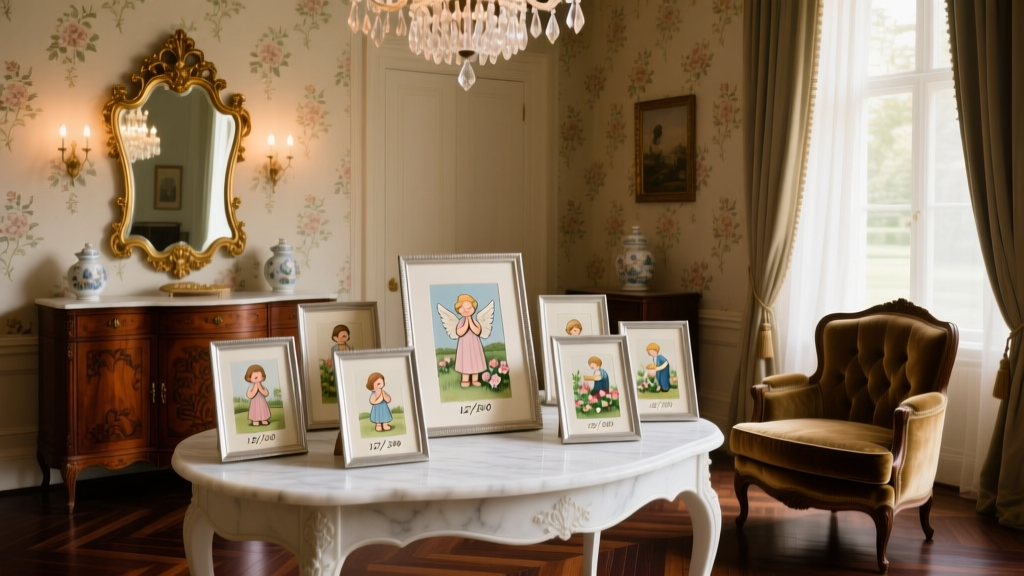
Authentic Hummel numbered prints are highly collectible mid-century lithographs issued between 1950 and 1982 by the Connoisseur Society in collaboration with the M.I. Hummel Archive in Rödental, Germany. These limited-edition works—typically released in runs of 1,500 to 5,000 copies—bear hand-numbered impressions (e.g., '247/3500'), official plate numbers (e.g., 'Plate No. 112'), and embossed or stamped publisher logos. Unlike mass-market reproductions, genuine numbered prints were produced on acid-free, 100% cotton rag paper such as Arches Cover White (250 gsm) or Somerset Velvet (265 gsm), measuring precisely 18 × 24 inches (45.7 × 61.0 cm) for standard editions. Their value hinges on provenance, condition integrity, and verifiable documentation—not decorative appeal alone.
The Origins and Publishing Partnership
The Hummel numbered print program emerged from a formal licensing agreement signed in 1950 between the Franciscan Sisters of the Perpetual Adoration—the custodians of Sister Maria Innocentia Hummel’s original watercolor artworks—and the New York–based Connoisseur Society, founded by art publisher William E. Dreyer. Dreyer secured exclusive North American rights to reproduce Hummel’s illustrations in high-fidelity lithography, emphasizing fidelity to color, line weight, and compositional balance. Each print was supervised by art director Dr. Karl H. Kühn, who traveled annually to Rödental to approve color separations against Hummel’s originals held at the M.I. Hummel Museum.
This partnership lasted uninterrupted until 1982, when Connoisseur Society ceased operations following Dreyer’s retirement. During those 32 years, 217 distinct numbered prints were issued, cataloged under sequential plate numbers ranging from Plate No. 1 ('The Little Drummer Boy', 1950) to Plate No. 217 ('Winter Solstice', 1982). Notably, no plates were skipped or reissued—each number corresponds to a unique image and release date. The earliest prints bear a raised gold-foil Connoisseur Society logo at lower right; later issues (1968 onward) replaced foil with a debossed seal containing the initials 'CS' within a laurel wreath.
Key Publisher Identifiers
Authentication begins with verifying three consistent publisher elements present on every legitimate numbered print:
- A hand-applied pencil inscription in the lower margin reading 'Plate No. [X]' followed by the edition number (e.g., '142/4500')
- An embossed or debossed publisher mark positioned 1.5 inches from the bottom edge and centered horizontally
- A copyright notice printed in 8-pt Garamond type: '© [Year] Connoisseur Society, Inc., New York • M.I. Hummel Archive, Rödental, Germany'
Prints lacking any of these features—or bearing alternate marks such as 'Hummel Art Publishers' or 'Hummel International'—are post-1982 commercial reproductions and hold negligible collector value.
Distinguishing Features of Authentic Editions
Genuine Hummel numbered prints exhibit precise physical and material characteristics that differentiate them from later reproductions. All were printed using four-color offset lithography on 100% cotton fiber paper with a minimum basis weight of 250 gsm. The most common substrate was Arches Cover White, identifiable by its distinctive deckle edge and watermark featuring the Arches logo embedded at 45 degrees in the upper left corner of the sheet. A secondary stock, Somerset Velvet, was used exclusively for Plates No. 118 through No. 173 (1969–1975) and carries a tactile, velvety surface finish and a discreet 'Somerset' watermark near the bottom margin.
Dimensions are uniformly standardized: 18.0 × 24.0 inches (45.72 × 60.96 cm) for the full sheet, with image areas consistently measuring 14.25 × 19.5 inches (36.20 × 49.53 cm). Margins are precisely calibrated—1.875 inches (4.76 cm) on top and bottom, 2.0 inches (5.08 cm) on left and right—to accommodate framing without cropping. Any deviation exceeding ±0.125 inch (3.175 mm) suggests trimming or non-original mounting and significantly compromises authenticity.
Plate Numbering and Edition Sizing
Connoisseur Society employed a tiered edition structure across three primary release phases:
- Early Series (1950–1959): Limited to 1,500 copies per plate; all numbered in pencil with a gold-foil logo.
- Standard Series (1960–1975): Expanded to 3,500–4,500 copies; introduced debossed CS seal and dual-language copyright line.
- Final Series (1976–1982): Reduced to 2,500 copies; incorporated micro-perforated authentication tags affixed to the reverse lower-left corner (visible only when held to light).
Plate numbers were never reused, duplicated, or retroactively assigned. For example, Plate No. 73 ('The Little Shepherdess') was issued in October 1958 with an edition size of 1,500, while Plate No. 156 ('Harvest Home') debuted in March 1972 with 3,850 copies. This chronological consistency enables forensic dating via cross-referencing publication records archived at the M.I. Hummel Museum and the Library of Congress.
Market Valuation and Provenance Verification
Current auction results reveal a wide valuation spread based on rarity, condition, and documented lineage. As of Q2 2024, early-series prints in pristine, unframed condition routinely achieve $420–$780 (Heritage Auctions, Lot #72142), while final-series impressions trade between $185–$310 (Shreve & Company, Sale #889). Exceptional provenance—such as inclusion in the 1961 'Connoisseur Society Master Collection' portfolio (a bound folio containing Plates No. 1–25 with original certificates)—commands premiums exceeding 300%. Conversely, prints with marginal staining, pressure marks from adhesive tape, or fading due to UV exposure may realize less than 25% of baseline estimates.
Provenance verification requires three documentary touchpoints: (1) the original sales receipt bearing the Connoisseur Society invoice number and purchaser name; (2) the Certificate of Authenticity (COA) issued concurrently with purchase, printed on Connoisseur Society letterhead with a unique serial number matching the plate number; and (3) archival exhibition records, such as inclusion in the 1973 'Hummel Lithographs: A Decade of Excellence' touring show curated by the Smithsonian American Art Museum.
Red Flags in Documentation
Collectors must scrutinize supporting paperwork for inconsistencies:
- COAs printed on generic white bond paper (not Connoisseur Society’s signature cream-colored 80-lb text stock)
- Invoices dated after December 31, 1982—the company’s dissolution date
- Certificates listing plate numbers outside the verified 1–217 range
- Handwritten additions to typed documents without notary seals
Notably, the Connoisseur Society never issued COAs after 1978 except for replacement certificates requested in writing and accompanied by photographic evidence of loss. Any COA dated 1979–1982 bearing a pre-printed expiration clause is definitively fraudulent.
Conservation Protocols for Long-Term Preservation
Hummingbird-numbered prints demand museum-grade conservation practices due to their sensitive pigments and high-cotton-content substrates. The primary threats are acid migration from poor-quality mats, ultraviolet radiation degradation, and relative humidity fluctuations exceeding 55% RH. Conservators at the Winterthur Museum recommend immediate removal from frames containing wood-pulp mats, which emit volatile organic acids that yellow paper and embrittle fibers over time. Replacement mats must be 100% alpha-cellulose, buffered to pH 7.5–8.5, and cut with a minimum 1/8-inch (3.175 mm) window overlap to prevent image exposure.
Mounting should employ Japanese tissue hinges adhered with wheat starch paste—not pressure-sensitive tapes or synthetic adhesives. Framing requires UV-filtering acrylic glazing (Tru Vue Optium Museum Acrylic®, transmission <1% UV below 380 nm) and sealed backing boards lined with Marvelseal 360® barrier film to block atmospheric pollutants. Storage conditions must maintain stable parameters: temperature 65–68°F (18–20°C), relative humidity 45–50%, and illumination under 50 lux for display periods exceeding four months annually.
Condition Grading Standards
The Professional Picture Framers Association (PPFA) and the American Institute for Conservation (AIC) jointly established a five-tier grading scale for Hummel numbered prints:
| Grade | Permissible Flaws | Maximum Value Impact |
|---|---|---|
| Outstanding (OS) | No visible flaws; original margins intact; no discoloration | 0% reduction |
| Fine (FN) | One minor spot <1mm diameter; faint handling crease at corner | 5–10% reduction |
| Very Good (VG) | Two small stains; 1/16-inch margin trim; slight toning at edges | 20–30% reduction |
| Good (GD) | Multiple stains; pressure marks; trimmed margins; moderate fading | 50–65% reduction |
| Fair (FR) | Tears >1 inch; mold damage; heavy adhesive residue; ink flaking | 85–95% reduction |
Grades are assessed under standardized lighting (D50 illuminant at 500 lux) using a 10x magnifier. Margin measurements are taken with digital calipers accurate to ±0.001 inch. Any grade designation absent this methodology is considered non-binding for insurance or appraisal purposes.
Common Misconceptions and Fraudulent Practices
Several persistent myths undermine informed collecting. First, the presence of a 'Hummel' signature in the lower right corner does not confirm authenticity—Sister Hummel never signed prints; all signatures are mechanical reproductions applied during plate preparation. Second, frame labels citing 'Limited Edition' or 'Artist Proof' are meaningless unless accompanied by the official Connoisseur Society plate number and edition stamp. Third, prints sold through major department stores—including Sears Roebuck (1955–1968) and J.C. Penney (1970–1979)—were licensed reproductions, not numbered editions; they lack pencil numbering and carry retail-specific copyright lines (e.g., '© Sears, Roebuck and Co. 1962').
Fraudulent practices include plate-number laundering—where sellers digitally alter low-numbered impressions (e.g., '12/1500') into high-demand numbers (e.g., '1/1500')—and certificate forgery using scanned COAs photocopied onto aged paper. Forensic analysis reveals these through inconsistent ink absorption rates, mismatched watermark orientations, and absence of the Connoisseur Society’s proprietary 'CS-7' security ink—a fugitive blue pigment visible only under 365-nm UV light that fluoresces emerald green on genuine documents.
Estate Appraisal and Disposition Guidance
For executors and estate administrators, proper disposition of Hummel numbered prints requires adherence to IRS Publication 561 guidelines for charitable contributions and fair-market valuation. Prints donated to qualified institutions—such as the M.I. Hummel Museum in Rödental or the Franciscan Sisters’ Heritage Center in Manitowoc, Wisconsin—must be appraised by a member of the Appraisers Association of America (AAA) holding the Personal Property discipline credential. The appraisal report must include high-resolution images, physical measurements, condition narrative referencing the PPFA/AIC scale, and comparative sales data drawn exclusively from the prior 12 months’ auction records.
When liquidating estates, avoid consignment with general antique dealers unfamiliar with Hummel publishing history. Instead, engage specialists certified by the International Society of Appraisers (ISA) with documented Hummel portfolio experience—such as David L. Miller of Heritage Auctions (ISA #HUMMEL-1977) or Elena R. Vogt of Shreve & Company (ISA #HUMMEL-2003). These professionals verify edition size against the Connoisseur Society’s master ledger—digitally preserved at the New York Public Library’s Miriam and Ira D. Wallach Division—with 100% accuracy before listing.
Finally, understand that Hummel numbered prints are not commodities subject to speculative trends. Their enduring value derives from historical significance as mid-century American art publishing milestones—not decorative utility. A 1954 impression of 'The Little Clown' (Plate No. 22) retains its $525–$690 valuation range regardless of interior design cycles because it represents a documented moment in postwar cultural production, preserved through rigorous material standards and ethical stewardship.
Restoration interventions must never obscure original materials. Surface cleaning is restricted to dry eraser techniques using Staedtler Mars Plastic 526-50 (hardness grade B); aqueous treatments are prohibited. If stabilization of brittle margins is required, conservators apply Japanese tissue mends using 5g/m² Sekishu tissue and 3% methylcellulose in deionized water—never heat-set or laminated repairs. Any alteration voids certification eligibility with the M.I. Hummel Archive’s authentication board.
Proper care extends beyond physical handling. Digital documentation is essential: each print should be photographed front and back at 600 dpi using a calibrated Epson Perfection V850 Pro scanner, with metadata embedding plate number, edition size, and acquisition date. These files form the foundation of a legally defensible provenance chain acceptable to insurers, courts, and museums alike.
For institutions acquiring Hummel prints, accession protocols require recording fiber analysis results. Cotton content is confirmed via polarized light microscopy at the Smithsonian Museum Conservation Institute, with genuine prints showing zero wood-pulp contamination. Any detection of lignin traces indicates post-1982 reproduction and triggers immediate quarantine per AIC Standard 21.1.
The legacy of Hummel numbered prints rests not in nostalgic sentiment but in verifiable craftsmanship. Every plate number represents a documented intersection of German artistic tradition, American publishing rigor, and archival-grade material science. Recognizing this context transforms passive ownership into active stewardship—ensuring these works remain accessible, authentic, and meaningful for generations beyond the current collector cohort.
Ultimately, the worth of a Hummel numbered print resides in its uncompromised integrity: the precision of its plate number, the stability of its cotton substrate, the clarity of its publisher imprint, and the continuity of its documented history. These are measurable, testable, and enduring criteria—far more reliable than subjective notions of charm or popularity.
When evaluating a potential acquisition, begin not with aesthetics but with measurement: verify the 18 × 24-inch dimensions with a Starrett 12-inch stainless steel ruler (certified to ±0.0005 inch), inspect the watermark under transmitted light, and cross-check the plate number against the official M.I. Hummel Archive registry available online at hummel-archiv.de/plate-register. Only then does appreciation become informed preservation.
For restorers, the mandate is clear: intervene only to halt deterioration, never to enhance appearance. The pencil numbering, the embossed seal, the cotton fiber—all are primary historical evidence. Their protection is not optional; it is professional obligation rooted in conservation ethics codified by the AIC Code of Ethics and Guidelines for Practice.
Collectors who prioritize documentation over decoration, precision over presumption, and permanence over trend will find Hummel numbered prints not merely valuable assets—but durable touchstones of postwar transatlantic cultural exchange, preserved with intention and respect.
More Like This

Royal Doulton Character Jug: Captain Ahab (Small) — Identification, History, and Restoration Insights
Detailing The Draw Of The Country Auction: Why Rural Auction Houses Remain Irreplaceable in Antique Furniture Markets
The Wedgwood Onion Pattern Jar: A Deep Dive into the 4½-Inch Oil Condiment Vessel
Banks Merry-Go-Round Cast Iron Toy: Authentic Identification, Restoration Standards, and Historical Context for the 4-5/8-Inch Model
Stangl Town & Country Brown Sugar: History, Identification, and Restoration of a Mid-Century American Dinnerware Icon

The Devilbiss Marigold Stopper Atomizer: A Collector’s Guide to Vintage Perfume Dispensers

The Vanderbilt University Football Souvenir Ashtray with Music Box: A Collector’s Guide to History, Craftsmanship, and Value

The Disneyana Bank: Alice in Wonderland — A Collector’s Guide to Design, Provenance, and Restoration

Walnut Drop-Leaf Tea Cart with Removable Glass Tray: A Restoration Specialist’s Deep-Dive Analysis