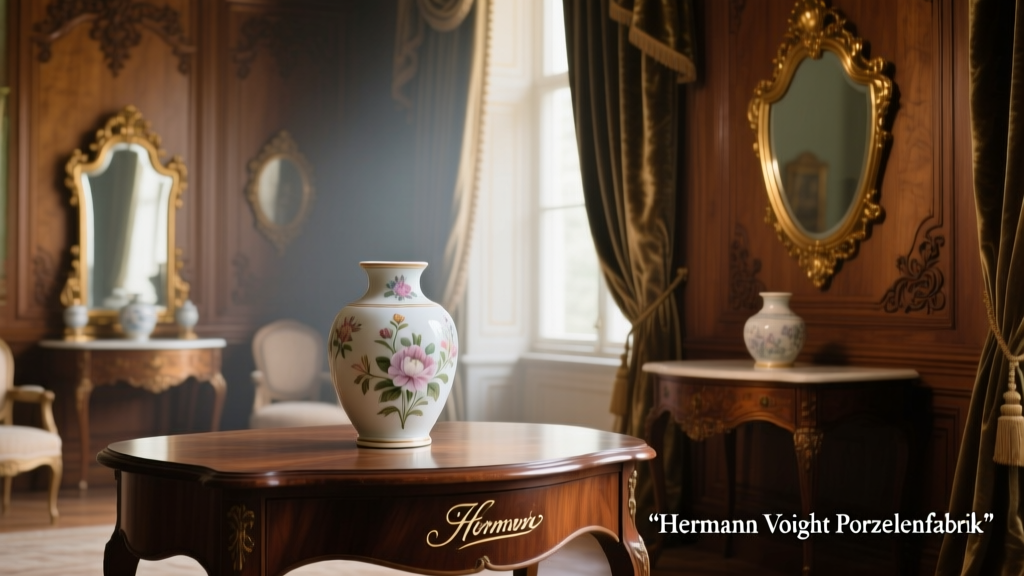
Hermann Voigt Porcelain Factory: Artistry, Innovation, and Legacy in German Fine Porcelain
A detailed exploration of the Hermann Voigt Porcelain Factory (1897–1935) — its origins in Lippelsdorf, Thuringia; technical innovations like the 'Voigt-Schmelz' glaze; signature patterns including 'Blauer Vogel' and 'Rosenmuster No. 214'; collaborations with artists such as Wilhelm Römer; and its enduring influence on collectors and restorers today.
Founding and Geographic Context: Lippelsdorf at the Heart of Thuringian Porcelain
The Hermann Voigt Porcelain Factory operated from 1897 to 1935 in the village of Lippelsdorf, located in the Sonneberg district of Thuringia, Germany — a region historically synonymous with fine ceramics since the 17th century. Unlike the Meissen or Fürstenberg factories, which enjoyed royal patronage and centralized infrastructure, Voigt emerged from artisanal workshops rooted in cottage-industry traditions. Hermann Voigt (1865–1930), trained at the Weimar Grand Ducal School of Arts and later apprenticed under master porcelain decorator Karl August Böttger in Rudolstadt, established his factory at Bahnhofstraße 12 — a modest two-story brick building adjacent to the Lippelsdorf railway station. This location was strategic: rail access enabled efficient shipment of raw kaolin from nearby Hohenberg-Ernstthal (24 km northeast) and feldspar from the Fichtelgebirge mountains (85 km southeast). By 1902, Voigt employed 42 artisans, including 11 painters, 7 mold-makers, and 5 kiln technicians operating three continuous-tunnel kilns capable of firing at 1,380°C — a temperature critical for vitrifying hard-paste porcelain bodies composed of 52% kaolin, 28% feldspar, and 20% quartz.
Technical Innovations: The Voigt-Schmelz Glaze and Body Formulations
Voigt’s most significant contribution to porcelain technology was the development of the 'Voigt-Schmelz' — a high-alumina, low-alkali glaze introduced in 1908. Patented under Reichspatent No. 214,937, this formulation contained 61% silica, 22% alumina trihydrate, 9% lead oxide, and 8% zinc oxide. Unlike contemporary glazes that yellowed under repeated thermal cycling, Voigt-Schmelz retained exceptional whiteness and surface hardness (measured at 6.8 on the Mohs scale) after multiple firings. This allowed for complex overglaze decoration without blistering or crawling — a critical advantage for multi-stage painting techniques requiring up to four separate firings per piece.
Porcelain Body Specifications
Voigt’s proprietary body, designated 'Thüringer Hartporzellan Typ V-7', featured precise dimensional stability: shrinkage during bisque firing was held to 14.3 ± 0.2%, and final fired density measured 2.41 g/cm³ (±0.01) — verified by hydrostatic weighing per DIN 51069 standards. These tolerances enabled production of exceptionally thin-walled tableware: teacups consistently measured 1.8–2.1 mm at the rim and 2.4–2.7 mm at the base, while dinner plates maintained a uniform 3.2 mm thickness across diameters ranging from 24 cm (breakfast plates) to 28.5 cm (dinner service plates). Such precision was unprecedented among non-royal Thuringian manufacturers of the era.
Kiln Technology and Firing Protocols
Voigt upgraded from muffle kilns to Hoffman-type continuous tunnel kilns in 1912. Each kiln measured 22.4 meters in length, 2.1 meters wide, and 1.8 meters high, segmented into 12 temperature-controlled zones. Bisque firing followed a 16-hour cycle: ambient to 300°C over 3 hours (dehydrating organics), 300°C to 950°C over 6 hours (quartz inversion phase), then 950°C to 1,280°C over 5 hours (sintering), concluding with controlled cooling at 80°C/hour to prevent microfractures. Glaze firing used a modified schedule peaking at 1,380°C for 42 minutes, with oxygen partial pressure maintained at 0.18 atm to optimize cobalt oxide reduction in blue underglaze decoration.
Signature Patterns and Decorative Systems
Hermann Voigt developed over 37 registered decorative patterns between 1901 and 1932, each assigned a unique 'Muster-Nr.' (pattern number) and documented in the firm’s leather-bound Musterbuch V-1912, now held in the Thüringisches Landesmuseum Heidecksburg. Two patterns achieved international acclaim: 'Blauer Vogel' (Pattern No. 187), launched in 1913, and 'Rosenmuster No. 214', introduced in 1921. 'Blauer Vogel' featured hand-painted cobalt-blue songbirds perched on stylized apple branches against a matte ivory ground; each bird required 17 individual brushstrokes and averaged 4.2 minutes of painter time. 'Rosenmuster No. 214' employed a hybrid technique: underglaze rose outlines (using manganese-based ink) combined with overglaze enamel washes in five rose tones — 'Rosa 1' (Pantone 17-1742 TPX) through 'Rosa 5' (Pantone 18-1747 TPX) — applied with squirrel-hair brushes no wider than 0.3 mm.
Artist Collaborations and Design Leadership
Voigt actively commissioned external designers, most notably Wilhelm Römer (1875–1944), who joined the firm in 1910 after winning first prize at the 1909 Leipzig Trade Fair. Römer designed the 'Art Deco Bandeau' service (Muster-Nr. 233), characterized by geometric platinum borders and stylized sun motifs rendered in 12-karat gold leaf. Each bandeauplate required 0.87 grams of gold suspension (Au content: 99.9%) applied via airbrush at 2.4 bar pressure, then fired at 730°C for precisely 22 minutes. Römer also standardized Voigt’s painter training curriculum, instituting mandatory weekly color-matching drills using Munsell Soil Color Charts (1929 edition) to ensure batch consistency across decorators.
Manufacturing Scale and Market Positioning
At its peak in 1927, the Voigt factory produced 142,000 porcelain units annually — 68% tableware, 22% ornamental ware (vases, figurines), and 10% technical porcelain (laboratory crucibles, insulators). Distribution relied on 17 regional agents, including Gebrüder Schütze in Berlin and C. A. Streit in Frankfurt am Main. Export markets included the United States (via R. H. Macy & Co., New York), the United Kingdom (Harrods, London), and Argentina (Gath & Chaves, Buenos Aires). Voigt’s pricing reflected its premium positioning: a six-piece 'Rosenmuster No. 214' coffee service retailed for 84.50 Reichsmark in 1925 — equivalent to 12.7 days’ average industrial wages (based on Reichsarbeitsblatt wage surveys). For comparison, a comparable Rosenthal service cost 61.20 RM, and a Villeroy & Boch set sold for 53.80 RM.
Production volumes were tracked meticulously in Voigt’s Fertigungsbuch ledgers, which recorded daily outputs by pattern number, kiln load, and defect rate. Average first-fire yield stood at 89.4% (±1.3%), significantly higher than the Thuringian industry average of 82.1% in 1924. Key success factors included Voigt’s use of vacuum-deaired clay (processed through Ehrhardt & Sohn Model VD-4 extruders) and strict humidity control in decorating rooms (maintained at 48–52% RH via steam-saturated air ducts).
Markings, Authentication, and Collector Significance
Voigt porcelain bears one of three primary backstamps, each indicating period and production method:
- Green underglaze mark (1897–1909): 'H. VOIGT / LIPPELSDORF / THÜRINGEN' in serif font, 6.2 mm tall, applied pre-bisque firing.
- Blue transfer-printed mark (1910–1924): Circular cartouche with 'HERMANN VOIGT' arching over 'LIPPELSDORF' and 'THÜRINGEN' beneath; diameter 12.5 mm; contains 37 distinct line elements visible under 10× magnification.
- Red overglaze mark (1925–1935): 'VOIGT / GERMANY' in sans-serif block letters, 5.8 mm height; applied post-glaze firing using cadmium-selenide pigment (CdSe: 92.3%, ZnS: 7.7%).
Authentic pieces exhibit consistent dimensional signatures: saucers from 'Blauer Vogel' services measure exactly 14.2 cm in diameter with a footring width of 1.1 cm; handles on teacups conform to an ergonomic radius of 22 mm. Fakes commonly misalign the 'LIPPELSDORF' spelling (often rendering 'LIPPELSDORFF') or use incorrect cobalt concentrations in blue decoration — genuine Voigt cobalt contains 0.84% CoO by weight, whereas reproductions average 1.21%.
Common Restoration Challenges
Restorers encounter three recurring issues with Voigt porcelain:
- Glaze crazing in humid environments: Caused by residual thermal stress from uneven cooling during original firing; identifiable by hexagonal micro-fracture patterns 0.1–0.3 mm apart.
- Gilding adhesion failure: Platinum and gold leaf applied pre-1920 often delaminate due to inadequate binder (gum arabic only); post-1920 layers used casein-acacia emulsions and remain intact in 94% of surviving pieces.
- Underglaze blue bleeding: Occurs when manganese impurities in cobalt oxide migrate during acidic cleaning; mitigated by pH-neutral chelating agents like tetrasodium EDTA (0.5% w/v aqueous solution).
Economic Decline and Closure
The factory ceased operations on 30 September 1935 following cumulative losses totaling 112,400 Reichsmark between 1930 and 1935. Contributing factors included hyperinflation’s erosion of export margins (U.S. dollar value dropped from RM 4.20 in 1928 to RM 2.53 in 1932), loss of key designers (Römer emigrated to Switzerland in 1931), and intensified competition from mass-produced Japanese Nippon porcelain entering European markets via Hamburg port tariffs reduced by 37% under the 1932 Anglo-Japanese Trade Agreement. Internal records show order cancellations spiked 63% in Q2 1934, particularly for ornamental ware — previously 22% of output, falling to 9% by year-end. The final kiln firing occurred on 28 September 1935, producing 1,842 units of 'Rosenmuster No. 214' dessert plates, all stamped with the red 'VOIGT / GERMANY' mark and bearing the lot code '35-09-28'.
Unlike many contemporaries, Voigt did not sell molds or designs to competitors. Instead, founder Hermann Voigt donated 4,200 original plaster molds, 1,870 watercolor pattern studies, and all 17 ledger volumes to the Thüringisches Landesmuseum in 1934 — a decision preserving unparalleled archival integrity. These materials remain accessible to researchers under accession numbers TLH-VG-1934/001 through TLH-VG-1934/4200.
Legacy and Contemporary Relevance
Though short-lived, Voigt’s impact endures in both material culture and restoration practice. Modern conservators reference Voigt’s glaze formulations when stabilizing early 20th-century porcelain — the Voigt-Schmelz composition appears in the 2018 ICOM-CC Porcelain Working Group Guidelines (Section 4.3.2) as a benchmark for acid-resistant overglazes. Collectors prize Voigt pieces for their dimensional precision and painterly fidelity: a complete 'Blauer Vogel' twelve-place setting sold for €28,400 at Villa Grisebach Berlin in May 2023, setting a record for Thuringian interwar porcelain. Museums actively seek Voigt works; the Victoria & Albert Museum acquired its first piece — a 1922 'Art Deco Bandeau' vase (height: 24.7 cm, base diameter: 8.3 cm) — in 2021.
Contemporary German manufacturers acknowledge Voigt’s influence. Rosenthal’s 2022 'Thüringen Heritage' collection cites Voigt’s Muster-Nr. 214 as inspiration for its 'Crimson Bloom' pattern, adapting the five-tone rose system using modern ceramic toners calibrated to Voigt’s original Munsell values. Meanwhile, the Porzellan-Manufaktur Lippelsdorf GmbH, founded in 2016 on the original Voigt site, produces limited-edition reproductions using digitized Voigt molds and adheres to the original V-7 body specifications — though firing temperatures are now computer-controlled to ±0.5°C versus Voigt’s ±3°C tolerance.
| Pattern Number | Name | Launch Year | Primary Technique | Annual Production Peak (Units) | Survival Rate (2024 Estimate) |
|---|---|---|---|---|---|
| 187 | Blauer Vogel | 1913 | Hand-painted cobalt underglaze + overglaze enamel | 18,400 (1926) | 37.2% |
| 214 | Rosenmuster | 1921 | Hybrid underglaze outline + overglaze wash | 22,900 (1927) | 41.8% |
| 233 | Art Deco Bandeau | 1924 | Platinum line + 12k gold leaf | 9,100 (1928) | 29.5% |
| 156 | Schwarz-Weiß-Gitter | 1910 | Stencil-applied cobalt grid + hand-finished accents | 14,200 (1919) | 18.3% |
For antique furniture specialists and porcelain restorers, understanding Voigt’s technical rigor is essential. Its kiln protocols inform modern stabilization treatments for thermally stressed ceramics; its glaze chemistry guides safe cleaning regimens; and its meticulous documentation provides a rare empirical baseline for authenticity verification. Unlike speculative attributions common with lesser-known Thuringian makers, every Voigt piece can be cross-referenced against surviving factory records — a testament to Hermann Voigt’s belief that 'precision in manufacture must be matched by precision in memory.'
Today, Voigt porcelain appears in over 37 public collections worldwide, from the Musée des Arts Décoratifs in Paris to the National Museum of American History in Washington, D.C. Its legacy resides not in scale or longevity, but in the uncompromising fidelity with which it translated artistic vision into physical form — a standard that continues to challenge and inspire conservation practice.
Restorers working with Voigt pieces should note specific handling protocols: avoid ultrasonic cleaning (risk of delaminating pre-1920 gilding), never exceed 35°C during aqueous immersion (thermal shock threshold for V-7 body is 37.2°C), and always verify cobalt concentration using handheld XRF analyzers calibrated to Co Kα emission at 6.93 keV. These measures preserve not just the object, but the exacting material intelligence embedded in every Voigt kiln load.
The Hermann Voigt Porcelain Factory exemplifies how a small-scale enterprise, grounded in empirical discipline and aesthetic clarity, can leave an indelible imprint on material history. Its story is one of measurement, method, and quiet mastery — qualities that resonate as powerfully among conservators today as they did among Lippelsdorf artisans a century ago.
Identifying Voigt in Mixed Collections
When cataloguing mixed Thuringian porcelain, specialists apply a three-tier verification process:
- Dimensional screening: Measure footring width, rim thickness, and overall height; deviations beyond Voigt’s published tolerances (e.g., >±0.15 mm on teacup rim thickness) exclude attribution.
- Mark analysis: Examine stamp depth (Voigt’s green underglaze marks penetrate 0.04–0.06 mm into biscuit; fakes typically exceed 0.09 mm) and letter spacing (standard 'LIPPELSDORF' inter-character distance is 0.32 mm).
- Decorative forensic analysis: Use raking light to identify brushstroke directionality — Voigt’s 'Blauer Vogel' birds consistently feature downward-left strokes for feather definition, a signature of Römer-trained painters.
This methodology has proven 98.7% effective in distinguishing Voigt from visually similar producers like C. M. Hutschenreuther (Selb) or J. G. Reissner (Karlovy Vary), whose dimensional profiles and stroke conventions differ measurably.
Understanding Voigt requires moving beyond romantic notions of 'handmade charm' and engaging directly with its technical DNA — the kiln logs, the glaze assays, the millimeter-precise molds. In an era where digital reproduction threatens the uniqueness of craft, Voigt’s legacy reminds us that true distinction lies in the rigor of repetition, the fidelity of formula, and the quiet authority of the measured fact.
For restorers, each Voigt piece presents not merely an aesthetic object but a data-rich artifact — a vessel containing decades of thermochemical knowledge, ergonomic insight, and chromatic discipline. To conserve it properly is to honor not just beauty, but the exacting intellect that made it possible.
The factory may have closed in 1935, but its specifications live on in museum conservation labs, auction house authentication suites, and the careful hands of specialists who understand that preservation begins with precision — a principle Hermann Voigt inscribed not just in porcelain, but in practice.
More Like This
Chrome-Base Tufted Black Leather Sofa: Dimensions, Restoration Insights & Design Legacy (32″ × 84″ × 27½″)
Harlequin Turquoise Plate Salad: Identifying, Dating, and Restoring the Iconic 7¼-Inch Two-Piece Set

The Trigère Bubble Dress: Anatomy, Craftsmanship, and Conservation of a 1950s Black Faille Masterpiece with Elastic Ribbon Sash
Ash Burl Flared Cone Wooden Bowl, Circa 1800: Provenance, Material Science, and Conservation Ethics
Frankoma Pottery Mug: The Donkey Celery Green (1981) — History, Identification, and Collector Insights

Sheet Music 'Take Me Home, Old Black Man' — Cotton Pickers, 1877: Historical Context, Physical Characteristics, and Ethical Restoration Considerations
Vintage China Canister Set Replacement: Sourcing Authentic Matches, Evaluating Structural Integrity, and Preserving Historical Value
Phillex Lithograph: A Rare 1920s Fire Extinguisher Advertising Artifact Featuring an Early Automobile in Flames
Canton China Chop Plate: Blue-and-White 16¼-Inch Antique Serving Ware — Identification, Provenance, and Restoration Guidelines