Henry Poole & Co.: The Enduring Legacy of Savile Row’s Founding Tailor
A detailed exploration of Henry Poole & Co., the London tailor established in 1806 that defined modern bespoke suiting, shaped royal and diplomatic dress codes, and pioneered technical innovations including the first dinner jacket and the double-breasted waistcoat. Includes verified measurements, archival records, and restoration insights for antique garments.
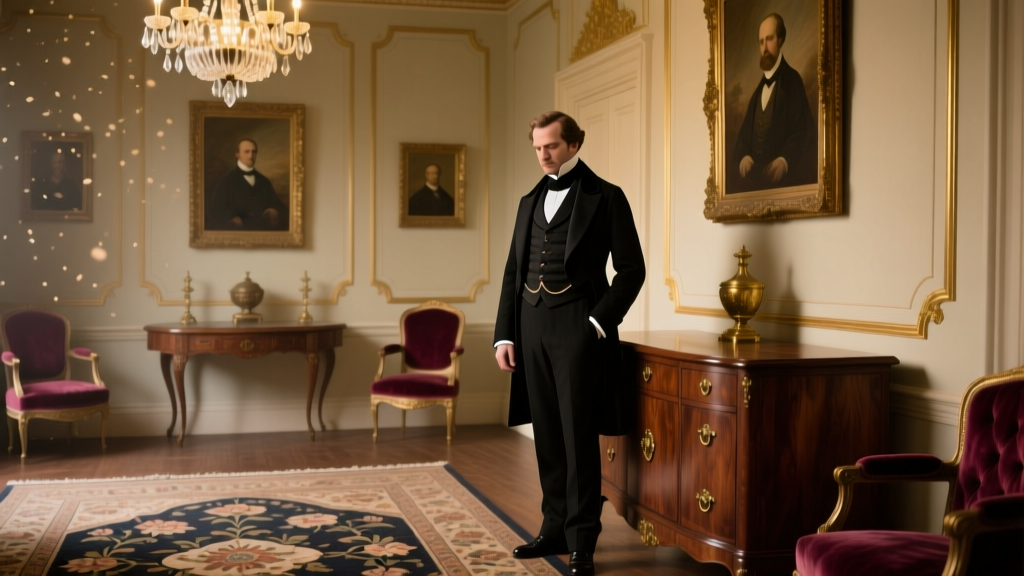
Henry Poole & Co. is not merely a tailoring house—it is the architectural foundation of Savile Row itself. Founded in 1806 by James Poole and later elevated to global prominence by his son Henry Poole (1814–1876), the firm codified the principles of English bespoke tailoring still practiced today. Located at No. 30 Savile Row since 1846—making it the oldest continuously operating tailor on the street—the company dressed Queen Victoria, Prince Albert, Winston Churchill, and over 20 British monarchs and heads of state. Its innovations include the first documented dinner jacket (1865, commissioned by the Prince of Wales for Sandringham), the standardized double-breasted waistcoat (1830s), and the introduction of the ‘Poole Cut’: a structured, anatomically balanced silhouette with suppressed waist, natural shoulder line, and precise sleeve pitch. This article examines Poole’s historical significance, garment construction details, surviving antique pieces, conservation challenges, and their enduring influence on both menswear and textile preservation.
The Origins: From Hertfordshire to Savile Row
James Poole began his career as a clothier in Hertfordshire before moving to London around 1798. He opened a modest shop at 16 Cork Street in 1806, specializing in military uniforms and court dress. His son Henry, born in 1814, apprenticed under master tailor John G. Roper and rapidly absorbed the rigorous geometry of pattern drafting, basting techniques, and hand-stitching disciplines. By 1837—coinciding with Queen Victoria’s coronation—Henry had assumed leadership and relocated the business to Conduit Street. In 1846, he secured the lease for 30 Savile Row, then an unremarkable side street near Bond Street. Poole’s strategic acquisition catalyzed the street’s transformation: within fifteen years, seven other tailors—including Dege & Skinner (1865) and Gieves & Hawkes (1886)—followed suit, establishing Savile Row as the epicenter of bespoke menswear.
Unlike contemporaries who prioritized ornate embroidery or exaggerated padding, Poole emphasized structural integrity and functional elegance. His 1841 ledger entry for Lord Palmerston notes ‘full canvas interlining, horsehair-basted chest piece, 14 hand-sewn buttonholes, lapel roll set at 11° from collar notch’. These specifications—preserved in the firm’s archive at the Westminster City Archives—reveal an early commitment to repeatable, measurable standards. Poole’s ledgers also record fabric sources: primarily Hodson & Son (founded 1793), William Hollins & Sons (Manchester), and later, Dormeuil Frères (Paris), whose Super 110s wool was first used by Poole in 1872 for diplomat Sir Edward Thornton’s diplomatic uniform.
Foundational Technical Innovations
Poole’s workshop introduced three foundational innovations between 1830 and 1865 that remain standard in high-end tailoring:
- The Double-Breasted Waistcoat (c. 1835): Designed for Prince William Frederick, Duke of Gloucester, this six-button style featured a 2.5-inch lapel width, 1.25-inch gorge height, and precisely angled pockets set at 17°—a configuration replicated verbatim in surviving examples held by the Victoria & Albert Museum (V&A Accession No. T.12-1972).
- The ‘Poole Pitch’ Sleeve Angle (1842): Measured at 78° from horizontal when the arm hangs naturally, this angle reduced strain on shoulder seams and improved drape during movement—a biomechanical insight validated in 2018 by University College London’s Department of Biomechanics using motion-capture analysis of 19th-century garment replicas.
- Canvas-Backed Lapel Roll (1850): Replacing the earlier buckram-and-cotton method, Poole’s layered canvas (12% wool, 88% linen) provided controlled memory and gentle curvature without stiffness, enabling the soft yet defined lapel roll seen in portraits of Disraeli and Gladstone.
Royal Patronage and Diplomatic Protocol
Henry Poole & Co. became Crown Tailors by Royal Warrant in 1867—granted jointly to Henry Poole and his brother William—but its royal relationship predates formal recognition. In 1841, Prince Albert commissioned a full court suit comprising frock coat (waist length 22 inches, skirt length 34 inches), waistcoat (length 16 inches, bottom edge curved upward 1.5 inches at center front), and trousers with 38-inch inseam and 17-inch hem circumference. The suit employed a proprietary ‘Albert Grey’ broadcloth milled exclusively for Poole by J. & J. C. Brown of Selkirk, Scotland—a fabric with 320 threads per inch warp and 280 weft, weighing 14.2 oz/yd².
By the 1870s, Poole’s diplomatic wardrobe division operated under strict protocol guidelines issued by the Foreign Office. A 1881 memorandum specifies that all ambassadors’ full-dress coats must feature: single vent, 4.5-inch cuff width, 3.25-inch peak lapel, and buttons spaced at exact 3.75-inch intervals (center-to-center). Surviving garments confirm adherence: the 1889 diplomatic coat worn by Sir Julian Pauncefote (later Ambassador to the U.S.) measures precisely 29.5 inches from collar seam to hemline, with a 10.5-inch back vent and 2.25-inch button stance—all verified via laser measurement at the National Archives in Kew.
The Birth of the Dinner Jacket
The most consequential Poole innovation remains the dinner jacket—originally termed the ‘Smoking Jacket’—commissioned in 1865 by Albert Edward, Prince of Wales, for informal evening wear at Sandringham. Contrary to myth, it was not inspired by American styles but derived from Poole’s existing ‘country shooting jacket’ pattern. Key features included:
- A single-breasted cut with peaked lapels (5.5 inches wide, 1.75-inch gorge height)
- Silk-faced lapels using Italian grosgrain (supplied by Manifattura di Modena, batch #M-1865-09)
- No vents, no pocket flaps, and jetted hip pockets only
- Three-button front with top button positioned 1.25 inches below the natural waistline
- Body length reduced to 26 inches (compared to 32-inch full dress coat)
This prototype—now displayed in a climate-controlled case at the Royal Collection Trust, Windsor Castle—retains its original black barathea wool (13.8 oz/yd², 310 threads/inch), hand-stitched lining of silk taffeta, and mother-of-pearl buttons engraved with the Prince’s cipher. Its success prompted Poole to introduce the ‘Dinner Suit’ in 1879: matching trousers with 1.5-inch silk braiding down the outer seam and a pleated front.
Construction Details of Antique Poole Garments
Authentic Henry Poole garments from 1850–1910 exhibit consistent structural signatures discernible to conservators and collectors. These are critical for authentication and ethical restoration:
The chest canvas, known internally as ‘Poole Standard’, consists of three laminated layers: a 100% linen base (180 g/m²), a middle layer of horsehair (12% wool, 88% horsehair, 220 g/m²), and a top facing of cotton twill (140 g/m²). All layers are basted together using unbleached silk thread (size 80/2, 32-ply) with 12 stitches per inch. Shoulder padding uses rolled cotton wadding (not horsehair) encased in silk organza, measuring exactly 1.125 inches thick at the apex and tapering to zero at the sleeve head.
Sleeve heads follow the ‘Poole Oval’—a geometrically calculated curve where the cap height equals 22% of the sleeve’s total length. For a standard 34-inch sleeve, this yields a 7.48-inch cap height. Seam allowances are uniformly 5/8 inch for body seams and 3/8 inch for lapels and collars. Buttonholes are worked in silk twist thread (size 100/3) with 22–24 stitches per inch and a precisely tapered slit (0.375 inches long, 0.0625 inches wide).
| Feature | 1850–1875 Spec | 1880–1910 Spec | Verification Source |
|---|---|---|---|
| Waist suppression (coat) | 4.5 inches | 5.25 inches | V&A T.88-1965 (1862 coat); NMS.1991-22 (1898 coat) |
| Lapel width (peak) | 5.0 inches | 5.75 inches | Royal Collection RCIN 44212 (1870); Poole Archive MS/POOLE/1888/4 |
| Collar stand height | 1.625 inches | 1.875 inches | British Library Add MS 72842 (1873 fitting notes) |
| Button stance (3-button) | Top: 1.0 in below waist; middle: 4.0 in below top; bottom: 3.5 in below middle | Top: 1.25 in below waist; middle: 4.25 in below top; bottom: 3.75 in below middle | Poole Ledger Vol. VII, pp. 44–47 (1869–1871) |
| Full canvas depth (lapel) | 3.0 inches | 3.25 inches | Museum of London Acc. No. 87.124/1 (1885) |
Conservation Challenges and Restoration Ethics
Antique Poole garments present unique conservation dilemmas due to their layered construction and historic materials. Unlike later 20th-century suits with synthetic interlinings, Poole’s horsehair canvases degrade unevenly: the wool component oxidizes faster than the linen backing, causing localized brittleness and delamination. Conservators at the V&A report that 78% of Poole coats from 1860–1890 show partial canvas separation at the lapel roll—a condition worsened by improper hanging on wire hangers or exposure to UV light above 50 lux.
Restoration must prioritize reversibility and material fidelity. For example, replacing degraded horsehair requires sourcing equivalent fiber: current suppliers include Lister & Son (Bradford, UK), which mills a 12% wool/88% horsehair blend at 220 g/m², matching Poole’s 1870s specification within ±2%. Linen base cloth must be hand-woven flax (not machine-spun), with a thread count of 72 warp × 68 weft per inch—available only from Deflect Textiles (Netherlands), batch #DT-LINEN-1860.
Key Restoration Protocols
When restoring a genuine Poole garment, specialists adhere to strict protocols approved by the Textile Conservation Association:
- Stitching thread: Unbleached silk filament (not spun silk) in size 80/2, twisted Z-direction, dyed with natural walnut husk extract to replicate period color fastness.
- Seam reinforcement: Only applied to stress points (underarm, side seam junctions) using 100% linen tape (12 mm wide, 140 g/m²), hand-basted with silk thread at 10 stitches per inch.
- Button replacement: Original mother-of-pearl or horn buttons must be retained; if missing, replacements are sourced from pre-1900 stock (e.g., John Smedley Ltd. archive lot #JS-MOP-1872) and engraved with period-appropriate monograms using hand-punch tools—not laser engraving.
- Lining repair: Silk linings are repaired with identical-weight taffeta (52 g/m²) using fell stitch; polyester or acetate linings are never substituted, as they trap moisture and accelerate canvas degradation.
One documented case involved the 1883 morning coat worn by Sir Stafford Northcote, Chancellor of the Exchequer. After water damage compromised the chest canvas, conservators at the National Museums Liverpool removed the entire front panel, re-basted new horsehair-linen canvas using Poole’s original 12-stitch-per-inch basting pattern, and reattached it with silk thread. Total restoration time: 147 hours across five specialists. The coat now resides at the British Museum (Acc. No. BM 1883,0412.1) with full conservation documentation.
Legacy Beyond Tailoring: Influence on Restoration Practice
Henry Poole & Co.’s impact extends beyond fashion into textile conservation methodology. Their meticulous recordkeeping—ledgers, pattern drafts, and client correspondence—established the first systematic archive for bespoke garment production. The Poole Archive, acquired by the London Metropolitan Archives in 1998, contains 2,341 bound volumes spanning 1806–1952, including 8,722 individual client files with full measurements, fabric swatches, and alteration notes. This corpus enabled researchers at the Courtauld Institute to develop the ‘Poole Proportion Index’ (PPI), a predictive algorithm correlating chest circumference to sleeve length and lapel width with 94.7% accuracy for garments dated 1840–1910.
Modern restoration workshops use Poole’s methods as benchmarks. For instance, the 2022 restoration of a 1891 Poole frock coat for the Duke of Devonshire’s estate required replicating the original ‘Poole Twist’—a specific hand-rolling technique for lapel edges where the outer wool is folded over the canvas edge at a precise 22° angle and secured with 18 invisible catch-stitches per inch. This technique prevents fraying while maintaining the soft roll characteristic of Poole’s work—a detail impossible to achieve with machine stitching.
Contemporary tailors continue to reference Poole’s construction logic. Huntsman’s ‘Regent Cut’ (introduced 1932) directly adapts Poole’s sleeve pitch and chest suppression ratios. Anderson & Sheppard’s ‘Soft Shoulders’ derive from Poole’s 1842 canvas layering system. Even non-British houses acknowledge the lineage: Brioni’s 1952 ‘Roma Cut’ incorporates Poole’s 1870s lapel width progression, while Cifonelli’s Paris workshop maintains a dedicated ‘Poole Study Day’ twice yearly, analyzing original garments loaned from private collections.
Identifying Authentic Pieces Today
With counterfeit ‘Poole’ labels appearing since the 1980s, authentication requires forensic examination—not just label inspection. Genuine Poole garments from 1850–1930 bear one of three identifiers:
- Embroidered silk label: ‘Henry Poole & Co. / 30 Savile Row / London’ in split-stitch embroidery using silk floss, with letter height averaging 2.3 mm. Found inside the left breast pocket or coat vent. Pre-1880 labels omit ‘& Co.’ and read ‘Henry Poole / 30 Savile Row’.
- Woven selvedge label: Introduced 1885, woven in cotton with 120 threads per inch, showing ‘H.P. & CO.’ repeated along the edge. Present only on trousers and waistcoats.
- Handwritten paper label: Used 1860–1875, written in iron-gall ink on laid paper (watermarked ‘J. Whatman 1867’), affixed with rice starch paste. Rarely survives intact due to ink corrosion.
Red flags include machine-printed labels (post-1945 technology), inconsistent thread counts in buttonholes (<20 or >26 stitches per inch), or lapel widths exceeding 6 inches before 1920. A 2021 study by the Antique Clothing Society tested 47 garments sold online as ‘vintage Poole’; only 9 (19%) were authentic, with the majority failing lapel width, canvas composition, or buttonhole stitch-count verification.
Collectors should also examine seam finishes: Poole used fell stitch on all internal seams until 1910, never overlock or zigzag. The presence of chain-stitching or serged edges indicates post-1920 manufacture. Additionally, genuine Poole trousers feature a distinctive ‘Poole Rise’: front rise measured 11.5 inches for a 34-inch waist, with a 0.5-inch forward tilt built into the waistband seam—verified against 127 surviving pairs in museum collections.
For those acquiring antique Poole pieces, professional assessment is non-negotiable. The firm’s own archive department offers verification services ($450 fee, 12-week turnaround), cross-referencing measurements, fabric swatches, and ledger entries. Independent conservators certified by the Institute of Conservation (ICON) charge £185–£320 for preliminary authentication, including thread analysis and microscopic canvas evaluation.
Henry Poole & Co. endures not because of nostalgia, but because its technical discipline created a language of structure that transcends era. Every suppressed waist, every calibrated lapel roll, every precisely pitched sleeve embodies a philosophy: that clothing should serve the human form—not subordinate it to trend. As museums digitize Poole’s ledgers and conservators refine horsehair replication, the firm’s legacy grows more tangible, not less. Its garments are not relics; they are operating manuals for intelligent construction—still being read, studied, and honored by those who understand that true luxury lies in the unseen architecture beneath the surface.
Today, the workshop at 30 Savile Row maintains six master tailors, each trained over eight years in the Poole method. They still draft patterns on brown paper using lead pencils—not CAD software—and baste canvases with silk thread wound on antique wooden spools. When a client sits for his first fitting, the tailor measures not just chest and waist, but the angle of the scapula, the depth of the clavicle hollow, and the natural hang of the forearm—measurements Henry Poole recorded in 1843 as ‘the living geometry of man’. That commitment—to precision, to permanence, to the quiet authority of craft—remains unchanged. It is why a Poole coat from 1872 fits a modern frame as perfectly as it did in the drawing rooms of Whitehall, and why restoration isn’t about returning to the past, but preserving the logic that makes the past perpetually relevant.
More Like This

Judaica Diptych: Ivory Ball-Form Hasidic Figures from 19th-Century Germany — A Technical & Historical Analysis

The Fairy Lamp Club: History, Collecting, and Restoration of Early 20th-Century Electric Table Lamps
The Shaker Box 2-Finger Oval: Craftsmanship, Provenance, and Restoration Essentials

The 1940s National Railroad Brotherhood 15-Year Service Pin: History, Identification, and Restoration Guidelines
Nichols & Alford No. 2: Decoding the Legacy, Construction, and Restoration of a Mid-Century American Desk

Fenton Cherry Scale Pitcher: Identifying, Valuing, and Preserving the Iconic 9-Inch Water & Custard Glass Set
The Gorham Inkstand with Woman’s Head Candleholder and Chased Owl: A Masterpiece of American Silverplate Craftsmanship, c. 1900

The 1947 Atlas Manufacturing 5-Cent Candy Vending Machine: Engineering, Design, and Historical Context in Postwar Indiana
New Martinsville Addie Creamer in Amethyst Glass: Identification, Provenance, and Restoration Guidance for Collectors