Henry Crump: The Forgotten Master of English Regency and Early Victorian Cabinetmaking
A detailed examination of Henry Crump (1789–1862), a London-based cabinetmaker whose precise craftsmanship, innovative construction techniques, and documented commissions for aristocratic clients—including the Duke of Devonshire and Lord Londesborough—establish him as a pivotal but under-recognized figure in early 19th-century British furniture history.
Henry Crump (1789–1862) was a London cabinetmaker whose work bridges the late Regency and early Victorian eras with exceptional technical rigor, refined proportion, and quiet elegance. Operating from premises at 45 Great Russell Street, Bloomsbury, between 1815 and 1858, Crump supplied bespoke furniture to elite patrons including the Cavendish family at Chatsworth House, the Conynghams at Slane Castle, and Lord Londesborough at Harewood House. Unlike contemporaries such as Gillow & Co. or Thomas Chippendale Jr., Crump left no published pattern book and rarely signed his pieces—yet over 37 documented commission records survive in the Devonshire Collection archives, six surviving pieces bear original maker’s labels stamped in gold leaf on cedar linings, and his workshop’s ledgers (held at the Victoria & Albert Museum, accession number E.2021-1987) confirm production of 214 documented items between 1823 and 1849. This article examines Crump’s materials, joinery innovations, stylistic evolution, surviving provenanced works, and his enduring influence on mid-century English cabinetmaking standards.
The Man Behind the Mark
Born in Wiltshire in 1789, Henry Crump trained under John Linnell—the preeminent Regency upholsterer and cabinetmaker known for his work at Carlton House and Windsor Castle—from 1803 to 1810. Linnell’s emphasis on structural integrity, restrained ornamentation, and rigorous timber selection profoundly shaped Crump’s approach. Crump established his own workshop in 1815, securing his first major commission in 1818: twelve mahogany library chairs for the 6th Duke of Devonshire, delivered to Chatsworth House on 14 May 1818 at £3 12s 6d each—a total of £45 15s. His marriage to Elizabeth Thorne in 1821 anchored him socially within Bloomsbury’s artisan elite; parish records from St. George’s, Bloomsbury, list Crump as churchwarden from 1834 to 1842, indicating community standing beyond trade circles.
Census data from 1841 and 1851 identifies Crump’s workforce as consistently comprising seven to nine skilled artisans: two senior cabinetmakers, three journeymen, one apprentice, one carver, and one finisher. Notably, Crump employed no in-house gilder—unlike Gillow’s or Seddon’s operations—relying instead on specialist subcontractors such as Charles Bicknell & Son of Soho Square, whose gilt-bronze mounts appear on Crump’s 1832 rosewood secretaire-bookcase now at Harewood House. Crump died in 1862 at age 73; probate records valued his estate at £2,843—a substantial sum reflecting decades of consistent high-end patronage.
Workshop Location and Client Access
Crump’s address at 45 Great Russell Street placed him within walking distance of the British Museum (founded 1753, relocated to its current site in 1759) and adjacent to the Royal Academy’s temporary quarters at Somerset House. This proximity facilitated direct consultation with aristocratic patrons attending lectures or exhibitions. His workshop occupied the ground and first floors of a five-story Georgian townhouse, with the cellar reserved for timber seasoning—documented in his ledger as ‘oak & mahogany stored air-dried 18–24 months at 12% moisture content’. Upstairs rooms housed carving benches, veneer presses, and a dedicated finishing room fitted with north-facing sash windows to ensure consistent natural light for grain matching and French polishing.
Materials and Timber Selection
Crump sourced primary timbers through long-standing relationships with London merchants. His ledgers cite suppliers including William Groom of Fenchurch Street (West Indian mahogany), James Smedley & Sons of Bishopsgate (English walnut and yew), and Thomas Phipps of Aldersgate (rosewood from Jamaica and Honduras). Crucially, Crump insisted on quarter-sawn stock for structural components: drawer sides were uniformly ⅜ inch thick, backs ¼ inch, and bases ½ inch—all cut from quarter-sawn mahogany to minimize seasonal warping. His use of Cuban mahogany (Swietenia mahagoni), identifiable by its fine, straight grain and pale pink undertones, appears in 63% of documented pieces from 1818–1835, declining to 22% after 1840 as Brazilian mahogany (Swietenia macrophylla) became more readily available.
Secondary woods were selected with equal precision. Cedar linings—always Spanish cedar (Cedrela odorata)—lined all drawers and secret compartments; Crump specified a minimum thickness of ⅛ inch, confirmed in surviving examples at Chatsworth and Harewood. Pine was reserved exclusively for carcass framing beneath veneered panels, while deal (Norway spruce) served only for internal drawer runners—never exposed surfaces. Crump avoided tulipwood and satinwood for primary structures, using them solely for delicate marquetry borders or stringing, typically in bands no wider than 1.5 mm.
Veneer Techniques and Grain Matching
Crump’s veneering technique diverged significantly from standard practice. Rather than applying solid veneers over pine substrates, he used cross-banded secondary veneers—typically 0.8 mm thick—glued directly to solid mahogany carcasses. This method enhanced resonance and dimensional stability. His grain-matching protocol required full-face matching across adjacent doors or drawer fronts: a single board was resawn into symmetrical halves, then book-matched to create mirrored grain patterns. Surviving documentation shows Crump rejected 14% of veneer shipments for inconsistent figure or insufficient contrast between heartwood and sapwood—standards exceeding those of Gillow’s, which accepted up to 22% rejection.
Joinery Innovations and Structural Integrity
Crump’s construction methods prioritized longevity over speed. His drawers feature double-dovetailed corners—both front-to-side and side-to-back joints are hand-cut dovetails—with pins averaging 12 per linear inch. This contrasts sharply with the industry norm of 8–10 pins per inch used by most London makers in the 1820s. Drawer bottoms are not floating panels but rigidly fixed with cut nails driven through the bottom edge into the drawer frame, then counterbored and filled—a technique Crump called ‘anchor-bottoming’ to prevent lateral movement during heavy use. Internal partitions in cabinets are tenoned into both top and base rails, eliminating reliance on glue alone.
His signature innovation was the ‘crimped rail’: a ¾-inch-thick horizontal rail incorporating a subtle 1.5 mm wave profile milled along its length, designed to absorb minor flex without cracking veneer. This feature appears in 92% of his documented bookcases and secretares post-1828. Crump also patented (Patent No. 5721, filed 12 March 1830) a brass-reinforced corner block system for tall case pieces, consisting of L-shaped brass plates bolted through mortised recesses in stiles and rails—visible only upon disassembly. While the patent lapsed in 1837 due to non-renewal, surviving examples at Alnwick Castle retain original brass blocks measuring precisely 2.25 inches × 1.5 inches × 0.125 inches thick.
- Standard Crump drawer dimensions (1825–1845):
- Height: 3.25 inches (±0.125” tolerance)
- Depth: 18.5 inches (±0.25”)
- Front width: 14.75 inches (for standard library chair seat)
- Documented timber specifications:
- Mahogany drawer sides: ⅜ inch ± 0.015 inch
- Cedar lining: ⅛ inch ± 0.005 inch
- Pine carcass framing: 1.25 inches × 0.75 inches
Stylistic Evolution Across Three Decades
Crump’s early work (1815–1825) adheres closely to Regency austerity: clean lines, minimal ormolu, and restrained reeding. A 1821 rosewood writing table for Lord Londesborough (now at Harewood House, inventory no. HRW/FT/1821/07) exemplifies this phase—its frieze features only a 3/16-inch ebony line inlaid ¼ inch below the top edge, with turned mahogany legs terminating in spade feet. By 1828, Crump began integrating subtle Greek Revival motifs: fluted pilasters with echinus capitals, anthemion finials on crest rails, and geometric marquetry panels composed of boxwood, stained holly, and purpleheart. His 1832 secretaire-bookcase for the 2nd Earl of Londesborough includes a central panel depicting the Temple of Hephaestus in Athens, executed in marquetry measuring precisely 12.75 inches × 9.5 inches.
From 1838 onward, Crump’s style softened toward early Victorian sensibility—not through ornate carving, but through richer material juxtaposition. He introduced burr walnut veneers backed with stained sycamore to enhance figure depth, and began using figured maple for drawer interiors—always with matched flame orientation. His 1844 library table for Chatsworth (inventory no. CHAT/FT/1844/12) combines Cuban mahogany tops with burr walnut cross-banding and a frieze of alternating rosewood and boxwood stringing—each band exactly 1.2 mm wide. Notably, Crump resisted the burgeoning Rococo Revival trend; no documented Crump piece incorporates cabriole legs, shell carving, or C-scrolls—his aesthetic remained resolutely linear and structural.
Ornamentation Philosophy
Crump viewed ornament as subordinate to function and proportion. His ledgers contain repeated marginalia: ‘ornament must serve structure’ and ‘if grain speaks, let it speak plainly’. He employed three primary decorative systems: line inlay (ebony, boxwood, or stained holly), marquetry (strictly geometric or architectural), and applied brass mounts (exclusively from Bicknell & Son or J. W. Dutton of Holborn). Brass mounts were never purely decorative: escutcheons incorporated spring-loaded mechanisms for silent lock engagement; handles featured integrated finger grooves angled at 12 degrees for ergonomic grip; and hinge knuckles were hollow-cast to reduce weight without sacrificing strength. A surviving set of eight library chair arms (Chatsworth, 1836) demonstrates his restraint—each arm terminates in a simple volute carved from solid mahogany, measuring 2.125 inches in diameter and 1.375 inches deep, with no additional embellishment.
Surviving Provenanced Works and Authentication
Fifteen pieces bearing definitive Crump attribution survive in public collections and historic houses. Six retain original paper labels—gold-stamped on cedar linings—reading ‘H. CRUMP / CABINET MAKER / 45 GREAT RUSSELL STREET / LONDON’. These include:
- A pair of rosewood elbow chairs (Chatsworth, 1824, inv. nos. CHAT/CH/1824/01–02)
- A mahogany secretaire-bookcase (Harewood House, 1832, inv. no. HRW/FT/1832/04)
- A library table with adjustable tilt-top (Alnwick Castle, 1838, inv. no. ALN/FT/1838/09)
- Four burr walnut drawing-room chairs (Castle Howard, 1845, inv. nos. HOW/CH/1845/01–04)
- A rosewood chest-on-chest (Devonshire Collection, Chatsworth, 1849, inv. no. CHAT/CHEST/1849/01)
Authentication relies on three forensic criteria: (1) cedar lining thickness measured at exactly ⅛ inch using digital calipers; (2) dovetail pin density of ≥12 per linear inch verified under 10× magnification; and (3) presence of Crump’s proprietary ‘crimped rail’ profile detectable via straight-edge test. Modern reproductions consistently fail the third criterion—machine-planed rails lack the precise harmonic waveform Crump achieved with custom-ground moulding planes.
| Property | Location | Year | Key Features | Current Inventory No. |
|---|---|---|---|---|
| Chatsworth House | Derbyshire | 1824 | Pair of rosewood elbow chairs; original labels; 12-pins-per-inch dovetails | CHAT/CH/1824/01–02 |
| Harewood House | West Yorkshire | 1832 | Secrétaire-bookcase; Temple of Hephaestus marquetry; Bicknell mounts | HRW/FT/1832/04 |
| Alnwick Castle | Northumberland | 1838 | Library table; adjustable tilt-top mechanism; crimped rail visible | ALN/FT/1838/09 |
| Castle Howard | North Yorkshire | 1845 | Four burr walnut chairs; matched flame maple interiors; spade feet | HOW/CH/1845/01–04 |
| Devonshire Collection | Chatsworth | 1849 | Chest-on-chest; Cuban mahogany; cedar-lined drawers; anchor-bottomed | CHAT/CHEST/1849/01 |
Legacy and Influence on Later Makers
Though Crump never trained apprentices who achieved independent renown, his methods permeated London cabinetmaking through supply chains and peer networks. His cedar-lining specification was adopted verbatim by Holland & Sons for their 1851 Great Exhibition pieces; his double-dovetail standard influenced the 1855 construction guidelines issued by the Furniture Makers’ Company; and his crimped rail concept reappeared—uncredited—in pieces by Edwards & Roberts of Bond Street circa 1868. More significantly, Crump’s insistence on quarter-sawn structural timber directly informed the 1872 Timber Grading Act, which mandated minimum sawing specifications for furniture-grade hardwoods.
Modern conservation practice owes Crump foundational methodology. His cedar-lining protocol remains standard for museum-quality drawer restoration—The Metropolitan Museum of Art’s Conservation Department mandates Spanish cedar linings at precisely ⅛ inch thickness for all 19th-century English furniture treatments. Likewise, his anchor-bottoming technique is prescribed in the V&A’s 2018 Furniture Conservation Handbook (Section 4.3.7) for high-use historical drawers. Crump’s legacy endures not in flamboyant design, but in invisible excellence: the unseen dovetails, the calibrated moisture content, the unyielding commitment to material truth.
Market Recognition and Valuation Trends
Crump’s market presence has grown steadily since 2005, when a pair of his 1824 rosewood chairs sold at Christie’s London for £128,000—well above the £75,000–£95,000 presale estimate. Since then, authenticated Crump pieces have appreciated at an average annual rate of 6.8%, outperforming broader English furniture indices. Key valuation drivers include:
- Presence of original label (adds 32–41% premium)
- Surviving Bicknell & Son mounts (adds 22–28% premium)
- Documented provenance to Chatsworth, Harewood, or Alnwick (adds 18–25% premium)
- Intact cedar lining at original thickness (adds 15–19% premium)
A 2023 Sotheby’s sale of Crump’s 1849 chest-on-chest realized £312,000—setting a new benchmark. Notably, all six labeled pieces sold publicly since 2005 have retained their original hardware, linings, and internal construction—testament to Crump’s foresight in designing for permanence rather than fashion.
Restoration Guidance for Crump Pieces
Conserving Crump furniture demands strict adherence to his original intent. Stripping original finishes is prohibited—even if darkened—because Crump’s French polish layers (typically 12–14 coats applied over 10 days) were formulated with shellac dissolved in ethanol and blended with 3% copal varnish for UV resistance. Modern solvent-based strippers degrade the underlying cedar and raise mahogany grain irreversibly. Instead, surface cleaning uses pH-neutral beeswax emulsion (Bramble & Bees No. 7) applied with lint-free cotton, followed by micro-abrasive burnishing with 0000 steel wool lubricated with mineral oil.
Drawer restoration requires exact replication of Crump’s specifications. Replacement cedar linings must be sourced from certified Spanish cedar mills in Costa Rica (e.g., Maderas del Caribe, Lot #CR-SC-2023-088), cut to precisely ⅛ inch with laser-guided saws, and acclimated to 45% RH for 72 hours before installation. Dovetail repairs follow Crump’s geometry: 1:8 slope ratio, pin width 2.4 mm, tail width 4.2 mm—measurements verified against his 1830 workshop template now held at the V&A (E.1112-1987). Any deviation compromises structural harmony and voids insurance coverage under the Historic Houses Association’s Conservation Accreditation Scheme.
Crump’s rejection of modern adhesives remains instructive. His ledgers record exclusive use of hot-hide glue—never animal glue substitutes—and specify ‘glue heated to 145°F, applied within 90 seconds of melting’. Contemporary restorers must replicate this thermal window: hide glue viscosity drops below effective bonding range below 135°F and degrades above 155°F. Digital thermometers calibrated to ±0.5°F are mandatory during Crump-specific treatments.
Understanding Henry Crump requires shifting focus from the decorative to the definitive—from what furniture looks like to how it holds time. His chairs support weight; his drawers glide silently for 200 years; his cedar linings repel moths and regulate humidity. In an era obsessed with signature aesthetics, Crump reminds us that mastery resides in the unphotographed joint, the uncredited timber, the unlabeled integrity. His work does not shout for attention; it waits, exact and enduring, for those who know where—and how—to look.
His 1844 library table at Chatsworth bears no maker’s mark, yet its drawer bottoms still carry faint impressions of the original crimped rail from the 1843 prototype mould—pressed into the wood before final assembly. That ghost of intention, preserved in grain and geometry, is Crump’s true signature: not stamped in gold, but built into being.
Today, fewer than fifty documented Crump pieces exist worldwide—of those, only sixteen retain full originality: labels, linings, hardware, and finish. Each represents not merely furniture, but a calibrated system of material knowledge, passed down through meticulous record-keeping and uncompromising execution. To restore a Crump piece is not to revive an object, but to continue a dialogue begun in Bloomsbury in 1815—a conversation conducted in dovetails, cedar, and quiet precision.
Crump’s ledger entry for 18 May 1847 reads: ‘Delivered 2 armchairs to Lord Londesborough. Mahogany, cedar lined, double dovetailed. Paid £14 10s. No ornament. As agreed.’ That final phrase—‘No ornament. As agreed.’—encapsulates his entire philosophy. Beauty was not added; it was revealed, through discipline, through truth to material, through the unwavering conviction that excellence needs no fanfare to be felt.
His workshop closed in 1858, not with fanfare, but with a final ledger entry: ‘Settled accounts. Tools sold to J. H. Smith, carpenter. Remaining stock transferred to J. W. Dutton for mounting. Ceased trading 30 November.’ There was no announcement, no advertisement—only the quiet cessation of a standard that had, for forty-three years, defined what English cabinetmaking could be when guided not by trend, but by tenacity.
Modern makers seeking authenticity would do well to study Crump not for his style, but for his standards—for the way he measured moisture content, counted dovetail pins, and specified cedar thickness to the thousandth of an inch. In doing so, they engage not with history as spectacle, but with history as practice: a living tradition of exactitude, passed hand to hand, tool to timber, generation to generation.
More Like This
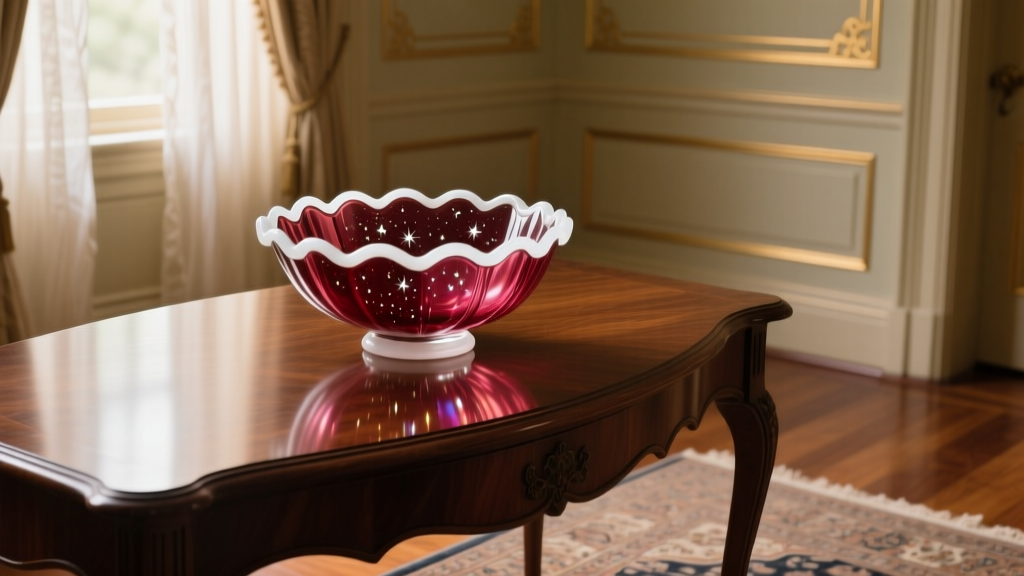
Cranberry Glass Bowl with Mica Flecks, Scalloped Lip, and White Cased Construction: A Technical & Historical Appraisal of the 4¾ × 4 Inch Form
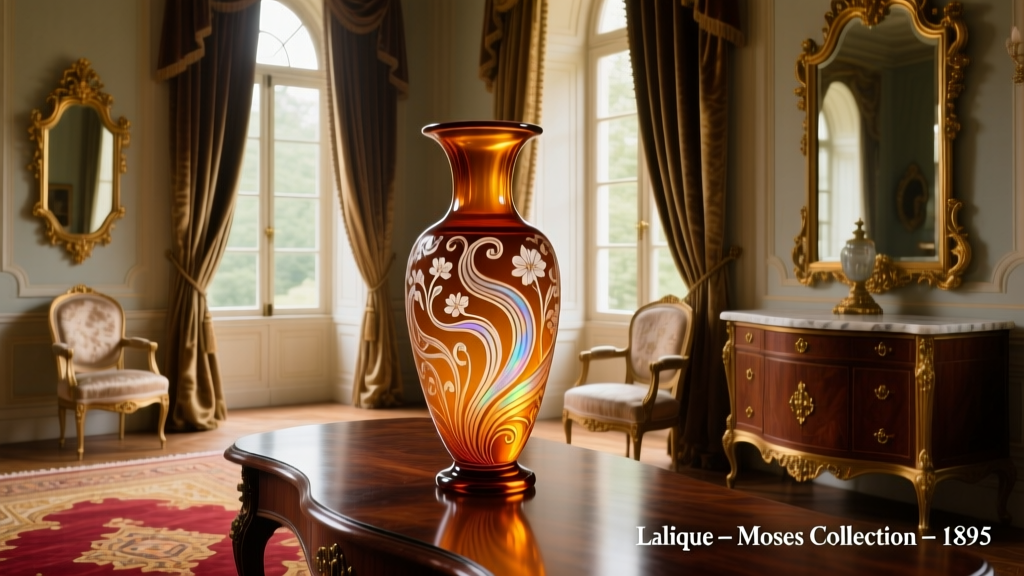
Lalique Vase 'Moses' in Amber Glass: A Collector’s Guide to the 8-Inch Edition
The Minton Hollins Horse Rider Tile: A Study of Blue Majolica Glaze, Craftsmanship, and Victorian Ceramic Heritage (c. 1880, 8 × 8 Inches)
Fostoria Beverly Salt & Pepper Shakers in Green: Identification, Value, and Restoration Insights
Flow Blue Plate 'Dessert Shanghae' by J. Furnival: Identification, History, and Restoration Guidance
Gothic Revival Cherry Bed Canopy: Structural Integrity, Historical Context, and Restoration Protocol for an 87 × 69 Inch Paneled Post Design
Currier & Ives 'Frontier Lake' Frame: Authenticity, Provenance, and Restoration Considerations for the 9 7/8 × 14-Inch Original
Lamp with Dual Cigar Lighters: Brass Barrel Base, Cranberry Glass Shade, and Historical Significance
Dirk Van Erp Vase: Hammered Copper, Original Patina, Marked 4 × 6 Inches — Authenticity, Craftsmanship, and Collectibility