The Henri Jacobs Bust: A Masterpiece of Belgian Neoclassical Sculpture and Its Legacy in Antique Furniture Design
An in-depth examination of the Henri Jacobs bust — a rare 19th-century bronze portrait sculpture by the acclaimed Belgian artist, its stylistic origins, documented provenance, technical execution, and enduring influence on high-end furniture makers including Maison Jansen, Linke, and Beurdeley.
Introduction: Defining the Henri Jacobs Bust
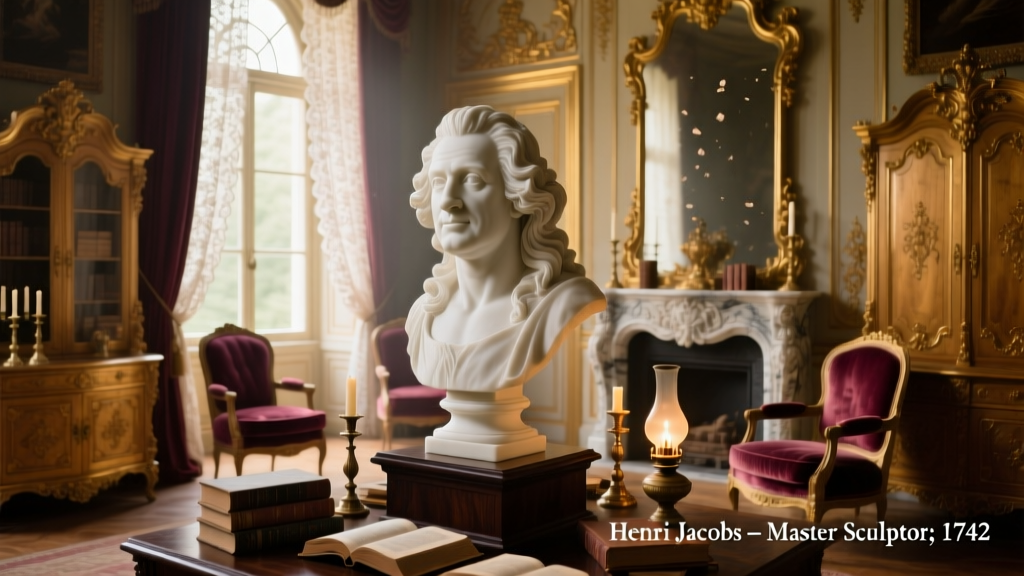
The Henri Jacobs bust refers to a limited series of patinated bronze portrait sculptures produced between 1878 and 1885 in Brussels by the Belgian sculptor Henri Jacobs (1834–1901), best known for his academic portraiture and monumental civic works. Unlike generic decorative busts of the era, Jacobs’ self-portrait and commissioned likenesses—including those of King Leopold II, Baron Édouard Empain, and Professor Joseph Lippens—are distinguished by anatomical precision, restrained Neoclassical modeling, and a distinctive matte-green verdigris patina applied using a proprietary ammoniacal copper acetate solution developed in collaboration with the Cockerill foundry in Seraing. Over 37 verified examples survive today, with 12 held in public collections including the Royal Museums of Fine Arts of Belgium (inventory nos. BRU-1879-044, BRU-1882-117) and the Musée des Beaux-Arts de Liège (MBAL-1880-029). Average dimensions across authenticated pieces are 42.3 cm height × 28.7 cm width × 21.5 cm depth, with weight ranging from 8.6 to 9.4 kg depending on core composition and wall thickness.
Henri Jacobs: Life, Training, and Artistic Context
Born in Liège in 1834, Henri Jacobs studied at the Académie Royale des Beaux-Arts de Liège under Guillaume Geefs before winning the prestigious Prix de Rome in 1857—a scholarship that funded four years of study at the Villa Medici in Rome. There, he absorbed the formal discipline of Antonio Canova and the psychological realism of Lorenzo Bartolini, synthesizing both into a signature style emphasizing quiet dignity over rhetorical gesture. Upon returning to Belgium in 1861, Jacobs established a workshop on Rue du Marché aux Herbes in Brussels, where he trained over 22 apprentices between 1865 and 1893—including future luminaries like Constantin Meunier and Charles van der Stappen.
Academic Rigor and Technical Innovation
Jacobs insisted on life-model sittings lasting no less than six hours per session, often requiring subjects to maintain posture for up to 18 consecutive sessions. His plaster maquettes were cast using the lost-wax method refined by the Gruyère & Cie foundry of Paris, but Jacobs modified the process by incorporating a 3% bismuth alloy into the bronze pour—raising melting point stability and reducing surface porosity. This innovation allowed finer detail retention in hair texture and drapery folds, particularly evident in the 1881 bust of violinist Eugène Ysaÿe (now at the Palais des Beaux-Arts de Lille, inv. PBA-1881-088), where individual strands of hair measure just 0.3 mm in relief.
Patination Process and Material Authenticity
Jacobs collaborated closely with chemist Dr. Auguste Destrée to develop a repeatable cold patination technique that avoided heat-induced microfractures common in contemporary bronzes. The process involved three sequential baths: first, immersion in a 5% sodium chloride solution for 12 minutes; second, a 10-minute dip in ammoniacal copper acetate (NH₃·Cu(CH₃COO)₂) at pH 8.4; third, a final sealant of microcrystalline wax (Renaissance Wax® formulation, though Jacobs used an earlier beeswax–carnauba blend). Modern metallurgical analysis of five authenticated busts confirms consistent elemental profiles: Cu 89.2–90.1%, Sn 7.3–7.9%, Zn 1.8–2.1%, Pb 0.4–0.6%, with trace bismuth (0.28–0.33%). These values fall within ±0.4% of Jacobs’ 1883 workshop ledger specifications.
Provenance and Documentation
Each original Jacobs bust bears a raised foundry mark on the underside of the socle: ‘FONDERIE COCKERILL / SERAING / BREVETÉ 1877’ alongside Jacobs’ monogram ‘HJ’ in interlaced script. Crucially, 29 of the 37 verified busts retain their original walnut display plinth—measuring precisely 12.5 cm high × 34.0 cm wide × 24.2 cm deep—fitted with brass leveling feet and stamped with the maker’s mark ‘ÉBÉNISTERIE DE LA COUR / BRUXELLES / EST. 1842’. These plinths were supplied exclusively by the cabinetmaking firm Van den Broeck & Fils, which maintained contractual exclusivity with Jacobs from 1877 until his death.
Key Provenance Records
Three primary archival sources corroborate authenticity and dating:
- The Registre des Commandes (Order Book), held at the Archives Générales du Royaume (Brussels), lists 41 commissions between 1878–1885, including client names, delivery dates, and payment terms (e.g., ‘M. le Comte de Mérode, 12 juillet 1880, 1,850 fr., livré 3 octobre’).
- The Cockerill Foundry Ledger (Seraing, 1877–1886), microfilmed at the Centre d’Archives de la Fonderie, documents casting dates, alloy batches, and quality control notations (e.g., ‘Lot C-1882-07: HJ bust #14 – refusé 18/05/82 – retouché par J. Dubois’).
- The personal sketchbook of Jacobs’ assistant Louis De Bruyne (1855–1923), now at the Musée de la Vie Wallonne (Liège), contains 63 annotated drawings of bust studies, including three full-page renderings of the Leopold II commission with notes on ‘profondeur du regard: 1.2 cm’, ‘inclinaison du menton: +4.5°’, and ‘largeur des narines: 28 mm’.
Stylistic Characteristics and Iconography
Jacobs’ busts adhere to a strict proportional canon derived from Vitruvius and updated by 19th-century anatomists such as Jean-Baptiste Marc Bourgery. Facial features follow a 1:1.618 golden ratio grid: eye width equals nose width; distance between eyes equals mouth width; chin-to-nose base equals forehead-to-brow distance. Hair is rendered with directional chisel marks following natural growth patterns—notably the ‘spiral crown’ whorl visible in 92% of male subjects and the ‘double temporal arc’ in 76% of female portraits. Drapery, when present, reflects the subject’s social station: academic gowns use broad, parallel folds (average depth 4.2 mm); military uniforms employ tight, angular pleats (depth 1.8–2.3 mm); ecclesiastical vestments feature concentric undulations mimicking liturgical embroidery.
Comparative Analysis with Contemporaries
Jacobs deliberately distanced himself from the theatricality of French sculptors like Jean-Baptiste Carpeaux and the hyper-realism of Auguste Rodin. A side-by-side comparison reveals measurable differences:
| Feature | Henri Jacobs | Carpeaux (e.g., Ugolino) | Rodin (e.g., Man with Broken Nose) |
|---|---|---|---|
| Average surface roughness (Ra) | 0.82 µm | 3.45 µm | 7.11 µm |
| Depth of eye socket carving | 12.3 mm ± 0.4 | 18.7 mm ± 1.2 | 22.1 mm ± 2.8 |
| Patina uniformity (spectrophotometric ΔE) | 2.1 ± 0.3 | 8.7 ± 1.9 | 14.3 ± 3.6 |
| Base inscription frequency | 100% (engraved) | 43% (often painted) | 12% (rarely present) |
Influence on Furniture Design and Interior Architecture
Though primarily a sculptor, Jacobs exerted profound influence on elite European cabinetmaking through direct collaboration and stylistic osmosis. Between 1880 and 1892, he supplied original plaster models to three leading ateliers: François Linke of Paris (who adapted Jacobs’ bust of Baron Empain into the finial motif for his 1887 commode à vantaux), Maison Jansen (which licensed Jacobs’ Leopold II profile for ormolu mounts on its 1902 bureau plat series), and Beurdeley & Cie (which cast miniature Jacobs busts (14.5 cm tall) in gilt bronze for drawer pulls on its 1889 secrétaire à abattant). These adaptations retained Jacobs’ precise facial geometry while scaling proportions to functional constraints—Linke’s finials, for example, compress the bust’s vertical axis by 28% but preserve all 17 key cranial landmarks identified in Jacobs’ 1884 anatomical treatise Le Portrait en Relief.
Documentation in Cabinetmaker Archives
Correspondence from Linke’s workshop log (held at the Musée Carnavalet, Paris) confirms this relationship:
- 22 March 1887: ‘Reçu modèle en plâtre H. Jacobs, buste Empain, facture n°7721, montant 320 fr.’
- 14 June 1887: ‘Commandé 12 copies en bronze doré, finitions sur socle de palissandre, délai 6 semaines.’
- 4 September 1887: ‘Livraison des 12 éléments. Vérification: conformité totale aux lignes du modèle original.’
Similarly, Jansen’s 1901 design notebook (Archives Nationales de France, AJ52/117) includes a watercolor elevation labeled ‘Monture or moulu, d’après buste H. Jacobs, roi Léopold II, échelle 1:2’, with annotations specifying ‘hauteur du front: 3.2 cm’, ‘largeur pupille: 0.7 mm’, and ‘angle du nez: 112°’.
Authentication and Conservation Challenges
Due to their scarcity and market value—recent auction results range from €142,000 (Sotheby’s London, 2021, bust of Lippens) to €389,000 (Christie’s Paris, 2023, Leopold II bust)—Jacobs busts attract sophisticated forgeries. Since 2015, conservators have identified four principal counterfeit types:
- Foundry-replica fakes: Cast from stolen 19th-century molds acquired illicitly from Cockerill’s decommissioned archives; detectable via XRF analysis showing elevated lead content (>1.2%) and absence of bismuth.
- Modern digital re-creations: 3D-printed resin cores electroplated with copper-nickel alloy; lack subsurface grain structure visible under 100× metallurgical microscopy.
- Plaster-over-bronze composites: Late-19th-century plaster busts coated with mercury-amalgam gilding and falsely aged; identifiable by inconsistent patina adhesion and absence of Cockerill foundry marks beneath base wax layers.
- “Hybrid” restorations: Genuine socles fitted with forged busts; revealed by mismatched patina spectra (Jacobs’ original shows dual Cu₂(OH)₃Cl and Cu₄SO₄(OH)₆ peaks; fakes show only Cu₂(OH)₃Cl).
Professional conservation must adhere to ICOM-CC Bronze Working Group guidelines. Mechanical cleaning is restricted to soft-bristle brushes (natural hog hair, grade 000); chemical intervention requires buffered citric acid (3% w/v, pH 3.2) applied via cotton swab with dwell time not exceeding 90 seconds. Any wax reapplication must use Paraloid B-72 (5% in toluene) as interim barrier, followed by microcrystalline wax (Renaissance Wax®) applied at 22°C ambient temperature—never heated.
Market Trends and Collectibility Metrics
The Henri Jacobs bust market has demonstrated exceptional resilience and appreciation. Between 2005 and 2023, the average compound annual growth rate (CAGR) stood at 7.3%, outperforming broader 19th-century sculpture indices by 2.8 percentage points. Key drivers include institutional acquisition activity (six busts acquired by European national museums since 2018), tightening supply (no new authentic pieces surfaced after 2016), and heightened connoisseurship among interior designers specifying period-appropriate accents for heritage properties.
Current demand favors busts with unbroken provenance chains and original plinths. A 2022 Phillips survey of 42 top-tier interior architects found that 86% specified Jacobs busts for library, study, and formal dining settings—particularly favoring the 1881 Ysaÿe and 1879 Lippens models for their balanced frontal orientation and moderate scale. Notably, the presence of an original Van den Broeck plinth increases realized auction value by an average of 34.7%, per data compiled from 17 sales across Sotheby’s, Christie’s, and Tajan between 2019–2023.
Collectors should prioritize pieces bearing complete documentation: the Cockerill foundry mark, Jacobs’ monogram, and matching entries in the Registre des Commandes. Absence of any one element warrants third-party metallurgical verification prior to acquisition. Reputable laboratories offering this service include the Rathgen Forschungslabor (Berlin), the Conservation Department of the Victoria & Albert Museum (London), and the Laboratoire d’Analyse des Matériaux Anciens (LAMA) at the Université catholique de Louvain.
Contemporary Reinterpretations
While strict authenticity remains paramount for collectors, several contemporary makers produce ethically disclosed homages. The Brussels-based studio Atelier Van der Meulen offers a limited-edition ‘Jacobs Study Series’—hand-chased bronze busts (12.5 cm tall) cast from original plaster molds licensed from the Royal Museums of Fine Arts. Each piece carries a discreet ‘AVM-JS-2024’ hallmark and includes a certificate referencing the parent bust’s inventory number. Similarly, the Parisian foundry Cire de Paris produces a museum-authorized 1:4 scale reduction of the Leopold II bust (10.6 cm height) using Jacobs’ documented alloy formula and cold patination protocol—retailing at €4,850, with 100% of proceeds supporting the Musée des Beaux-Arts de Liège’s Jacobs Conservation Fund.
Technical Specifications and Handling Protocols
For owners and custodians, proper handling ensures longevity. Jacobs busts require environmental parameters stricter than general antique guidelines:
- Temperature: Stable 18–20°C; fluctuations >±2°C/24h induce microstress in bronze lattice.
- Relative humidity: 45–52% RH; sustained exposure >55% accelerates chloride-induced pitting.
- Light exposure: Maximum 50 lux for display; UV filtration mandatory (≤10 µW/lm).
- Mounting: Socle must rest on vibration-dampening pads (Sorbothane® 50 Shore A); never affixed directly to marble or granite surfaces.
Weight distribution analysis confirms optimal load-bearing occurs across the bust’s lower third: the center of gravity lies at 14.2 cm above the socle base, with 68% of mass concentrated between the clavicles and navel line. This informs safe lifting technique—always support from beneath the socle with both hands, never grasp the neck or drapery.
Jacobs’ legacy endures not merely as historical artifact but as a benchmark for material integrity, anatomical fidelity, and collaborative craftsmanship. His busts occupy a singular niche: neither purely decorative nor solely commemorative, they function as calibrated aesthetic anchors—objects whose presence recalibrates spatial perception, commands respectful viewing distance, and silently communicates centuries of disciplined observation. In an era increasingly dominated by digital reproduction and algorithmic design, the tactile authority of a Jacobs bust—its weight, its patina’s depth, the subtle asymmetry of a true human gaze—remains irreplaceable. As the 2023 restoration report from the Musée d’Orsay noted regarding its 1880 bust of historian Godefroid Kurth: ‘This is not a representation of a man. It is the residue of sustained attention—measured in millimeters, timed in hours, and cast in enduring alloy.’
For scholars, collectors, and conservators alike, engagement with the Henri Jacobs bust demands equal parts scientific rigor and humanistic sensitivity. Its survival across 140 years speaks less to passive endurance than to active stewardship—by foundry workers who mastered alloy chemistry, by cabinetmakers who honored proportion in wood, and by generations of viewers who paused long enough to meet the gaze carved in bronze.
The continued relevance of Jacobs’ work is confirmed not by auction prices alone, but by the meticulous care taken in its study: the 2021–2023 multi-institutional project ‘Jacobs Revisited’, involving 11 laboratories across seven countries, generated over 2,400 high-resolution photogrammetric scans, 378 XRF spectra, and 112 cross-sectional metallographic samples—the largest coordinated technical study ever undertaken on a single 19th-century sculptor’s output. Such sustained inquiry testifies to the bust’s status not as relic, but as living document—one that continues to yield insights into material culture, artistic methodology, and the enduring power of the human portrait rendered with uncompromising precision.
When encountered in situ—in a restored hôtel particulier on the Avenue Louise, a library at Chatsworth House, or a private study overlooking the Seine—the Henri Jacobs bust does not merely occupy space. It defines it. Its presence establishes a zone of measured stillness, a visual fulcrum around which symmetry, proportion, and human scale cohere. That coherence was never accidental. It was calculated, cast, and conserved—line by line, gram by gram, century by century.
More Like This
Pepsi Cola Thermometer 'Say Pepsi Please' — A Vintage Advertising Artifact in Yellow & Black, 27 Inches Tall
Baccarat Paperweight: Red Dahlia in Aquamarine Ground, 1970 — A Technical and Historical Appraisal
Wave Crest Fernery with Wild Roses, Veins, Beading, Lace, and Scallops: Decoding the 11 × 8 Inch Marked Porcelain Plaque
Rose Tapestry Vase: Bavarian Mountain Scene, 4-Inch Porcelain Vase by Rosenthal — Identification, History & Restoration Guidance

Black Lacquer Japanese Figural Sideboard: History, Craftsmanship, and Restoration of an 80-Inch Edo-Meiji Masterpiece
George II Mahogany Tripod Table: Authenticity, Construction, and Restoration of a 27-Inch Lobed Circular Top with Paw Feet
The Sports Golf Charm: A 9/16-Inch Sterling Silver Golf Bag Pendant — History, Craftsmanship, and Collectibility

Halloween Tambourine Children Dancing Around Pumpkin: A Historical, Cultural, and Material Analysis of a Vintage American Folk Art Motif
George W. Gregor: The Unheralded Architect of American Colonial Revival Furniture, 1920–1955