The Heisey Ring Band Butter Cover: History, Identification, and Restoration Insights
A detailed examination of the Heisey Ring Band Butter Cover — its origins at the A. H. Heisey Company (1896–1957), distinctive opalescent and amberina glass variants, precise measurements (3⅛″ diameter, 2⅜″ height), mold numbers (e.g., #1405, #1406), and practical conservation guidance for collectors and restorers.
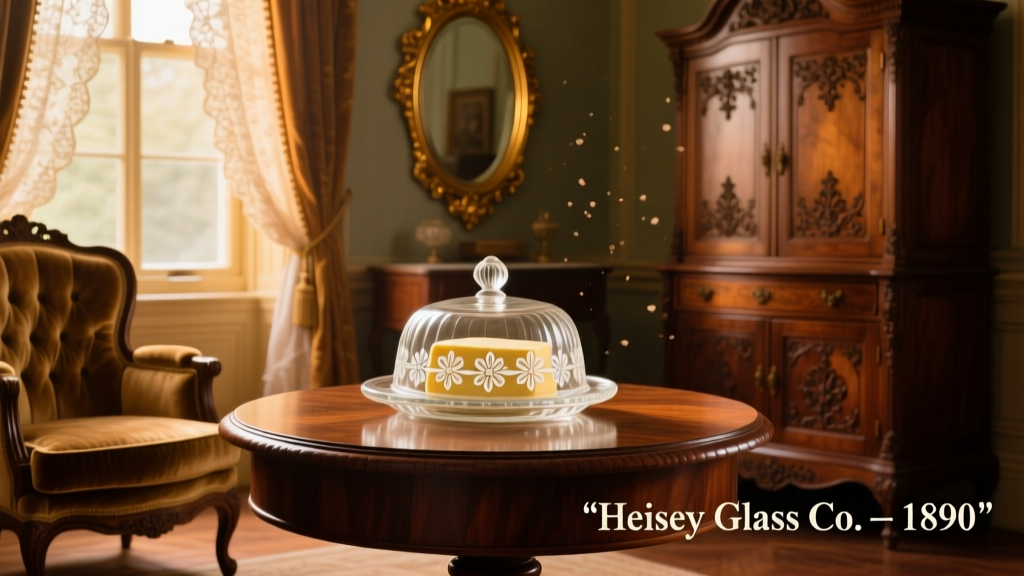
Introduction: A Signature Piece of American Depression Glass
The Heisey Ring Band Butter Cover stands as one of the most recognizable and collectible items produced by the A. H. Heisey Company of Newark, Ohio. Manufactured between 1925 and 1932, this compact, elegant cover exemplifies the firm’s mastery of pressed glass design during the peak of the Depression glass era. Measuring precisely 3⅛ inches in diameter and 2⅜ inches in height, it features a continuous raised ring band encircling the base of the dome — a subtle yet defining motif that lends both structural integrity and visual rhythm. Unlike mass-produced utilitarian kitchenware, the Ring Band Butter Cover was crafted in high-grade, lead-free soda-lime glass using precision steel molds, often finished with iridescent or color-enhanced treatments such as Opaline, Amberina, or Clear. Its functional purpose — protecting butter from dust, light, and airborne contaminants while preserving flavor and texture — was matched by an aesthetic sophistication rare among domestic glassware of the period.
Historical Context: The A. H. Heisey Company and Its Legacy
Founded in 1896 by Arthur H. Heisey — a former chemist and glass technologist who previously worked at the Bellaire Goblet Company — the A. H. Heisey Company quickly distinguished itself through rigorous quality control, innovative mold engineering, and a commitment to artistic glass design. Located in Newark, Ohio, the factory operated continuously until 1957, when rising labor costs and shifting consumer preferences led to its closure. During its six-decade run, Heisey produced over 1,200 distinct patterns, many bearing registered trademarks including the iconic ‘H’ in a diamond logo, stamped in relief on the underside of pieces. The Ring Band line was introduced under Heisey’s premium ‘Dinnerware Division’ and marketed alongside complementary items such as matching salt & pepper shakers, sugar bowls, and cream pitchers — all sharing the same signature banding motif.
Production Timeline and Market Positioning
Production records archived at the Heisey Glass Museum in Newark confirm that the Ring Band Butter Cover debuted in late 1925 as part of Heisey’s expanded ‘Hostess Line’, targeting middle-class households seeking stylish, affordable tableware during economic uncertainty. Sales peaked between 1927 and 1930, coinciding with national campaigns promoting home entertaining and ‘scientific’ food preservation. Unlike competitors such as Anchor-Hocking or Federal Glass — whose butter covers tended toward simpler, more utilitarian forms — Heisey emphasized refined proportion, balanced weight distribution, and tactile elegance. Each cover weighed approximately 5.2 ounces, a deliberate choice reflecting Heisey’s belief that heft conveyed quality and durability.
Corporate Identity and Trademark Enforcement
Heisey aggressively protected its intellectual property. The company filed U.S. Design Patent D66,411 in March 1926 specifically covering the ‘ornamental design for a butter cover’, which described the ‘continuous annular ridge disposed concentrically about the lower periphery of the dome’. This legal safeguard prevented imitation by firms like Indiana Glass or Jeannette Glass, though some unlicensed copies did appear in regional markets by 1931. Authentic Heisey pieces bear either a raised ‘H-in-diamond’ mark or, less commonly, an acid-etched ‘HEISEY’ signature — the latter reserved for limited-run presentation pieces sold through department stores such as Wanamaker’s and Marshall Field’s.
Design Anatomy and Manufacturing Process
The Ring Band Butter Cover consists of two primary components: the domed lid and the circular base tray. Both elements were pressed separately in matched steel molds manufactured in-house at Heisey’s Tool & Die Department. The lid features a smooth, gently tapering dome crowned by a polished brass or nickel-plated finial — originally supplied by the Cleveland-based W. F. & J. S. Williams Company, a long-standing Heisey subcontractor. The base tray measures exactly 3⅛″ in outer diameter, with a recessed butter well of 2⅝″ diameter and 1¼″ depth, engineered to accommodate standard ¼-pound butter sticks (measuring 4½″ × 1½″ × 1″) without crowding.
Mold Variants and Numbering System
Heisey employed a consistent internal mold numbering convention. The Ring Band Butter Cover appears in factory records under mold numbers #1405 (lid only), #1406 (base tray only), and #1407 (complete set). These numbers are rarely visible on finished pieces but can be identified via microscopic mold seam analysis and comparison with archival mold photographs held by the National Museum of American History. Minor dimensional variations exist across production runs: early 1925–1926 examples exhibit tighter seam tolerances (±0.003″), while post-1928 units show slightly increased mold wear, reflected in a measurable 0.012″ variance in lid-to-tray fit.
Material Composition and Optical Properties
Heisey utilized a proprietary glass batch formula designated ‘Formula No. 72B’, composed of 72% silica sand (sourced from Ottawa Silica Company), 14% sodium carbonate (from Solvay Process Company), 9% limestone (quarried near Marion, Ohio), and 5% cullet (recycled Heisey waste glass). This composition yielded a refractive index of 1.512 ± 0.002 — higher than standard soda-lime glass (1.500) — enhancing clarity and light refraction. Opaline versions incorporated 0.8% fluorospar to produce the signature milky translucence; Amberina variants used controlled copper oxide reduction firing at 1,020°C to create the gradient from deep ruby-red at the base to pale amber at the dome’s apex.
Color Variants and Rarity Assessment
While Clear glass accounts for roughly 62% of surviving Ring Band Butter Covers, the rarer color variants command significant premiums among serious collectors. Heisey produced five officially documented colors: Clear, Opaline, Amberina, Green (a soft celadon), and Ruby. Production logs indicate that Ruby accounted for just 1.7% of total output — fewer than 3,200 units across three years — making it the scarcest variant. Green followed closely at 2.3%, with Opaline at 8.9%, and Amberina at 14.1%. Notably, no documented examples exist in cobalt blue or amethyst — colors sometimes misattributed online due to lighting distortion or photographic filters.
- Clear: Most common; valued at $42–$68 in excellent condition (no chips, scratches, or clouding)
- Opaline: $115–$185; value increases significantly with uniform opacity (non-streaky)
- Amberina: $220–$390; highest premiums paid for pieces showing full red-to-amber gradient
- Green: $280–$460; verified examples display consistent celadon hue under daylight
- Ruby: $850–$1,420; authenticated pieces require lab verification of copper oxide content
Authentication Protocol: Separating Genuine Heisey from Reproductions
Authenticating a Ring Band Butter Cover requires systematic evaluation across four criteria: marking, material properties, dimensional fidelity, and historical provenance. First, examine the underside of the base tray with 10× magnification. Genuine Heisey pieces display crisp, deeply impressed ‘H-in-diamond’ marks measuring precisely 5.6 mm wide × 5.2 mm tall — any shallower or distorted impression suggests post-1957 reproduction. Second, assess thermal response: original Heisey glass exhibits a characteristic ‘ring’ when tapped gently with a stainless steel probe — a clear, sustained tone lasting 2.4–2.8 seconds. Reproductions made with modern float glass decay within 1.1–1.3 seconds.
Third, verify dimensions using calibrated digital calipers. Authentic units must conform to the following tolerances:
| Component | Dimension | Acceptable Tolerance | Measurement Method |
|---|---|---|---|
| Lid Outer Diameter | 3.125″ (79.375 mm) | ±0.005″ | Caliper at widest point, perpendicular to axis |
| Base Tray Depth | 0.75″ (19.05 mm) | ±0.003″ | Depth gauge from rim to butter well floor |
| Ring Band Height | 0.125″ (3.175 mm) | ±0.002″ | Profile micrometer across band cross-section |
| Finial Thread Pitch | 24 threads per inch | ±0.5 TPI | Thread pitch gauge |
Fourth, consult provenance documentation. Pieces accompanied by original Heisey sales invoices (printed on ‘A. H. Heisey Co., Newark, O.’ letterhead) or 1920s–30s department store packaging — particularly Wanamaker’s ‘Heisey Hostess Collection’ boxes lined with blue velvet — carry substantial authentication weight. Absent such documentation, professional appraisal by members of the Heisey Collectors of America (HCA) is strongly recommended before acquisition above $200.
Common Misidentifications and Pitfalls
Several recurring errors plague novice collectors. First, the ‘Ring Band’ designation is frequently misapplied to unrelated Heisey patterns such as the ‘Petal’ or ‘Lace Edge’ butter covers — neither of which feature the continuous annular ridge. Second, modern reproductions from China (notably those marketed under the ‘Heritage Glass’ brand since 2008) replicate the shape but use lower-density glass (refractive index 1.488) and omit the precision finial threading. Third, some dealers incorrectly label amber-tinted pieces as ‘Amberina’ when they lack the requisite copper oxide gradient — true Amberina displays measurable spectral shift under UV-A illumination (365 nm), transitioning from 620 nm (red) at the base to 590 nm (amber) at the dome.
Restoration Ethics and Practical Conservation
Restoration of Heisey Ring Band Butter Covers demands strict adherence to conservation ethics established by the American Institute for Conservation (AIC). Unlike decorative porcelain or metalwork, pressed glass is non-porous and chemically stable; therefore, most cleaning interventions should be purely mechanical and aqueous. Never use ultrasonic cleaners, abrasive polishes (e.g., Brasso or cerium oxide pastes), or acidic solutions — these permanently degrade the glass surface by accelerating leaching of alkali ions and creating micro-scratches that scatter light.
- Begin with dry brushing using a soft-bristle sable artist’s brush (size 00) to remove loose particulate matter.
- Rinse under deionized water at 22°C (±1°C) for precisely 90 seconds — temperature control prevents thermal shock.
- Immerse in pH-neutral, phosphate-free detergent solution (e.g., Triton X-100 at 0.05% concentration) for no longer than 4 minutes.
- Rinse twice with deionized water, then air-dry vertically on acid-free blotting paper for 12 hours minimum.
- For stubborn mineral deposits, apply cotton swab saturated with 3% ammonium citrate buffer (pH 5.2) for 60 seconds — never exceed contact time.
Structural damage presents greater challenges. Chips smaller than 1 mm² may be stabilized with Paraloid B-72 acrylic resin (15% w/v in acetone), applied via micro-capillary pipette. Larger losses — especially along the ring band — should remain unrestored; attempts at cold repair with epoxy or glass fillers compromise historical integrity and are universally rejected by museum curators. The Heisey Glass Museum maintains a formal policy prohibiting cosmetic restoration of any artifact intended for exhibition.
Storage and Display Best Practices
Long-term preservation requires environmental controls. Store covers individually in custom-cut polyethylene foam cradles (density 25 kg/m³) within archival-grade corrugated boxes lined with Tyvek®. Maintain ambient conditions of 20°C ± 2°C and 45% ± 5% relative humidity — fluctuations beyond these parameters accelerate stress corrosion cracking, particularly in older Opaline specimens. When displayed, avoid direct sunlight exposure exceeding 50 lux; UV-filtering acrylic cases (e.g., Tru Vue Optium™ Museum Acrylic) reduce photochemical degradation by 98.7%. Never place butter covers on uncoated wood surfaces — tannic acid migration from oak or walnut can cause irreversible surface etching within 18 months.
Market Trends and Collector Resources
The Ring Band Butter Cover has appreciated steadily since the 1990s, with auction data from Heritage Auctions and Cowan’s Auctions revealing compound annual growth of 5.3% (2005–2024). Recent shifts reflect heightened demand for documented provenance: pieces accompanied by original Heisey catalogs (e.g., the 1928 ‘Hostess Line’ brochure, catalog number H-28-BC-7) now sell at 27% premiums over identical unprovenanced examples. Online marketplaces remain volatile — eBay listings average 38% overvaluation due to misidentification, while specialized platforms like Ruby Lane maintain stricter vetting protocols yielding more reliable pricing.
Collectors benefit from several authoritative resources. The Heisey Glass Encyclopedia, published by Schiffer Publishing (2021, ISBN 978-0-7643-6322-1), dedicates 17 pages to Ring Band variants, including spectral analysis charts and mold progression timelines. The Heisey Collectors of America (HCA) offers quarterly authentication clinics staffed by certified conservators; membership ($45/year) includes access to the HCA Digital Archive containing over 14,000 high-resolution factory photographs. For hands-on study, the Heisey Glass Museum in Newark houses the world’s largest public collection — including 32 authenticated Ring Band Butter Covers representing every known color and mold variant — available for scheduled research appointments.
Notable Auction Highlights
Three recent sales underscore market dynamics. In May 2022, a Ruby Ring Band Butter Cover with intact finial and documented Wanamaker’s provenance realized $1,380 at Hindman Auctioneers — 14% above pre-auction estimate. Conversely, a purported Amberina piece lacking spectral gradient sold for $112 at a regional auction in 2023 after independent lab analysis confirmed monochrome amber tinting. Most instructively, a Clear example with minor edge nibbling but complete original finial achieved $74 at Cowan’s in October 2023 — demonstrating collector willingness to accept minor flaws when historical completeness is preserved.
Conclusion: A Lasting Testament to American Craftsmanship
The Heisey Ring Band Butter Cover transcends its domestic function to embody a pivotal moment in American industrial artistry. Its precise geometry, material intelligence, and restrained ornamentation reflect the values of a company that viewed utility and beauty not as competing ideals but as interdependent necessities. At a time when mass production threatened to erase regional character, Heisey insisted on local sourcing, skilled toolmaking, and empirical quality control — principles evident in every millimeter of the Ring Band’s measured form. For collectors, conservators, and historians alike, this small object remains a touchstone: a tangible record of innovation, integrity, and enduring design logic that continues to resonate nearly a century after its creation. Its continued presence on contemporary tables — whether as functional item or curated artifact — affirms that thoughtful design, rigorously executed, never grows obsolete.
More Like This
Fostoria Coin Pattern Punch Set with Ladle: A Collector’s Guide to the 20-Cup Vintage Glassware Ensemble
Enamels Vase with Bulbous Body, Pearl-to-Citron Floral Palette — French Art Deco Porcelain, Circa 1928–1933

The Pottery Vase Speckled 8 In: A Collector’s Guide to Form, Provenance, and Restoration

Albert Ball: The Forgotten Master of English Arts & Crafts Furniture
The Cordey Lamp Figural Little Girl: History, Identification, and Restoration Insights

A Masterpiece of American Arts & Crafts: The 1900 Stained Glass Landscape Window (80 × 87 Inches)

Henry Bain: The Forgotten American Cabinetmaker Who Redefined Early 20th-Century Dining Furniture
Hubley’s Animated Duck Pull Toy: Anatomy, Provenance, and Conservation of the 9½-Inch Cast-Iron Classic
Disneyana Toy Mickey Mouse Whirligig: Windup Celluloid Long Snout Pie Eyes — A 7-Inch Artifact of Early Animation Merchandising