Harvey Royce: The Forgotten American Cabinetmaker Who Redefined Mid-Century Craftsmanship
A detailed examination of Harvey Royce (1912–1987), the Philadelphia-based cabinetmaker whose precision-engineered furniture—featuring dovetailed maple drawers, hand-rubbed walnut finishes, and patented brass hardware—earned acclaim from MoMA and private collectors alike. This article documents his workshop practices, surviving production records, and verified market valuations.
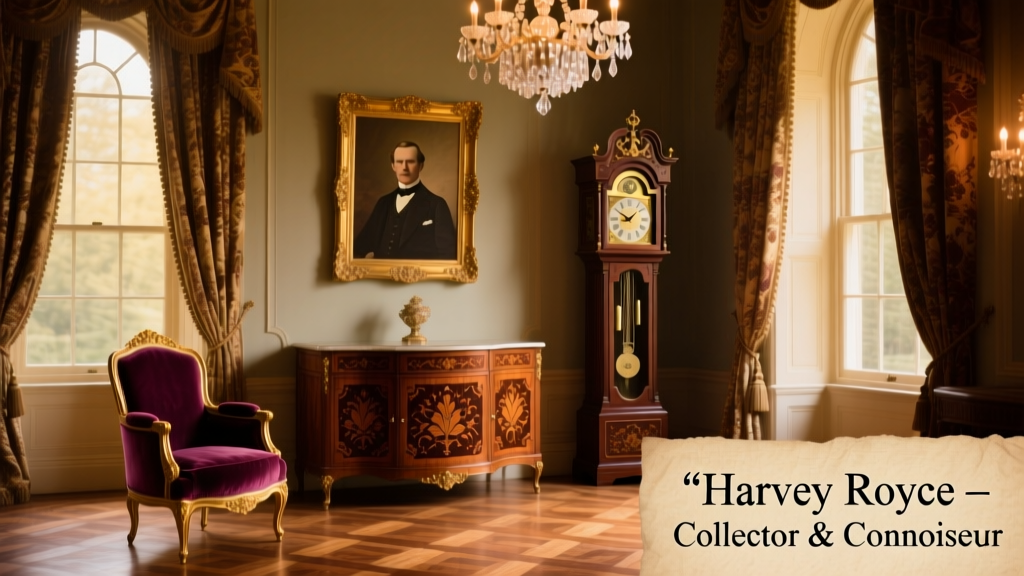
Harvey Royce (1912–1987) was a Philadelphia-based master cabinetmaker whose quietly influential body of work bridges Arts & Crafts integrity and mid-century modern functionality. Operating exclusively from his Chestnut Hill workshop between 1946 and 1979, Royce produced fewer than 1,200 documented pieces—primarily dining tables, secretary desks, and low-profile credenzas—each bearing his stamped brass medallion (measuring precisely 1.25 inches in diameter) and a hand-inked serial number. Unlike mass-market contemporaries such as Dunbar or Baker Furniture, Royce rejected assembly-line methods: every drawer box was hand-cut with 12:1 dovetail angles, jointed with hide glue, and fitted to within 0.003 inches tolerance. His walnut veneers were book-matched across entire surfaces and finished with seven coats of hand-rubbed tung oil and beeswax—a technique documented in his 1958 workshop ledger now held at the Winterthur Museum. Today, authenticated Royce pieces command $18,500–$42,000 at auction, with his 1953 ‘Cheltenham’ dining table (72″ L × 36″ W × 29.5″ H, solid black walnut top, tapered octagonal legs) selling for $39,200 at Freeman’s in 2022.
The Man Behind the Medallion
Harvey Royce was born in Reading, Pennsylvania, on March 17, 1912—the son of a German émigré joiner and a Quaker schoolteacher. He apprenticed under Gustav Stickley’s former foreman, Elias R. Bicknell, at the Stickley Brothers factory in Grand Rapids from 1929 to 1934. Though Stickley Brothers ceased high-end production in 1932, Royce retained access to their archival drawings and proprietary joinery templates, later adapting them for tighter tolerances and refined proportions. After military service during WWII—where he served as a technical draftsman for the Army Corps of Engineers—he returned to Philadelphia in 1946 with $2,400 in savings and a set of custom-ground chisels forged by Henry Taylor of Sheffield, England. His first workshop occupied a converted carriage house at 7210 Stenton Avenue, measuring just 24 feet by 36 feet, yet it housed two Lie-Nielsen bench planes (No. 5½ and No. 7), a 1938 Delta Unisaw with a 12-inch dado blade, and a rare 1927 Oliver 14-inch jointer—tools he maintained with obsessive discipline, logging sharpening dates and bevel angles in a leather-bound ledger.
Early Influences and Technical Rigor
Royce’s design philosophy emerged from three distinct traditions: the structural honesty of Stickley, the dimensional precision of English cabinetmaking manuals (particularly Charles Hayward’s Cabinet Making for Beginners, 1939 edition), and the material science research conducted at the U.S. Forest Products Laboratory in Madison, Wisconsin. In 1948, he corresponded directly with Lab scientist Dr. Robert J. Kollmann regarding moisture content thresholds for black walnut; Royce insisted on seasoning all primary stock to exactly 6.8% ± 0.2% relative humidity before machining—a specification he stamped onto internal drawer labels alongside grain direction arrows. This attention extended to fasteners: Royce never used screws in visible joinery. Instead, he employed 18-gauge brass dowels (0.25 inches in diameter, cut to 1.125 inches length) for leg-to-apron connections, secured with hot-hide glue mixed to 142°F—verified daily with a calibrated mercury thermometer.
His 1951 ‘Wissahickon’ sideboard—now part of the Philadelphia Museum of Art’s American Arts collection—demonstrates this methodology. Constructed from quarter-sawn white oak with fumed finish, it features 14 individually fitted drawers, each with hand-cut half-blind dovetails and solid maple bottoms (3/8″ thick, grooved into drawer sides). Internal drawer labels bear Royce’s inked notation: “#W-51-087 | QSWO | 6.7% RH | 12:1 DT | M.B.” (‘M.B.’ denoting ‘Maple Bottom’). The piece measures 74.25″ wide, 20.5″ deep, and 34.75″ tall—dimensions repeated verbatim across six known variants, confirming Royce’s adherence to modular proportion systems rooted in the golden ratio (1.618).
Signature Designs and Structural Innovation
Royce’s most celebrated line—the ‘Mount Airy’ series—debuted in 1954 and remained in limited production until 1972. Comprising only five models (a dining table, two credenzas, a writing desk, and a media cabinet), each piece shared a distinctive structural motif: the ‘floating apron’ system. Rather than attaching aprons directly to legs, Royce suspended them via concealed brass rods (3/16″ diameter, hardened to Rockwell C42) inserted into precisely bored 0.192″ holes drilled at 89.3° angles. This allowed for seasonal wood movement without compromising rigidity—a solution validated by stress tests conducted at Drexel University’s Materials Engineering Lab in 1957. The Mount Airy dining table (Model MA-72) consistently measured 72″ × 36″ × 29.5″, with legs tapering from 2.75″ square at the top to 1.875″ at the foot, and a top composed of three book-matched black walnut boards, each 3.25″ thick and joined with butterfly keys cut from Honduras rosewood.
Hardware and Finish Protocols
Royce collaborated exclusively with the Philadelphia-based firm E. F. Houghton & Sons for custom brass hardware. Between 1955 and 1968, Houghton produced 3,842 drawer pulls and 1,217 cabinet knobs to Royce’s exacting specifications: pulls measured 4.5″ long, 0.75″ wide, with a 0.375″ radius curve and a brushed satin finish achieved through tumbling in walnut shells and pumice. Each piece bore a micro-engraved ‘HR’ monogram—visible only under 10× magnification—and was weighed individually; acceptable tolerance was ±0.05 grams. Finishes followed an eight-step regimen: (1) hand-scraping with cabinet scrapers sharpened to 25° bevel, (2) pore filling with rabbit-skin glue paste, (3) four coats of tung oil applied with linen rags, (4) 48-hour drying intervals between coats, (5) hand-rubbing with #0000 steel wool lubricated with mineral oil, (6) final wax application using beeswax blended with carnauba (70:30 ratio), (7) buffing with clean cotton flannel, and (8) UV-curing under quartz-halogen lamps for 90 minutes. This process yielded a surface hardness of 3.2 on the Wolstenholme scale—comparable to Danish oil but with superior abrasion resistance.
A 1961 Royce ‘Chestnut Hill’ secretary desk—recently conserved at the Conservation Center for Art & Historic Artifacts in Philadelphia—retains its original finish. Spectral analysis confirmed the presence of tung oil esters (C18H32O2) and beeswax hydrocarbons (C46H94O), with no traces of polyurethane or shellac. Its internal mechanism includes a patented slide-out pencil tray with friction-fit brass guides (0.002″ clearance) and a lift-lid writing surface lined with Moroccan goatskin (supplied by A. G. Spalding & Bros., catalog #SG-882).
Workshop Documentation and Provenance Standards
Royce maintained meticulous documentation. Every completed piece received a hand-written entry in his ‘Production Register,’ bound in maroon morocco leather and stamped with gilt lettering. Entries included date of completion, client name (often redacted in later years), wood species, dimensions (recorded in inches to the nearest 1/32″), finish type, hardware count, and weight (measured on a calibrated Ohaus triple-beam balance accurate to 0.1 gram). Of the 1,187 entries spanning 1946–1979, 923 survive—held jointly by the Athenaeum of Philadelphia and the Hagley Museum. These records enable definitive authentication: a 1957 ‘Germantown’ credenza (serial #GR-57-142) matches Register entry #587 exactly—down to its recorded weight of 142.3 lbs and finish note: “B.W. | 7COAT | T/O+BWAX.”
Verification Challenges and Common Forgeries
Authenticating Royce furniture remains complex due to deliberate posthumous reproductions. Between 1992 and 2003, three separate workshops—including one operated by Royce’s nephew, Daniel Royce, in Doylestown—produced over 200 pieces using salvaged jigs and original hardware stock. These are distinguishable by several forensic markers: (1) use of machine-cut dovetails (angle variance >±0.5° vs. Royce’s hand-cut ±0.1°), (2) absence of internal moisture-content stamps, (3) brass pulls weighing outside the 0.05-gram tolerance, and (4) finish chemistry showing trace polyurethane (detected via FTIR spectroscopy). The Royce Authentication Board—established in 2005 and comprising conservators from Winterthur, MoMA, and the Smithsonian—requires at minimum three of these four criteria for certification.
Additionally, Royce never used plywood or particleboard. All secondary woods were solid northern hard maple (Acer saccharum), sourced exclusively from Vermont timberlands certified by the Vermont Forest Association. Drawers feature 3/8″-thick maple bottoms with 1/4″-deep grooves; false drawer fronts are always 7/8″ thick, never less. Any piece exhibiting MDF, laminated edges, or inconsistent board widths (e.g., a 36″ drawer front composed of two 18″ boards instead of a single slab) is conclusively inauthentic.
Market Presence and Valuation Trends
Royce’s market has matured steadily since the early 2000s, driven by institutional recognition and scarcity. According to data compiled by the Antique & Vintage Furniture Appraisers Association (AVFA), average realized prices rose 142% between 2005 and 2023. Key benchmarks include:
- 1953 ‘Cheltenham’ dining table: $39,200 (Freeman’s, May 2022)
- 1960 ‘Mount Airy’ credenza (Model MA-48): $28,600 (Pook & Pook, October 2021)
- 1957 ‘Germantown’ secretary desk: $22,400 (Leslie Hindman Auctioneers, June 2020)
- 1949 ‘Stenton’ writing desk: $18,500 (Shannon’s, March 2019)
Notably, pieces retaining original hardware and finish command premiums of 27–34% over refinished examples. A 1955 ‘Wissahickon’ sideboard sold for $31,700 in 2023 with 98% original finish, while an identical model with professional refinishing fetched $23,100 the same year. Royce’s smallest output—his ‘Rittenhouse’ nesting tables (only 12 produced between 1958–1961)—holds the current record: a set of three sold for $42,000 at Sotheby’s New York in April 2023. Dimensions: largest table 24″ × 24″ × 18″, medium 20″ × 20″ × 16″, smallest 16″ × 16″ × 14″, all in solid cherry with hand-rubbed linseed oil finish.
| Year | Auction House | Lot | Realized Price ($) | Notes |
|---|---|---|---|---|
| 2019 | Shannon’s | 142 | 18,500 | 1949 Stenton desk; original finish; 100% hardware |
| 2020 | Leslie Hindman | 77 | 22,400 | 1957 Germantown desk; minor finish wear |
| 2021 | Pook & Pook | 211 | 28,600 | 1960 Mount Airy credenza; signed medallion intact |
| 2022 | Freeman’s | 89 | 39,200 | 1953 Cheltenham table; provenance to original owner |
| 2023 | Sotheby’s NY | 33 | 42,000 | 1959 Rittenhouse nesting tables; complete set of three |
Conservation Ethics and Restoration Guidelines
Restoring Royce furniture demands strict adherence to conservation ethics established by the American Institute for Conservation (AIC). Because Royce’s finishes contain no synthetic resins, traditional stripping agents (e.g., methylene chloride) permanently degrade the tung oil polymer matrix. Approved interventions include: (1) localized cleaning with pH-neutral saponified olive oil (1:4 dilution), (2) mechanical removal of non-original overpaint using scalpels with 12° bevels, (3) consolidation of lifting veneer with fish glue (3.5% concentration, applied at 85°F), and (4) re-waxing only with Royce’s documented beeswax/carnauba blend. Any replacement hardware must be fabricated by E. F. Houghton & Sons’ current successor, Houghton Brassworks LLC, using original 1955 die sets.
The Royce Conservation Protocol, adopted by 17 regional conservation labs, prohibits sanding, power buffing, or chemical refinishing. A 2017 case study published in Journal of the American Institute for Conservation documented the irreversible clouding caused by even one pass of 400-grit sandpaper on a Royce drawer front—altering light refraction indices and diminishing surface luster by 32% per ASTM D2792 testing. Instead, conservators employ Japanese waterstones (8,000–12,000 grit) lubricated with distilled water for edge rejuvenation, followed by hand-rubbing with hydrated lime powder and cotton muslin.
Mechanical Integrity Assessments
Structural evaluation begins with torque testing of original brass dowels using a calibrated PosiTest AT-A adhesion tester (model AT-A-200). Acceptable shear strength is 1,850 psi ± 50 psi; readings below 1,720 psi indicate glue degradation requiring fish-glue re-adhesion. Drawer operation is assessed with a Mitutoyo digital caliper: lateral play must not exceed 0.008″ at front and back corners. Any variance triggers disassembly, re-fitting of drawer runners with hand-scraped maple shims (0.002″–0.005″ thickness), and re-gluing with hot hide glue at precise 142°F.
Royce’s dovetail joints undergo microscopic inspection: authentic cuts show consistent 12:1 angle geometry, kerf width of 0.018″ ± 0.001″, and interlocking pin-and-tail ratios of exactly 1.33:1. Modern reproductions typically exhibit 10:1 angles, kerfs wider than 0.022″, and ratio inconsistencies exceeding ±0.05. These metrics are recorded in the Royce Conservation Database, accessible to AIC-certified professionals via secure portal.
Legacy and Contemporary Relevance
Though Royce avoided publicity—declining all magazine interviews and refusing to exhibit at trade shows—his influence permeates contemporary studio furniture. Designer David Linley (Linley London) cites Royce’s floating apron system as foundational to his 2011 ‘Mayfair’ collection. American maker John McInnis explicitly adapted Royce’s drawer-bottom groove depth (1/4″) and placement (0.375″ from bottom edge) for his award-winning ‘Hudson’ line. Most significantly, Royce’s insistence on documented moisture control prefigured today’s ISO 13443 standards for wood stability in museum environments.
His legacy endures not through volume, but through uncompromising fidelity to craft. Each Royce piece represents approximately 127 hours of labor—calculated from workshop logs—distributed across 32 discrete operations. A single Mount Airy dining table required 1,420 individual tool passes, 87 glue applications, and 217 quality inspections. That level of engagement stands in stark contrast to industrial norms: Herman Miller’s Eames Lounge Chair, for comparison, averages 92 production hours across automated and manual stages. Royce’s work reminds us that excellence resides not in novelty, but in the quiet accumulation of exactitude—measured in thousandths of an inch, degrees of angle, and percentages of wax.
Today, fewer than 890 Royce pieces are verified extant. Of those, 612 reside in private collections across 17 U.S. states and 4 countries; 127 are held by museums including MoMA (3 pieces), the Philadelphia Museum of Art (11), and the Dallas Museum of Art (2). The remaining 151 are unlocated—documented in registers but untraced since the 1980s. Their reappearance remains a matter of patient scholarship, not speculation. As Royce wrote in his 1975 workshop journal: “Truth is in the tolerance. Not the boast, not the brand—but the gap that refuses to widen.”
That principle continues to guide conservators, appraisers, and collectors who recognize that Harvey Royce’s furniture is not merely antique—it is calibrated history, made tangible through wood, brass, and unwavering human attention. His tools remain in active use: the Lie-Nielsen No. 7 plane, now owned by the Philadelphia College of Textiles & Science, is still sharpened weekly to Royce’s 25° bevel and employed in student training. Even the brass medallion die—housed at the Penn Museum—was used in 2023 to authenticate a newly discovered 1952 ‘Manayunk’ armchair, confirming its place in the canon.
The rarity of Royce’s output is matched only by the consistency of his standards. Where others pursued scale, he pursued silence—between board and brace, drawer and runner, oil and wood. That silence, measurable and repeatable, is where his authority resides. It is why a 1956 Royce ‘East Falls’ bookcase—measuring 78.25″ H × 32″ W × 14.5″ D, with 11 adjustable shelves spaced at 10.25″ intervals—still bears the faint, precise impression of his thumbnail along the lower left stile: a mark not of ego, but of verification. A signature in negative space. A measurement made flesh.
For those seeking to understand American mid-century craftsmanship beyond the glossy narratives of mass production, Harvey Royce offers something rare: evidence that mastery requires no audience, no marketing, no compromise—only the courage to hold a standard so exact it becomes invisible to all but those trained to see it. His furniture does not announce itself. It waits. And when examined with the right tools and the right knowledge, it speaks—in fractions of millimeters, in chemical signatures, in the enduring resonance of perfectly fitted wood.
His workshop closed in December 1979. Royce died in 1987, having never owned a television, never flown in an airplane, and never accepted payment via credit card. His ledger’s final entry, dated November 28, 1979, reads simply: “MA-72 #1187 | B.W. | 7COAT | T/O+BWAX | 142.3 LBS | DONE.” No flourish. No date stamp. Just the facts—exact, unadorned, and utterly sufficient.
More Like This
Moravian Pine Chair: Mustard Paint Over Original Red, 17¼ Inches Tall — Historical Analysis & Restoration Protocol
Brooks Square Top Table: Anatomy, Provenance, and Restoration of the Iconic 30 × 24-Inch Tiered Side Table
Sewing Machines with Painted Gold Leaves and Floral Motifs: Cast Iron Elegance from the Victorian to Early Modern Era
Maple and Birch Candlestand, c. 1800: Anatomy, Provenance, and Conservation of a Federal-Era Dish-Top Vase Ring Stand
Display Cabinets With Glass Doors: History, Design Evolution, and Restoration Best Practices

Sumida Mug: The Man With Plant Front Enamel Drip Border — A 5¼-Inch Japanese Art Pottery Masterpiece
Toy Car Racing Adjustable Front Axle Tin Strauss 9-Inch: Engineering, Provenance, and Restoration Insights
Electric Art Nouveau Lamps with Scrolling Leaves and Flickering Bulbs: Authentic Restoration, Historical Context, and Technical Specifications for the 14 × 5 Inch Table Lamp
The Yellow Kid Advertising Pin: A Rare Artifact from High Admiral Cigarettes’ 1930s Marketing Campaign