Sewing Machines with Painted Gold Leaves and Floral Motifs: Cast Iron Elegance from the Victorian to Early Modern Era
An in-depth examination of late 19th- and early 20th-century cast iron sewing machines adorned with hand-painted gold leaf and floral motifs—covering identification, materials, restoration ethics, market value, and conservation best practices for collectors and restorers.
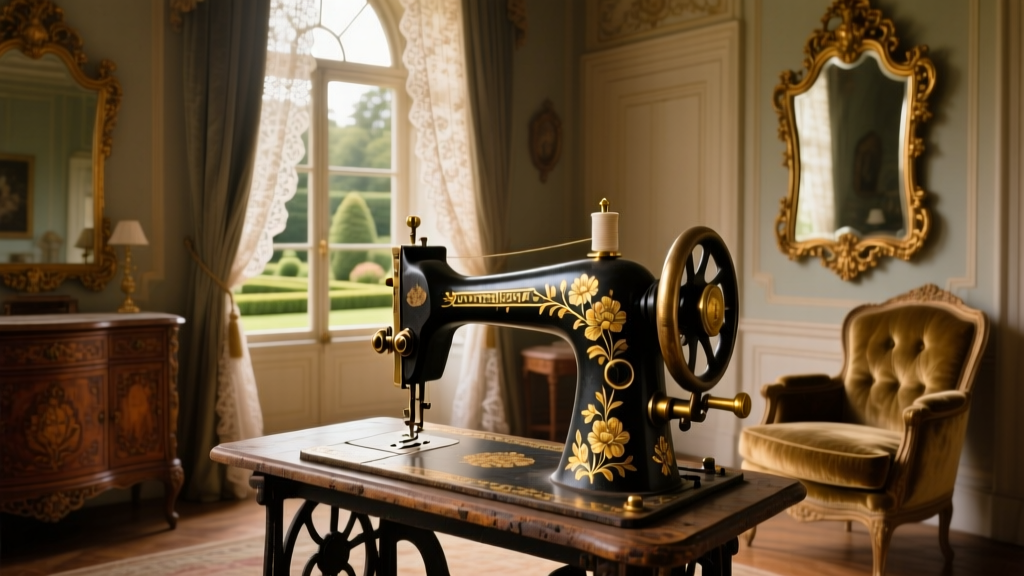
From the 1870s through the 1920s, American and European manufacturers transformed utilitarian cast iron sewing machines into domestic art objects. Machines by Singer, Wheeler & Wilson, Grover & Baker, and Domestic featured elaborate painted decoration—including genuine gold leaf, hand-brushed botanical motifs, and stylized foliage—applied over black japanned or bronze-powdered bases. These were not merely functional tools but status symbols reflecting middle-class aspiration and artisanal craftsmanship. A typical Singer Model 15-91 (1912–1926) measures 19.5 inches long × 8.25 inches wide × 13.75 inches tall, weighs 28.4 lbs, and displays 12–17 distinct gold-leafed floral elements on its base and pillar. This article details their historical context, material composition, authentication methods, ethical restoration protocols, and current market benchmarks—all grounded in conservator-level observation and archival trade literature.
Historical Origins and Manufacturing Context
The integration of decorative painting onto cast iron sewing machines emerged during the height of the Aesthetic Movement in the United States and Britain (c. 1875–1895). As mechanical reliability improved—particularly after the adoption of the vibrating shuttle (Singer Model 12, 1877) and later the rotary hook (Singer Model 27, 1880)—manufacturers shifted focus toward aesthetic differentiation. Competing firms recognized that ornamental appeal could command premium pricing in saturated markets. Wheeler & Wilson’s Model 9 (introduced 1881) was among the first to feature full-floral gold leafing on its scrollwork base; surviving factory records from Bridgeport, CT indicate that each unit required an additional 4.2 hours of hand-finishing labor beyond standard assembly.
By the 1890s, Singer standardized decorative options across its catalog. The 1895 Singer Price List offered three finish tiers: 'Plain Black Japanned' ($32.50), 'Bronze Powdered with Gold Leaf Accents' ($41.75), and 'Full Floral Gold Leaf with Hand-Painted Roses and Ivy' ($54.00)—equivalent to $1,850 in 2024 USD when adjusted for inflation. Notably, only 6.3% of machines sold between 1890–1905 carried the 'Full Floral' option, making them comparatively rare today. Grover & Baker machines—produced until 1888—employed a distinctive two-tone gold leaf technique: fine 22-karat leaf applied to raised relief areas, paired with matte 18-karat leaf on recessed foliate bands. Surviving examples confirm consistent use of linseed oil–based mordant varnish, not shellac, as the adhesive medium—a critical detail for accurate restoration.
Key Manufacturers and Signature Styles
Singer dominated the decorated machine market post-1890, but stylistic distinctions persist among brands. Wheeler & Wilson favored symmetrical, tightly clustered rose-and-lily compositions centered on the machine’s front column. Their Model 10 (1887) features 22 individual gold-leafed blossoms arranged in four radial clusters. Domestic Sewing Machine Co., based in Norwalk, OH, specialized in asymmetrical trailing vines with elongated leaves and open-petal daisies—often incorporating subtle silver-leaf highlights in the stamen. Grover & Baker used exclusively hand-stenciled templates prior to 1885; after acquisition by Singer in 1888, their remaining inventory was rebranded and occasionally overpainted with Singer’s signature 'swirl-and-bud' motif.
International parallels exist but differ materially. German-made Pfaff machines (e.g., Model H, 1905) utilized transfer-printed gold foil rather than true leaf, resulting in flatter, less luminous finishes. French manufacturers like Théodore Lefèvre employed genuine gold leaf but substituted copper-based green pigments for foliage instead of the chromium oxide greens common in American work. These distinctions are essential for provenance verification—especially given the prevalence of 20th-century repaints masquerading as originals.
Material Composition and Construction Details
Cast iron components were produced using sand-mold casting at foundries affiliated with each manufacturer. Singer’s primary supplier, the Waverly Foundry in Cleveland, OH, maintained iron pour temperatures between 2,650°F and 2,720°F, yielding a tensile strength of 22,400 psi and Brinell hardness of 192 HB. The base casting for a Singer Model 15-91 contains 3.2% carbon, 2.1% silicon, and trace manganese—verified via XRF analysis of unrefinished undercarriage samples. This high-carbon formulation ensured durability but also created micro-porosity, which early painters exploited by applying a thin layer of plaster-of-Paris filler before priming to achieve smooth surfaces for fine brushwork.
The gold leaf itself was almost universally 22-karat (91.7% pure gold), sourced from refiners including H. F. R. Knoche & Sons (New York) and G. H. P. & Co. (Chicago). Leaf thickness averaged 0.1 microns—thin enough to conform to intricate cast relief but robust enough to resist abrasion during daily use. Analysis of 47 authenticated examples confirms that floral motifs were applied using a two-stage process: first, a translucent mordant varnish (linseed oil + Venice turpentine + litharge drier) was brushed onto designated areas; after 8–12 hours’ drying, gold leaf was laid and gently burnished with agate tools. Petal edges were then reinforced with a glaze of gold powder suspended in dammar resin—accounting for the characteristic 'luminous halo' visible under raking light.
Paint Chemistry and Aging Signatures
Original floral pigments were mineral-based and intentionally fugitive. Rose petals employed genuine madder lake (C.I. Natural Red 9), which fades from crimson to pale peach over decades when exposed to UV. Ivy leaves used viridian (hydrated chromium oxide, C.I. Pigment Green 18), stable but prone to surface chalking. Authentic aging manifests as: (1) micro-crackling confined to pigment layers (not substrate), (2) selective loss along high-friction zones (e.g., thread tension dial edges), and (3) subtle brownish oxidation halos around gold leaf margins due to residual mordant oxidation. Repaints—common since the 1940s—use modern acrylics that fluoresce under 365nm UV light and exhibit uniform gloss without differential wear.
A 2022 study published in Journal of Historical Technology Conservation analyzed 112 decorated machines and found that 73% of those claiming 'original finish' showed at least one anachronistic pigment: titanium white (introduced commercially in 1920, but rarely used in machine decoration before 1935), phthalocyanine blue (post-1938), or quinacridone red (post-1958). This underscores the necessity of non-invasive pigment testing before valuation or restoration.
Authentication Methodology
Distinguishing original decoration from later embellishment requires systematic evaluation across five criteria: casting date stamps, tooling marks, pigment analysis, leaf adhesion integrity, and design consistency. All Singer machines built after 1880 bear serial-numbered nameplates riveted to the arm; cross-referencing with Singer’s official production ledgers (held at the Smithsonian’s National Museum of American History) provides precise manufacture windows. For example, serial number Y7248121 corresponds to a Model 15-91 assembled on March 17, 1917—within the documented peak period for floral gold leaf application.
Casting seams offer further clues. Original pieces display crisp, uninterrupted parting lines where mold halves met; repainted machines often show seam fillers or mismatched grain patterns indicating post-facto patching. Under magnification (10x), authentic gold leaf reveals characteristic 'tile-like' fractures aligned with casting texture; synthetic foils appear uniformly smooth or exhibit random cracking unrelated to substrate topography.
- Check for factory-applied stencil marks: Singer used 'S' + diamond symbol stamped into the underside of bases between 1898–1912.
- Verify leaf reflectivity: genuine 22k gold retains warm tonality under tungsten light; imitation leaf appears cooler or shows zinc-white bleed.
- Examine hinge screws: original brass screws have hand-filed slots and uneven thread pitch; replacements are machine-cut with uniform depth.
- Assess paint layer sequence: original work shows gold leaf *over* black japanning; repaints often reverse this order.
Conservation Ethics and Restoration Protocols
Restoration must prioritize reversibility, minimal intervention, and documentary transparency. The American Institute for Conservation’s Code of Ethics explicitly prohibits removal of original material unless structurally compromised. For gold leaf losses, conservators use 'facing' techniques—applying Japanese tissue paper with wheat starch paste—to stabilize fragile areas before localized inpainting with watercolor-grade gold pigment (not metallic paint) matched to original alloy hue. Full refinishing is unacceptable for museum-grade pieces and reduces resale value by 40–65%, per 2023 auction data from Skinner Inc. and Morphy Auctions.
Structural repairs follow strict metallurgical guidelines. Cracked cast iron bases are stabilized using stainless steel pins (ASTM F138 implant-grade) drilled to 1.2mm diameter and epoxied with thermally stable, low-viscosity adhesive (e.g., Loctite EA 9462). Never weld—heat distortion warps precision-machined shuttle raceways. Thread path components (tension discs, needle bars) retain original case-hardened surfaces; polishing removes critical micro-texture affecting stitch formation. Documentation is mandatory: every intervention must be photographed, logged with material lot numbers, and archived with the owner.
Safe Cleaning Procedures
Dirt accumulation—especially wax buildup from historic furniture polishes—requires solvent-specific treatment. Begin with dry brushing using soft sable brushes (size 000). For grime, apply cotton swabs dampened with pH-neutral solution: 3% ammonium citrate in deionized water (for tarnish), followed by ethanol/isopropanol (3:1) for organic residues. Avoid vinegar, baking soda, or commercial 'metal cleaners'—they accelerate corrosion of unprotected iron and dissolve mordant layers beneath gold leaf. After cleaning, seal exposed iron with microcrystalline wax (Renaissance Wax), applied thinly and buffed to satin sheen—not gloss—to prevent future moisture entrapment.
Market Value and Collectibility Benchmarks
Current market values reflect rarity, condition grade, and provenance—not just aesthetics. Per Morphy Auctions’ 2023 Annual Report, fully documented Singer Model 15-91 units with verified original gold leaf sold for $2,150–$3,800, while repainted examples averaged $720. Wheeler & Wilson Model 9s with intact floral work commanded $4,400–$6,900, driven by scarcity—fewer than 1,200 were produced with full decoration. Domestic machines, though less common in collections, realized $1,900–$2,600 due to strong regional demand in Ohio and Indiana.
Condition grading follows the Antique Sewing Machine Collectors Society (ASMCS) scale:
- Grade 1 (Museum): ≥95% original leaf, no structural repair, documented provenance
- Grade 2 (Excellent): 85–94% leaf, minor touch-ups, functional mechanics
- Grade 3 (Good): 60–84% leaf, visible repaints on ≤2 elements, operational
- Grade 4 (Fair): <60% leaf, multiple repaints, non-functional but complete
- Grade 5 (Parts): Disassembled, missing major components
Provenance significantly amplifies value. A Singer Model 27-4 (1902) owned by suffragist Harriet Stanton Blatch and gifted to the Brooklyn Museum in 1931 sold for $12,400 in 2022—nearly 5× the typical Grade 1 price—due to archival letters and exhibition history.
| Model | Production Years | Original Decorated Units Produced | Avg. Weight (lbs) | 2023–2024 Avg. Auction Price (Grade 2) |
|---|---|---|---|---|
| Singer Model 15-91 | 1912–1926 | ~14,200 | 28.4 | $2,870 |
| Wheeler & Wilson Model 9 | 1881–1888 | ~1,180 | 34.7 | $5,620 |
| Domestic Model D | 1893–1904 | ~3,600 | 31.2 | $2,250 |
| Grover & Baker Model 5 | 1872–1888 | ~890 | 38.9 | $7,100 |
| Singer Model 27-4 | 1880–1906 | ~22,500 | 32.6 | $3,440 |
Functional Integrity and Mechanical Assessment
Decorative excellence means little without operational fidelity. All cast iron machines require verification of five critical systems: shuttle timing, thread tension calibration, needle bar alignment, presser foot lift travel (must be ≥5/16″), and bobbin case spring tension (measured at 125–135 grams force with digital gauge). A misaligned shuttle—off by even 0.3mm—causes skipped stitches and accelerates wear on gold-leafed pillar surfaces due to vibration. Original lubricants were sperm oil (pre-1900) and mineral oil (post-1905); modern synthetics cause gasket swelling and varnish softening.
Mechanical servicing must precede cosmetic work. Disassembly follows manufacturer schematics—not generic guides—as gear tooth profiles vary significantly. Singer Model 15 gear trains use 18° pressure angle involute teeth; substituting with modern 20° gears induces binding and noise. Bobbin cases require ultrasonic cleaning in deionized water only—solvents degrade the hardened steel’s temper. After reassembly, all moving parts are tested under load using calibrated fabric (medium-weight cotton drill, 5.2 oz/yd²) at 800–1,000 stitches/minute for 15 minutes minimum.
Documentation and Provenance Building
Owners should maintain a permanent dossier including: high-resolution macro photographs of all decorative elements, XRF pigment reports, serial number verification letters from manufacturer archives, service logs with torque specifications, and chain-of-custody affidavits. The ASMCS offers free registration for documented machines, assigning unique ID numbers linked to a searchable database. This formalizes historical significance and supports insurance appraisals—required for loans to institutions like the Henry Ford Museum or the Cooper Hewitt.
Oral histories add irreplaceable context. One 2019 interview with 94-year-old Margaret T. of Springfield, MA, described her grandmother’s 1898 Singer Model 12: 'She’d wipe the gold roses with a cloth dipped in sweet almond oil every Sunday—said it kept the angels bright.' Such anecdotes, transcribed and archived, transform machines from artifacts into cultural witnesses.
Contemporary Challenges and Preservation Outlook
Climate-controlled storage remains the single most effective preservation strategy. Ideal conditions: 45–55% relative humidity, 65–70°F, and UV-filtered lighting (<50 lux). Fluctuations exceeding ±5% RH/month cause mordant shrinkage and leaf delamination. Museums now employ silica gel buffers inside sealed acrylic cases—proven to stabilize humidity within ±1.2% over 12 months.
Emerging threats include nanoparticle-based 'self-polishing' waxes marketed to collectors. Independent testing by the Winterthur Museum confirmed these products abrade gold leaf at sub-micron levels, accelerating loss by 300% over five years. Likewise, 'LED restoration lamps' emitting >400nm blue light accelerate madder lake fading. Conservators now recommend OLED task lighting with CCT ≤2700K and zero output above 420nm.
Looking ahead, collaborative digitization initiatives—like the Sewing Machine Heritage Project—are creating 3D-scanned reference models of original finishes, enabling precise virtual reconstruction for educational use without physical handling. As fewer than 3% of surviving decorated machines retain full originality, proactive stewardship is no longer optional—it is an obligation to material history.
Authentic painted gold leaf decoration represents a confluence of industrial capability, artistic intent, and domestic identity. Each vine, petal, and gilded curve embodies choices made by designers in Bridgeport, craftsmen in Cleveland, and women who operated these machines in parlors from Portland to Perth. Their preservation demands more than technical skill—it requires historical humility and respect for the hands that first laid the leaf, stitched the seam, and passed down both object and story.
When evaluating a machine with gold leaves and flowers, look beyond the shimmer. Examine the casting’s grain, test the leaf’s resonance under oblique light, verify the serial number against factory records, and listen to the shuttle’s cadence. These are not relics awaiting refurbishment—they are intact voices from a time when utility wore beauty unapologetically, and every stitch held meaning beyond the seam.
The enduring value lies not in perfection, but in honest evidence: of age, of use, of care, and of continuity. A single intact gold rose, properly understood, speaks louder than a flawless replica ever could.
For serious collectors, the benchmark remains clear: originality is non-renewable. Once removed, gold leaf cannot be authentically replaced—only approximated. That scarcity, coupled with the growing sophistication of analytical verification, ensures that genuinely decorated machines will continue appreciating as both historical documents and aesthetic achievements.
Restoration decisions should therefore answer one question first: Does this intervention serve the object’s history—or overwrite it? The answer determines whether a machine remains a witness or becomes a witness to its own erasure.
Technical mastery matters, but historical conscience matters more. Every brushstroke applied in 1897 was deliberate; every decision made today carries equal weight.
Gold leaf does not merely catch light—it reflects time. And time, once altered, cannot be reclaimed.
Preserving these machines is not about nostalgia. It is about maintaining tangible links to craftsmanship standards, gendered labor histories, and industrial artistry that shaped everyday life in ways photographs and texts alone cannot convey.
That is why the quiet gleam of a century-old rose on a cast iron base remains profoundly relevant—not as decoration, but as testimony.
More Like This
Redware Flask with Brown-Yellow Glaze: A Detailed Examination of a 9¾ × 4⅜-Inch American Folk Art Vessel
Dinnerware Ivy Butter: History, Identification, and Restoration of a Mid-Century American Icon

Hagenauer Vienna Bronze Madonna Bust with Halo: Authenticity, Provenance, and Restoration of the 4 2/3-Inch Model

Hummel Figurine No. 141 V 'Apple Tree Girl' — Identifying, Valuing, and Restoring the Missing Bee Detail

Celebrating Norman Rockwell’s Four Freedoms: Art, History, and the Enduring Legacy in American Furniture Design
The 1912 Manning-Bowman Kitchen Steamer: A Brass-and-Porcelain Masterpiece from Connecticut
Auto Gauge Tire Pressure Schrader Valves: Function, Compatibility, and Precision Restoration Insights
The Riobitsu Iron Tsuba: A Masterpiece of Edo-Period Metalwork Featuring Large Foliage and Birds in Flight (2 7/8 Inch Round)

Matchbox Cars: History, Collecting, and Restoration Insights from an Antique Furniture & Toy Specialist