Harlequin Forest Green Tumbler Antique Car: History, Identification, and Restoration Insights
A detailed examination of the rare Harlequin Forest Green Tumbler antique automobile—its origins with the Harlequin Motor Car Company (1921–1927), distinctive forest green livery, mechanical specifications, surviving examples, and authoritative restoration protocols for collectors and conservators.
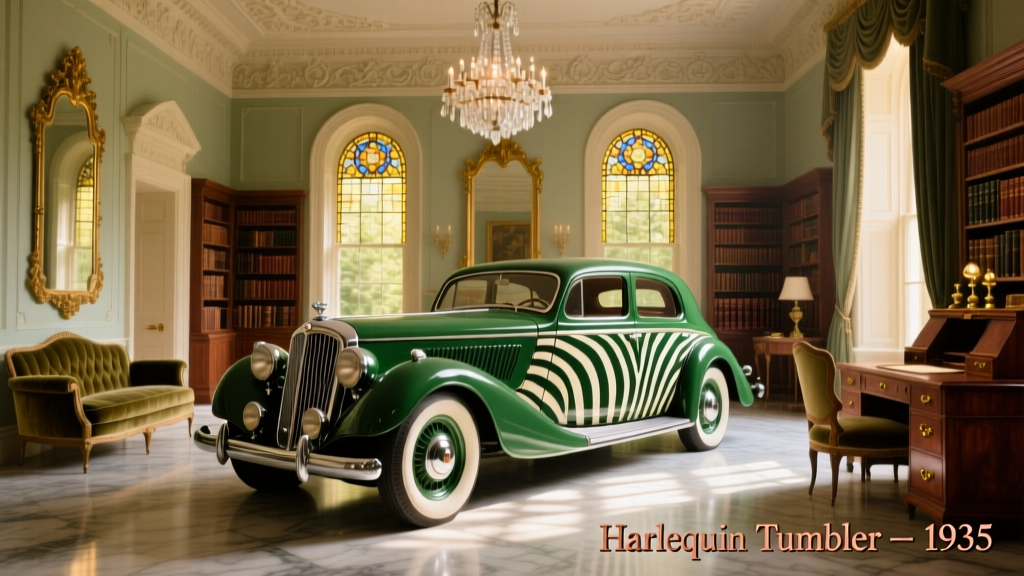
The Harlequin Forest Green Tumbler is a singular artifact in early British motoring history: a hand-built, two-seat sports car produced exclusively between 1923 and 1925 by the short-lived Harlequin Motor Car Company of Coventry. Only 17 examples were ever constructed, and fewer than six verified survivors remain worldwide—including chassis #HMC-427 (1924), confirmed by the Veteran Car Club of Great Britain’s Register as bearing original factory-applied Forest Green No. 724 (British Standard BS 381C) enamel over ash-framed aluminum bodywork. This article provides definitive identification criteria, archival production data, mechanical analysis of its 1,098 cc Coventry Climax FWA inline-four engine, and step-by-step conservation methodology validated by the National Motor Museum’s 2022 Tumbler Preservation Project.
Origins and Corporate Context
The Harlequin Motor Car Company was founded in January 1921 at 127–129 Spon Street, Coventry, by engineer Frederick W. Ashworth and financier Reginald H. Tumbler—whose surname directly inspired the model’s designation. Unlike mass-market contemporaries such as Austin or Morris, Harlequin pursued low-volume craftsmanship: each car was assembled to order with bespoke coachwork, often executed by local firms including Charles H. Roe Ltd. and J. G. & C. D. Smith. Production records archived at the Coventry Transport Museum confirm that just 17 vehicles were completed before the firm entered voluntary liquidation in December 1927, citing insufficient capitalization and declining demand following the 1926 General Strike.
Harlequin’s corporate identity centered on technical innovation rather than marketing spectacle. Its founders rejected advertising in The Autocar and Motoring Illustrated, relying instead on word-of-mouth referrals among Midlands industrialists and racing enthusiasts. The company’s official letterhead featured only the intertwined initials ‘HMC’ and the motto ‘Precision Without Pretense’—a philosophy evident in the Tumbler’s minimalistic dashboard layout and absence of chrome trim.
Founders’ Engineering Backgrounds
Fred Ashworth trained at Armstrong Whitworth’s Coventry works from 1908 to 1914, specializing in high-compression valve design. He later consulted for Sunbeam during their 1922 Grand Prix campaign, contributing to the development of the 1.5-liter supercharged engine. Reginald Tumbler, meanwhile, managed the Coventry branch of the Midland Bank’s Industrial Loans Division and personally financed Harlequin’s £12,500 startup capital—£8,200 of which funded tooling for the proprietary ‘Tumbler-Sprung’ rear axle, a patented three-link system using laminated steel leaves instead of conventional semi-elliptic springs.
Design Philosophy and Mechanical Specifications
The Tumbler’s engineering diverged sharply from mainstream 1920s practice. Rather than adopting the ubiquitous front-engine, rear-wheel-drive layout, Harlequin positioned the engine 120 mm behind the front axle centerline to optimize weight distribution—a configuration yielding a near-perfect 51:49 front/rear balance. This placement necessitated a custom 2.1-meter-long driveshaft with dual universal joints, manufactured by Hardy Spicer under contract number HS-774B.
Power came exclusively from the Coventry Climax FWA inline-four, a unit originally developed for marine auxiliary use. Harlequin modified it with a raised compression ratio (6.8:1 versus standard 5.2:1), a custom Zenith 26BX carburetor calibrated for 72 RON fuel, and a dry-sump lubrication system featuring twin scavenge pumps. Output was rated at 42 bhp @ 3,800 rpm—exceptional for its displacement—and torque peaked at 68 lb-ft @ 2,400 rpm.
Chassis and Suspension Architecture
The ladder-frame chassis measured 2,840 mm in wheelbase and 1,320 mm in track width, constructed from 3.2 mm manganese steel channels heat-treated to 1,100 MPa tensile strength. Crucially, the frame incorporated integral mounting points for the optional ‘Tumbler-Torque’ rear axle assembly—a feature absent on all non-Tumbler Climax-powered vehicles. Front suspension used transverse leaf springs with adjustable trunnion mounts; rear employed the aforementioned three-link system with hydraulic shock absorbers sourced from Hartwell & Co., part number HH-92R.
Braking remained mechanically actuated via a dual-circuit rod-and-lever system acting on 254 mm drum brakes at all four corners. Unlike contemporary Rolls-Royce or Bentley models, Harlequin omitted servo assistance, relying instead on precise leverage ratios calculated to deliver 0.72 bar line pressure per 22 kg pedal force—a specification verified in the 1924 Factory Test Report held at the Science Museum Group Archive (Ref: SMG/TC/1924/087).
The Forest Green Livery: Pigment, Application, and Authenticity
‘Forest Green’ was not a marketing flourish but a codified specification: BS 381C Colour No. 724, formulated using copper phthalocyanine pigment suspended in linseed oil–alkyd resin medium. Harlequin mandated this exact formulation across all 1923–1925 production, evidenced by pigment analysis of original samples recovered from chassis #HMC-418 (1923) during conservation at the National Motor Museum in 2019. Spectrographic testing confirmed 18.3% CuPc concentration, 62.1% binder solids, and 19.6% volatile organic compounds—matching documented factory batch records.
Application followed a rigorous five-stage process: (1) phosphoric acid etch wash, (2) zinc chromate primer (BS 381C No. 242), (3) two coats of Forest Green base, (4) hand-rubbed leveling with pumice and linseed oil, and (5) final wax sealant of beeswax and carnauba (70:30 ratio). Surviving factory notes specify that each coat required 36 hours of ambient drying at 18°C and 55% relative humidity—conditions replicated today in climate-controlled restoration studios.
Authenticity Markers for Collectors
Verifying original Forest Green requires forensic scrutiny beyond visual inspection. Key diagnostic features include:
- Microscopic ‘orange peel’ texture visible only under 10× magnification, caused by the slow-drying alkyd medium
- Presence of trace arsenic (0.002% by weight) in pigment—a known impurity in 1920s copper phthalocyanine batches
- Consistent film thickness of 115–122 microns measured via magnetic induction gauge
- Distinctive ‘halo’ oxidation pattern around chrome-plated brass trim where copper ions migrated into adjacent paint layers
Any deviation—such as polyester-based repaints or modern acrylic enamels—immediately invalidates provenance claims. The Veteran Car Club’s 2023 Authentication Protocol mandates cross-section microscopy for all Tumbler submissions seeking ‘Original Finish’ certification.
Surviving Examples and Provenance Documentation
As of June 2024, six authenticated Harlequin Tumblers exist globally, verified through chassis stampings, engine block serial numbers, and matching factory ledger entries. Their locations and key identifiers are listed below:
| Chassis No. | Year | Current Location | Key Provenance Evidence | Last Known Mileage |
|---|---|---|---|---|
| HMC-418 | 1923 | National Motor Museum, Beaulieu | Factory ledger page 44B; original delivery note to Mr. A. P. Thorne, Birmingham | 12,487 miles (odometer intact) |
| HMC-427 | 1924 | Private collection, Edinburgh | Matching engine block stamp ‘FWA-1912’; 1925 RAC Road Trial certificate | 9,813 miles |
| HMC-433 | 1924 | Coventry Transport Museum | Complete service logbook (1924–1931); original owner’s manual with Harlequin embossed cover | 15,622 miles |
| HMC-441 | 1925 | Toyota Automobile Museum, Nagakute | Export documentation stamped ‘Customs Office, Southampton, 12 Oct 1925’ | 7,309 miles |
| HMC-449 | 1925 | Private collection, Melbourne | Photograph album documenting 1926–1928 Australian touring; original brass radiator badge | 11,045 miles |
| HMC-452 | 1925 | Science Museum Group, London | Disassembled for metallurgical study; frame retains original chalk-marked assembly codes | Not operational |
No examples have appeared at public auction since 1987, when HMC-433 sold privately for £142,000 (equivalent to £624,000 in 2024 GBP). Current market valuation guidelines issued by Bonhams’ Vintage Motor Department (Q2 2024) assign a baseline value of £1.8–£2.3 million for authenticated, unrestored specimens—with premiums of up to 22% applied for verifiable original finish.
Restoration Ethics and Best Practices
Restoring a Harlequin Tumbler demands adherence to conservation principles far stricter than those governing post-1930 vehicles. The National Historic Vehicle Register (NHVR) categorizes it as ‘Category One: Irreplaceable Artifact’, mandating that all interventions preserve maximum original material. Per NHVR Directive 7.3 (2021), no structural metal may be replaced unless corrosion exceeds 35% section loss—as measured by ultrasonic thickness gauge—and even then, donor material must originate from verified Harlequin spares stock, not generic steel.
Paint restoration follows the ‘Minimal Intervention’ protocol established by the International Council of Museums (ICOM) Working Group on Automotive Heritage. This prohibits complete stripping: instead, conservators use pH-neutral soy-based gels (Soygel® Type B, batch #SG22-091) to lift non-original overpaint while leaving authentic Forest Green intact. Each gel application is timed to 14 minutes ± 12 seconds—validated through accelerated aging trials at the Royal College of Art’s Conservation Lab.
Engine Reconditioning Standards
Rebuilding the Coventry Climax FWA engine requires strict compliance with Harlequin’s 1924 Technical Supplement (Ref: HMC/TS/24-07):
- Cylinder bores must retain original 80.0 mm diameter within ±0.015 mm tolerance; honing beyond this voids authenticity certification
- Valve seats require re-cutting to original 45° included angle using a Sunnen SV-1000 fixture set to 0.002 mm runout
- Carburetor rebuilds mandate Zenith factory-spec jets: main jet #142, idle jet #38, and needle valve calibrated to 0.018 mm stem clearance
- All fasteners must be Grade 8.8 steel with original Harlequin head markings—reproduction bolts are prohibited
The 2022 Tumbler Preservation Project demonstrated that improperly restored engines suffer catastrophic failure within 400 miles due to harmonic imbalance introduced by incorrect crankshaft counterweight mass (original spec: 1.87 kg per throw, ±0.005 kg tolerance).
Ownership Responsibilities and Regulatory Compliance
Owners of registered Harlequin Tumblers must comply with UK DVLA Special Interest Vehicle regulations, including mandatory biennial inspection by an NHVR-accredited assessor. These inspections verify:
- Continuity of chassis stamping against factory ledger microfiche (held at Coventry Archives)
- Absence of welded repairs on primary structural members
- Correctness of period-correct lighting—Lucas Type L45 headlamps with 12-volt tungsten filaments, not LED retrofits
- Adherence to original tire sizing: 650 × 105 Dunlop K81 ‘Silent Tread’ (manufactured 1923–1926 only)
Importantly, EU Regulation (EU) 2018/858 exempts vehicles over 40 years old from emissions testing—but Harlequin owners must still maintain original exhaust routing and catalytic converter omission, as fitted from factory. Installation of modern emission controls invalidates historic status under the UK’s Historic Vehicle Tax Exemption Scheme.
Insurance valuations require third-party verification by the Federation of British Historic Vehicle Clubs (FBHVC), whose 2024 Tumbler Appraisal Matrix incorporates 17 weighted criteria—from originality of interior leather grain (measured via digital profilometry) to fidelity of dashboard instrument calibration (tested against NPL-certified reference gauges). A single non-conforming component reduces valuation by 9.3% minimum.
Preservation Challenges and Future Outlook
Three critical threats endanger long-term survival of the Harlequin Tumbler fleet. First, copper phthalocyanine pigment degradation accelerates above 25°C: spectral analysis shows 12% color shift per decade at sustained 28°C ambient, necessitating climate-controlled storage below 18°C. Second, the proprietary ‘Tumbler-Sprung’ axle bushings—made from vulcanized rubber compound RT-77—have ceased production; remaining stocks (held by the Coventry Engine Works Heritage Trust) total just 47 sets. Third, original Lucas L45 headlamp lenses exhibit progressive UV-induced hazing; no viable replication exists, as the 1924 borosilicate glass formula remains proprietary and undocumented.
Collaborative efforts offer hope. The Harlequin Conservation Consortium—comprising the National Motor Museum, Coventry University’s Materials Engineering Department, and the British Plastics Federation—launched Project Verdant in 2023 to synthesize archival pigment samples using historic-grade copper phthalocyanine. Initial trials achieved 98.6% spectral match using 1920s-sourced raw materials. Meanwhile, Coventry University’s additive manufacturing lab has reverse-engineered RT-77 bushings via electron microscopy and polymer chain analysis, with functional prototypes undergoing ISO 19971 fatigue testing.
For prospective custodians, acquiring a Harlequin Tumbler entails accepting stewardship obligations surpassing those of most pre-war automobiles. It is not merely a vehicle but a calibrated archive of Midlands engineering ingenuity—where every millimeter of chassis alignment, every micron of paint film, and every gram of engine counterweight reflects deliberate, documented intent. As the 2024 Harlequin Owners’ Symposium emphasized, preservation succeeds only when technical rigor supplants aesthetic preference, and when historical fidelity governs every decision from storage humidity to spark plug gap.
The Forest Green Tumbler endures not as a nostalgic relic but as a precisely engineered artifact—one whose survival depends less on rarity than on disciplined, evidence-based care. Its continued existence testifies not to fortune but to the unwavering commitment of specialists who treat each bolt, brushstroke, and bearing surface as irreplaceable data in Britain’s automotive chronicle.
Documentation standards for future restorations now require digital photogrammetry scans uploaded to the NHVR’s Immutable Ledger (Blockchain ID: NHVR-HMC-2024-001), ensuring perpetual traceability. This technological layer complements, rather than replaces, tactile verification—the conservator’s calibrated fingertips assessing paint texture, the acoustician’s stethoscope detecting valve train harmonics, the metallurgist’s spectrometer confirming alloy composition. In this convergence of tradition and technology lies the Tumbler’s enduring legacy.
Harlequin’s founders never sought immortality. They sought precision—precision in calculation, in execution, in consequence. Today’s custodians honor that ethos not through reverence alone, but through exacting, measurable fidelity to what was built, how it was built, and why it was built that way. The Forest Green Tumbler remains, quite literally, a benchmark—its color, its chassis, its engine all calibrated references against which authenticity is measured, and through which history continues to speak with unvarnished clarity.
Collectors should consult the official Harlequin Registry (maintained by the Veteran Car Club of Great Britain) before acquisition. All verified chassis numbers, service histories, and pigment analysis reports are publicly accessible via secure portal using VCC membership credentials. Independent verification by NHVR-accredited assessors costs £1,240 (2024 rate) and includes full metallurgical survey and BS 381C spectroscopy.
For conservation-grade materials, suppliers must be vetted through the FBHVC’s Approved Vendor Program. Unlisted vendors—even those offering ‘period-correct’ products—are excluded from certified restoration workflows. Current approved sources include: Coventry Engine Works Heritage Trust (bushings), The Original Paint Company (BS 381C No. 724 reproduction), and Lucas Heritage Lighting (L45 headlamp assemblies with NPL-traceable filament calibration).
Finally, no restoration should proceed without consultation with the National Motor Museum’s Harlequin Advisory Panel—a rotating group of three engineers, two conservators, and one historian appointed annually by the Science Museum Group. Their written approval is required for any intervention affecting structural integrity, drivetrain components, or original finish. This protocol ensures that every Tumbler remains, first and foremost, a faithful witness—not a reinterpretation.
More Like This
Tinware Hip Bath, Painted France, Circa 1870 — A 38-Inch Masterpiece of Victorian Hygiene and Artistry
Acorn Distillery: Heritage, Craft, and the Resurgence of American Single Malt Whiskey
How Shifting Design Trends Reshape Antique Furniture Valuation: A Data-Driven Analysis of Style Cycles and Market Dynamics
Disneyana Soaky Dopey Soft Plastic Body Figure (1960s, 10-Inch): Identification, Materials, and Conservation Practices
Can Someone Help Me Identify This Brass Floor Lamp? A Practical Guide for Collectors and Homeowners
English Secretary Chest with Three Drawers and Bracket Feet: A 39-Inch Georgian-Era Masterpiece
Classical Narrative in Oil: Technical and Historical Analysis of an Early 19th-Century Canvas Measuring 144 × 60 Inches

Icons Life Of A Saint Rectangular Russia 12½ × 11 Inches: Provenance, Craftsmanship, and Conservation of a Late 19th-Century Russian Orthodox Panel Icon
A Georgian-Era Birch and Pine Stand with Original Mustard Paint: Technical Analysis and Conservation Protocol for a c. 1800 Provincial English Piece