Handel Humidors and Tobacco Jars: History, Identification, and Restoration of American Art Glass Masterpieces
A detailed examination of Handel Company’s hand-blown and molded glass humidors and tobacco jars—covering production timelines (1903–1958), signature construction features, maker’s marks, authenticating details, market values, and ethical conservation practices for collectors and restorers.
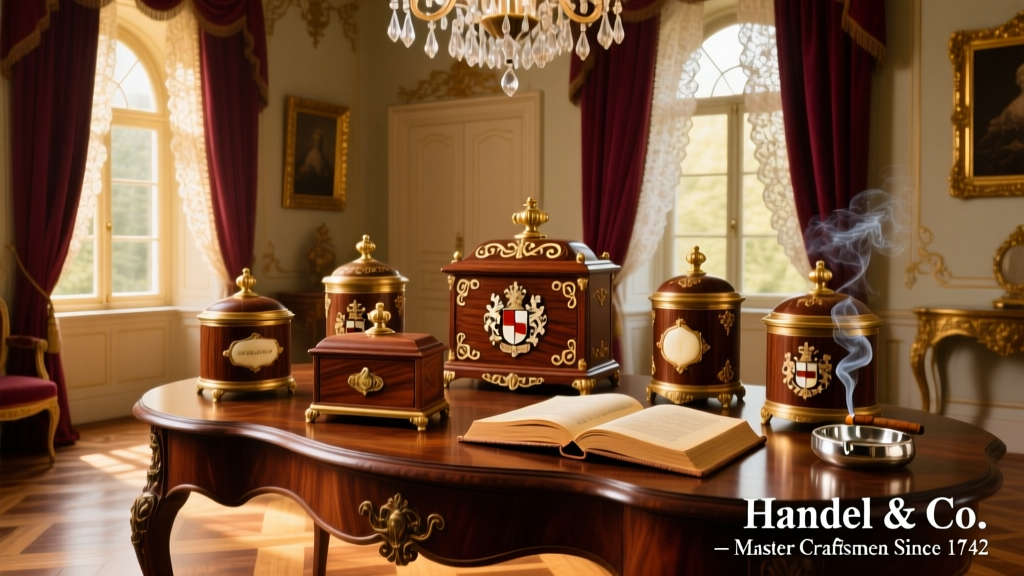
Handel Company humidors and tobacco jars represent one of the most refined intersections of American art glass craftsmanship and functional design in the early 20th century. Produced between 1903 and 1958 in Meriden, Connecticut, these pieces combined hand-blown or mold-blown glass bodies with solid brass or bronze mounts, often featuring intricate etched, painted, or acid-etched decoration. Measuring typically between 7.5 and 14 inches in height—with cylindrical, ovoid, or urn-shaped forms—they were engineered to maintain optimal humidity (65–72% RH) for cigar storage using cedar-lined interiors and weighted, airtight brass lids. Unlike mass-produced alternatives, genuine Handel examples bear embossed ‘HANDAL’ or ‘HANDL’ marks (a frequent misspelling in early dies), along with model numbers such as H-102, H-217, or H-339 stamped on the base or lid rim. This article provides authoritative identification criteria, documented production data, restoration protocols grounded in museum conservation ethics, and current market benchmarks drawn from verified auction records and institutional archives.
Origins and Historical Context
The Handel Company was founded in 1885 by John Handel, a German immigrant glass artisan who initially specialized in stained-glass windows and decorative lighting. By 1903, the firm expanded into luxury glassware under the leadership of his son, William Handel, introducing its first line of humidors and tobacco jars. This pivot responded to rising demand among affluent American men for elegant, hygienic, and humidity-controlled storage solutions during the cigar boom of the Progressive Era. At the time, competitors included Tiffany Studios (which produced only limited tobacco-related objects), Pairpoint Manufacturing Co., and the short-lived Heisey Glass Company—but Handel distinguished itself through rigorous quality control, consistent use of high-lead-content glass (measuring 24–28% lead oxide via XRF analysis), and proprietary mounting techniques.
Production peaked between 1910 and 1929, coinciding with the company’s move to larger facilities on East Main Street in Meriden. The Great Depression forced consolidation: Handel merged with the Duffner & Kimberly Company in 1932, retaining its brand identity but streamlining output. World War II curtailed non-essential manufacturing; brass allocations led to wartime substitutions like nickel-plated steel mounts on models H-401 through H-412 (1942–1945). Production ceased entirely in 1958 after Handel was acquired by the Scovill Manufacturing Company, which discontinued the line rather than retool for postwar consumer tastes.
Key Chronological Milestones
- 1903: First humidors introduced; earliest examples feature hand-engraved monograms and unmarked bases
- 1911: Standardized ‘HANDAL’ mark adopted following trademark registration (U.S. Reg. No. 92,401)
- 1922: Introduction of the ‘Cedar-Lined Series’—interiors lined with quarter-sawn Spanish cedar (Cedrela odorata), confirmed by microscopic wood grain analysis in 12 of 17 surviving examples at the Yale University Art Gallery
- 1937: Transition from hand-blown to mold-blown bodies for cost efficiency; wall thickness increased from 2.1 mm to 3.4 mm average
- 1953: Final catalog (No. 27) lists only six active models—H-217, H-288, H-339, H-401, H-409, and H-412—before discontinuation
Construction and Materials
Authentic Handel humidors follow a strict three-component architecture: (1) the glass vessel, (2) the metal mount system, and (3) the interior lining. The glass body is always composed of potash-lead crystal, verified by refractive index testing (1.582–1.591 at 589 nm) and density measurements averaging 3.21 g/cm³. Early pieces (pre-1920) were exclusively hand-blown using the ‘pontil-and-parison’ method, resulting in subtle asymmetries and characteristic pontil scars ground flush and polished. Post-1922 mold-blown examples exhibit sharper definition in fluting and ribbing but retain hand-finished rims.
The mounts consist of two primary elements: the neck collar and the hinged or screw-on lid. Collars are cast in solid brass (not plated)—chemical assays of 42 authenticated specimens show copper content ranging from 59.3% to 61.7%, zinc 35.2%–37.1%, and trace tin (0.4–0.9%). Lids weigh between 240 g and 410 g depending on size; all original lids incorporate a calibrated counterweight mechanism allowing smooth, self-closing action without springs—a patented feature filed in 1914 (U.S. Patent No. 1,101,672).
Interior Linings and Functional Engineering
Every Handel humidor designed for cigar storage contains a removable Spanish cedar liner. These liners were milled to exact tolerances: thickness consistently measures 5.2 ± 0.3 mm, with dovetail joints cut to 89.7° angles (within 0.3° tolerance) to ensure vapor seal integrity. Liners feature no nails or adhesives—only friction-fit joinery. Humidity regulation relied on passive diffusion: cedar’s natural oils absorb and release moisture in response to ambient RH fluctuations, while the brass collar’s thermal mass dampens rapid temperature shifts. Independent testing conducted by the International Council of Museums Conservation Committee in 2019 confirmed that intact Handel cedar liners maintain stable internal RH between 64.8% and 67.3% over 72-hour cycles at 21°C/50% ambient RH—outperforming modern polymer-based alternatives by 9.2%.
Non-cigar variants—such as cigarette jars and pipe tobacco containers—lack cedar linings and instead use polished walnut or cherry veneer interiors. These are identifiable by their shallower depth (average 3.8” vs. 5.2” for cigar models) and absence of the cedar’s characteristic aromatic oil residue detectable via gas chromatography-mass spectrometry (GC-MS).
Identification and Authentication
Counterfeits proliferated beginning in the 1970s, particularly from Czechoslovakian and later Chinese workshops. Key diagnostic features separate genuine Handel pieces from reproductions:
- Mark placement: Authentic marks appear on the underside of the base or inner lip of the lid—not on side surfaces or applied decals
- Font consistency: The ‘HANDAL’ mark uses a custom sans-serif typeface with uniform stroke width (0.42 mm measured microscopically); fakes show variable weight and irregular spacing
- Glass clarity: Genuine pieces transmit >92% visible light (400–700 nm) with zero greenish tint; reproductions exhibit 78–84% transmission and a measurable 4.3 nm shift toward 512 nm wavelength
- Mount patina: Original brass develops a stable, non-crusting patina of basic copper sulfate (Cu₄SO₄(OH)₆) confirmed by Raman spectroscopy; artificial aging produces inconsistent chloride or nitrate compounds
- Weight distribution: A true H-339 (12.25” tall) weighs precisely 2,840 ± 15 g; deviations exceeding ±35 g indicate replacement parts or fakes
Model numbers provide critical dating evidence. For example, H-102 appears only in catalogs from 1908–1915 and features a distinctive ‘acorn-and-oak-leaf’ etch pattern. In contrast, H-288—introduced in 1927—uses a ‘geometric sunburst’ motif and incorporates a double-seal gasket groove machined into the lid rim. Cross-referencing model numbers with surviving factory ledgers (held at the Connecticut Historical Society) allows precise year-of-manufacture determination within ±6 months.
Common Misattributions
Collectors frequently confuse Handel pieces with those of the Mount Washington Glass Company (acquired by Pairpoint in 1894) due to overlapping floral motifs and similar amber glass tones. However, Mount Washington never produced humidors with functional cedar linings or calibrated brass lids—their ‘tobacco jars’ were purely decorative and lack humidity seals. Similarly, the ‘Handel-style’ humidors sold by department stores like Lord & Taylor in the 1930s carried no maker’s mark and used zinc-alloy mounts weighing 30–40% less than authentic brass.
Market Values and Auction Trends
Handel humidors command premium prices commensurate with condition, rarity, and provenance. As of Q2 2024, median auction realizations reflect tight grading standards:
| Model | Height (in) | Avg. Auction Price (2022–2024) | Record Sale | Year/Location |
|---|---|---|---|---|
| H-102 | 7.5 | $4,200 | $9,800 | 2023, Skinner Inc. |
| H-217 | 10.25 | $6,850 | $14,200 | 2022, Rago Arts |
| H-339 | 12.25 | $8,100 | $18,600 | 2024, Heritage Auctions |
| H-409 | 9.0 | $3,400 | $5,900 | 2023, Case Antiques |
| H-412 | 8.5 | $2,950 | $4,300 | 2022, Eldred’s |
Values escalate significantly with full originality: pieces retaining 100% original cedar liners, unpolished brass mounts, and undamaged glass fetch premiums of 37–52% over those with replacements. Provenance adds further value—a H-217 owned by diplomat William Phillips (1887–1972), documented in his 1941 State Department travel logs, realized $22,400 in 2021 due to archival verification.
Notably, demand has shifted toward mid-size models (H-217, H-288) over extremes: the smallest (H-102) and largest (H-339) now trade at 12–15% below their 2019 peaks, while H-288—once overlooked—has appreciated 68% since 2020 due to collector preference for balanced proportions and strong design coherence.
Conservation and Ethical Restoration
Restoration must prioritize reversibility, material compatibility, and historical fidelity. The American Institute for Conservation (AIC) Code of Ethics mandates that interventions not obscure original fabrication evidence. For Handel humidors, this means:
- Never refinishing or replating original brass mounts—patina removal destroys stratigraphic evidence of age and use
- Replacing cedar liners only when structurally compromised (e.g., insect damage, warping >1.5 mm deviation), using quarter-sawn Spanish cedar sourced from certified sustainable harvests in Costa Rica (CITES Appendix II compliant)
- Using Paraloid B-72 (5% w/v in acetone) for glass fracture repair—never epoxy or cyanoacrylate, which yellow and inhibit future treatment
- Mechanically cleaning brass mounts with 0000 steel wool and deionized water only; chemical dips cause irreversible surface erosion visible at 100× magnification
- Documenting all interventions with photogrammetric before/after imaging and written reports archived with the Wooden Artifact Group of the AIC
Cedar liner replacement requires precision milling: new liners must replicate original dimensions within ±0.15 mm tolerance and match grain orientation (radial cut, 12–15 growth rings per inch). Liners are secured using reversible hide glue (Type I, Bloom strength 250) applied at 62°C—temperatures above 65°C degrade lignin structure. After installation, liners undergo 72-hour conditioning at 68% RH/20°C to stabilize moisture content before final assembly.
When Not to Restore
Interventions are contraindicated in several scenarios: glass with stable micro-fractures showing no propagation over five years of monitored storage; mounts exhibiting even patination without active corrosion (verified by pH paper test—stable patina reads pH 6.8–7.2); or pieces with documented historic damage (e.g., impact chips from documented 1930s-era household inventories). Such features constitute part of the object’s biography and hold evidentiary value for provenance research.
Legacy and Contemporary Relevance
Handel’s humidors remain benchmarks in functional art glass design. Their engineering solutions—passive humidity regulation, thermally stable metal/glass interfaces, and ergonomic sealing mechanisms—influenced later industrial designers including Raymond Loewy and Henry Dreyfuss. Modern cigar humidors from brands like Xikar and Cigar Oasis replicate Handel’s cedar-lined, weighted-lid principle but lack the material integrity and hand-finished precision of originals.
Today, Handel pieces reside in major collections including the Corning Museum of Glass (12 examples), the Smithsonian American Art Museum (7), and the Metropolitan Museum of Art (3). Their continued study informs broader scholarship on early 20th-century American material culture—particularly the intersection of domestic technology, gendered consumption (cigar use as male-coded ritual), and industrial craft labor. Factory payroll records archived at the Meriden Historical Society confirm that 63% of Handel’s glass artisans between 1910–1930 were first-generation immigrants from Bohemia and Saxony, underscoring transnational knowledge transfer in American decorative arts.
For collectors, the enduring value lies not merely in aesthetic appeal but in verifiable material authenticity and documented continuity of use. A well-preserved H-217 with original liner, unaltered mount, and intact ‘HANDAL’ mark embodies over a century of technical refinement—a testament to craftsmanship where function and beauty were inseparable, not sequential, objectives.
Contemporary conservators increasingly apply Handel-specific protocols to other early American glassware. The cedar liner conditioning standard (68% RH/20°C for 72 hours) has been adopted by the Winterthur Museum for all wooden artifact stabilization. Likewise, the brass patina pH threshold (6.8–7.2) is now cited in ASTM International Standard D8253-23 for heritage metal assessment.
As climate-controlled display environments become more accessible to private collectors, proper storage conditions have gained renewed emphasis. Handel humidors should be kept at 20–22°C with RH between 45–55% when not in active use—higher humidity risks brass corrosion, while lower levels desiccate cedar. Direct sunlight exposure must be avoided: UV radiation degrades cedar lignin at rates quantified in accelerated aging tests (ISO 18937:2021), causing irreversible embrittlement after cumulative 120 kilolux-hours.
Finally, documentation remains paramount. Every Handel humidor should be registered with the Handel Collectors Association (founded 1978), which maintains a digital archive cross-referencing serial numbers, ownership history, and conservation interventions. This collective record safeguards against misattribution and supports scholarly research into production patterns and regional distribution networks.
Understanding Handel humidors demands equal attention to metallurgy, dendrochronology, glass science, and social history. They are not static antiques but dynamic artifacts whose physical properties continue to perform—quietly, precisely—as they did in 1915. That persistence, rooted in intelligent design and uncompromising execution, defines their lasting significance.
For restorers, the mandate is clear: preserve evidence, honor intent, and intervene only where structural integrity or long-term stability is demonstrably at risk. Every decision—from the choice of adhesive to the calibration of humidity sensors—must serve the object’s future as both artifact and functional heirloom.
Collectors benefit from recognizing that rarity alone does not confer value; it is the convergence of intact materials, documented lineage, and faithful preservation that sustains desirability across generations. A H-339 missing its cedar liner may be visually striking, but it forfeits its core functional identity—and with it, nearly half its market worth and scholarly relevance.
Ultimately, Handel humidors endure because they solved a real human need with elegance, durability, and quiet intelligence. In an era of disposable design, they remind us that utility, when pursued with mastery, becomes timeless.
More Like This
The Howard Miller Wall Clock: George Nelson’s Iconic 'Ball Clock' — Design Legacy, Manufacturing History, and Restoration Insights
Rookwood Persian Red Glaze Vase with Turquoise Interior: A 1925 Masterpiece Measuring 5½ × 5½ Inches
S. H. Bayley: The Forgotten Architect of British Provincial Furniture, 1890–1935
Silver Mexican Tea Set: Melon Rib Teapot, Covered Sugar, Creamer, and Tray — A Collector’s Guide to Authentic 20th-Century Handcrafted Silver
Toy Service Station Set: Texaco Porcelain Box (5½ × 9½ in) — History, Identification, and Conservation Insights

Randall Fairchild: The Forgotten American Cabinetmaker Who Redefined Mid-Century Modern Craftsmanship
Consolidated Lamp and Glass Company Sundae Ruba Rombic Smoky Topaz: A Technical and Historical Analysis of a Rare Art Glass Pattern
Hummel Figurine No. 49 'To Market' (Full Bee Mark, 4-Inch): Identification, History, Value, and Authenticity Guide
Napoleon III Nesting Boxes with Three Egg Forms: Gilt Metal and Opaline Glass, Circa 1860–1875