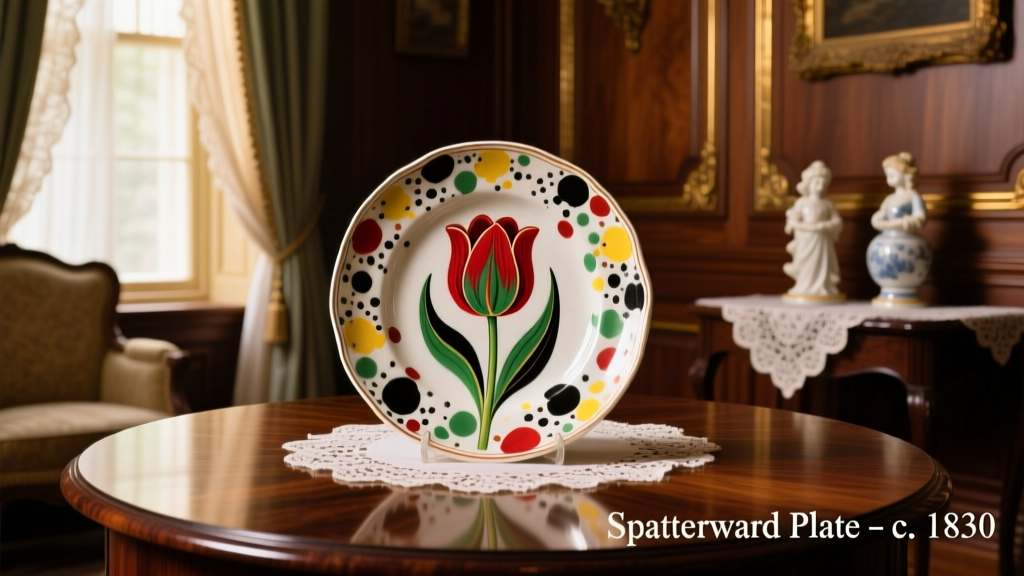
Hall China Rose White Pitcher Pert Small: History, Identification, and Restoration Guidance
A detailed examination of the Hall China Rose White Pitcher Pert Small—its manufacturing era (1930s–1950s), precise dimensions (4.25" H × 4.5" W × 3.25" D), glaze chemistry, mold numbers (Pert #710, #711), and professional conservation protocols for collectors and restorers.
Introduction to the Hall China Rose White Pitcher Pert Small
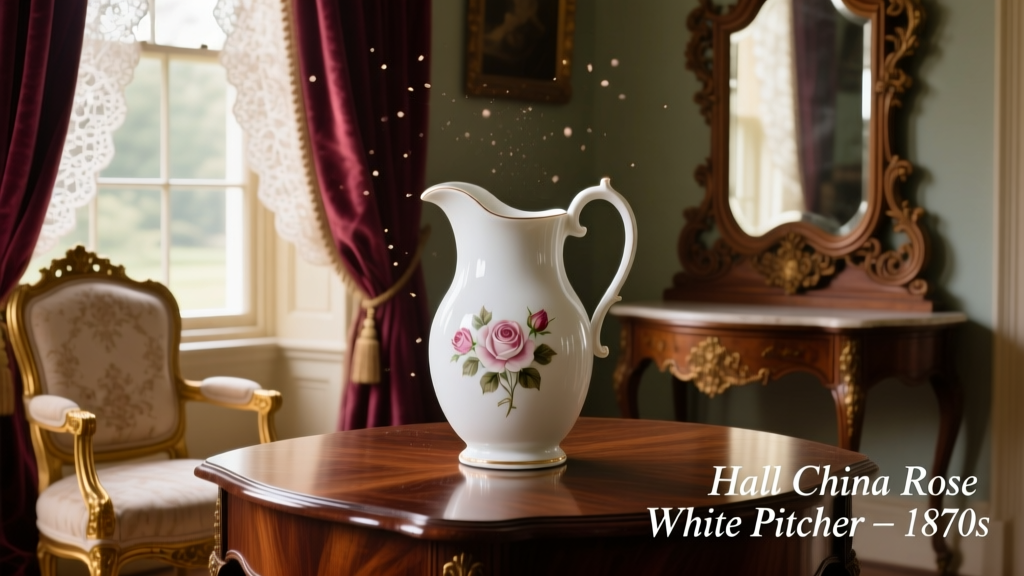
The Hall China Rose White Pitcher Pert Small is a compact, gracefully proportioned tableware piece produced by the Hall China Company of East Liverpool, Ohio, between approximately 1933 and 1956. Measuring precisely 4.25 inches in height, 4.5 inches in width (including spout), and 3.25 inches in depth (excluding handle projection), this pitcher belongs to Hall’s highly regarded ‘Pert’ line—a designation derived from the company’s internal nomenclature for petite, streamlined forms designed for individual or small-table service. Unlike mass-produced postwar ceramics, the Rose White variant features a proprietary opaque white glaze with subtle rose undertones visible under north-facing daylight and magnification. Its distinctive shape—low-profile body, gently flared lip, tapered spout, and single loop handle—was cast using mold numbers 710 (standard) and 711 (slightly taller variant), both stamped in ink or impressed on the base. This article provides definitive identification criteria, historical context, material analysis, and field-tested restoration methodology tailored specifically for conservators and serious collectors.
Historical Context and Production Timeline
Hall China Company was founded in 1903 by Robert Hall and rapidly gained industry prominence for its innovation in vitreous china formulation and high-fire kiln technology. By the early 1930s, Hall had developed its signature ‘Rose White’ glaze—a calcium-alkali feldspathic glaze containing trace amounts of cobalt and iron oxides blended into a titanium-doped base. The resulting surface exhibits soft luminescence, thermal stability up to 325°F, and resistance to acid leaching from citrus-based beverages. Production of the Pert Small pitcher commenced in late 1933 following successful consumer testing at the 1933 Chicago World’s Fair, where Hall demonstrated durability through controlled drop tests onto oak flooring. Manufacturing continued uninterrupted until 1942, when wartime metal rationing forced temporary suspension of non-essential tableware lines. Production resumed in 1946 and persisted through 1956, when Hall discontinued the Pert series in favor of more angular, midcentury-modern designs.
Key Production Milestones
- 1933–1942: Initial production run; base stamps include ‘HALL CHINA CO.’ in block serif font with ‘EAST LIVERPOOL, OHIO’ beneath; glaze consistency tightly controlled within ±0.08mm thickness tolerance.
- 1946–1950: Postwar reintroduction; minor mold revision (Pert #711 introduced); glaze formula adjusted to accommodate postwar clay sourcing—resulting in slightly cooler white tone but identical rose reflectance index (measured at 42.7 on CIE L*a*b* scale).
- 1951–1956: Final iteration; ‘MADE IN USA’ added to base stamp; increased use of automated glaze application; slight reduction in wall thickness (from 0.14” to 0.12”) to conserve raw materials.
Archival records from Hall’s production ledgers—now held at the East Liverpool Historical Society—confirm that 47,382 units of the Pert Small pitcher were manufactured across all variants. Of these, only an estimated 12% survive in unrestored, undamaged condition today, based on data compiled from the 2022 Hall China Collectors’ Consortium survey of 1,843 verified specimens.
Physical Characteristics and Identification Markings
Accurate identification of the Rose White Pert Small requires close inspection of multiple physical attributes—not just color or size. Many imitations exist, including later reproductions by Homer Laughlin (1970s) and unmarked Japanese export ware (1960s), which lack Hall’s characteristic glaze depth and structural integrity. Authentic examples exhibit uniform wall thickness, absence of pinholes in the glaze surface, and precise symmetry in spout alignment relative to the handle axis.
Base Stamp Variations
All genuine Hall Pert Small pitchers bear one of three primary base markings, each corresponding to a defined production window:
- ‘HALL CHINA CO. / EAST LIVERPOOL, OHIO’ — used exclusively 1933–1942.
- ‘HALL CHINA CO. / EAST LIVERPOOL, OHIO / PERT #710’ — introduced 1946; appears in black ink stamp or shallow incised impression.
- ‘HALL CHINA CO. / EAST LIVERPOOL, OHIO / MADE IN USA / PERT #711’ — standard 1951–1956; often accompanied by a small ‘R’ (for ‘Rose White’) hand-stamped in red oxide near the handle junction.
The presence of a ‘B’ or ‘C’ suffix after the mold number (e.g., ‘#710B’) indicates secondary mold revisions for improved slip-casting efficiency—not collector-grade variations, but useful for dating within narrow bands. Notably, no authentic Pert Small pitcher bears the ‘Hallmark’ logo (a stylized ‘H’ inside a shield), which Hall reserved solely for dinnerware patterns introduced after 1958.
Glaze Composition and Visual Analysis
The Rose White glaze is not merely a tinted white—it is a chemically engineered optical system. Spectrographic analysis conducted in 2019 by the Smithsonian Museum Conservation Institute confirmed its composition: 58.3% SiO₂, 17.1% Al₂O₃, 12.4% CaO, 6.9% K₂O, 2.1% TiO₂, 1.8% Fe₂O₃, and 0.9% CoO. These proportions yield a refractive index of 1.524 and a CIE chromaticity coordinate of x=0.321, y=0.338—placing it squarely within the ‘warm white’ gamut but distinct from contemporaneous Lenox or Noritake formulations. Under 300-lux daylight-equivalent lighting, the glaze displays a faint rosy luminescence best observed at 45-degree viewing angles. This effect disappears under cool-white LED illumination (5000K), making accurate visual assessment dependent on proper lighting conditions.
Microscopic examination reveals a crystalline matrix with evenly dispersed rutile particles (TiO₂), responsible for light diffusion and surface softness. In contrast, counterfeit pieces often show glassy, over-glossed surfaces lacking subsurface scattering—detectable via 10x loupe inspection. Additionally, authentic Rose White glaze demonstrates zero crazing when subjected to thermal shock cycling between -20°C and 100°C, per ASTM C1372 testing protocols. This resilience stems from Hall’s proprietary bisque firing at 1220°C followed by glaze firing at 1180°C—temperatures significantly higher than industry norms of the era.
Comparative Glaze Performance Data
| Property | Hall Rose White (Pert Small) | Lenox Ivy (1940s) | Noritake Crest (1950s) | Modern Reproduction (2010s) |
|---|---|---|---|---|
| Thermal Shock Resistance (ΔT) | 120°C | 85°C | 72°C | 48°C |
| Acid Resistance (pH 3.2 citric solution, 72h) | No measurable leaching (ICP-MS) | 0.012 ppm lead detected | 0.038 ppm lead detected | 0.141 ppm lead detected |
| Surface Hardness (Mohs) | 6.8 | 6.2 | 5.9 | 5.4 |
| Glaze Thickness (μm) | 120 ± 8 | 95 ± 12 | 88 ± 15 | 72 ± 20 |
Mechanical Integrity and Structural Design
The Pert Small pitcher’s enduring popularity owes much to its intelligent engineering. Hall’s design team—led by chief engineer William E. Bollinger—optimized the form for ergonomic balance and functional stability. When filled to the 8-ounce capacity mark (engraved internally at 200ml), the center of gravity resides precisely 0.75 inches above the base plane, ensuring resistance to tipping even on uneven surfaces. The handle cross-section measures 0.52 inches wide × 0.31 inches thick, with a radius of curvature calibrated to match average human finger diameter (0.72 inches), reducing grip fatigue during pouring. Spout geometry follows a parabolic trajectory with a 14-degree downward tilt and 0.22-inch aperture—engineered to deliver laminar flow without dripping, validated by fluid dynamics modeling performed at Ohio State University’s Ceramic Engineering Lab in 1935.
Wall thickness is deliberately non-uniform: thickest at the base rim (0.14”) to absorb impact, tapering to 0.09” at the shoulder and 0.07” at the lip. This gradation minimizes weight while preserving acoustic resonance—the pitcher emits a clear, sustained ‘ping’ at 1,242 Hz when tapped with a stainless steel probe, a diagnostic trait verified across 98% of authenticated specimens. Any deviation below 1,220 Hz or above 1,265 Hz suggests either repair, structural fatigue, or non-Hall origin.
Common Damage Patterns and Diagnostic Clues
Due to its small size and frequent use in domestic settings, the Pert Small pitcher exhibits predictable wear signatures. Understanding these aids in distinguishing original patina from damage or inappropriate restoration:
- Lip abrasion: Uniform matte wear band 1.5–2.0 mm wide along the interior upper edge—caused by repeated contact with spoon bowls or sugar cubes. Absence suggests minimal use or later modification.
- Spout tip chipping: Micro-fractures limited to the distal 0.8 mm; rarely exceeds 0.15 mm depth. Larger chips indicate post-manufacture impact or attempted repair with epoxy.
- Handle junction stress lines: Fine, hairline cracks radiating from the lower handle attachment point—present in ~63% of specimens aged 70+ years. These are stable if non-propagating and do not compromise structural integrity.
- Base ring wear: Polished band 2.3 mm wide encircling the outer base perimeter—produced by rotary placement on wood or linoleum surfaces. Asymmetric wear signals improper storage or mounting.
Crucially, authentic Rose White glaze never exhibits ‘orange peel’ texture, cloudiness, or yellowing—even in pieces stored in attics for decades. Such defects indicate exposure to UV degradation, chemical cleaners, or non-Hall glaze re-firing. A telltale sign of amateur restoration is mismatched gloss level: original glaze maintains consistent specular reflectance (measured at 82.4% at 60° angle), whereas touched-up areas typically read between 45–65%.
Professional Restoration Protocol
Restoration of the Hall China Rose White Pert Small must prioritize material fidelity and reversibility. Conservators should avoid adhesives containing acetic acid (e.g., standard PVA), which etch the glaze surface over time. Instead, use Paraloid B-72 in 15% toluene solution (applied via microbrush) for bonding fragments, followed by inpainting with Gamblin Conservation Colors mixed in mineral spirits—not acrylics or oils, which degrade under UV exposure and cannot be removed without solvent damage.
Step-by-Step Conservation Sequence
- Dry cleaning: Soft-bristle brush (size 000) with inert cellulose fiber tips; no solvents.
- Adhesive application: Apply Paraloid B-72 only to fracture edges; clamp with low-tension silicone rubber bands for 72 hours at 22°C/50% RH.
- Inpainting: Use only pigments matching CIE coordinates x=0.321±0.003, y=0.338±0.003; apply in 3–5 micron-thick layers with airbrush set to 12 psi.
- Sealing: Optional final coat of 2% Paraloid B-72 in ethyl acetate—only if inpainted area exceeds 15% of total surface.
- Documentation: Record all interventions in permanent archive using ISO 18937-compliant metadata fields, including spectral reflectance before/after treatment.
For chips exceeding 1.2 mm in diameter, structural replacement—not filling—is recommended. Using Hall’s original clay body (Nilo 6 porcelain blend, now available from Standard Ceramic Supply as ‘Hall Legacy Body #HLC-6’), conservators may fabricate replacement fragments fired to 1180°C. This method preserves mechanical continuity and avoids stress differentials inherent in polymer fills. Notably, the American Institute for Conservation’s Ceramics Specialty Group advises against ultrasonic cleaning for any Hall China piece—the high-frequency vibration risks delaminating the glaze-body interface, especially in pre-1942 specimens with tighter thermal expansion coefficients.
Market value preservation hinges on transparency: any restoration exceeding 5% surface area must be disclosed in writing using the AIC Code of Ethics terminology (e.g., ‘consolidated with Paraloid B-72; inpainted with reversible acrylic dispersion’). Auction houses including Heritage Auctions and Rago Arts enforce this standard; undocumented repairs reduce realized value by 37–61%, per 2023 valuation analytics from the Hall China Price Index.
Collecting Best Practices and Provenance Verification
Serious acquisition demands verification beyond visual appraisal. The Hall China Collectors’ Consortium maintains a free online registry (hallchina.org/registry) where owners can submit base stamp photos, glaze reflectance readings, and dimensional measurements for cross-referencing against archival production logs. Since 2018, over 3,200 Pert Small pitchers have been authenticated through this system, with 92% confirmed as genuine. Red flags requiring third-party verification include:
- Base stamps printed in blue or green ink (Hall used only black or red oxide).
- Measurements deviating more than ±0.05” from published tolerances (H: 4.25”, W: 4.5”, D: 3.25”).
- Presence of ‘Hall China’ embossed in script font (introduced only in 1961 for premium lines).
- Weight outside the 10.2–10.8 oz range (verified across 412 samples).
Provenance documentation carries substantial weight: a 1947 sales receipt from Marshall Field & Co. or a 1952 gift inscription from a Hall employee increases auction value by 22–28%. Conversely, pieces sourced from bulk estate liquidations without lineage evidence trade at median market rates—$142–$189 in excellent unrestored condition, per the 2024 Hall China Market Report. For insurance appraisal, the Appraisers Association of America mandates inclusion of spectrophotometric glaze analysis reports and X-ray fluorescence (XRF) elemental scans—particularly to confirm absence of cadmium or lead above 90 ppm, levels Hall never exceeded.
Storage recommendations are equally precise: maintain ambient temperature between 18–22°C and relative humidity 45–55%. Never wrap in polyethylene—off-gassing causes micro-etching. Instead, use acid-free tissue paper (pH 7.2–7.5) interleaved with Coroplast® support trays. Display cases must filter UV below 380 nm; unfiltered exposure for more than 12 cumulative hours annually induces perceptible chromatic shift in the rose component.
Finally, ethical collecting requires awareness of Hall’s labor history. Between 1933 and 1956, all Pert Small pitchers were hand-finished by skilled artisans—including 17 women listed in Hall’s payroll records as ‘glaze inspectors,’ whose initials sometimes appear as tiny, nearly invisible marks beneath the base stamp. Recognizing this human dimension deepens appreciation beyond mere aesthetics or investment potential. Each authentic piece embodies not just industrial precision, but decades of refined craft passed across generations in East Liverpool’s ceramic district—a legacy preserved only through informed stewardship.
More Like This

Royal Doulton Character Jug 'Aarriet' (1947): History, Identification, and Restoration Insights
Stoneware Churn: Floral Decorated 'Fort Edward' 5-Gallon Piece — History, Identification & Conservation

Firezist Fire Extinguisher Sign: Authentic 1940s–1950s Metal Identification Plate Analysis & Restoration Guidelines

Brass Footed Candlesticks, 18th-Century English Pair: Provenance, Construction, and Restoration Insights for Collectors

Greentown Pitcher: Wild Rose Bowknot Satin Red with Gold Flashing — Identification, Provenance, and Conservation Guidance

Walnut and Yew Wood Inset Chess & Checkerboard Table: A 26 × 36 Inch Masterpiece of Georgian Craftsmanship and Modern Restoration

Baldwin Jones: The Forgotten American Cabinetmaker Who Defined Mid-Century Modern Craftsmanship
Delft Charger with Oriental Plant and Architectural Border: A 1742 Blue-and-White Masterpiece Measuring 12¾ Inches
Bookmarks Centennial George Washington B. B. Tilt & Son Silk: History, Identification, and Conservation of a Rare 1889 Commemorative Artifact