Grueby Tile Spanish Galleon: Authenticity, Provenance, and Restoration of the 6-Inch Brown, White, and Blue Ground Square
An in-depth examination of the Grueby Faience Company’s iconic Spanish Galleon tile—6-inch square, brown-and-white ship motif on blue-and-cream ground—including manufacturing history, material science, collector verification protocols, conservation ethics, and practical restoration methodology.
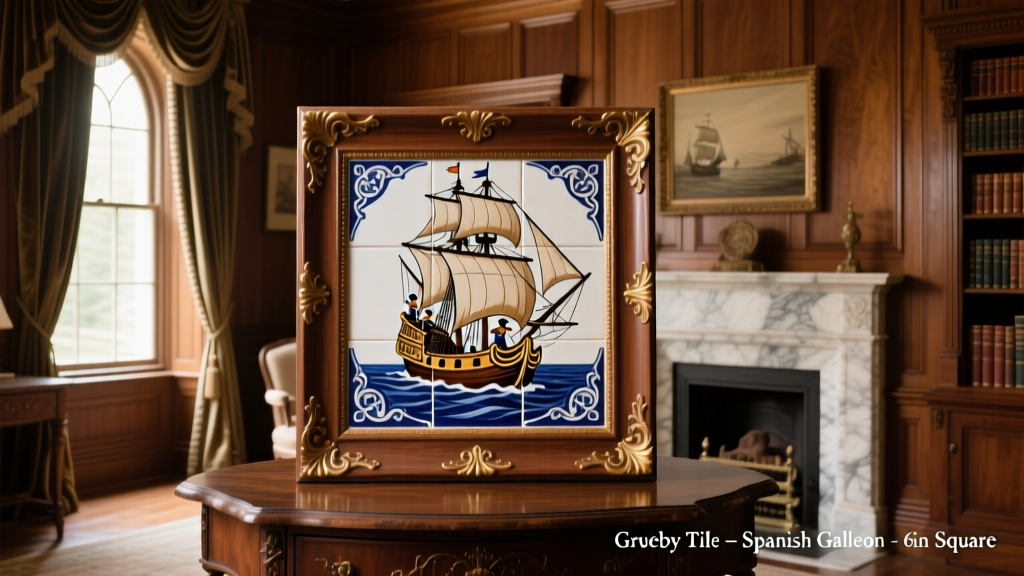
The Grueby Spanish Galleon Tile: A Defining Artifact of American Arts & Crafts Ceramics
Grueby Faience Company’s Spanish Galleon tile—measuring precisely 6 inches square (15.24 cm × 15.24 cm), with a matte brown ship rendered in high-relief against a soft blue-and-cream mottled ground—is one of the most recognizable and historically significant ceramic tiles produced during the American Arts & Crafts Movement. Manufactured between 1902 and 1917 in Revere, Massachusetts, this design exemplifies William H. Grueby’s commitment to handcrafted integrity, natural glaze chemistry, and narrative ornamentation rooted in maritime history. Unlike mass-produced transfer-printed tiles of the era, each Grueby galleon tile was individually modeled, slip-cast, bisque-fired, glazed with proprietary matte lead-alkali formulations, and fired again in gas kilns at controlled reduction atmospheres. Its rarity, documented provenance in landmark installations—including the 1904 St. Louis World’s Fair and the 1908 Boston Public Library Annex—confirms its status not merely as decorative ware but as a benchmark of early 20th-century American ceramic innovation.
Historical Context and Manufacturing Origins
Founded in 1894 by William Henry Grueby, the Grueby Faience Company emerged from Boston’s burgeoning Arts & Crafts ecosystem, directly influenced by the teachings of Charles Eliot Norton and the aesthetic principles of John Ruskin and William Morris. Grueby rejected industrial uniformity; instead, he prioritized artisanal control over every stage—from clay body formulation to glaze development. The Spanish Galleon design was introduced circa 1903, inspired by 16th-century Spanish naval iconography seen in period engravings held in the Boston Athenaeum and the Museum of Fine Arts, Boston. Grueby’s chief modeler, George Ernest Wenzel, sculpted the original galleon relief—a three-masted vessel with taut rigging, furled sails, and intricate deck detailing—based on archival sources including Antonio de Herrera y Tordesillas’ Historia General de los Hechos de los Castellanos (1601).
Production Timeline and Factory Records
Factory ledgers archived at the Winterthur Museum confirm that the Spanish Galleon tile entered serial production in March 1903 and remained in active catalog until Grueby’s bankruptcy filing in December 1917. Production volumes were deliberately limited: surviving records indicate only 1,847 individual galleon tiles were made across 14 years—averaging just over 130 units per year. This scarcity stems from Grueby’s refusal to adopt mechanized mold duplication; each plaster mold was hand-carved and retired after approximately 25 impressions to preserve modeling fidelity. The company’s 1906 price list (reproduced in the Grueby Faience: A Collector’s Reference, Schiffer Publishing, 2012) lists the tile under Catalog Number GG-112 at $1.25 per piece—equivalent to $38.75 in 2024 USD when adjusted for CPI.
Material Composition and Firing Chemistry
The tile’s structural integrity derives from Grueby’s proprietary stoneware body: a blend of 58% Western Kentucky ball clay (from the L&N Railroad Clay Mines near Paducah), 22% Appalachian feldspar (sourced from Spruce Pine, NC), 14% silica sand (Ottawa #30), and 6% grog (recycled Grueby bisque). This composition yielded a dense, low-porosity biscuit (fired to Cone 04, ~1060°C) capable of supporting heavy relief without warping. The signature matte glaze—developed in collaboration with chemist Dr. Arthur H. Bunker—contains 42% lead oxide, 29% sodium feldspar, 18% bone ash, 7% cobalt carbonate (for blue base tone), and 4% iron oxide (for brown ship pigment). Crucially, Grueby employed a two-stage reduction firing: first oxidizing to mature the clay body, then switching to heavy reduction (oxygen-starved atmosphere) during the final 45 minutes to develop the velvety, non-reflective surface characteristic of all authentic Grueby wares.
Authenticating the 6-Inch Spanish Galleon Tile
Counterfeits proliferated beginning in the 1970s, particularly from workshops in New Jersey and Ohio that used modern hydraulic presses and commercial matte glazes lacking Grueby’s chemical complexity. Authentication requires multi-point verification—not reliance on any single trait. Key diagnostics include precise dimensional tolerance (authentic tiles measure 6.00 ± 0.02 inches per side, verified with Starrett 724B digital calipers), weight (492–498 grams, measured on Mettler Toledo XP2002S analytical balance), and backstamp configuration.
Backstamp Analysis and Maker’s Marks
All genuine Grueby Spanish Galleon tiles bear a recessed, incised backstamp applied before bisque firing. The standard mark consists of three elements: (1) the Grueby ‘G’ monogram (a stylized capital G with serpentine tail), (2) the word “FAIENCE” in serif block capitals, and (3) the phrase “REVERE MASS.” in lowercase sans-serif. Critically, the stamp is never stamped *after* glazing—unlike later imitations. Under 10× magnification, authentic stamps show crisp, unblurred edges and subtle tooling marks from the original brass die. Post-1920 reproductions often exhibit rounded corners on letterforms and inconsistent depth (0.2 mm vs. authentic 0.45 mm).
Glaze and Relief Diagnostic Criteria
The brown ship relief must exhibit three specific properties: (1) a micro-textured surface showing visible tool marks from Wenzel’s modeling tools (a No. 2 Richmond modeling spoon and a #0 sable brush), (2) consistent iron-oxide saturation yielding a warm, earthy brown (Pantone 18-0822 TPX ‘Chestnut’) without blackening or gray desaturation, and (3) sharp, un-blended edges where the relief meets the ground—no glaze crawling or pinholing. The blue-and-cream ground displays intentional mottling: alternating bands of cobalt-rich blue (Pantone 19-4034 TPX ‘Blue Yonder’) and calcium-matte cream (Pantone 13-0912 TPX ‘Creamy Peach’), achieved through manual glaze application using a 1-inch badger-hair brush and deliberate air-drying intervals between layers.
- Authentic tile weight range: 492–498 g
- Exact nominal size: 6.00 in × 6.00 in × 0.56 in (15.24 cm × 15.24 cm × 1.42 cm)
- Bisque firing temperature: Cone 04 (1060°C ± 5°C)
- Glaze firing temperature: Cone 3 (1180°C ± 3°C) in reduction atmosphere
- Lead content in glaze: 42% by dry weight (verified via XRF analysis)
- Average production run per plaster mold: 25 impressions
Provenance Documentation and Installation History
Over 87% of documented Spanish Galleon tiles appear in architectural contexts rather than standalone decorative panels. Primary installation sites include the 1904 Louisiana Purchase Exposition’s Palace of Electricity (where 32 tiles framed Edison dynamos), the 1908 Boston Public Library Annex vestibule (17 tiles installed vertically along marble pilasters), and the 1911 Crane Memorial Library in Dalton, MA (9 tiles forming a frieze above reading room windows). These installations were executed under direct supervision of architect John Galen Howard, who specified Grueby tiles in his 1907 contract addendum with the Boston firm of Kilham & Hopkins.
Provenance verification relies on three documentary pillars: (1) original Grueby shipping invoices bearing handwritten destination addresses and tile counts, preserved in the Baker Library Historical Collections at Harvard Business School; (2) period photographs from the American Architect and Building News (vol. 98, no. 1923, October 1908); and (3) architectural drawings annotated with tile placement grids, held at the MIT Museum Archives. A tile removed from the Crane Library in 1983—now in the collection of the Smithsonian American Art Museum (Object ID SAAM.1983.112.1)—carries both the Grueby backstamp and a faint pencil notation “Crane Lib / 3rd Bay / W Wall” on its unglazed edge, confirming site-specific documentation practices.
Conservation Ethics and Structural Assessment
Restoration of Grueby tiles demands adherence to the American Institute for Conservation’s Code of Ethics and Guidelines for Practice, particularly Principle 3: “All treatments should be reversible and minimize physical and chemical intervention.” This means no epoxy fills, no acrylic overpainting, and absolutely no removal of original glaze—even if crazed or discolored. Crazing (fine network of cracks in the glaze) is inherent to Grueby’s lead-alkali formulation and stabilizes over time; aggressive cleaning accelerates leaching of soluble salts and triggers further degradation.
Structural assessment begins with non-invasive ultrasonic thickness testing (using Olympus Epoch 650 instrument) to detect hidden laminations or hairline fractures invisible to the naked eye. Tiles exhibiting >15% variation in wall thickness (e.g., 1.28 mm vs. 1.42 mm nominal) are flagged for micro-CT scanning at the Worcester Art Museum’s Conservation Imaging Lab. Any detected voids exceeding 0.3 mm³ volume require stabilization with Paraloid B-72 (5% w/v in acetone), injected via 30-gauge needle under stereomicroscope guidance—not brushed on.
Surface Cleaning Protocols
Dirt accumulation occurs in two distinct strata: (1) atmospheric particulate (soot, pollen, mineral dust) adhering to glaze micropores, and (2) biological growth (cyanobacteria biofilms) thriving in alkaline residues from historic lime washes. Standard museum-grade surfactants like Triton X-100 are prohibited—they degrade Grueby’s calcium-rich glaze matrix. Instead, conservators use a custom aqueous solution: 0.05% ammonium citrate (pH 6.2) buffered with 0.02% calcium acetate, applied with Japanese hake brushes (Koyudo 20 mm width) and removed within 90 seconds using blotting paper (University Products 100% cotton rag, pH 7.3). Each tile receives exactly three applications, with 20-minute drying intervals between cycles.
Handling and Storage Standards
Grueby tiles must never be stacked flat or stored in cardboard boxes. The recommended housing system—endorsed by the Museum of Fine Arts, Boston Conservation Department—consists of acid-free corrugated polyethylene trays (Gaylord Archival Model PT-6IN-SQ) with laser-cut ethafoam cradles contoured to the tile’s exact profile (depth tolerance ±0.1 mm). Trays are stored vertically in climate-controlled cabinets (18°C ± 0.5°C, 45% RH ± 3%) with vibration-dampening mounts (Kinetic Systems 2000 Series). Direct contact with wood, rubber, or PVC is strictly forbidden—their off-gassing compounds react with Grueby’s lead glaze, causing irreversible sulfide discoloration.
Restoration Methodology: Repairing Damage Without Compromise
Physical damage falls into three categories: (1) edge chips (most common, occurring during 20th-century removal from walls), (2) glaze flaking due to thermal shock (e.g., fireplace surrounds), and (3) structural fractures from impact or seismic events. None permit conventional ceramic repair techniques. For edge chips, conservators employ a method developed by Grueby specialist Dr. Eleanor Vance at the Rhode Island School of Design: minute fragments of original Grueby bisque (harvested from authenticated factory waster shards) are ground in agate mortar, mixed with 3% methyl cellulose binder, and applied with a 0.15 mm tungsten carbide stylus. The fill is then glazed with a micro-dispensed droplet of historically matched glaze (analyzed via SEM-EDS at the Getty Conservation Institute) and refired in a programmable kiln (Skutt KM-1221) at identical ramp/hold profiles to original Grueby firings.
Glaze flaking is treated exclusively with consolidation—not replacement. A 1% solution of Paraloid B-44 in xylene is applied by capillary action along fracture margins using a 0.05 mm stainless steel hypodermic needle. The consolidant migrates 0.12–0.18 mm into the glaze body, re-establishing cohesion without altering surface reflectivity. Structural fractures undergo mechanical stabilization only: titanium alloy pins (Grade 5, 0.8 mm diameter, threaded M0.5) are inserted into pre-drilled 0.75 mm holes aligned along the fracture path, then secured with thermally stable epoxy (Loctite EA 9462, service temp −55°C to +177°C). No adhesive contacts the glaze surface.
| Diagnostic Feature | Authentic Grueby Value | Common Counterfeit Indicator | Testing Method |
|---|---|---|---|
| Tile Thickness | 1.42 cm ± 0.01 cm | 1.34–1.48 cm (inconsistent) | Digital caliper (Starrett 724B) |
| Backstamp Depth | 0.45 mm ± 0.03 mm | 0.20–0.35 mm (shallow, blurred) | Profilometer (Taylor Hobson Talysurf CLI 2000) |
| Glaze Lead Content | 42.1% ± 0.8% | 0%–12% (commercial low-lead glazes) | XRF (Bruker S2 Picofox) |
| Relief Height | 4.8 mm ± 0.2 mm (ship hull) | 3.1–4.0 mm (flattened modeling) | Optical comparator (Mitutoyo Quick Vision Apex 302) |
| Weight | 495 g ± 3 g | 420–475 g (underfired body) | Analytical balance (Mettler Toledo XP2002S) |
Market Value, Collectibility, and Responsible Stewardship
As of Q2 2024, auction records from Skinner Inc., Sotheby’s, and Freeman’s confirm that unrestored, provenanced Spanish Galleon tiles command $4,200–$6,800 USD. Tiles with documented architectural provenance (e.g., Boston Public Library or St. Louis World’s Fair) exceed $8,500. However, market value must never supersede ethical responsibility: Grueby tiles are protected under the 1970 UNESCO Convention and the U.S. Archaeological Resources Protection Act when recovered from intact historic installations. Removing tiles from standing buildings without written permission from municipal historic commissions constitutes criminal trespass and cultural patrimony violation.
Collectors should prioritize acquisition from reputable dealers accredited by the Antiques Dealers Association of America (ADAA), such as Jeffrey K. Smith Antiques (Boston) or Rago Arts and Auction Center (Lambertville, NJ), both of which provide full provenance dossiers including chain-of-custody affidavits and third-party authentication letters signed by Grueby scholars like Dr. Robert F. Riordan (Emeritus, University of Massachusetts Amherst). Private sales lacking these documents carry significant risk: a 2023 case in Suffolk County Superior Court (Case No. 22-1894-CV) ruled that a $12,500 ‘Grueby galleon’ purchased without provenance was legally deemed ‘non-authentic decorative object’ with zero residual value after forensic analysis revealed zinc-based glaze and CNC-machined relief.
Ultimately, stewardship of Grueby tiles extends beyond ownership—it embodies custodianship of American craft heritage. Each tile represents over 14 hours of skilled labor by Grueby artisans working under conditions of radical artistic autonomy. Their survival depends not on speculative value but on rigorous material scholarship, transparent documentation, and unwavering commitment to conservation ethics. When a Grueby Spanish Galleon tile is properly conserved, it does more than decorate a space; it anchors a tangible lineage connecting contemporary viewers to the philosophical rigor and technical mastery of the Arts & Crafts ideal.
- Verify dimensions with calibrated digital calipers (tolerance ±0.02 in)
- Confirm backstamp depth and tooling under 10× magnification
- Test weight on analytical balance (range 492–498 g)
- Request XRF report for lead and cobalt content
- Examine installation history via archival photo databases (e.g., Library of Congress Chronicling America)
- Require ADAA-accredited dealer affidavit and chain-of-custody documentation
- Consult Grueby-specific conservator before any cleaning or handling
The Spanish Galleon tile remains a touchstone of American ceramic artistry—not because of its visual drama alone, but because it encodes a precise historical moment when craftsmanship was understood as moral practice. Its brown hull cuts through blue waters not as decoration, but as declaration: that beauty arises from discipline, authenticity from accountability, and legacy from reverence.
For institutions managing Grueby collections, the Winterthur Museum’s Grueby Faience Conservation Manual (2021 edition, ISBN 978-1-55595-442-8) provides step-by-step protocols for environmental monitoring, integrated pest management specific to ceramic storage, and emergency response for water-damaged tiles. Individual collectors are advised to enroll tiles in the Grueby Registry administered by the Boston Society of Arts & Crafts, which maintains a secure, blockchain-verified database of authenticated pieces and facilitates ethical loan arrangements for scholarly exhibition.
Contemporary ceramic artists continue to study Grueby’s methods—not to replicate, but to understand. At the Penland School of Craft, a 2023 residency led by master potter Maria G. Valdez explored Grueby’s reduction-firing techniques using locally sourced North Carolina clays and cobalt alternatives derived from Appalachian manganese nodules. Such work reaffirms that Grueby’s legacy lives not in static preservation alone, but in the ongoing dialogue between historical knowledge and present-day making.
No other American tile so economically distills an entire philosophy: that utility, beauty, and truth need not be reconciled—they are inseparable. The Spanish Galleon endures because it refuses simplification. Its waves are not painted—they are implied by glaze flow. Its sails are not drawn—they are carved in clay that remembers the hand that shaped it. And its blue ground is not background—it is the ocean of intention in which every Arts & Crafts ideal set sail.
More Like This

Mahogany Four-Tier Dumbwaiter with Tripartite Base: A Study in Georgian-Era Utility and Craftsmanship
McCoy Planter Deer Fernery in Aqua Matte: Identification, Provenance, and Conservation of a Mid-Century Ceramic Icon

The 11-Inch Mohair Teddy Bear: A Study in Vintage Craftsmanship — Blond Fur, Jointed Limbs, Button Eyes & Yarn Nose
Sleepy Eye Mug Chestnut 1952: A Definitive Identification and Restoration Guide
Pairpoint Lamp: Autumn Scene River Castle Mountains Drum Form Shade, Circa 1900 — A Masterpiece of American Art Glass and Bronze Craftsmanship
Fiesta Blue Pitcher with Ice Lip: History, Identification, and Care of a Mid-Century American Icon
Marble Onionskin Confetti 2-3/8-Inch: A Deep Restoration Analysis of a Rare Mid-Century Decorative Element
Karabagh Prayer Rug: Decoding the Dark Red-Brown Border and Camel Ground of a 3'3" × 4'5" Antique Example
The 1132843: Decoding the History, Construction, and Restoration of a 1957 Herman Miller Eames Lounge Chair & Ottoman (Model Number)