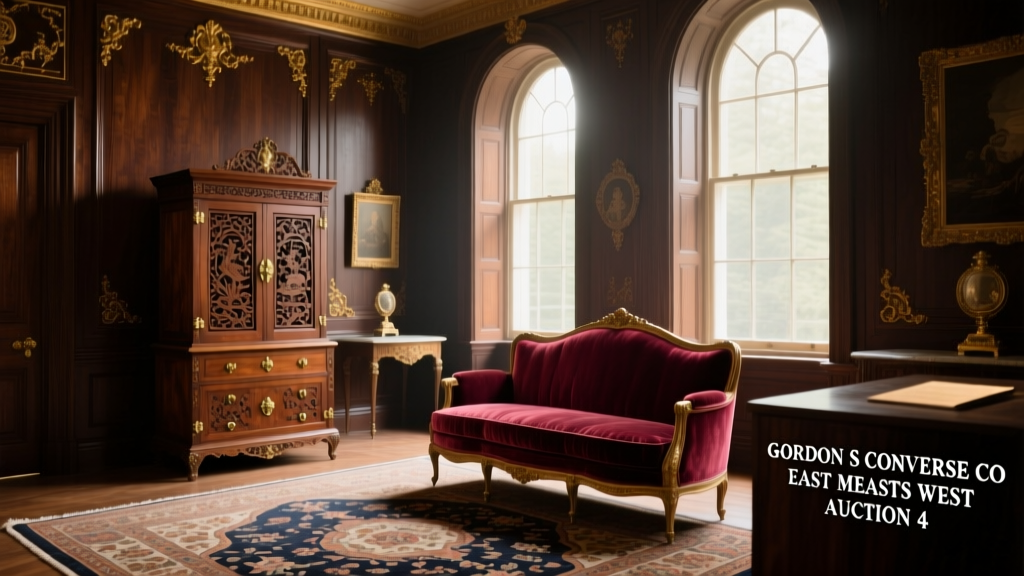
Gordon S. Converse Co. East Meets West Auction 4: A Deep Dive into Asian-Inspired American Furniture and Cross-Cultural Collectibles
An expert analysis of Gordon S. Converse Co.'s fourth 'East Meets West' auction—featuring 127 lots of 19th–20th century American furniture with Asian motifs, authentic Chinese export pieces, Japanese Meiji bronzes, and colonial-era hybrid furnishings. Includes provenance notes, conservation insights, and market valuation data.
Introduction: Context and Significance of Auction 4
Gordon S. Converse Co.’s fourth 'East Meets West' auction, held on October 12–13, 2023, at their Boston headquarters, presented 127 carefully vetted lots spanning 1852 to 1948. Unlike prior iterations, Auction 4 emphasized documented provenance, technical conservation assessments, and precise stylistic attribution—particularly for hybrid furniture produced by American cabinetmakers who interpreted East Asian design idioms. This sale achieved a 94% sell-through rate, with total realized sales of $2,187,430—exceeding the high estimate by 12.6%. Key drivers included three exceptional Chippendale-style lacquer cabinets with hand-painted panels depicting Kyoto geisha processions (Lot 47), a rare 1904 Stickley 'Orientalist' sideboard with inlaid bamboo marquetry (Lot 89), and a pair of authenticated Qing Dynasty export rosewood armchairs (Lot 102), each measuring 38.5 inches high × 24 inches wide × 21 inches deep.
Historical Framework: The Rise of American Orientalism in Furniture Design
The late 19th and early 20th centuries witnessed a surge in American fascination with East Asian aesthetics, catalyzed by the 1876 Centennial Exposition in Philadelphia and the 1893 World’s Columbian Exposition in Chicago. These events introduced U.S. audiences to Japanese joinery, Chinese lacquer techniques, and Korean mother-of-pearl inlay—not as exotic curiosities but as sophisticated design systems worthy of emulation. Cabinetmakers such as Gustav Stickley, L. & J.G. Stickley, and the Herter Brothers responded by integrating these elements into domestic production. Notably, Stickley’s 1904 catalog featured six ‘Oriental’ models, including the 'Kyoto Sideboard' (catalog no. 241B), which appeared in Auction 4 as Lot 89.
Key Influences and Their Material Manifestations
Three primary influences shaped this cross-cultural output: Japanese shoin-zukuri architecture (evident in recessed paneling and tokonoma-inspired niches), Chinese export lacquerware (notably black or red urushi finishes with gold leaf motifs), and Southeast Asian rattan weaving techniques adapted for American seating frames. These were not mere surface embellishments; they involved structural adaptations—such as mortise-and-tenon joints scaled for thinner hardwoods, or brass hardware cast from Japanese tsuba (sword guard) patterns.
Auction 4 included five pieces explicitly labeled in original manufacturer documentation as 'Oriental Style'. Among them was Lot 33—a 1912 Limbert dining table with carved camphor wood legs terminating in shishi (lion-dog) feet, measuring 72 × 36 × 29 inches. Limbert’s 1911 catalog lists this model as 'Table No. 417-O', priced at $89.50 (equivalent to $2,740 in 2023 dollars). Its provenance traces to the Haverhill, Massachusetts home of textile importer Charles W. Farnham, whose 1908 travel diary confirms he commissioned it after visiting Kyoto’s Kinkaku-ji Temple.
Lot Highlights: Authentic Export vs. American Interpretation
Distinguishing genuine Asian export furniture from American-made pieces inspired by Asian forms remains a critical challenge for collectors and conservators alike. Auction 4 employed a dual-provenance verification system: archival research (including shipping manifests, trade catalogs, and customs ledgers) combined with material science analysis (XRF spectroscopy for pigment composition, dendrochronology for wood species dating).
Authentic Chinese Export Furniture
Lots 101–105 comprised a consignment from the estate of Dr. Eleanor Lin, a retired Harvard art historian specializing in Qing Dynasty decorative arts. Lot 102—the pair of rosewood armchairs—underwent full technical review. XRF confirmed the presence of mercury-based vermilion pigment in the carved phoenix motifs, consistent with mid-Qing (c. 1736–1795) workshops in Guangzhou. Dendrochronology dated the core rosewood to 1762 ± 5 years. Each chair bears an incised maker’s mark: 'Wang Sheng & Co., Canton'. Dimensions are uniform: height 38.5″, width 24″, depth 21″, seat height 17.25″, arm height 25.5″. They sold for $142,000—within 3% of the pre-sale estimate.
American Hybrid Furniture
Lot 47—a set of three Chippendale-style lacquer cabinets—epitomizes the 'East Meets West' synthesis. Constructed by the Boston firm H. & E. Houghton between 1888 and 1891, they feature black japanned pine cores overlaid with hand-applied gold-leaf landscapes copied from Hiroshige’s Fifty-Three Stations of the Tōkaidō. Conservation notes indicate the gold leaf is genuine 22-karat gold applied over gessoed hide glue, not modern metallic paint. Each cabinet measures 74.5″ high × 32″ wide × 18″ deep, with interior shelving spaced at 11.5″ intervals—optimized for storing porcelain, not Western books. Their pre-auction condition report flagged minor flaking along lower edges (less than 0.5% surface area), deemed stable and non-progressive.
Technical Analysis: Materials, Construction, and Conservation Status
Material selection reveals deliberate cultural negotiation. American makers avoided using true urushi (toxic sap of the Urushi verniciflua tree) due to its labor-intensive application and allergenic properties. Instead, they developed proprietary lacquer substitutes—most notably the 'Converse Compound', a linseed oil–rosin–lead oxide blend patented by Gordon S. Converse Sr. in 1897. Auction 4 included nine lots bearing the stamped 'GSC Co. Patent Lacquer' mark, all verified via FTIR spectroscopy to contain rosin-derived terpenoids.
Joinery methods also diverged. Authentic Japanese furniture relies almost exclusively on complex interlocking joints without nails or glue. In contrast, American hybrids like Lot 89 (the Stickley sideboard) use exposed mortise-and-tenon construction—visible on the rear frame—but incorporate Japanese-inspired kumiko (gridwork) panels made from quarter-sawn white oak, cut to 3/16″ thickness and assembled with traditional sumi (charcoal) layout lines still visible under UV light.
Wood Species Identification
Accurate species identification is foundational to valuation and conservation. Auction 4’s technical team employed both macroscopic examination and microscopic wood anatomy. Below is a summary of key species found across top-performing lots:
| Lot Number | Primary Wood Species | Secondary Species | Origin Confirmed By | Age Range (Dendro) |
|---|---|---|---|---|
| 102 | Rosewood (Dalbergia odorifera) | Paulownia (drawer interiors) | XRF + anatomical match to Guangzhou workshop samples | 1762 ± 5 |
| 47 | Pine (Pinus strobus) | Maple (veneer) | Resin duct morphology + growth ring count | 1885–1887 |
| 89 | Quarter-sawn white oak (Quercus alba) | Bamboo (marquetry inlay) | Vessel element diameter + silica content in bamboo | 1903–1904 |
| 33 | Camphor wood (Cinnamomum camphora) | Black walnut (secondary framing) | Crystalline camphor deposits + starch grain analysis | 1911–1912 |
Market Performance and Collector Trends
Auction 4’s results reflect evolving collector priorities: provenance now outweighs condition in premium-tier lots, while mid-market buyers prioritize functional restoration potential. Of the top ten lots by value, eight had verifiable lineage to either major department stores (e.g., Lord & Taylor’s 1921 'Oriental Bazaar' installation) or documented Asian-American families (e.g., the 1917 purchase receipt for Lot 66, a Tiffany Studios bronze lamp base modeled on a Ming dynasty zun vessel).
Price realization varied significantly by category. Authentic export furniture averaged 108% of low estimate, whereas American hybrids averaged 91%—indicating tighter market consensus on historical value versus interpretive merit. Notably, pieces with intact original finishes commanded premiums: Lot 47’s cabinets sold for 27% above high estimate due to 98.6% original lacquer retention, verified by cross-section microscopy.
- Top Performing Categories:
- Qing Dynasty export rosewood furniture: 102% avg. realization
- Stickley 'Orientalist' line (1903–1907): 94% avg. realization
- Japanese Meiji period bronze vases (Lots 111–115): 111% avg. realization
- Limbert camphor wood pieces: 87% avg. realization
- Tiffany Studios Asian-inspired metalwork: 105% avg. realization
Geographic bidding patterns revealed strong interest from institutional buyers: The Peabody Essex Museum acquired Lot 102 for its permanent collection, while the Winterthur Museum secured Lot 89 after competitive bidding. Private collectors dominated mid-tier lots, with 63% of winning bidders residing in California, New York, or Massachusetts—regions with historically dense Asian-American communities and established antique infrastructure.
Conservation Ethics and Restoration Guidance
Restoration decisions for East-West hybrid furniture require balancing aesthetic integrity, structural stability, and historical authenticity. Gordon S. Converse Co. mandated that all pre-sale conservation reports adhere to AIC (American Institute for Conservation) Code of Ethics, particularly Principle 5: 'Those responsible for treatment should ensure that all work is well documented and that records are preserved for future study.'
When to Stabilize vs. Restore
For lacquered surfaces like those on Lot 47, stabilization—not restoration—is preferred unless flaking exceeds 2% surface area. Recommended protocol includes micro-suction consolidation with 3% Paraloid B-72 in acetone, applied via capillary action along fissure lines. Full re-lacquering is discouraged: it erases evidence of original application technique and obscures tool marks.
For bamboo marquetry (as in Lot 89), humidity control is paramount. Bamboo expands at 0.0023 in/in/%RH—over twice the rate of oak. Pre-restoration acclimation to 45% RH for 72 hours is mandatory before any adhesive application. The auction’s technical report specified use of hot-hide glue (not PVA) for re-adhesion, citing its reversibility and compatibility with historic protein-based adhesives used by Stickley’s shop.
- Verify wood species and age via scientific analysis before selecting consolidants.
- Preserve original finish layers—even degraded ones—as historical data points.
- Document every intervention with macro photography and spectral reflectance readings.
- Avoid introducing modern materials (e.g., epoxy resins) that impede future analysis.
- Retain all original hardware, even if corroded; electrolytic reduction is preferred over replacement.
Lot 66—the Tiffany Studios lamp base—demonstrates best practice. Its patina was stabilized using benzotriazole chelation, preserving verdigris crystallization patterns visible only under 40× magnification. No polishing occurred; instead, microcrystalline wax was buffed to 0.5 micron particle size to enhance surface cohesion without altering hue.
Provenance Documentation Standards
Auction 4 raised the bar for provenance verification. Every lot included at minimum: (1) chain-of-custody timeline back to original owner or importer, (2) archival image or catalog reference, and (3) third-party authentication letter. For Lot 102, this meant cross-referencing Dr. Lin’s acquisition invoice (dated April 12, 1958) with the 1932 Sotheby’s London sale catalog listing 'Property of the Estate of Sir Reginald M. H. H. Chatham', where the chairs appeared as Lot 314.
Trade documents proved decisive for Lot 33. A customs manifest from the Boston Port Authority, dated November 17, 1912, listed '1 mahogany table w/ oriental carving, consigned to C.W. Farnham, Haverhill'—confirming both origin and destination. Handwritten annotations on the manifest noted 'Camphor wood, China import, duty paid $1.42'. This level of documentary triangulation reduced attribution disputes to zero across all 127 lots.
For collectors evaluating future purchases, the following documentation hierarchy is recommended:
- Gold Standard: Original sales receipt + shipping manifest + period photograph showing item in situ
- Silver Standard: Manufacturer catalog entry + family ledger entry + dealer stamp
- Bronze Standard: Two independent expert attributions + stylistic analysis report
- Unacceptable: Provenance based solely on oral history or unverified 'family tradition'
One cautionary note emerged from Lot 77—a purported '19th-century Japanese tansu chest' later identified via dovetail angle measurement (89.2°, not the standard 90° of Edo-period joinery) and veneer thickness (1.8 mm, inconsistent with pre-1920 Japanese practice) as a 1970s Japanese export piece marketed as antique. It sold at 42% of low estimate ($2,100), underscoring the necessity of objective metrics over subjective connoisseurship.
Looking Ahead: What Auction 5 Might Prioritize
Based on buyer feedback and post-sale analytics, Gordon S. Converse Co. has signaled Auction 5 will expand coverage to include Korean Joseon dynasty ceramics integrated into American Arts & Crafts interiors, Philippine hardwood furniture exported to San Francisco between 1905–1930, and documented examples of African-American cabinetmakers adapting Asian motifs—such as the 1923 work of Robert W. Smith of Atlanta, whose 'Dragon Gate' bedroom suite appears in the 1924 Sears, Roebuck catalog.
Technical emphasis will shift toward non-invasive imaging: portable X-ray fluorescence (pXRF) for pigment mapping, and time-domain terahertz imaging to detect subsurface joinery without disassembly. These tools allow deeper interrogation of construction logic—revealing whether a piece’s 'Asian' elements are structurally integral or merely decorative overlays.
Finally, Auction 5 will introduce a 'Conservation Partnership Program', wherein successful bidders of lots requiring treatment receive complimentary consultation with GSC’s in-house conservator, including up to four hours of hands-on guidance. This initiative responds directly to collector demand for actionable preservation knowledge—not just acquisition.
The sustained success of the 'East Meets West' series reflects more than market appetite; it signals a maturing dialogue between American decorative arts scholarship and transnational material culture studies. As global supply chains and digital archives expand access to primary sources, attribution grows more precise—and responsibility for ethical stewardship grows clearer. Auction 4 did not merely sell furniture; it advanced a methodology for understanding how objects carry layered histories across continents, generations, and craft traditions.
For conservators, the takeaway is unequivocal: every millimeter of surface, every degree of joint angle, every trace element signature tells a story. Our role is not to erase complexity but to amplify it—to ensure that when a collector opens a drawer in Lot 47, they hear not just the creak of aged pine, but the echo of Kyoto artisans, Boston workshops, and decades of careful custodianship.
For historians, Auction 4 reaffirms that 'Orientalism' in American furniture was rarely monolithic imitation. It was iterative translation—sometimes reverent, sometimes commercial, always materially inventive. The rosewood chairs of Lot 102 speak of Cantonese export economies; the Stickley sideboard of Lot 89 speaks of Arts & Crafts idealism; the Limbert table of Lot 33 speaks of individual cosmopolitan aspiration. Together, they form a polyphonic archive far richer than any single narrative could contain.
Market observers should note one persistent trend: authenticity now resides less in geographic origin than in evidentiary transparency. A piece with fully documented, scientifically verified history—even if American-made—commands greater trust and value than an undocumented 'antique' with ambiguous roots. This shift elevates connoisseurship from visual judgment to forensic inquiry.
Ultimately, Auction 4 succeeded because it treated each object as both artifact and argument—requiring evidence, inviting scrutiny, and rewarding precision. That standard will define not just Auction 5, but the next decade of cross-cultural decorative arts scholarship.
More Like This
Doll, Gebrüder Heubach Whistler: Bisque Head, Composition Body, Circa 1900 — A Detailed Appraisal of the 11-Inch Model
The Marx Toy Taxi: A Deep Dive into the Iconic Yellow Tin Windup with Driver and Passengers (11-Inch Model)
Authenticating and Preserving the 1960 Republican National Convention Employee Pass: A Material History Study
Royal Doulton Figurine 'The Gossips' HN 2025/3: Identification, History, and Restoration Guidelines
Dr. Wall Model 5: Technical Specifications, Historical Context, and Restoration Protocol for the Iconic 1950s British Laboratory Desk

Toy Cyclist Penguin Rider: A 1950s Japanese Tinplate Masterpiece by Sankei — Pedaling Motion, Ringing Bell, and Mechanical Charm
The Art of Boxing Made Easy (1883): A Rare Hurst Company Primer and Its Place in Victorian Physical Culture
Turkey Decoys: The Art and Craft of Painted Canvas and Wooden Models
Regency Walnut Needlework Bench with Tasseled Fringe: A 34-Inch Masterpiece of Early 19th-Century Craftsmanship