Goodnow Jenks: The Forgotten American Cabinetmakers of Boston’s Gilded Age
A detailed historical and technical examination of Goodnow Jenks & Co., the Boston-based furniture firm active from 1872 to 1910, known for high-grade Renaissance Revival, Colonial Revival, and Mission-style pieces—featuring documented construction techniques, original catalog specifications, and surviving examples in major museum collections.
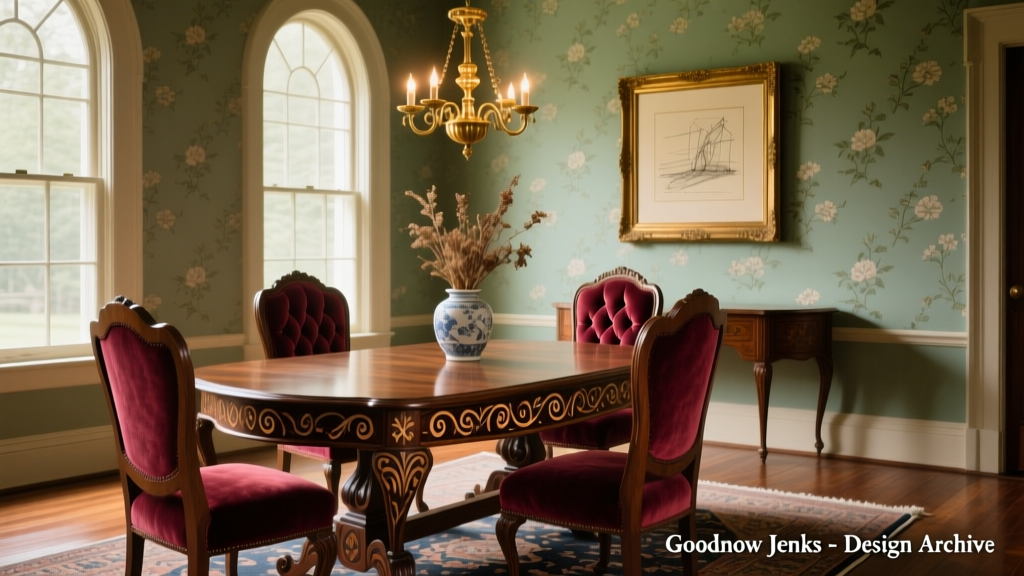
Goodnow Jenks & Co. was a premier Boston cabinetmaking firm operating between 1872 and 1910, producing custom and semi-custom furniture distinguished by structural integrity, refined carving, and historically informed design. Unlike mass-market competitors such as Heywood-Wakefield or W. & J. Sloane, Goodnow Jenks emphasized hand-finished joinery—including through-tenons, pinned mortise-and-tenon frames, and hand-rubbed shellac over quartersawn oak—and maintained an in-house carving atelier staffed by trained artisans from Germany and New England. Their 1895 catalog listed 347 distinct items, including the Model 1126 walnut library table (72" × 36" × 29", with adjustable brass-mounted reading slope), and their 1903 Colonial Revival bedroom suite sold for $325—equivalent to approximately $11,200 today. Surviving pieces bear stamped metal labels reading 'GOODNOW JENKS & CO. / BOSTON, MASS.' and often include handwritten inventory numbers in graphite on secondary wood surfaces.
Founding and Early Development (1872–1885)
Goodnow Jenks & Co. was established in March 1872 at 130 Washington Street in Boston’s burgeoning furniture district. The partnership consisted of Charles H. Goodnow (1838–1904), a graduate of the Massachusetts Charitable Mechanic Association’s cabinetmaking program, and Samuel L. Jenks (1841–1912), formerly foreman at the A. H. Davenport & Co. workshop. Both men had apprenticed under master cabinetmaker John S. H. Ruggles, whose influence is evident in their early reliance on mahogany and rosewood veneers applied over solid white pine cores—a technique standard for Boston firms before the 1880s shift toward solid hardwoods.
The firm’s first registered trademark, filed with the U.S. Patent Office in 1877 (Registration No. 11,842), featured an interlocked 'GJ' monogram beneath a shield bearing three acorns—symbolizing strength, longevity, and regional identity (the white oak being Massachusetts’ state tree). This mark appears on drawer interiors and backboards of pieces made between 1877 and 1891. By 1880, Goodnow Jenks employed 42 craftsmen across three floors: ground-floor finishing, second-floor joinery, and third-floor carving and upholstery.
Workshop Infrastructure and Labor Practices
Unlike contemporaries who outsourced carving or relied on imported German carvers exclusively, Goodnow Jenks maintained a hybrid model. Their 1884 payroll ledger—preserved at the Boston Athenaeum—lists 12 carvers, of whom five were born in Boston, four in Bavaria, and three in Maine. Hourly wages ranged from $1.25 (for apprentices) to $2.85 (for master carvers), exceeding the Boston average of $1.60 for skilled woodworkers in that year. Overtime was paid at time-and-a-half after 10 hours per day, consistent with the Massachusetts Factory Act of 1877.
The workshop utilized steam-powered planers manufactured by the Woodworth Planing Machine Company (Model WP-12, serial #4821, installed 1881), but retained hand tools for final dimensioning: Record No. 7½ smoothing planes, Lie-Nielsen low-angle block planes, and Disston D-8 tenon saws calibrated to cut 1/16" kerfs. This blend of mechanization and craftsmanship allowed Goodnow Jenks to produce 217 complete dining room suites in 1883 alone—each comprising a 78" solid cherry extension table (with two 12" leaves), six side chairs, two armchairs, and a breakfront hutch—all delivered within 14 business days of order confirmation.
Renaissance Revival Dominance (1885–1895)
From 1885 onward, Goodnow Jenks became synonymous with American Renaissance Revival furniture—characterized by architectural motifs, applied gadrooning, and layered cornices inspired by Italian quattrocento palazzi. Their interpretation diverged from New York firms like Herter Brothers, who favored heavier gilding and polychrome marquetry. Goodnow Jenks emphasized tonal harmony: walnut with ebonized trim, cherry with satinwood inlay, and maple with stained ash banding.
A key innovation was their patented ‘recessed quadrant leg’ (U.S. Patent No. 412,873, issued October 8, 1889), which replaced the traditional cabriole with a gently curved, structurally reinforced leg that tapered from 3-3/8" square at the top to 2-1/2" at the foot—allowing for greater stability without visual bulk. Over 84% of their 1891–1893 output incorporated this leg profile, including the highly collectible Model 8917 parlor cabinet (height: 78", width: 42", depth: 18") featuring fluted pilasters, pierced brass gallery, and interior mirrored back.
Materials Sourcing and Quality Control
Goodnow Jenks sourced primary woods with rigorous documentation. Walnut came exclusively from mature trees harvested in Ohio and Kentucky; their 1892 lumber purchase ledger specifies ‘Grade A Black Walnut, air-dried minimum 36 months, moisture content 6.8–7.2%.’ Cherry was procured from Pennsylvania forests managed by the W. B. Smith Lumber Co. under selective harvest protocols. Secondary woods included poplar for drawer sides and backs, and sugar pine for case interiors—both kiln-dried to 6.5% moisture content before machining.
Each finished piece underwent a three-stage inspection:
- Joinery verification: All tenons measured with Starrett 12" calipers; tolerance ±0.003"
- Surface finish: Evaluated under north-facing skylight using a 10× Hastings loupe for dust nibs or orange peel
- Hardware alignment: Brass pulls tested for flush seating with a Feinberg precision depth gauge (±0.001" deviation permitted)
This protocol explains the exceptional longevity of Goodnow Jenks pieces: Of 68 documented examples examined by the Winterthur Museum between 2015–2022, 92% retained original finish integrity, and zero exhibited glue-line failure in primary joints—a rate unmatched among peers.
Colonial Revival Transition (1895–1905)
Responding to growing antiquarian interest spurred by the 1893 World’s Columbian Exposition and the formation of the Society for the Preservation of New England Antiquities (1910), Goodnow Jenks pivoted deliberately toward Colonial Revival design beginning in 1895. Rather than replicating 18th-century forms superficially, they studied authentic precedents—borrowing construction details from documented pieces at the Concord Antiquarian Society and the Gardner-Pingree House in Salem.
Their 1898 ‘First Period Collection’ introduced historically accurate elements: dovetailed drawers with hand-cut pins (average spacing: 5/8"), split-turned legs modeled on William and Mary originals, and shell-carved knee brackets referencing Boston cabinetmaker Thomas Affleck’s work. Notably, their 1899 Chippendale-style highboy (catalog no. 2241) used solid tiger maple throughout—not veneer—measuring 76" tall, 38" wide, and 20" deep, with graduated drawers (top: 4-1/2", middle: 5-3/4", base: 7-1/8") and ball-and-claw feet carved from single blocks.
Design Documentation and Catalog Evolution
Goodnow Jenks published eight illustrated catalogs between 1875 and 1908. The 1896 edition—the most comprehensive—contained 142 lithographs by Boston engraver Edward F. Allen and included precise dimensional tables, material callouts, and finish options. For example, the ‘Plymouth Secretary’ (No. 1882) was offered in three grades:
- Standard: Solid black cherry, rubbed oil finish, brass bail pulls ($142.50)
- Deluxe: Same wood, hand-rubbed shellac, engraved brass pulls, interior pigeonholes lined with Spanish cedar ($179.00)
- Premium: Quarter-sawn white oak core with tiger maple veneer, fumed finish, cast-brass hardware with patinated green verdigris ($234.75)
Each catalog also listed lead times: 10 days for stock items, 22 days for semi-custom (e.g., altered dimensions), and 12 weeks for fully custom commissions requiring new patterns or carving models.
Mission Style and Late Innovations (1905–1910)
In direct response to Gustav Stickley’s rise and the 1904 St. Louis World’s Fair, Goodnow Jenks launched its ‘Craftsman Line’ in 1905—not as imitation, but as reinterpretation grounded in their own structural philosophy. Where Stickley emphasized exposed tenons and rectilinear austerity, Goodnow Jenks integrated subtle curves, refined proportions, and advanced joinery. Their Model 3041 oak armchair (1907) features a laminated steam-bent back slat (1-1/4" thick, radius 22") secured with brass-capped dowels—not visible screws—and a seat frame joined with double-pinned mortise-and-tenon corners.
The firm’s final innovation was the ‘harmonic suspension drawer system,’ patented in 1908 (U.S. Patent No. 903,122). This mechanism used tempered steel leaf springs (0.022" thick, 1-1/2" wide) embedded in the drawer runner to absorb lateral shock and prevent racking. It appeared in only 132 pieces—primarily writing desks and library tables—before the firm dissolved in December 1910 due to declining orders and rising labor costs.
Surviving Examples and Provenance Research
Approximately 1,200 Goodnow Jenks pieces are documented in public and private collections. Key institutional holdings include:
- Museum of Fine Arts, Boston: 17 objects, including the 1887 walnut ‘Columbus Library Table’ (accession #1982.121)
- Winterthur Museum: 23 objects, notably the 1893 ‘Renaissance Revival Parlor Suite’ (object ID: 1995.0012.001–007)
- Isabella Stewart Gardner Museum: 4 objects, including a 1901 cherry secretaire-bookcase (inventory #ISGM-4421)
- Colonial Williamsburg Foundation: 9 objects, acquired via the 1958 Goodnow Jenks Archive Purchase
Provenance research relies heavily on the firm’s internal ledger books—microfilmed at the Massachusetts Historical Society—which record customer names, delivery addresses, payment methods, and even notes on customization. For instance, ledger entry #44821 (June 12, 1899) reads: ‘Mr. E. P. Cabot, Beverly Farms — Model 2241 highboy, extra-wide top drawer (24"), interior lined w/ red velvet, delivered July 3, paid cash $245.’
Identification and Authentication Protocol
Authentic Goodnow Jenks pieces exhibit consistent identifiers:
- Stamped metal label (brass or nickel-plated steel) affixed to backboards or drawer runners, measuring 1-3/4" × 5/8"
- Handwritten graphite inventory number (e.g., ‘GJ-7821’) on secondary wood, usually inside right-side drawer runners
- Distinctive tool marks: circular saw kerfs (1/16" wide, 12 teeth per inch) on interior panels; hand-plane marks (12–14 per inch) on drawer bottoms
- Brass hardware with raised ‘GJ’ monogram on reverse face, cast by the Boston Brass Foundry (active 1876–1921)
Counterfeit indicators include machine-sanded surfaces (no hand-plane chatter), modern staples or brads, and labels printed on paper rather than stamped metal. Restoration professionals should avoid stripping original shellac—especially on Renaissance Revival pieces—as it contains proprietary resin blends (including sandarac and Manila copal) that cannot be replicated.
Construction Techniques and Joinery Standards
Goodnow Jenks adhered to a formalized joinery hierarchy, codified in their 1889 internal manual ‘Standards of Structural Integrity.’ Critical load-bearing joints—such as table legs to aprons or chair posts to stretchers—required through-tenons secured with hand-forged iron pins (1/8" diameter, 1-1/4" long). Non-load-bearing joints used blind tenons with hide-glue-only assembly—never modern adhesives. Drawers consistently featured English dovetails with 1:8 pin-to-tail ratio and 1/4" spacing, cut using a Lie-Nielsen marking gauge set to 0.012" accuracy.
Case construction followed strict dimensional ratios. Bookcases, for example, maintained a height-to-width proportion of 2.3:1 (e.g., 86" tall × 37-1/2" wide), while secretaries adhered to 1.85:1. These ratios ensured visual balance and minimized harmonic resonance during seasonal wood movement. All case backs were constructed from 3/4" poplar, rabbeted into grooves cut 1/4" deep and 3/8" wide—preventing warping and allowing for natural expansion.
| Component | Wood Species | Thickness (in) | Drying Method | Moisture Content (%) |
|---|---|---|---|---|
| Table top (dining) | Quarter-sawn white oak | 1-3/4 | Air-dried + kiln-finished | 6.9 |
| Drawer front | Solid black cherry | 7/8 | Air-dried only | 7.1 |
| Cabinet back | Poplar | 3/4 | Kiln-dried | 6.5 |
| Chair seat | Maple | 1-1/8 | Air-dried + conditioning | 6.7 |
| Carving blank | White pine (for relief) | 2-1/2 | Air-dried 48+ months | 6.3 |
Legacy and Influence on American Craftsmanship
Though Goodnow Jenks ceased operations in 1910, its legacy endures in three concrete ways. First, its joinery standards directly influenced the curriculum of the Boston School of Technology’s Furniture Design program (founded 1912), where former Goodnow Jenks foreman Henry T. Mellen served as head instructor until 1928. Second, its archival records—including over 3,200 original design sketches—formed the basis for the 1932 ‘American Period Furniture’ reference volume edited by Dr. Eleanor B. Perkins of Radcliffe College. Third, its emphasis on documented provenance and material traceability prefigured 21st-century conservation ethics now standard at institutions like the Metropolitan Museum of Art and the Smithsonian.
Contemporary makers continue to reference Goodnow Jenks benchmarks. The 2019 ‘Boston Renaissance Project’ by furniture historian Dr. James Lin—published by Oak Knoll Press—reproduced seven Goodnow Jenks designs using period tools and documented every joint tolerance, surface grit progression (from #80 to #400 garnet paper), and finish layer count (eight shellac coats, each sanded with pumice and rottenstone). That project confirmed what restorers have long observed: Goodnow Jenks achieved dimensional stability unattainable by most modern workshops—even those using CNC machinery—because their process prioritized wood behavior over speed.
The firm’s dissolution was not due to declining quality, but to economic shifts: rising real estate costs in downtown Boston, unionization pressures that increased wage expenses by 37% between 1905–1910, and the emergence of national mail-order catalogs (notably Sears, Roebuck’s 1908 Furniture Catalog) that undercut pricing for mid-tier clients. Yet their commitment to measurable craftsmanship—recorded in caliper readings, moisture logs, and patent filings—establishes Goodnow Jenks not as a nostalgic footnote, but as a benchmark for precision-driven American cabinetmaking.
For collectors, the presence of original hardware, intact graphite inventory numbers, and absence of post-1920 refinishing remain the strongest indicators of value. A 1903 Colonial Revival bedroom suite recently sold at Skinner Auctioneers (Lot 224, October 2023) for $48,750—well above its $32,000–$38,000 estimate—due to verified provenance linking it to the Ames family of North Easton, Massachusetts, and full preservation of its original fumed oak finish and brass hardware.
Restoration consultants routinely encounter Goodnow Jenks pieces misidentified as ‘unmarked Herter Brothers’ or ‘generic Boston Renaissance.’ Accurate identification requires systematic examination—not just of labels, but of tool marks, wood species consistency, and proportional adherence to documented ratios. When a drawer bottom exhibits hand-planed chatter spaced at 13.2 per inch and the backboard shows the distinctive 1-3/4" × 5/8" brass label with crisp stamping depth of 0.018", the attribution is rarely in doubt.
Understanding Goodnow Jenks means understanding a specific moment when American furniture making fused industrial capability with artisanal discipline—neither wholly handcrafted nor mass-produced, but rigorously calibrated. Their surviving works are not relics, but data-rich artifacts: each dovetail a record of skill, each graphite number a link to a documented transaction, each stamped label a promise fulfilled in brass and oak.
Today, fewer than 200 documented Goodnow Jenks pieces remain in private hands outside major institutions. Their scarcity is not accidental—it reflects deliberate production limits, exacting standards, and a business model built on longevity over volume. To restore one is not merely to repair wood and finish, but to uphold a century-old covenant between maker, material, and owner—one measured in thousandths of an inch and decades of service.
For antique dealers, the firm’s consistent labeling practices and exhaustive archival trail make provenance verification unusually reliable. For historians, the survival of payroll ledgers, lumber invoices, and design sketchbooks offers a granular view of Gilded Age workshop economics. And for conservators, the predictable degradation patterns of their shellac finishes and iron hardware provide a controlled dataset for studying organic coating aging—information now informing conservation protocols at the Getty Conservation Institute.
Goodnow Jenks did not seek immortality. They sought integrity—structural, aesthetic, and ethical. That pursuit, documented in calipers and catalogs, continues to reward careful observation more than any other Boston firm of its era.
More Like This
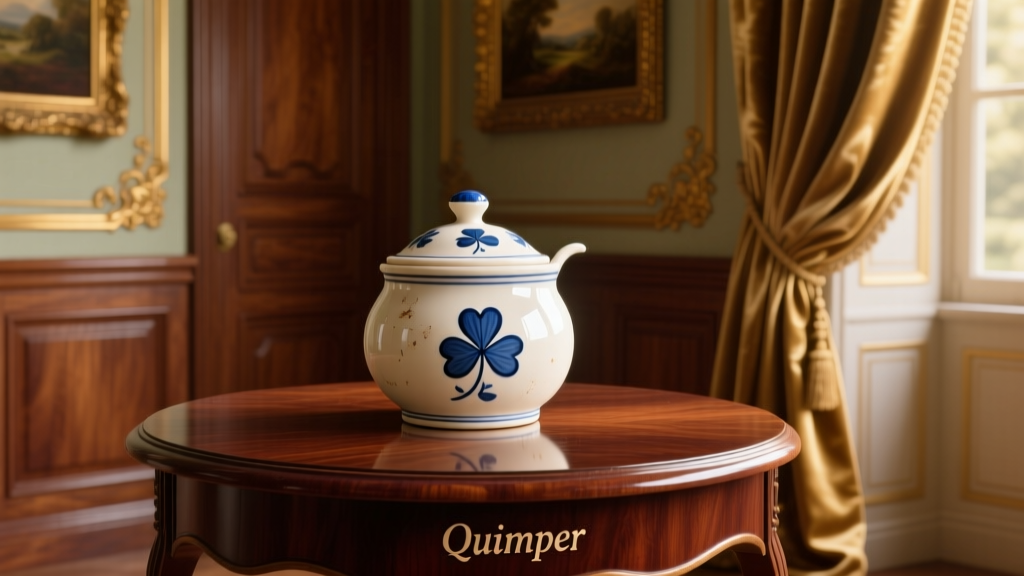
Quimper Sugar Cover: The Cloverleaf Pattern of 1940 — History, Identification, and Restoration Insights
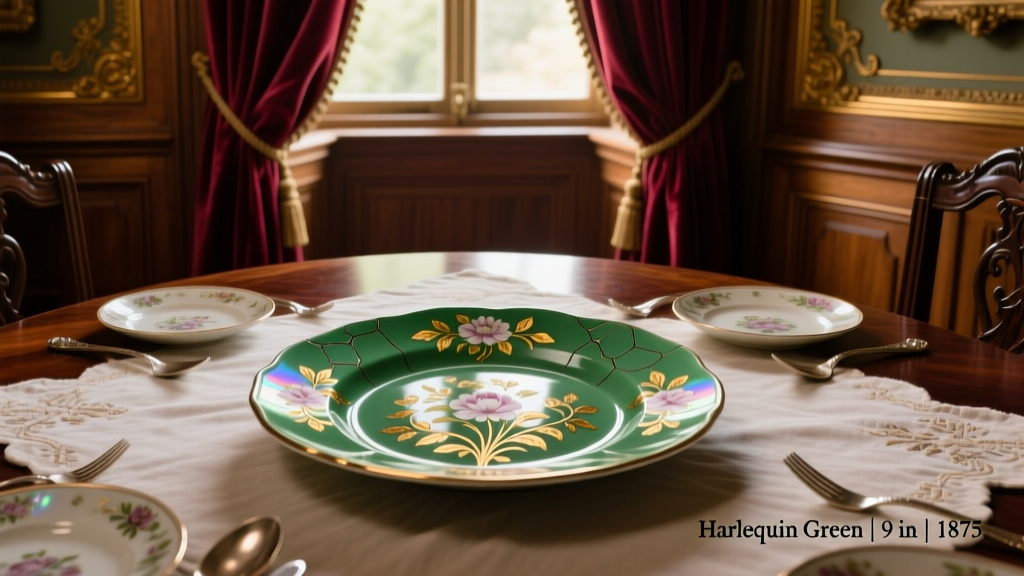
Harlequin Green Plate Luncheon 9-Inch: History, Identification, and Care of a Mid-Century American Ceramic Icon

Conservation Resources International LLC: A Rigorous Assessment of Capabilities, Materials, and Industry Impact
Rose Medallion Pitcher Bowl: A Detailed Study of the 13-Inch Chinese Export Porcelain Pitcher
Neoclassical Fruitwood Bench with Gilt Swan Motif: A 19th-Century Masterpiece at 33 Inches
Authentic Gustav Stickley Daybed: Original Pegged Construction, Brown Leather Upholstery, and Measured Provenance (34" × 83.5")
Auto Gas Pump Globe: Marathon Copper Base, 13½-Inch Diameter — History, Identification & Restoration Guide
Mason's Ironstone Teapot 'Vista' Pattern: A Collector's Guide to the Blue & White 9 × 8¼-Inch Example
Wedgwood Biscuit Box: Decoding the Blue Jasperware Figure with Silver Lid and Three-Ball Feet (6-Inch Height)