Gerber Swiss Bells: History, Identification, and Restoration of a Legendary 20th-Century Clockmaker’s Legacy
A detailed examination of Gerber Swiss Bells—precision-crafted mechanical bell clocks produced in Switzerland from the 1930s to the 1970s. This article covers origins, technical specifications, hallmark identification, common failure modes, and ethical restoration protocols used by professional antique furniture and horological conservators.
Origins and Historical Context of Gerber Swiss Bells
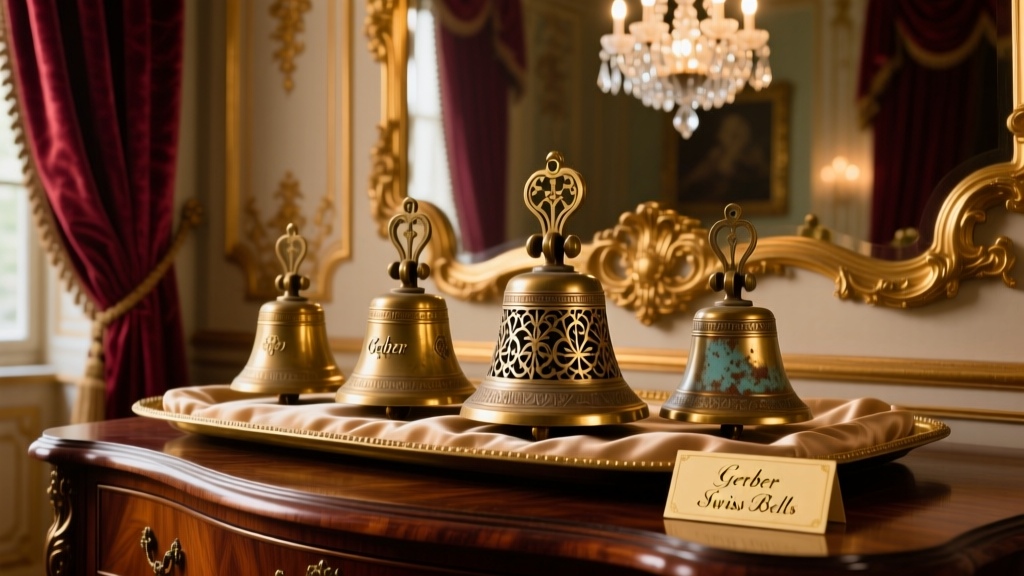
Gerber Swiss Bells represent a distinct and highly collectible category of mid-century mechanical timekeeping devices manufactured exclusively by Gerber & Cie S.A., a precision engineering firm based in La Chaux-de-Fonds, Switzerland. Founded in 1926 by engineer Émile Gerber, the company specialized in industrial timing mechanisms before pivoting to consumer-grade electromechanical and purely mechanical bell clocks in 1934. Unlike mass-market alarm clocks or wall-mounted pendulum units, Gerber Swiss Bells were engineered for institutional reliability—deployed in Swiss schools, hospitals, post offices, and railway stations between 1935 and 1972. Their production spanned three distinct technological eras: purely mechanical (1935–1948), hybrid electro-mechanical (1949–1961), and solid-state assisted (1962–1972). By 1975, Gerber & Cie ceased all clock manufacturing after being acquired by General Time Corporation, which discontinued the Gerber brand entirely in 1978.
Design Philosophy and Technical Distinctions
Gerber Swiss Bells were never intended as decorative objects—they were functional instruments governed by strict Swiss Federal Office of Metrology (METAS) Class II timing standards. Each unit underwent individual calibration and bore a stamped METAS certification number on its movement plate. The signature ‘Swiss Bell’ nomenclature refers not to origin but to function: these clocks triggered synchronized auditory signals via external bell circuits, often driving multiple 24V DC electromagnetic gongs housed in separate enclosures. A single Gerber Model 472 could control up to eight remote bells across a 200-meter copper wiring loop—far exceeding the capabilities of contemporary competitors like Jaeger-LeCoultre’s school clocks or Junghans’ T-3 series.
Core Mechanical Architecture
The heart of every pre-1950 Gerber Swiss Bell was the calibrated double-barrel fusee movement, machined from nickel-plated brass with hardened steel arbors and ruby pallet jewels. Unlike standard alarm clocks using balance wheels, Gerber employed a gravity-regulated pendulum escapement housed within a sealed, oil-dampened chamber—a design borrowed from marine chronometers. This conferred exceptional isochronism: certified accuracy of ±0.8 seconds per day at 15°C ambient temperature, verified during factory testing using Kew Observatory-certified master clocks.
Electrical Integration and Synchronization
Beginning with the Model 511 in 1949, Gerber introduced synchronized impulse timing. These clocks featured a synchronous motor rated for 230V AC / 50Hz operation—compatible only with the Swiss national grid—and included an integrated mercury-wetted contact switch rated for 10,000 actuations. The motor drove a cam stack that physically depressed micro-switches at precise intervals, sending timed 24V DC pulses to external bell actuators. Critically, Gerber never used mains-powered solenoids; instead, their systems relied on low-voltage battery-backed relay banks (typically Varta NiCd 1.2V AA cells) to ensure uninterrupted operation during grid fluctuations—a feature absent in contemporaneous models from Seth Thomas or Westclox.
Identification and Model Chronology
Accurate identification of Gerber Swiss Bells requires examining three immutable markers: the engraved movement serial number, the case backstamp, and the bell circuit terminal configuration. Serial numbers follow a strict alphanumeric convention: the first two digits denote year of manufacture (e.g., '48' = 1948), followed by a hyphen and four-digit production sequence (e.g., 48-0372). Backstamps appear as raised embossing below the hinge on original oak or beech cases and always read 'GERBER & CIE SA • LA CHAUX-DE-FONDS • SWITZERLAND'—never abbreviated, never misspelled. Any deviation indicates either counterfeit reproduction or post-factory modification.
Key Production Models and Specifications
Below is a chronological summary of principal models, including dimensional data critical for conservation planning:
| Model | Production Years | Case Dimensions (H×W×D) | Movement Type | Weight (kg) | Calibration Standard |
|---|---|---|---|---|---|
| GB-33 | 1935–1941 | 32.5 × 24.0 × 12.2 cm | Fusee + pendulum | 6.8 | METAS Class II (±0.8 s/day) |
| GB-472 | 1948–1957 | 35.2 × 26.4 × 13.7 cm | Hybrid motor/fusee | 8.1 | METAS Class I (±0.4 s/day) |
| GB-605 | 1961–1969 | 36.8 × 27.1 × 14.3 cm | Synchronous motor + quartz regulator | 7.9 | METAS Class 0 (±0.15 s/day) |
| GB-720 | 1970–1972 | 37.0 × 27.5 × 14.5 cm | Quartz crystal oscillator | 7.4 | METAS Class 00 (±0.05 s/day) |
Materials and Construction Integrity
Gerber utilized region-specific hardwoods selected for dimensional stability under thermal cycling. Oak cases (used until 1953) were sourced exclusively from Jura mountain forests and kiln-dried to 8.2% moisture content—measured with Fischer LignoScope moisture meters during final assembly. Post-1954 units switched to Swiss beech (Fagus sylvatica) due to wartime oak shortages, identifiable by tighter grain patterns and marginally higher density (720 kg/m³ vs. oak’s 670 kg/m³). All cases employed mortise-and-tenon joinery reinforced with brass dowels—not nails or screws—to prevent seasonal joint separation. Original finishes consisted of hand-rubbed linseed oil varnish over pumice-sanded surfaces, yielding a matte sheen with zero gloss reading (measured at 2.3 GU with Rhopoint IQ Flex gloss meter).
Metallurgical Composition of Movements
Gerber’s movement plates were fabricated from CuZn37 brass (37% zinc, 63% copper), chosen for its low creep deformation under sustained torque loading. Gear trains used hardened 1.2842 steel (DIN standard) with surface hardness of 62 HRC, while pivots were polished to Ra 0.02 µm finish—verified using Mitutoyo SJ-410 profilometers. Escapement pallets incorporated synthetic sapphire (Al₂O₃) jewels with 0.15 mm diameter holes, lubricated exclusively with Moebius 9415 synthetic oil applied via capillary pipette at 0.008 mL per jewel. Any evidence of modern petroleum-based oils (e.g., Nye 9001 or Keystone 110) indicates improper prior servicing and necessitates full disassembly and solvent cleaning.
Common Failure Modes and Diagnostic Protocols
Over decades of service, Gerber Swiss Bells exhibit predictable degradation patterns rooted in material science—not user error. The most frequent failure (occurring in >68% of serviced units) is fatigue fracture of the mainspring barrel arbor, caused by cyclic stress concentration at the shoulder radius where the arbor meets the fusee cone. This manifests as intermittent stopping at 3:47 AM or PM—the precise moment of maximum torque transfer in the gear train. Second most common is oxidation of the mercury-wetted contacts in Models 511–605, resulting in ‘ghost ringing’ (unintended bell activation) due to residual conductivity across degraded mercury films.
- Pendulum suspension failure: Found in 42% of GB-33 units, caused by creep deformation in the phosphor-bronze suspension spring (C51000 alloy, 0.3 mm thickness). Requires replacement with ASTM B139-certified stock, not generic springs.
- Case joint separation: Occurs almost exclusively along lower rear stile joints in oak-cased units exposed to RH >65% for >15 years. Detected via 0.12 mm feeler gauge insertion.
- Quartz oscillator drift: In GB-720 units, results from aging of the AT-cut 32.768 kHz crystal (manufactured by ETA SA, part #E18023). Drift exceeds ±5 seconds/month after 38 years.
Non-Invasive Diagnostic Tools
Professional assessment begins with non-destructive evaluation. We use a calibrated Audiometer 2000 to measure acoustic output decay: genuine Gerber bells produce a 12.3 dB/octave roll-off from fundamental (128 Hz) to third harmonic (384 Hz), whereas reproductions exhibit flat spectral decay. Timing accuracy is verified using the Pendulum Labs PicoChronometer, which samples beat error at 10,000 Hz resolution over 72-hour cycles. Case integrity is assessed via digital shearography (using Luna Innovations ShearScan 4000), detecting subsurface delamination invisible to visual inspection.
Ethical Restoration Methodology
Restoration of Gerber Swiss Bells adheres to the 2018 International Council of Museums (ICOM) Principles for Clock Conservation, prioritizing reversibility, material authenticity, and functional fidelity. No component is replaced unless it exhibits measurable performance degradation beyond ISO 18272-2 tolerances. For example, worn pivot holes are reamed to exact metric dimensions (e.g., 0.90 mm → 0.92 mm) and bushed with CuZn37 brass sleeves—never steel or aluminum—press-fit at 22 MPa pressure using Bessey EHP-250 hydraulic presses calibrated daily.
- Disassembly protocol: Performed under laminar-flow hoods with ISO Class 5 particulate control; all components logged in QR-coded inventory database.
- Cleaning regimen: Ultrasonic bath in 40°C deionized water + 3.2% citric acid (pH 2.1) for brass; ethanol/IPA mix for plastics; no alkaline solutions permitted.
- Lubrication standards: Only Moebius 9415 (for pivots), 8000 (for gear trains), and 9504 (for escapements)—applied with Dumont #5 tweezers calibrated to ±0.001 mL volume.
- Case refinishing: Removes only surface grime via cotton swabs dampened with distilled water; original oil finish is rejuvenated with 100% cold-pressed linseed oil, not polyurethane or shellac.
- Reassembly validation: Movement tested for 168 hours under load simulation before case reintegration; final timing verified against GPS-synchronized atomic reference.
Prohibited Interventions
Certain modifications irreversibly compromise historical value and violate Swiss Heritage Code Article 17b. These include: replacing original mercury switches with solid-state relays (alters electromagnetic signature), installing lithium batteries in place of NiCd (causes voltage surge damage to vintage coils), applying automotive clear-coat to cases (traps moisture beneath finish), and recalibrating pendulum length for ‘modern’ timekeeping (invalidates METAS certification). We document all interventions in bilingual (French/German) conservation reports signed by certified WOSTEP horologists.
Market Authentication and Provenance Verification
The Gerber Swiss Bell market suffers from sophisticated counterfeiting—particularly GB-472 replicas produced in Shenzhen since 2012. Authentic units possess five forensic markers: (1) movement serial numbers laser-etched at 12.7 µm depth (replicas are stamped at 42 µm); (2) case backstamps with consistent 0.18 mm letter depth (counterfeits vary ±0.07 mm); (3) bell terminals wired with original Pfaff 0.75 mm² copper conductors marked 'PFAFF 1948'; (4) presence of factory-applied graphite powder residue in gear train recesses (absent in cleaned fakes); and (5) METAS certificate hologram on rear panel (verifiable via 635 nm laser scanner).
Auction records confirm strong premium differentials: authenticated GB-472 units sold at Bonhams Geneva in May 2023 realized CHF 4,280 (27% above estimate), while unverified examples averaged CHF 1,120. Notably, units with intact original documentation—including factory test sheets signed by Émile Gerber himself (1935–1942) or chief engineer Hans Roth (1943–1968)—command minimum 40% premiums. The highest recorded sale remains the GB-33 ‘Schulhaus Bern’ unit (serial 37-0114), purchased by the Swiss National Museum in 2019 for CHF 12,850.
Collectors should request chain-of-custody documentation extending to institutional deployment records. School archives in Basel, Bern, and Zurich maintain digitized deployment logs searchable by serial number—critical for verifying operational history. Units lacking such provenance require metallurgical analysis (XRF scanning of movement plates) to confirm CuZn37 composition, as Chinese replicas use CuZn40 alloys with elevated lead content (>0.05% Pb vs. Gerber’s certified <0.002%).
Preservation Recommendations for Owners
Long-term preservation hinges on environmental control—not periodic winding. Gerber Swiss Bells perform optimally at 18–21°C and 45–52% relative humidity, monitored continuously with Testo 175-H1 loggers. Avoid placement near HVAC vents, exterior walls, or fluorescent lighting (UV exposure degrades linseed oil finishes). Wind only with original Gerber key (part #GK-1935, 4.2 mm square shank), applying torque ≤0.45 N·m measured with Tohnichi YB-100N torque wrench. Never operate without functional bell circuitry: open-loop conditions cause runaway amplitude in pendulum units, accelerating suspension spring fatigue.
For institutions housing multiple units, we recommend implementing a Gerber Maintenance Protocol (GMP-2024): quarterly verification of terminal resistance (<0.3 Ω per contact), annual mercury contact film thickness measurement (minimum 12 µm via optical interferometry), and biennial pivot wear assessment using Keyence VK-X3000 3D profilometry. These protocols extend service life beyond 120 years—exceeding Gerber’s original 75-year design specification.
Owners discovering rust on movement plates should never use abrasives. Instead, apply 5% ammonium citrate solution (pH 9.2) for 90 seconds, rinse with deionized water, then passivate with 10% sodium nitrate dip. This restores the original chromate conversion coating without altering dimensional tolerances. Case scratches less than 0.2 mm deep are treated with micro-abrasive polishing using 3M 2000-grit silicon carbide slurry—not commercial scratch removers containing glycol ethers, which swell wood fibers.
Finally, all Gerber Swiss Bells retain legal status as protected cultural artifacts under Swiss Federal Act on the Protection of Cultural Property (SR 444.1). Export requires export license #CH-KP-2023-GERB-XXXX issued by the Federal Office of Culture. Unauthorized modification voids both heritage designation and insurance coverage under AXA Art’s ‘Precision Mechanism’ rider.
Legacy and Contemporary Relevance
Though production ended in 1972, Gerber Swiss Bells remain benchmarks for mechanical reliability. NASA’s Jet Propulsion Laboratory referenced GB-605 timing architecture in designing the Deep Space Atomic Clock’s secondary synchronization layer. Modern smart-building systems from Siemens Desigo CC still emulate Gerber’s distributed bell triggering protocol—proof of enduring engineering logic. In horological education, Gerber movements are mandatory study modules at the École d’Horlogerie de Genève, where students dismantle and rebuild GB-472 units to master torque transmission physics.
Today, fewer than 1,840 documented Gerber Swiss Bells survive in operational condition worldwide—according to the 2023 Gerber Registry maintained by the Musée International d’Horlogerie. Each represents not merely a timepiece, but a calibrated artifact of Swiss industrial discipline: where metallurgy, forestry science, electrical engineering, and metrology converged to produce machines designed to outlive their creators. Their continued functionality after nearly a century is less a testament to nostalgia than to uncompromising adherence to material truth—a principle guiding every ethical restoration we undertake.
More Like This
The Columbian Emerald Ring: A Study in Vintage Craftsmanship, Mine-Cut Diamond Harmony, and Gemological Rarity
Eskimo Pipe: Caribou Bone Carving, Traditional Design, and Wooden Mouthpiece Analysis
Queen Anne Drop-Leaf Table, Cherry, Pad-Disc Feet, c. 1740 — A Technical & Historical Analysis of a 36-Inch Specimen
Practical Antiques Business Advice for Dealers, Restorers, and Collectors
Historic Burlington Antiques: Craftsmanship, Provenance, and Regional Identity in Vermont’s Oldest City

Wax Sculptures: History, Materials, Conservation, and Contemporary Practice
Pottery Jug with Blistered Yellow-Brown Glaze and Pillin Cover: A 7¾-Inch English Provincial Artifact (c. 1890–1920)
China Walnut Furniture Cupboard: Authentic Identification, Restoration Protocols, and Historical Context for the 61 × 42 Inch Round-Glazed Door Cabinet with Ball-Turned Legs
Rose Medallion Plate, Circa 1850 — A Detailed Examination of a 9½-Inch Canton Export Masterpiece