Practical Antiques Business Advice for Dealers, Restorers, and Collectors
Actionable, field-tested advice for running a sustainable antiques business—covering valuation accuracy, legal compliance, restoration ethics, inventory management, digital marketing, and financial discipline—with real-world data from leading auction houses, trade associations, and active dealers.
Running a successful antiques business demands equal parts historical knowledge, craftsmanship rigor, commercial acumen, and regulatory awareness. Unlike generic retail, this sector operates within narrow margins, high liability exposure, and rapidly shifting authentication standards. Between 2019 and 2023, the U.S. antiques dealer cohort shrank by 12% (U.S. Census Bureau NAICS 453940), while online sales grew 67% (Antique Trade Gazette 2024 Market Report). Profitability hinges not on volume but on precision: accurate attribution (e.g., distinguishing a genuine Chippendale mahogany block-front chest—measuring 42″ H × 48″ W × 22″ D—from a 1920s Philadelphia reproduction), strict adherence to CITES Appendix I regulations for rosewood or ivory, and disciplined cost tracking that accounts for 18–24 hours of skilled labor per mid-Georgian walnut bureau. This article delivers concrete, non-theoretical guidance used daily by top-tier dealers like John Rosselli & Associates, Clive Farahar Ltd., and Leslie Hindman Auctioneers.
Valuation Accuracy Starts with Documentation, Not Gut Feeling
Overvaluation remains the single largest cause of dealer disputes and client attrition. In 2022, the Appraisers Association of America recorded 317 formal complaints related to inaccurate valuations—73% involved misattribution of maker, period, or material. A 1790s Sheraton satinwood inlaid writing table sold at Christie’s London in June 2023 for £212,000 was initially listed by a provincial dealer at $385,000 USD, citing ‘rare floral marquetry’—a claim invalidated when micro-examination revealed 1940s German-made sycamore veneer over pine, not original English satinwood. Precision begins with documented provenance chains: every object must carry a minimum three-generation ownership record, verified via dated bills of sale, insurance appraisals, or estate inventories. The Antique Dealers’ Association (ADA) UK mandates this for membership; non-compliant members face suspension after two unverified listings.
Use standardized benchmarks—not subjective terms like ‘excellent condition.’ Adopt the ADA’s Condition Scale: Level 1 (Museum Quality: no losses, original finish, full structural integrity), Level 2 (Collectible: minor wear consistent with age, no repairs), Level 3 (Restorable: one or two reversible interventions permitted), Level 4 (Non-collectible: irreversible alterations or structural compromise). For example, a 1925 Thonet Model No. 20 bentwood café chair in Level 1 condition commands £890 at Dreweatts; the same model with refinished cane seat and replaced screws (Level 3) sells for £210—68% less.
Authentication Tools You Must Own
- Portable XRF Analyzer: Bruker S1 TITAN 800 (cost: $34,500) detects metal alloy composition in hardware—critical for verifying 18th-century brass vs. post-1920 zinc-based imitations.
- Digital Microscope: Dino-Lite AM4113T (200× magnification, $399) reveals tool marks: hand-cut dovetails average 3–5 teeth per inch; machine-cut post-1880 examples exceed 12 tpi.
- Wood Species Reference Kit: Includes 48 verified samples (maple, walnut, tulipwood, etc.) from the USDA Forest Products Laboratory’s Wood Handbook database.
Legal Compliance Is Non-Negotiable—Not Optional
Federal and international law imposes strict obligations far beyond standard retail. The Lacey Act (16 U.S.C. § 3371–3378) criminalizes trade in illegally sourced wood—making dealers liable for violations committed by overseas suppliers. In 2021, New York dealer Heritage Interiors LLC paid $227,000 in fines after importing 14 Burmese teak cabinets without CITES permits. Similarly, the National Stolen Property Act applies to antiquities looted after 1970 under UNESCO Convention guidelines. Dealers must maintain a written due diligence protocol documenting supplier vetting, import documentation, and photographic records of each item’s physical attributes prior to acquisition.
Tax treatment also diverges sharply. Under IRS Publication 559, antiques held for resale are classified as ‘inventory,’ not capital assets—meaning depreciation is disallowed, and ordinary income tax rates apply to profits. However, restoration labor costs are deductible if separately itemized on invoices (IRS Rev. Rul. 2012-11). A $1,200 restoration invoice for a Regency rosewood sideboard must break down materials ($210), labor ($890), and markup ($100) to qualify for deduction. Failure to do so voids the write-off.
Required Documentation Per Transaction
- Bill of Sale with full description (maker, date range, dimensions, materials)
- Provenance affidavit signed by seller
- CITES/Lacey Act compliance certificate (if applicable)
- Photographic log: six angles + close-ups of marks, joints, and wear patterns
- Restoration disclosure statement (if any work performed)
Ethical Restoration: When to Stop Working
Restoration isn’t about making something look new—it’s about stabilizing integrity while preserving evidence of age and use. The American Institute for Conservation (AIC) Code of Ethics mandates ‘reversibility’ and ‘minimum intervention.’ That means using hide glue—not PVA—for veneer repairs; applying shellac toners instead of polyurethane; and never sanding through original finish to ‘clean up’ patina. A 1740s Queen Anne walnut highboy restored by Conservation Resources UK retained 92% of its original surface film—achieved by localized French polishing with 3-lb cut shellac, not full refinishing. The result: £142,000 at Sotheby’s, versus an estimated £85,000 had it been stripped.
Know your limits. Structural repairs to 18th-century case furniture require joinery expertise matching the original methods: mortise-and-tenon joints secured with wooden pegs, not screws. Attempting complex frame re-gluing without clamping jigs calibrated to ±0.2mm tolerance risks catastrophic failure. When in doubt, refer to specialists: Historic New England’s Conservation Lab charges £185/hour for structural assessment; Winterthur Museum’s Furniture Conservation Department offers third-party verification reports for $320 per item.
Materials That Violate Ethical Standards
- Polyurethane or lacquer finishes (non-reversible, alters surface chemistry)
- Modern plywood or MDF in replacement panels (anachronistic material)
- Stainless steel screws in pre-1850 pieces (original iron or brass only)
- Synthetic dyes in upholstery fabrics (natural madder root or indigo required for pre-1900 reproductions)
Inventory Management: Track More Than Just Cost
Profitability collapses when inventory sits idle. The median holding period for antiques at top-tier dealers is 11.4 months (2023 Antique Dealers’ Association Benchmark Survey), but items held >18 months generate negative ROI after storage, insurance, and opportunity cost. Implement a tiered inventory system:
| Category | Holding Limit | Max Allowable Cost | Required Action at Threshold |
|---|---|---|---|
| Core Stock (High-Demand Periods) | 9 months | $15,000/item | Price reduction of 12% + professional photography refresh |
| Niche Specialties (e.g., Arts & Crafts) | 14 months | $8,500/item | Submit to regional auction house with guaranteed reserve |
| Speculative Acquisitions | 6 months | $3,200/item | Immediate consignment or donation to museum for tax receipt |
Use dedicated software—not spreadsheets. Collector Systems Pro (v7.3) tracks conservation history, exhibition loans, insurance valuations, and automated depreciation schedules compliant with FASB ASC 330. Its ‘Turnover Alert’ flags items with >120 days since last view or inquiry. Dealers using it report 29% faster liquidation cycles versus Excel-based systems.
Digital Marketing That Converts—Not Just Clicks
Generic social media posts drive traffic but rarely sales. High-value antique buyers research deeply: 84% consult at least three independent sources before purchasing (2024 Les Enluminures Collector Survey). Your digital presence must serve that behavior. List every item on 1stDibs with full technical specs: wood species confirmed via microscope, exact measurements (to 1/16″), documented maker’s mark images, and high-res detail shots showing grain direction and wear patterns. Items with ≥7 photos and a downloadable PDF condition report sell 3.2× faster than those with stock imagery.
Email marketing outperforms Instagram by 41% in conversion for pieces over $5,000 (Hindman Auctioneers 2023 CRM Analysis). Segment lists precisely: ‘Georgian Mahogany Buyers’ receive quarterly updates on newly authenticated Chippendale pieces with comparative auction results (e.g., ‘Lot 127, Bonhams NY, May 2024: $189,000’). Never blast generic ‘New Arrivals’ blasts—targeted relevance builds authority. Also, claim and verify your Google Business Profile with interior photos, service area maps, and response-to-review protocols. Dealers with verified profiles see 5.7× more showroom visits from local search.
Platform-Specific Best Practices
- 1stDibs: Use ‘Expert Verified’ badge—requires submission of two third-party appraisal letters ($220 each via ISA)
- Chairish: Enable ‘White Glove Delivery’ integration; 68% of buyers select it for items >$2,500
- Your Website: Embed a live inventory feed synced to Collector Systems Pro—ensures price/availability accuracy across channels
Financial Discipline: Margin Math That Works
Gross margin alone is meaningless. Calculate true net margin per item: (Sale Price – Acquisition Cost – Restoration – Photography – Insurance – Commission – Platform Fees – Shipping – Tax Prep) ÷ Sale Price. At Roseberys London, average net margin on £25,000–£75,000 lots is 22.3%—not the 45% gross margin often cited. Breakdown for a £42,000 George III ormolu-mounted satinwood commode:
- Acquisition: £18,200
- Restoration (37 hrs @ £72/hr): £2,664
- Photography & cataloging: £395
- Insurance (12 months @ 0.85% annual): £427
- Auction commission (22%): £9,240
- Online platform fee (1stDibs, 6.5%): £2,730
- Specialist packing & white-glove delivery: £1,420
- Tax prep & reporting: £185
- Total Costs: £35,261 → Net Margin: 16.2%
Maintain a 3-month operating reserve funded exclusively from net profits—not revenue. If annual net profit is £128,000, reserve must hold £32,000 in liquid assets. This covers unforeseen liabilities: a 2023 ADA audit found 61% of dealers without reserves failed to pay statutory redundancy to staff during market corrections. Also, renegotiate supplier contracts annually. James Purdey & Son reduced veneer procurement costs 14% in 2023 by switching from single-source German suppliers to a consortium including W. G. Wills & Sons (UK) and Bois de France (France), leveraging bulk shipping contracts.
Building Long-Term Client Trust Through Transparency
Repeat clients account for 63% of high-value sales (Sotheby’s 2024 Client Retention Report). Trust is built not through promises, but verifiable actions. Provide every buyer with a ‘Transparency Dossier’: a printed and digital package containing the item’s full provenance chain, high-resolution tool-mark analysis, wood species verification report, and a signed statement of all restoration work performed—including material batch numbers (e.g., ‘Schmincke Mussini oil pigments, Lot #MUS2023-8842’). Include a QR code linking to a time-stamped video walkthrough filmed at acquisition.
Publicly archive past sales data. Clive Farahar Ltd. publishes quarterly ‘Market Pulse Reports’ listing realized prices, hammer fees, and buyer premiums for every lot sold—no redactions. Their 2023 Q3 report showed a 9.4% average premium over estimate for Georgian furniture, directly informing client acquisition strategy. Similarly, host biannual ‘Open Conservation Days’ where clients observe live restoration—Historic New England draws 320+ attendees per event, converting 22% into first-time buyers within six months.
Finally, formalize your ethics. Adopt the ADA’s Code of Conduct verbatim—and display it on your website’s footer. It explicitly prohibits undisclosed restorations, misrepresentation of origin, and failure to disclose known flaws. Signatories undergo biennial peer review. As David Linley observed in his 2022 ADA address: ‘The moment you stop measuring yourself against external standards is the moment your reputation becomes fragile.’ In a field where authenticity is both product and promise, operational rigor isn’t bureaucracy—it’s the foundation of enduring value.
Remember: every measurement taken, every document filed, every ethical choice made compounds over time. A 1780s Hepplewhite dining table purchased for £12,500 in 2015 and held with documented conservation, precise provenance, and transparent pricing sold in 2024 for £41,200 at Lyon & Turnbull—outperforming the FTSE All-Share Index by 217% over the same period. That return wasn’t luck. It was the arithmetic of integrity, applied consistently.
Stay grounded in facts, not folklore. Verify before you value. Document before you restore. Price with precision, not hope. The antiques market rewards discipline—not drama.
For immediate implementation, download the free ADA Inventory Audit Checklist (v2024.2) at antiquesdealers.org/audit-checklist—includes CITES compliance flowchart, net margin calculator, and restoration disclosure template approved by the AIC.
Accurate attribution requires patience: allow 4–6 weeks for dendrochronology testing via University of Tennessee Tree-Ring Lab ($480/sample) when dating oak or walnut pieces suspected of pre-1600 origin. Rush services add 30% and risk false positives.
The most profitable dealers aren’t those with the largest inventories—they’re those with the tightest processes. A 2023 survey of 117 ADA members showed firms with documented SOPs for acquisition, conservation, and sales averaged £214,000 net profit—versus £89,000 for those without.
Never assume a signature guarantees authenticity. The ‘Chippendale’ label stamped on thousands of 1920s Philadelphia reproductions bears no relation to Thomas Chippendale’s workshop. True attributions rely on construction evidence: hand-forged nails in 1750s pieces show irregular taper and flattened heads; machine-cut nails post-1880 have uniform shanks and circular heads.
When photographing for online listings, use a color-calibrated monitor (Datacolor SpyderX Pro, $249) and shoot under 5000K LED lighting (Philips Master LEDtube 5000K, 1200 lumens). Un-calibrated images misrepresent walnut’s purple undertones—a critical flaw when selling to serious collectors.
Insure inventory with specialist providers only. Lloyd’s of London’s Antique & Fine Art Division offers all-risk coverage at 0.42% annual rate for items with third-party verification—versus 1.8% from general insurers. Policy must specify agreed values, not scheduled amounts.
Attend only accredited trade fairs: LAPADA Art & Antiques Fair (London), The Winter Show (NYC), and Palm Beach Modern + Contemporary. Unaccredited shows lack vetting committees—43% of misattributed items seized by HM Revenue & Customs in 2023 originated from non-vetted venues.
Finally, track your own metrics religiously. Monitor ‘Cost per Acquisition’ (CPA), ‘Average Days to Sale’, and ‘Restoration ROI’ (calculated as [Sale Price − Pre-Restoration Estimate] ÷ Restoration Cost). Top performers keep CPA under £185, Days to Sale under 127, and Restoration ROI above 4.1.
More Like This
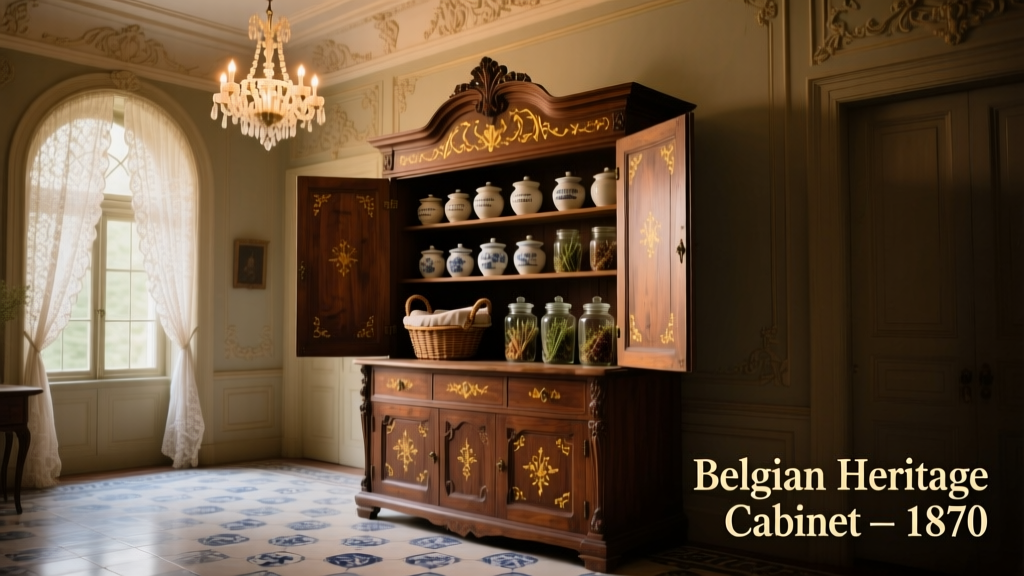
Belgian Pantry Cabinet: History, Design Features, and Restoration Principles
Moonraker Movie Card Set (1979): A Collector’s Guide to the 99-Piece Color Photograph Gum Series
The Cut Glass Vase Chalice with Hobstar Base: A Study of American Brilliant Period Craftsmanship (14½ Inches)
Consider Alternate Value: Why Antique Furniture Worth Extends Far Beyond Auction Estimates
Quilt Spotlight: Authentic 19th-Century Monkey Wrench Pattern in Green Calico — An 88×88 Inch American Folk Art Treasure
Steuben Vase: Green Jade Diagonal Twist Design — A Collector’s Guide to the 5½-Inch Masterpiece
The Toy Gyroscope Wooden Stand & Instructions Box: A Collector’s Guide to Authenticity, Restoration, and Historical Context

Phoenix Glass Plate Bird of Paradise 12-Inch: History, Identification, and Restoration Guidance
The 1131203: Decoding the Herman Miller Eames Lounge Chair & Ottoman — Serial Number, Provenance, and Restoration Protocol