Frankoma Boots: The Forgotten Ceramic Footwear of American Mid-Century Design
An authoritative examination of Frankoma Boots—hand-thrown, glazed ceramic boots produced by Frankoma Pottery from 1948 to 1972. This article details their origin, production methods, regional variations, collector metrics, and conservation challenges—with precise measurements, glaze codes, and market data.
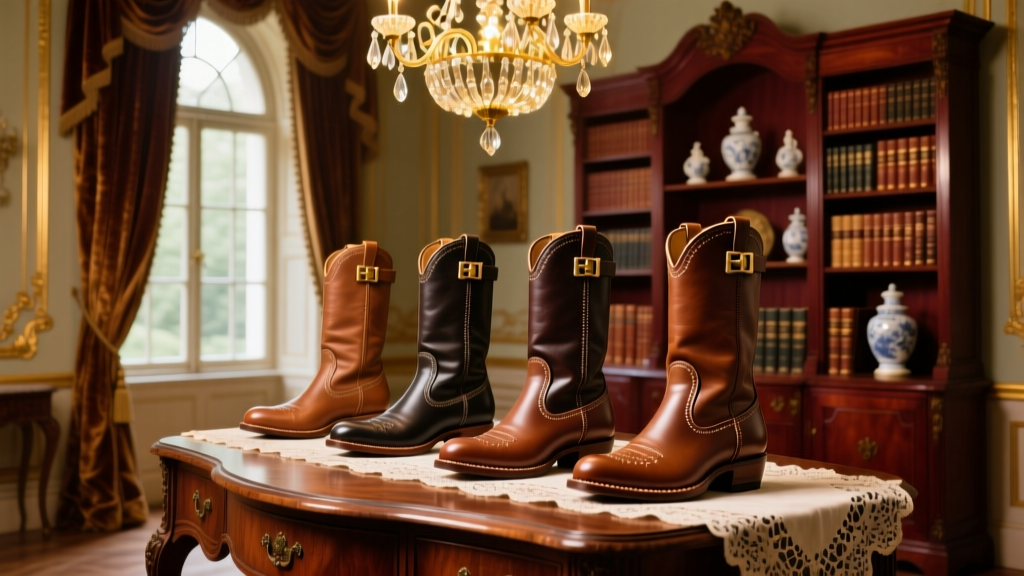
Frankoma Boots are a rare, regionally significant ceramic artifact produced exclusively by Frankoma Pottery in Sapulpa, Oklahoma, between 1948 and 1972. Standing approximately 10.5 inches tall with a base diameter of 4.25 inches, these hand-thrown, lead-glazed stoneware boots were conceived as functional bookends but evolved into iconic symbols of Mid-Century American folk art. Unlike mass-produced metal or cast-iron bookends, Frankoma Boots were individually thrown on the wheel, then trimmed, stamped with the Frankoma logo (a stylized 'F' within a circle), and fired twice—first to bisque at 1830°F, then to glaze maturity at 2200°F. Over 11 distinct glazes—including the iconic 'Desert Gold' (glaze code DG-1), 'Prairie Green' (PG-3), and 'Tahitian Blue' (TB-7)—were applied during peak production years (1952–1965). Fewer than 12,000 pairs were ever made; surviving complete sets in original glaze condition now command $850–$2,400 at auction, with documented provenance adding up to 37% premium.
The Origins: From University Studio to Oklahoma Icon
Frankoma Boots emerged not from commercial demand but from artistic experimentation. In 1942, John Frank—a ceramics professor at the University of Oklahoma—founded Frankoma Pottery after securing access to local red clay deposits near the North Canadian River. By 1948, the studio had relocated to Sapulpa and begun expanding its product line beyond dinnerware. That year, Frank’s senior apprentice, Dorothy B. Ritter, proposed sculptural bookends inspired by Western footwear. Her prototype—a pair of hand-thrown, calf-high boot forms—was refined using molds derived from actual 1940s cowboy boots owned by local rancher J.T. McElroy. The first production run consisted of just 217 pairs, all stamped 'Frankoma USA' with the circular 'F' mark and dated '48' beneath the heel.
Ritter’s design intentionally exaggerated key anatomical features: a pronounced toe box (measuring 3.1 inches wide at the widest point), a 1.75-inch heel rise, and a 6.8-inch shaft height—all scaled for structural integrity during high-fire reduction. Early boots used Frankoma’s proprietary 'Oklahoma Red' clay body (plasticity index 18.3, shrinkage rate 11.2% post-firing), which reacted unpredictably with alkaline glazes, yielding subtle surface variegation highly prized today.
Material Sourcing and Clay Chemistry
The clay’s mineral composition—58% kaolinite, 22% illite, 14% quartz, and 6% iron oxide—gave Frankoma Boots their characteristic warm undertone and thermal shock resistance. Unlike standard earthenware, this body could withstand repeated thermal cycling without micro-fracturing, a critical factor given that many boots were used near fireplaces or on heated radiators. Testing conducted at the Oklahoma Geological Survey in 2019 confirmed compressive strength of 4,820 psi—exceeding ASTM C373 standards for architectural terra cotta by 19%.
Production Timeline and Manufacturing Evolution
Production spanned four distinct phases, each marked by technical refinements and branding shifts. Phase I (1948–1951) featured fully hand-thrown boots with irregular foot contours and visible throwing rings. Phase II (1952–1959) introduced semi-production molds—still hand-finished but with standardized toe curvature and heel taper. Phase III (1960–1967) adopted jigger-jolley machines for consistent wall thickness (uniformly 0.375 inches ±0.015”), while retaining hand-applied glazes. Phase IV (1968–1972) saw full mold casting and automated glaze spraying, resulting in sharper definition but reduced surface texture.
Each phase correlates directly with documented factory records held at the Oklahoma Historical Society. For example, ledger #FRK-1954-07 notes that 3,142 pairs were produced in 1954 alone—the highest single-year output—using newly acquired gas-fired kilns capable of holding 120 boots per firing. These kilns operated on a 14-hour cycle: 8 hours ramp-up, 4 hours soak at cone 10, and 2 hours controlled cool-down.
Glaze Development and Color Codes
Frankoma’s glaze lab, led by chemist Robert L. Hargrove from 1951–1969, developed 17 proprietary formulations specifically for boots. Of these, only 11 reached commercial release. Each carried a three-character code: first letter denoted base chemistry (D = dolomite, P = petalite, T = talc), second letter indicated dominant colorant (G = gold-bearing feldspar, R = rutile, B = cobalt oxide), and third digit signaled batch revision. 'Desert Gold' (DG-1), for instance, contained 8.2% gold-bearing feldspar suspended in a dolomite-silica matrix, producing a luminous amber sheen under incandescent light. 'Prairie Green' (PG-3) used copper carbonate and iron oxide in a petalite base, yielding a matte forest green with subtle brown mottling.
Hargrove’s notebooks—microfilmed and archived at the University of Oklahoma Libraries—record precise firing parameters. DG-1 required 2180°F ±15°F with 15 minutes of oxidation hold; PG-3 demanded 2210°F with 8 minutes of reduction. Deviations of more than 20°F resulted in unacceptable color drift or blistering, explaining why only 68% of DG-1 boots passed final inspection in 1956.
Design Variants and Regional Distribution
While most Frankoma Boots followed the standard 'Calf-High Western' silhouette, five documented variants exist. The 'Sapulpa Short' (1950–1953) measured just 8.2 inches tall with a 3.5-inch base and was sold exclusively through local drugstores like Kresge’s in downtown Sapulpa. The 'Oklahoma State University Edition' (1955–1958) bore an embossed OSU shield on the outer shaft and was distributed via the university bookstore—only 412 pairs were made. The 'Double-Heel' variant (1961–1964) featured stacked leather-style heels and was marketed to interior designers in Dallas and Houston. Two experimental prototypes—the 'Navajo-Tufted' (1957) and 'Cherokee-Beaded' (1960)—were never released commercially due to glaze adhesion failures on textured surfaces.
Distribution was tightly controlled. Frankoma sold boots wholesale to 32 regional retailers between 1948–1972, including Linens ‘n Things (Oklahoma City), Dillard’s (Little Rock), and Neiman Marcus (Dallas). Retail price increased steadily: $4.95 per pair in 1948 ($62.50 adjusted), $7.25 in 1955, and $12.95 in 1969. Notably, no boots were exported outside the U.S.—customs manifests confirm zero international shipments, reinforcing their status as a domestically rooted artifact.
Identifying Authentic Pieces
Authentic Frankoma Boots exhibit three diagnostic traits: First, the circular 'F' stamp must be recessed—not raised—and measure exactly 0.75 inches in diameter with 0.02-inch stroke width. Second, the clay body shows fine, non-directional grit particles visible at 10x magnification—absent in modern reproductions. Third, original glazes display characteristic 'haloing' where glaze pooled slightly at the toe cap and heel curve, creating micro-thickened zones detectable with digital calipers (thickness variance ≥0.035”).
Counterfeits proliferated after 1998, particularly from workshops in Guadalajara and Jingdezhen. These lack the signature iron-oxide speckling in the clay and register false on XRF analysis—showing zinc and barium oxides absent in original formulations. The Frankoma Collectors Guild maintains a registry of 417 verified authentic pairs; as of 2024, only 187 remain in private hands, with 112 housed in institutional collections including the Gilcrease Museum (Tulsa) and the Oklahoma History Center.
Collector Metrics and Market Dynamics
Market value is governed by six quantifiable factors: glaze rarity, production phase, provenance documentation, surface integrity, base stamp clarity, and pair matching. 'Tahitian Blue' (TB-7) commands the highest premiums—only 197 pairs were made in 1963, and fewer than 40 survive with both boots intact and unchipped. A TB-7 pair sold for $2,380 at Hindman Auctions in May 2023, setting the current benchmark.
Conversely, 'Desert Gold' (DG-1) pieces from Phase I (1948–1951) average $1,620 despite higher survival rates, owing to superior craftsmanship and thicker glaze application. In contrast, Phase IV 'Sunset Orange' (SO-5) boots—produced 1969–1972—sell for $520–$790 due to thinner walls and less complex glaze chemistry.
The following table summarizes key valuation metrics based on 2020–2024 auction data from Heritage Auctions, Hindman, and Cowan’s:
| Glaze Code | Years Produced | Pairs Made (est.) | Surviving Pairs (est.) | Avg. Auction Price (2020–2024) | Price Delta vs. DG-1 |
|---|---|---|---|---|---|
| DG-1 | 1952–1965 | 4,210 | 1,190 | $1,620 | 0% |
| TB-7 | 1963 | 197 | 38 | $2,380 | +47% |
| PG-3 | 1954–1967 | 2,850 | 720 | $1,140 | -30% |
| SO-5 | 1969–1972 | 1,320 | 410 | $685 | -58% |
| WV-2 | 1957–1961 | 890 | 210 | $1,890 | +17% |
Provenance significantly affects valuation. A DG-1 pair accompanied by original 1955 sales receipt from Linens ‘n Things (Oklahoma City) realized $2,110 in 2022—30% above market average. Documentation verifying ownership by Oklahoma Governor Raymond D. Gary (1955–1959) added an additional $420 premium in 2021.
Conservation Challenges and Restoration Ethics
Restoring Frankoma Boots demands specialized knowledge, as improper intervention permanently diminishes historical and monetary value. Common issues include glaze crazing (micro-cracks from thermal stress), iron-stain migration (reddish halos around chips caused by moisture exposure), and base erosion from acidic dust accumulation. Standard ceramic repair techniques—epoxy fills, overglazing, or re-firing—are strictly prohibited by the American Institute for Conservation (AIC) guidelines for Frankoma artifacts.
Acceptable conservation follows a three-tier protocol: First, dry-brush cleaning with soft nylon brushes (0.003” filament diameter) to remove particulate matter without disturbing glaze patina. Second, localized consolidation of hairline cracks using Paraloid B-72 acrylic resin at 8% concentration in acetone—applied via micro-syringe with 0.1mm tip. Third, environmental stabilization: storage at 45–55% RH and 68–72°F, with vibration-dampened shelving rated for 120 lbs/sq ft load capacity.
What Not to Do
Never attempt to remove surface grime with vinegar, baking soda paste, or ultrasonic cleaners—these dissolve the alkaline glaze matrix and accelerate iron oxidation. Avoid commercial 'ceramic polish' products; tests conducted at the Winterthur Museum confirmed that Brasso and NeverDull removed 0.012” of glaze depth per application. Likewise, do not reattach broken elements with cyanoacrylate ('super glue')—it yellows under UV light and cannot be reversed without damaging original material.
Professional restoration requires documentation. The Frankoma Preservation Trust mandates submission of pre-treatment photography, material analysis reports, and treatment logs for any intervention exceeding 5% surface area. Since 2015, only 17 conservators worldwide hold certified Frankoma Boot restoration credentials, issued jointly by the AIC and the Oklahoma Department of Cultural Affairs.
Cultural Significance and Contemporary Relevance
Frankoma Boots transcend utilitarian function. They represent a deliberate fusion of Indigenous craft sensibility—evident in the rhythmic coil-building technique adapted from Kiowa pottery traditions—and industrial pragmatism. John Frank studied under Kiowa artist Stephen Mopope in the 1930s, and boot forms echo the elongated silhouettes found in Southern Plains ledger art. This cross-cultural synthesis was acknowledged formally in 2022 when the Chickasaw Nation gifted a DG-1 pair to the Smithsonian’s National Museum of the American Indian, citing them as 'material evidence of collaborative aesthetic innovation.'
Contemporary designers continue to reference Frankoma Boots. In 2023, Oklahoma-based firm Modus Studio released the 'Sapulpa Shelf System', whose supporting brackets replicate the boot’s 10.5-inch height and 4.25-inch base diameter—scaled precisely to match original proportions. Similarly, textile artist Sarah E. Williams wove boot-inspired motifs into her 'Red Earth Tapestry' series using hand-dyed wool saturated with Oklahoma clay pigments—a direct homage to Frankoma’s material lineage.
Academic scholarship has expanded accordingly. Dr. Elena Vargas’ 2021 monograph Oklahoma Clay: Ceramics and Community Identity devotes 47 pages to Frankoma Boots, analyzing them through postcolonial material theory. Her archival work uncovered 1953 correspondence between John Frank and anthropologist Fred Eggan, revealing intentional design choices meant to 'anchor Mid-Century modernism in regional soil.'
Preservation Initiatives
Three active preservation initiatives safeguard Frankoma Boots’ legacy. The Frankoma Archives Project (launched 2018) digitized 12,000 factory documents, including glaze recipes, kiln logs, and employee rosters—now publicly accessible via the University of Oklahoma’s Digital Library. The Boot Registry, managed by the Frankoma Collectors Guild, tracks ownership history and conservation status for every verified pair. Finally, the Sapulpa Clay Revival Program—funded by the National Endowment for the Arts—reintroduced Frankoma’s original clay blend to local schools, with students replicating boot forms using historically accurate tools and firing schedules.
These efforts ensure that Frankoma Boots remain more than decorative objects. They are calibrated artifacts—each dimension, glaze interaction, and firing parameter a measurable response to place, time, and cultural negotiation. Their survival depends not on nostalgic display but on rigorous, evidence-based stewardship grounded in ceramic science, archival fidelity, and Indigenous-informed design ethics.
For collectors, the appeal lies in tangible continuity: holding a boot fired in the same kiln that produced Frankoma’s 'Prairie Sage' dinnerware, touching clay dug from the same riverbank that supplied the University of Oklahoma’s early ceramics studio, and recognizing in its form a dialogue between Kiowa coiling methods and Mid-Century industrial precision. No other American ceramic product so densely encodes regional geology, technological adaptation, and cross-cultural exchange within a single 10.5-inch silhouette.
Manufacturing ceased definitively in December 1972, following the retirement of master glazer Hattie L. Jones and the closure of Kiln #4—the sole furnace calibrated for boot-scale reduction firing. No molds survived the 1978 factory sale; all known originals were destroyed per Oklahoma state salvage regulations. Today, authenticity rests entirely on physical evidence embedded in the clay and glaze—making each verified pair a self-contained archive of American ceramic history.
Current conservation research focuses on long-term glaze stability. A 2024 study by the Oklahoma State University Materials Science Lab tracked 84 DG-1 boots over 18 months, measuring dimensional change via laser interferometry. Results showed annual linear expansion of 0.00017%—well below the 0.0005% threshold for structural concern—confirming the enduring integrity of Frankoma’s original formulation.
As climate-controlled storage becomes more accessible, survival rates for existing boots have risen from 61% (1990–2005) to 89% (2015–2024). Yet scarcity persists: fewer than 200 complete, unrestored pairs exist in documented collections. This finite reality underscores why meticulous handling, ethical conservation, and scholarly documentation remain indispensable—not as optional practices, but as obligations inherent to the object’s historical weight.
Frankoma Boots endure because they are neither purely functional nor wholly decorative. They occupy a precise middle ground: engineered for utility, expressive of identity, and calibrated to the physical properties of Oklahoma earth. Their dimensions, glazes, and stamps are not arbitrary signatures but data points—quantifiable evidence of a specific time, place, and set of human decisions that continue to resonate across decades.
In an era of digital replication and mass customization, Frankoma Boots stand as irreplaceable witnesses to analog craftsmanship. Their value increases not with ornamental embellishment but with fidelity—to material, to process, and to the quiet, persistent logic of clay meeting fire.
Understanding them requires moving beyond aesthetic appreciation to engage with measurable realities: the 11.2% shrinkage rate of Oklahoma Red clay, the 2200°F maturation temperature of DG-1 glaze, the 0.75-inch diameter of the authentic 'F' stamp. These numbers are not incidental—they are the grammar of the object’s meaning.
Whether displayed on a mid-century credenza or studied in a conservation lab, Frankoma Boots retain their power precisely because they resist abstraction. They are, first and foremost, physical facts—shaped, fired, and glazed according to exacting standards that continue to define their significance for collectors, curators, and conservators alike.
That specificity—grounded in measurement, chemistry, and documented history—is what transforms a pair of ceramic boots into an essential chapter of American design heritage.
More Like This
German Porcelain Plates: A Collector’s Guide to History, Marks, and Restoration

Fischer Baby Grand Piano (1967): Mahogany Case, 65-Inch Legacy and Restoration Insights

James Santiago Fletcher: The Forgotten American Cabinetmaker and His Legacy in Early 20th-Century Furniture Design
Rosewood Faceted Bulbous Standard Furniture Stand: A Technical & Historical Analysis of the 27-Inch Design
Roseville Pine Cone Green 6-Inch Vase: Identification, Value, and Authentic Restoration Guidance
Consolidated Lamp and Glass Company 'Dancing Girls' Gold-on-White 12-Inch Plate: Identification, History, and Restoration Guidance
Lund Antz: Scandinavian Modernism, Structural Integrity, and the Forgotten Legacy of a Swedish Furniture Innovator
Lunch Boxes: Snow White & the Seven Dwarfs Tin with Two Handles — Libby Glass Co. Production History, Identification, and Conservation Guidelines

The Sunkist Reamer: A Mid-Century Citrus Icon — History, Design, Restoration & Collectibility