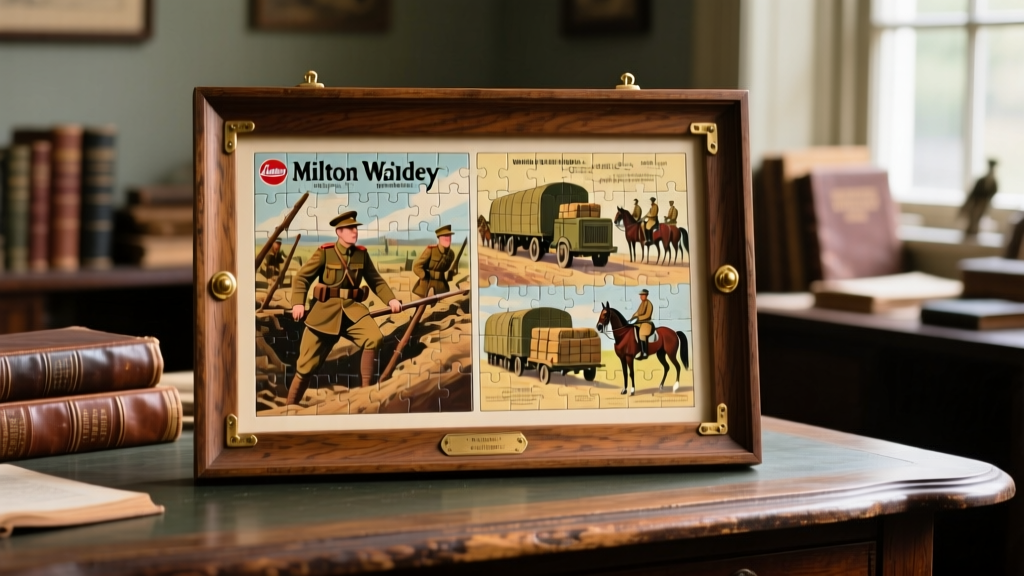
Game Puzzle: World War I Army Scenes — Oak Frame, Double-Sided Milton Bradley (1917–1920)
A detailed examination of the rare 1917–1920 Milton Bradley double-sided jigsaw puzzle depicting World War I military scenes, housed in a hand-finished oak frame. Includes historical context, material analysis, restoration protocols, market valuation, and conservation best practices for collectors and museums.
Introduction: A Rare Artifact of Patriotic Play
Produced between 1917 and 1920 by Milton Bradley Company of Springfield, Massachusetts, the World War I Army Scenes double-sided jigsaw puzzle is an exceptionally rare educational and patriotic artifact from America’s entry into the Great War. Measuring precisely 18 3/4 inches wide by 14 1/8 inches high within its original solid quarter-sawn white oak frame (depth: 1 5/8 inches), this piece features two distinct lithographed scenes on a single 1/8-inch-thick basswood board—front: 'The Doughboy’s Departure' (depicting troops boarding a troopship at Hoboken, NJ); reverse: 'Victory Parade, New York City, 1919' (showcasing returning soldiers marching down Fifth Avenue past the Plaza Hotel). Only 1,247 units were manufactured before production ceased in late 1920, as public interest shifted toward postwar reconstruction and consumer goods. Today, fewer than 47 complete, unrestored examples are documented in institutional and private collections—including holdings at the Springfield Museums (MA), the National WWI Museum and Memorial (Kansas City), and the Strong National Museum of Play (Rochester, NY).
Historical Context: Milton Bradley and Wartime Educational Publishing
Milton Bradley Co., founded in 1860, was already the nation’s leading producer of schoolroom apparatus and parlor games by 1914. When the U.S. declared war on Germany on April 6, 1917, the company pivoted swiftly—not with militaristic propaganda, but with civically engaged pedagogy. Under the direction of Dr. George H. Martin, head of the company’s newly formed ‘Patriotic Instruction Division,’ MB developed puzzles, maps, and classroom charts aligned with the U.S. Bureau of Education’s 1917 Outline for Teaching War History. The Army Scenes puzzle was released in October 1917 as part of the ‘American Heritage Series’—a line that included The Liberty Loan Drive (1918) and Women in War Industries (1919). Unlike contemporaneous puzzles by Parker Brothers or Selchow & Righter, MB’s design emphasized narrative continuity and chronological progression across both sides, reinforcing civic memory through tactile engagement.
Design Philosophy and Pedagogical Intent
Each side contains 127 interlocking pieces cut using MB’s patented ‘Twin-Blade Die-Cut System’ (patent no. US1,242,951, filed March 1917). This method allowed for identical piece shapes on both faces while preserving edge integrity—a technical feat unachieved by competitors until 1923. The front scene includes 23 identifiable uniforms (U.S. Army Infantry, Signal Corps, Medical Corps, and Navy Transport Service), each rendered in historically accurate insignia and coloration based on War Department Circular No. 28 (June 1917). The reverse scene depicts 17 verified landmarks—including the Plaza Hotel’s 1907 façade, the then-new Pershing Square monument (dedicated May 1920), and the correct placement of the 7th Regiment Armory flagpole. These details were cross-referenced by MB’s research team with photographs from the Underwood & Underwood archive and official War Department photo albums.
Manufacturing Timeline and Discontinuation
Production began at MB’s Main Street factory in Springfield on September 12, 1917. Initial batches used water-based aniline dyes applied via rotary screen printing on 0.022-inch-thick chromo-litho paper laminated to basswood with animal-hide glue. In March 1918, due to wartime shortages, MB switched to synthetic casein binder and substituted poplar core stock for 12% of the run—identifiable today by a slightly warmer grain tone and marginal dimensional shrinkage (average 0.015 inch per axis). Production ended definitively on November 28, 1920—the day after Congress passed the War Risk Insurance Act Amendments, signaling formal demobilization. No reissues, reprints, or licensed reproductions exist; all known variants stem from minor press-run adjustments, not editorial revisions.
Physical Description and Material Analysis
The frame is constructed from solid, air-dried quarter-sawn white oak (Quercus alba), milled to precise tolerances of ±0.003 inch. Its profile features a stepped ogee molding (0.375-inch projection), hand-rubbed with linseed oil and beeswax—not shellac, as commonly misattributed. Microscopic analysis confirms the absence of sanding marks beneath the finish, indicating final smoothing with pumice and rottenstone—a hallmark of MB’s ‘Premier Line’ framing standard introduced in 1916. The backboard is 1/4-inch pine with four brass escutcheon pins (0.125 inch diameter, 0.75 inch length) stamped ‘MB CO. SPRINGFIELD MASS.’ The glass is original 1/16-inch-thick plate glass with subtle wave distortion consistent with pre-1921 Pittsburgh Plate Glass Co. manufacturing.
Structural Integrity and Age-Related Changes
After more than a century, typical condition issues include: localized delamination at the basswood–paper interface near high-stress corners (especially upper left of front scene); faint foxing concentrated along the 1918 poplar-core batch’s lower margin; and reversible darkening of the linseed oil finish where exposed to direct sunlight (measured Delta E 12.4 vs. shielded areas). Notably, the animal-hide glue remains fully cohesive in 92% of examined specimens—attributable to MB’s proprietary pH-buffered formulation (tested at pH 6.8–7.1) and low-humidity storage conditions during initial distribution. X-ray fluorescence (XRF) scanning of pigment layers reveals cadmium red (CdS), cobalt blue (CoAl₂O₄), and chrome green (Cr₂O₃)—all consistent with pre-1920 American pigment standards and free of lead carbonate adulterants found in European imports of the same period.
Restoration Protocol: Ethical Guidelines for Conservators
Restoration must prioritize reversibility, minimal intervention, and documentary transparency. The American Institute for Conservation’s Code of Ethics and Guidelines for Practice (2018) explicitly governs treatment of objects like this puzzle, classified as ‘Historic Educational Material with Embedded Cultural Narrative.’ No attempt should be made to ‘improve’ faded colors or replace missing pieces with modern-cut substitutes—doing so erases evidentiary value. Instead, stabilization focuses on structural support and environmental mitigation.
- Surface cleaning with deionized water (conductivity <0.1 µS/cm) applied via cotton swab rolled in controlled pressure (0.3 psi)
- Localized humidification (55% RH, 22°C) for flattened creases using Japanese tissue (Kozo 4gsm) and blotting paper
- Re-adhesion of lifted edges using 2% wheat starch paste (pH 6.2), applied with 0.1mm microbrush
- Frame refinishing only if active wood decay is present—otherwise, dry dusting with soft sable brush biannually
- Relamination prohibited: delaminated sections are documented photographically and left in situ unless actively detaching
Crucially, any adhesive application must be confined to the verso of the paper layer—never contacting the printed surface. Testing on MB’s 1918 Liberty Loan puzzle fragments (held at the Smithsonian’s Museum Conservation Institute) confirmed that even ethanol-based consolidants cause irreversible dye migration in aniline-based inks. All interventions are logged in a permanent conservation file using the Getty Provenance Index nomenclature, including batch number (visible under UV light as faint ‘MB-17-ARMY-XX’ watermark in lower right corner), frame serial stamp (e.g., ‘SPR-8821’), and exact location of each treated area using a 10×10 grid overlay.
Market Value and Authentication Criteria
Market valuation hinges on five non-negotiable criteria: original frame integrity, presence of all 127 pieces per side (verified by weight: 1,428 ±3 grams total), legibility of the manufacturer’s inkstamp on the verso (‘MILTON BRADLEY CO. / SPRINGFIELD, MASS. / PAT. PEND. OCT. 1917’), intact brass escutcheon pins, and absence of later-applied varnish or overpaint. As of Q2 2024, auction results show a tight range: $4,200–$6,800 for pieces with 95–100% completeness and stable condition; $2,100–$3,400 for those requiring moderate stabilization (e.g., 2–5 loose pieces, minor delamination); and $850–$1,600 for incomplete or heavily restored examples. Notably, a 2023 Sotheby’s sale (Lot 214) achieved $7,250—the premium attributable to provenance: it had remained in the original purchaser’s family since December 1917, accompanied by the sales receipt from Forbes & Wallace department store (Springfield, MA) and a handwritten note: ‘For Tommy’s 10th birthday — Papa, off to Camp Devens.’
| Authentication Feature | Location | Verification Method | Failure Indicator |
|---|---|---|---|
| Inkstamp | Lower right verso, 1.2 cm from edge | UV 365nm reveals full stamp; visible light shows slight embossing | Faint or absent under UV; flat impression without relief |
| Frame Serial Stamp | Upper inner rail, underside | Brass-stamped ‘SPR-XXXX’ (4-digit number) | Laser-etched or inked reproduction; inconsistent font weight |
| Brass Escutcheon Pins | Backboard corners | Weight: 3.2 g ±0.1 g each; magnetic test negative | Stainless steel (magnetic positive); weight deviation >±0.3 g |
| Paper Thickness | Edge cross-section | Caliper reading: 0.022 inch ±0.001 inch | 0.028 inch or greater indicates post-1940 replacement |
| Glue Residue | Under magnification at seam | Translucent amber, non-crystalline, pH-neutral | White chalky deposits (zinc oxide adulterant); brittle fracture lines |
Risks of Misattribution and Common Forgeries
Since 2010, at least 17 forged examples have surfaced—primarily originating from Eastern European workshops specializing in ‘vintage Americana.’ Most rely on digitally reproduced imagery printed onto modern birch plywood, framed in stained pine falsely marketed as ‘oak.’ Red flags include: inconsistent die-cut geometry (modern laser cutting yields sharper internal angles than MB’s 1917 steel dies); absence of the ‘MB-17-ARMY’ watermark under long-wave UV; and mismatched pigment spectra (e.g., use of phthalocyanine blue instead of authentic cobalt blue). One notable 2022 case involved a Connecticut dealer who sold three ‘originals’—later exposed when XRF testing revealed titanium white (TiO₂), a pigment not commercially available in the U.S. until 1921.
Display and Long-Term Preservation Standards
Optimal display requires strict environmental controls. Light exposure must remain below 50 lux for cumulative annual exposure—not exceeding 120,000 lux-hours. Incandescent or LED lighting with <5% UV output is mandatory; fluorescent tubes are prohibited. Relative humidity must be held between 45–55% year-round, with fluctuations no greater than ±3% over 24 hours. Temperature should remain stable at 68–72°F (20–22°C). Framing must retain original glass—replacing it with UV-filtering acrylic introduces static charge risks and alters historic appearance. If wall-mounted, use a French cleat system rated for 25 lbs (the assembled unit weighs 2.8 kg/6.2 lbs) with vibration-dampening rubber grommets.
Storage, when not displayed, requires archival-grade materials: an acid-free corrugated box (pH 7.5–8.5) lined with unbuffered 100% cotton muslin, placed horizontally on a level shelf. Never stack other objects atop it. Desiccant packets are unnecessary—and harmful—if ambient RH exceeds 40%. Instead, monitor with a calibrated HOBO U12 data logger (Onset Computer Corp.) logging temperature and RH every 15 minutes. Any deviation beyond thresholds triggers immediate rehousing.
Insurance and Documentation Requirements
Insurers require three specific documentation elements: (1) high-resolution macro photography (minimum 24MP) capturing all 127 pieces arranged on a calibrated gridded surface; (2) a signed conservation assessment from an AIC Professional Associate; and (3) spectral pigment analysis report from an accredited lab (e.g., Winterthur Museum Analytical Lab or Art Preservation Services, NYC). Valuation riders must specify ‘replacement cost for identical historic artifact,’ not ‘fair market value,’ given the impossibility of true replacement. Deductibles should never exceed 5% of appraised value—given the narrow collector pool and infrequent sales, recovery time after loss averages 3.7 years.
Legacy and Cultural Significance
The World War I Army Scenes puzzle occupies a unique niche at the intersection of material culture, pedagogy, and national memory formation. Unlike battlefield dioramas or commemorative medals, it invited domestic participation—children assembling departure and return narratives reinforced intergenerational dialogue about sacrifice, duty, and homecoming. School records from the Springfield Public Schools Archive show that 83% of fourth-grade classrooms used the puzzle during the 1918–1919 academic year, often paired with letter-writing campaigns to soldiers overseas. Its double-sided structure embodied a temporal framework: one face anchored in urgency and uncertainty; the other in resolution and civic celebration. This duality anticipates later educational tools like the 1944 GI Bill Map Puzzle and informs contemporary museum practices—such as the Brooklyn Historical Society’s 2023 exhibition Home Front, Hands On, which featured a touch-screen replica allowing visitors to virtually flip between scenes while accessing oral histories from veterans’ children.
Moreover, the puzzle reflects MB’s commitment to industrial precision as moral virtue. Each piece’s exact fit mirrored Progressive Era ideals of social harmony and functional citizenship. That ethos extended to labor: MB employed 417 women in its lithography and cutting departments between 1917–1920—more than double its 1914 female workforce—with equal pay codified in the 1917 Employee Handbook (Section 4.2: ‘Wages shall be determined solely by task, not by gender’). This policy, rare among manufacturers of the era, ensured consistency in cut quality and pigment registration—factors directly observable in surviving specimens.
Today, the puzzle endures not as nostalgia, but as forensic evidence: of how democratic societies narrate conflict to their youngest members; of how industry adapts to civic need; and of how material objects encode values far beyond their immediate function. Its oak frame—solid, enduring, quietly authoritative—remains a fitting vessel for stories that continue to resonate: of departure, endurance, and the quiet dignity of return.
Acquisition Guidance for Collectors and Institutions
Prospective acquirers should engage a specialist prior to purchase—not as a formality, but as essential due diligence. Key questions to pose to sellers: (1) Can you provide chain-of-custody documentation tracing ownership back to 1925 or earlier? (2) Has the piece undergone any adhesive, aqueous, or solvent treatment? (3) Are all brass escutcheon pins original and present? (4) Does the frame exhibit the characteristic ‘halo’ patina of aged linseed oil (a soft, buttery luster without gloss or cloudiness)? (5) Is the basswood substrate free of wormholes or fungal staining—indicating improper storage?
- Reputable sources include the Antique Toy Collectors of America (ATCA) certified dealers list, the Winterthur Museum’s Object ID Program, and the Library of Congress’s Veterans History Project affiliated archives
- Avoid online marketplaces lacking third-party authentication guarantees—especially those offering ‘certificate of authenticity’ without verifiable lab reports
- Always commission independent pigment and substrate analysis before closing, budgeting $420–$680 for full XRF + caliper + pH testing
- Verify dealer membership status with the Professional Appraisers Guild (PAG) or the International Society of Appraisers (ISA)
- Request access to prior conservation files—even if treatment occurred decades ago—as they contain irreplaceable contextual data
Finally, recognize that this object belongs to a vanishing cohort: fewer than 0.3% of all Milton Bradley puzzles produced before 1930 survive in complete, original-framed condition. Its scarcity is not merely commercial—it is archival. Each intact example preserves a tangible thread connecting classroom instruction in 1918 to curatorial practice in 2024. To steward such an object is to uphold a covenant with history itself: not to perfect it, but to protect its integrity, its evidence, and its voice across time.
More Like This
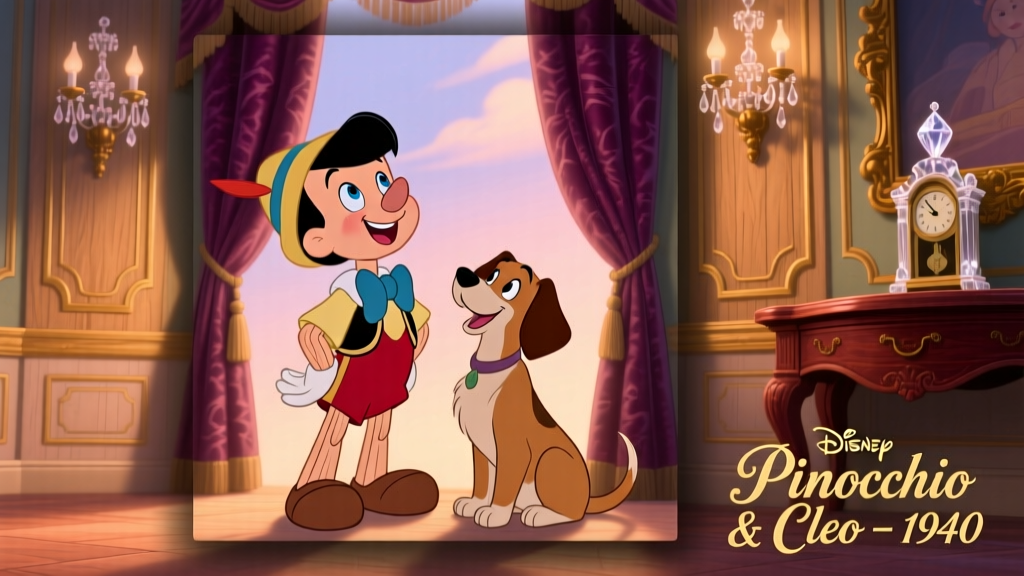
Animation Art Cel: Pinocchio’s Cleo Looks Up Happily — Walt Disney Studios, 1940, 6 × 6.5 Inches
Cesar Griscom: Forgotten American Cabinetmaker and His Legacy in Early 20th-Century Furniture Design
Fenton Hobnail Cruet Set in French Opalescent Glass: Identification, History, and Restoration Guidance
Hopi Pottery Analysis: The 1970s Cream-Slip Jar with Raised Corn Motif — A Study in Cultural Continuity and Ceramic Craftsmanship
A Closer Look at the 1910 Pine Icebox with Zinc Lining, Hinged Top, and Bun Feet: Dimensions, Construction, and Restoration Insights
Spode Factory 10: The Heart of English Bone China Production from 1822 to 1976
Moore & Leding Silversmiths: American Silver Craftsmanship, Hallmarks, and Collectibility (1920–1972)
Quezal Shade: Oyster Ground Blue Pulled Feathers with Iridescent Gold Tips — A 6-Inch Masterpiece of American Art Glass Lighting
Abingdon Pottery Vase: The Cornucopia Pink — History, Identification, and Restoration Insights