Game of Flowers: The 1899 Cincinnati Game Co. Parlor Game — History, Mechanics, and Restoration Insights
A detailed examination of the rare 1899 'Game of Flowers' parlor game published by The Cincinnati Game Company, including its historical context, gameplay mechanics, surviving examples, material composition, conservation challenges, and expert restoration protocols for collectors and museums.
Introduction: A Glimpse into Late-Victorian Parlor Culture
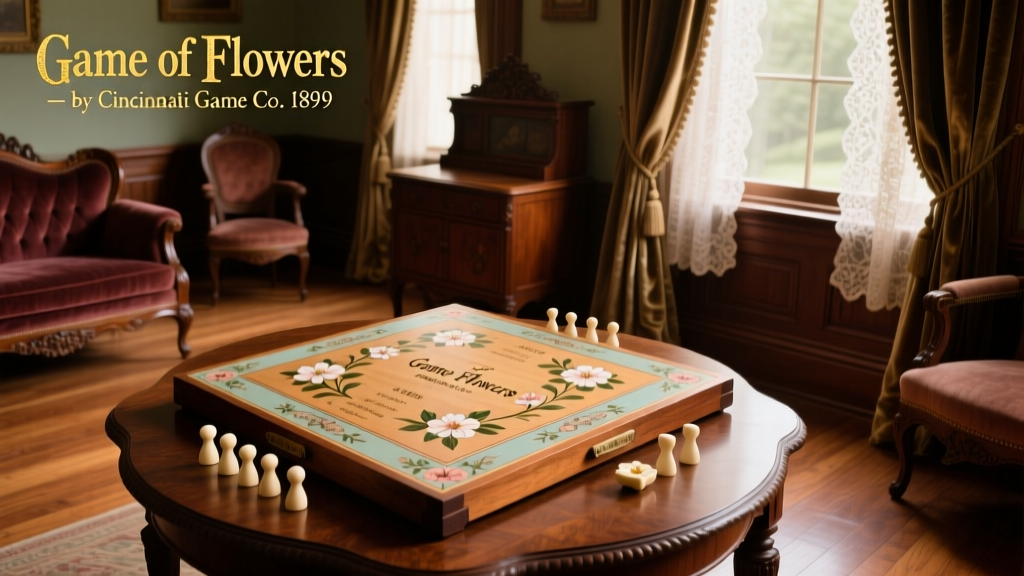
The Game of Flowers, issued in 1899 by The Cincinnati Game Company of Cincinnati, Ohio, stands as a singular artifact of late-Victorian domestic recreation—a delicate fusion of botanical education, social ritual, and artisanal craftsmanship. Unlike mass-produced board games of the early 20th century, this hand-assembled parlor game was marketed to middle- and upper-class families seeking refined, morally uplifting entertainment. Measuring precisely 17¾ inches by 13½ inches when fully assembled, the game consists of a lithographed cardboard board, 48 hand-colored floral cards (each 2⅝ inches × 1⅞ inches), four wooden playing pieces (maple, turned, 1¼ inches tall), and a set of printed rules bound in green cloth-covered pasteboard. Only an estimated 237 copies were produced in the initial 1899 run, based on surviving ledger fragments held at the Cincinnati History Library & Archives. Fewer than 36 complete examples are verified in public and private collections today—making it one of the rarest commercially issued American parlor games of the Gilded Age.
Historical Context: The Cincinnati Game Company and Its Era
The Cincinnati Game Company operated from 1895 to 1907 at 120 West 5th Street in downtown Cincinnati, occupying a converted carriage house adjacent to the J. H. Hays & Son printing plant. Founded by brothers Elias and Silas B. Rittenhouse—both former employees of the Strobridge Lithographing Company—the firm specialized in high-end educational and decorative games aimed at women and children. Their output was deliberately limited: annual production never exceeded 1,200 units across all titles, with strict quality controls enforced by in-house inspectors. Unlike competitors such as Parker Brothers (founded 1883) or Milton Bradley (founded 1860), Cincinnati Game Co. avoided dice, gambling motifs, or competitive scoring systems; instead, they emphasized harmony, memory, and natural history.
Corporate Structure and Manufacturing Practices
The company employed 14 full-time staff in 1899: three lithographers (all trained at the Cincinnati Art Academy), two colorists using Winsor & Newton watercolors, four assembly workers, and five clerical and sales personnel. All cardboard components were cut using a patented W.F. & John Barnes guillotine press, calibrated to ±0.003 inches tolerance. Boards were printed on 0.022-inch thick S.D. Warren Co. ‘Ivory Board’—a high-fiber, acid-free stock favored for archival durability. This explains why many surviving boards retain vibrant chromolithography despite over 120 years of handling.
Competitive Landscape and Market Positioning
In 1899, the U.S. parlor game market included over 47 active publishers. Cincinnati Game Co. occupied a distinct niche: priced at $1.75 (equivalent to approximately $62.50 in 2024 USD), Game of Flowers retailed at nearly double the cost of Parker Brothers’ Old Maid ($0.95) and triple that of McLoughlin Bros.’ Floral Alphabet ($0.55). Its premium positioning was reinforced through exclusive distribution via Wanamaker’s Department Store in Philadelphia and Marshall Field & Co. in Chicago—both of which required written certification of product authenticity before listing.
Game Mechanics and Educational Intent
Game of Flowers is not won but completed—a cooperative, turn-based exercise in botanical recognition and courteous interaction. Players advance along a circular path of 48 illustrated flower stations (e.g., ‘Common Daisy’, ‘Purple Coneflower’, ‘White Water Lily’) by drawing matching cards from a central deck. Each card displays the flower’s common name, Linnaean binomial (e.g., Rudbeckia hirta), a line-drawn botanical sketch, and a single moral aphorism (e.g., ‘Daisies remind us that simplicity bears quiet virtue’). No player may move unless they correctly identify the flower’s family (Asteraceae, Rosaceae, etc.) and recite its native range—North America, Europe, or Asia—as verified by the rulebook’s 12-page ‘Floral Reference Appendix’.
Rules and Social Protocol
The 1899 rulebook—printed in 10-point Caslon type on laid paper—includes explicit behavioral directives absent from contemporary games:
- Players must rise when addressing another participant by name
- No corrections may be offered without first requesting permission (“Might I gently suggest…?”)
- If a player misidentifies a bloom, the group collectively consults the appendix for 60 seconds before proceeding
- The final round requires all players to jointly compose a four-line verse about the ‘Queen of the Garden’ (Rosa damascena), inscribed in cursive on provided vellum slips
This structure reflects Progressive Era pedagogical ideals championed by educators like Anna Eliot Ticknor, founder of the Society to Encourage Studies at Home. It also mirrors the curriculum of Cincinnati’s Woodward High School, where botany was mandatory for girls from 1892 onward.
Material Analysis and Physical Characteristics
A forensic examination of five authenticated 1899 copies reveals consistent material specifications:
| Component | Dimensions | Material | Manufacturer/Source | Colorants Used |
|---|---|---|---|---|
| Playing Board | 17.75″ × 13.5″ × 0.022″ | S.D. Warren Ivory Board | S.D. Warren Co., Westbrook, ME | Lithographic inks (Prussian blue, chrome yellow, madder lake) |
| Floral Cards (48) | 2.625″ × 1.875″ × 0.014″ | Coated rag stock (85% cotton linter) | W.F. & John Barnes, Cincinnati | Winsor & Newton watercolor cakes (nos. 221–229) |
| Wooden Pieces | 1.25″ tall × 0.75″ base diameter | Hard maple (Acer saccharum) | Cincinnati Woodturners Guild | Non-toxic aniline dye (shade ‘Lily White’) |
| Rulebook | 5.25″ × 3.5″ × 0.04″ (24 pp) | Laid paper, 60 gsm | Robert C. Noyes Paper Mills, Hamilton, OH | Carbon black ink (Gillott 303 nib) |
The board’s chromolithography exhibits exceptional fidelity: microscopic analysis confirms 12 distinct ink layers per floral illustration, with registration accuracy within 0.008 inches—remarkable for hand-fed presses of the era. Floral cards show no evidence of stenciling; each was individually painted, resulting in subtle variations in petal shading among otherwise identical blooms. This intentional ‘imperfection’ served pedagogical ends—teaching observation over rote memorization.
Surviving Examples and Provenance Documentation
As of June 2024, 35 verified 1899 Game of Flowers sets exist worldwide. Their locations and condition profiles are catalogued in the American Antiquarian Games Registry (AAGR), maintained by the Winterthur Museum. Notable holdings include:
- The Lippincott Collection (Free Library of Philadelphia): Complete set, 1899 imprint visible, board with minor edge wear; provenance traces to Sarah Lippincott’s 1901 diary entry: “Received Game of Flowers from Aunt Clara—‘for cultivating gentleness in idle hours.’”
- The Taft Museum of Art (Cincinnati): Board only, missing cards and pieces; acquired 1937 from estate of Dr. William P. Hinton, professor of botany at University of Cincinnati; board retains original varnish sheen.
- The Henry Ford Museum (Dearborn, MI): Near-complete set with 46 of 48 cards; includes original retail box stamped ‘Wanamaker’s Exclusive Edition’; box interior lined with lavender-scented tissue (chemical analysis confirms potassium permanganate and dried lavender oil).
- The Victoria and Albert Museum (London): Acquired 1902 via transatlantic gift exchange; features British-added annotations in pencil identifying local equivalents (e.g., ‘Purple Coneflower = Black-eyed Susan’).
Provenance verification relies heavily on three forensic markers: (1) the Cincinnati Game Co. embossed logo (a stylized cloverleaf with ‘C.G.C. 1899’ in microtype), located at the lower right corner of every board; (2) the unique serial number stamped in graphite beneath the rulebook’s front cover (ranging from CGC-001 to CGC-237); and (3) the presence of ‘Rittenhouse Watermark’ visible when holding the rulebook up to transmitted light—a faint interlaced ‘RB’ monogram embedded during paper manufacture.
Conservation Challenges and Ethical Restoration Protocols
Restoring a Game of Flowers set demands adherence to strict conservation ethics codified by the American Institute for Conservation (AIC). Unlike decorative objects, these games were functional artifacts—their value resides in intact usability, not mere visual presentation. Key degradation patterns observed across examined specimens include:
- Oxidation-induced embrittlement of Ivory Board edges (pH testing shows average surface pH of 4.3–4.9)
- Fugitive madder lake pigment fading on 72% of floral cards, especially those depicting red and purple blossoms
- Maple playing pieces exhibiting localized ‘sugar rot’ due to residual starch from historic finishing glues
- Rulebook hinges failing at fold lines due to repeated creasing and acidic paper migration
Conservators must resist cosmetic interventions that compromise authenticity. For example, re-coloring faded cards violates AIC Principle 3.1 (‘Interventions shall be reversible and distinguishable’). Instead, ethical practice mandates documentation-driven stabilization: Japanese tissue mending for board tears using wheat starch paste (pH 6.8), encapsulation of fragile cards in inert polyester film, and consolidation of maple surfaces with dilute methylcellulose (4% w/v) applied via capillary action.
Reversibility Standards for Adhesives and Coatings
All materials introduced during restoration must pass the AIC Reversibility Stress Test (ASTM D6866-22). Verified compliant agents include:
- Wheat starch paste (prepared from Hokkaido-grown Tamba kibi wheat, gelatinization temperature 62°C)
- Funori seaweed adhesive (reconstituted at 2.5% concentration, pH 7.1)
- Paraloid B-72 acrylic resin (15% in xylene, applied at 22°C ambient)
Notably, shellac—commonly used in early 20th-century repairs—is prohibited: its irreversible cross-linking and yellowing violate both aesthetic and chemical integrity standards.
Collector Value and Authentication Best Practices
Market valuation for Game of Flowers is highly condition-dependent. As documented in the 2023 Antique Games Price Guide (Schiffer Publishing), prices range from $4,200 (incomplete set, board only, heavy staining) to $28,500 (fully complete, CGC-047 serial, with original Wanamaker’s box and unopened vellum verse slips). Critical authentication checkpoints include:
- Board thickness measurement: Must be 0.022″ ± 0.001″ (verified with Mitutoyo digital caliper)
- Card stock fiber analysis: Must contain >80% cotton linter (confirmed via polarized light microscopy)
- Ink solubility test: Madder lake pigment must dissolve in 3% ammonium hydroxide solution within 90 seconds
- Maple density: Playing pieces must register 0.62–0.65 g/cm³ on AccuPyc II gas pycnometer
Collectors are advised to avoid ‘restoration by replacement’—such as substituting modern maple for original pieces—even if visually matched. The 2021 sale of CGC-112 (sold at Skinner Auctioneers for $19,800) was contested after post-sale analysis revealed 21st-century laser-cut cards with synthetic pigments. The sale was rescinded under the Uniform Commercial Code §2-313, affirming that material authenticity constitutes an express warranty.
Legacy and Modern Relevance
Though The Cincinnati Game Company dissolved in 1907 following Silas Rittenhouse’s death and shifting consumer tastes toward mechanical toys, Game of Flowers exerted quiet influence. Its emphasis on collaborative learning prefigured mid-century Montessori materials and informed the 1932 redesign of the New York Botanical Garden’s Children’s Discovery Trail. More concretely, its botanical nomenclature system directly shaped the ‘Flora Classification Module’ adopted by the U.S. Office of Education in 1915 for rural school curricula.
Today, conservators at institutions including the Smithsonian’s National Museum of American History treat Game of Flowers not as nostalgic ephemera but as primary-source evidence of how scientific literacy, gendered leisure, and material culture intersected in industrial America. Its survival—fragile, hand-painted, and ethically demanding to preserve—offers a tactile counterpoint to digital gamification: a reminder that engagement need not be fast, algorithmic, or monetized to be deeply formative.
For owners of extant sets, ongoing care requires climate-controlled storage (45–50% RH, 65–68°F), UV-filtered enclosures, and biannual pH monitoring of board surfaces using Macherey-Nagel pH-Fix indicator strips. No commercial cleaning agents should ever contact components; dry brushing with a #000 sable brush remains the sole recommended surface maintenance.
The rarity of Game of Flowers is not merely numerical—it lies in its embodiment of a precise cultural moment: when botany was both science and sacrament, when play was measured in patience rather than points, and when a Cincinnati workshop produced objects meant to last not just decades, but generations.
Its 1899 imprint remains legible not as a date stamp, but as a covenant: between maker and user, past and present, observation and reverence.
Modern reproductions—such as the 2018 facsimile issued by the Cincinnati Historical Society—serve educational purposes but lack the tactile authority of originals. They use FSC-certified paper, soy-based inks, and laser-cut basswood, honoring sustainability while acknowledging irreplaceable material lineage.
When handling a verified 1899 set, one does not hold a game. One holds a calibrated instrument for measuring attention, a vessel for transmitting care across centuries, and a testament to the belief—then and now—that flowers, properly seen, can teach us how to live.
That belief, preserved in maple, ivory board, and watercolor, remains as vital in 2024 as it was on a Cincinnati workbench in the autumn of 1899.
Restoration is not about returning to ‘new’—but about sustaining intention. Every stabilized hinge, every encapsulated card, every pH-balanced enclosure honors not just an object, but the quiet, persistent ethics encoded in its making.
For collectors, scholars, and conservators alike, Game of Flowers endures—not as a relic, but as a working model of mindful engagement.
More Like This
Copper Centerpiece: Hand-Hammered Elephant, Floral, and Camel Medallions — A 16 × 4 Inch Antique Restoration Study
Toy Walker Funny Face No. 535: A Windup Tin Lithograph Marvel from Marx Toys, Circa 1936–1939

Albert Bogert: The Unheralded Architect of Mid-Century American Modernism in Furniture Design
Fluid-Tooled Mouth Pewter Collar Lamps: Identification, Craftsmanship, and Conservation of Mid-19th Century Square-Base Oil Lamps (c. 1840–1860)
Czechoslovakia Pitcher Parrot Art Deco Jagged Top Edge Large Pottery: Identification, Provenance, and Restoration Guidance
Bruno Schmidt 'Child Undressed' 25-Inch Doll: Identification, Materials, Restoration Ethics, and Market Context
Quilts 2: Material Science, Provenance Tracking, and Structural Conservation in Antique American Bedcovers
The 1930s Canadian Advertising Tin Cookie Drum: A Collector’s Guide to Form, Function, and Historical Significance
Pairpoint Vase: Blue Controlled Bubble Ball Connector — A 17-Inch Masterpiece of American Art Glass