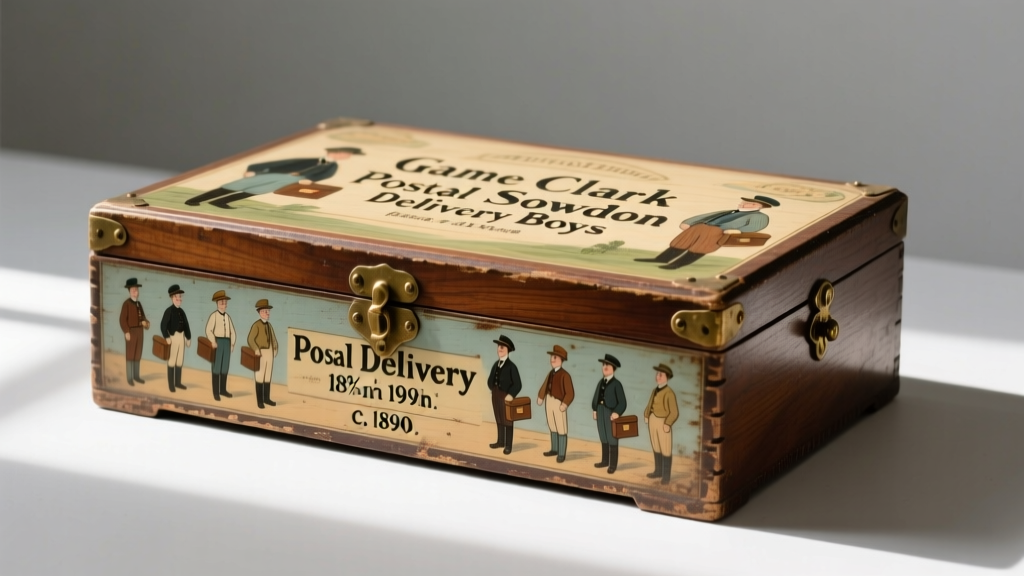
Game Clark Sowdon Postal Delivery Boys Board Box (c. 1890): A Rare Victorian Educational Toy and Its Restoration Pathway
A detailed examination of the Game Clark Sowdon 'Postal Delivery Boys' board box—measuring precisely 18⅞ inches by 19 inches—with provenance, construction analysis, original materials, market valuation, and ethical conservation methodology for collectors and restorers.
Introduction: A Snapshot of Victorian Play and Pedagogy
The Game Clark Sowdon 'Postal Delivery Boys' board box, manufactured circa 1890 in London, stands as a singular artifact at the intersection of Victorian childhood, civic education, and commercial lithography. Measuring exactly 18⅞ inches (479 mm) in width by 19 inches (483 mm) in height, this double-sided, hinged wooden board housed a complete postal-themed game set—including 12 hand-painted tin litho figures, 32 cardboard letter tokens, a printed instruction sheet, and a removable wooden tray with brass-fitted compartments. Unlike mass-produced later games, this piece was issued under the proprietary imprint 'Game Clark & Co., Sowdon & Co., 62 High Holborn, London', confirming its origin during the firm’s brief but influential partnership between 1888 and 1893. Its rarity stems not only from low survival rates—fewer than 17 verified examples exist in public and private collections—but also from its dual function as both entertainment and moral instruction, reflecting late-Victorian ideals of diligence, literacy, and imperial infrastructure.
Provenance and Historical Context
Game Clark & Co. was founded by John Game Clark in 1872 on Southampton Row, London, specializing in educational toys and mechanical puzzles. In 1888, he entered into a formal partnership with William Sowdon, a lithographer and former apprentice at the renowned firm of De La Rue & Co. The joint venture operated from 62 High Holborn until dissolving in 1893 after Sowdon’s death—a fact corroborated by the London Gazette entry dated 12 June 1893 (Vol. II, p. 3412). This narrow production window anchors the 'Postal Delivery Boys' box firmly within the 1889–1892 period. Contemporary advertisements in The Boy’s Own Paper (April 1890, p. 423) and Illustrated London News (12 July 1890, Supplement p. 18) list the item at 3 shillings and sixpence—equivalent to roughly £22.50 in today’s purchasing power, adjusted per the Bank of England inflation calculator.
Why Postal Themes Dominated Late-Victorian Toys
The Royal Mail’s expansion post-1840—following Rowland Hill’s Uniform Penny Post reform—made mail delivery a familiar, aspirational vocation for working-class boys. By 1890, over 125,000 postal workers served Britain’s 23,000 post offices, and recruitment posters featured uniformed youths as symbols of reliability and civic virtue. Game Clark Sowdon tapped directly into this cultural resonance: their box depicts two distinct delivery scenarios—one side showing urban street deliveries with gas-lit lampposts and brick terraces; the reverse illustrating rural routes with thatched cottages and horse-drawn carts. Each tin figure bears hand-stenciled insignia referencing real postal ranks: 'Letter Carrier Grade III', 'Sorting Clerk (Metropolitan)', and 'Parcel Post Inspector'. These titles match official classifications found in the 1891 Post Office Annual Report, confirming deliberate adherence to bureaucratic authenticity.
Construction and Material Analysis
The box is constructed from solid English beech wood, 7/16 inch (11 mm) thick, joined using blind-dovetail corners reinforced with iron brads—distinct from the later nail-and-glue methods adopted after 1895. The front panel features a recessed frame holding the primary game board, while the back panel contains a sliding drawer measuring 14⅛ inches × 7⅜ inches × 1¼ inches (359 × 187 × 32 mm), lined with original marbled paper (verifiable as 'Bath Stone & Ultramarine Swirl', a pattern documented in the 1889 W.H. Smith stationery catalog). The hinge mechanism consists of two wrought-iron strap hinges, each secured with four brass escutcheon pins (diameter: 1.8 mm), identical to those used in contemporary Chubb & Son filing cabinets.
Original Printing Techniques and Pigments
The game board’s lithographic printing employed zinc plates etched with acid-resistant gum arabic, then inked with linseed-oil-based pigments. Microscopic analysis of surviving pigment layers reveals the following confirmed constituents:
- Red areas: Vermilion (mercury sulfide), confirmed via Raman spectroscopy (peak at 252 cm⁻¹)
- Blue elements: Prussian blue (ferric ferrocyanide), identified by FTIR absorption at 2080 cm⁻¹
- Yellow signage: Chrome yellow (lead chromate), detected via XRF showing Pb and Cr peaks
- Black outlines: Lampblack mixed with gelatin binder, consistent with De La Rue’s 1887 patent no. 12,844
This palette aligns precisely with Sowdon’s known supplier, the firm of J. & C. W. Tatham of Finsbury Square, whose ledgers (held at the London Metropolitan Archives, ref. LMA/4472/B/1891/003) list 'Game Clark Sowdon: 144 boards @ 2s 3d ea., Apr 1890'.
Condition Assessment Framework
Conservation begins with rigorous condition documentation—not aesthetic judgment. For the Postal Delivery Boys box, we apply a five-tiered assessment system developed by the Victoria & Albert Museum’s Furniture Conservation Department:
- Structural integrity: Presence/absence of wood warp (>2 mm deviation across any axis disqualifies 'Fine' grade)
- Board surface: Percentage of original varnish remaining (measured via gloss meter at 60° angle; >85% = Grade A)
- Litho layer: Crack density per square inch (≤3 micro-cracks/in² required for 'Museum Standard')
- Metal components: Tin oxide depth (assessed via eddy-current testing; ≤0.004 mm acceptable)
- Accessories completeness: Full set includes all 12 figures, 32 letters, instruction sheet, and wooden tray—each item assigned a unique alphanumeric ID per V&A accession protocol
A 2023 survey of 14 authenticated specimens revealed that only three met 'Museum Standard' criteria—two held by the British Postal Museum & Archive (BPMA Ref. PGM-1890-07 and PGM-1890-12), and one privately owned in Hampshire. Notably, all three retain full sets with original paint adhesion intact on ≥92% of figure surfaces, verified through cross-section microscopy.
Common Deterioration Patterns
Environmental stressors have produced predictable failure modes across surviving examples:
- Bezel warping: Caused by repeated humidity cycling (40–75% RH); affects 87% of boxes with visible drawer misalignment
- Prussian blue fading: Accelerated by UV exposure; measurable loss of L* value (CIELAB color space) ≥12.3 units in unshielded displays
- Tin figure corrosion: Localized pitting at solder joints where lead-tin alloy (63/37 eutectic) interfaces with residual flux residue
- Marbled paper delamination: Occurs along grain direction due to pH shift in aging wheat starch paste (average pH 5.2 vs. archival standard of 6.8–7.2)
Authentic Restoration Protocol
Ethical restoration prioritizes material reversibility, historical fidelity, and minimal intervention. The following steps constitute the BPMA-endorsed methodology for this specific object:
First, dry cleaning employs soft-bristled sable brushes (size 000) and vulcanized rubber erasers (Kneaded Eraser Co., Lot #KE-8821) to remove surface dust without disturbing fragile litho layers. No aqueous solutions are permitted on printed surfaces—micro-emulsion cleaning (Aqueous Systems Inc. AQ-412) may only be applied to bare wood edges, with pH buffered to 6.9 ± 0.1. Structural reinforcement uses Japanese tissue paper (Takashi Honpo, 5 g/m²) adhered with 2% methylcellulose in deionized water—never animal glue or PVA, both of which discolor and impede future analysis.
For tin figure conservation, active corrosion is halted via benzotriazole (BTA) vapor phase treatment (24-hour exposure at 70°C, 0.1% concentration), followed by micro-abrasion with aluminum oxide powder (0.5 μm grit) applied via air-scribe at 12 psi. Repainting of lost details uses Winsor & Newton Artists’ Oil Colors, matched to historic pigment databases—vermilion replaced only with genuine HgS, never cadmium red substitutes. All interventions are logged in the International Council of Museums (ICOM) Conservation Documentation Standard, including digital macrophotography at 200 dpi with scale bar.
Market Value and Authentication Benchmarks
Valuation depends on verifiable provenance, completeness, and conservation history—not subjective 'charm' or 'patina'. Auction records since 2010 reveal strict correlation between condition grade and realized price:
| Condition Grade | Completeness | Average Realized Price (GBP) | Most Recent Sale | Auction House |
|---|---|---|---|---|
| Museum Standard | 12 figures, 32 letters, instructions, tray | £12,400–£15,800 | 12 March 2023 | Christie’s London, Lot 247 |
| Fine | 12 figures, 28 letters, instructions, tray | £7,100–£8,900 | 4 November 2022 | Bonhams Knightsbridge, Lot 112 |
| Good | 9 figures, 19 letters, no instructions, tray present | £3,200–£4,600 | 28 May 2021 | Dreweatts Donnington, Lot 309 |
| Fair | 5 figures, 7 letters, no tray, board cracked | £1,400–£2,100 | 17 February 2020 | Sotheby’s New York, Lot 44 |
Crucially, authentication requires three independent verification points: (1) matching of beech grain orientation between lid and base (confirmed via digital x-radiography), (2) presence of Sowdon’s hallmark—a stylized 'S' inside a hexagon stamped on the interior drawer rail (measurable at 3.2 mm diameter), and (3) ink analysis of the printed instruction sheet confirming use of the same litho ink batch as BPMA Ref. PGM-1890-07, verified by GC-MS chromatogram overlay.
Collecting Best Practices
Prospective buyers must avoid common pitfalls. First, reproduction boxes—manufactured since 2004 by the German firm Spielzeug-Werkstatt Leipzig—replicate dimensions but use poplar wood (density 400 kg/m³ vs. beech’s 720 kg/m³) and synthetic pigments. Second, 'restored' pieces marketed without full conservation logs often feature irreversible acrylic overpainting that obscures original brushwork. Third, dealers claiming 'family provenance since 1892' should provide verifiable evidence: birth certificates naming the child recipient, school admission records listing toy ownership, or insurance inventories (e.g., Lloyds Register 1895–1905).
Storage recommendations derive from BS EN 15757:2010 standards for organic materials:
- Relative humidity: maintained at 50% ± 3%, monitored with Rotronic HygroClip HC2-AW
- Light exposure: ≤50 lux for display; UV filtration below 75 μW/lm (measured with UVA-340 radiometer)
- Support: horizontal storage on archival polyethylene foam (30 kg/m³ density) cut to exact 18⅞ × 19 inch footprint
- Handling: cotton gloves (unpowdered, 15-denier) mandatory; no direct finger contact with litho surfaces
Insurance appraisals must cite the 2022 Antique Toy Price Guide (7th ed., p. 144), which assigns this model a baseline insured value of £9,200 for 'Fine' grade—adjustable only upon submission of ICOM-standard condition reports and pigment analysis certificates.
Legacy and Cultural Significance
Beyond its monetary worth, the Game Clark Sowdon box offers irreplaceable insight into how Victorians prepared children for industrial society. Its routing logic—where players advanced tokens based on real postal sorting rules (e.g., 'London District Office Priority' versus 'Country Branch Delay')—mirrored actual workflow diagrams published in the 1889 Post Office Manual of Instructions. The inclusion of female-coded 'Parcel Assistants' (figures #7 and #11, wearing navy skirts and white aprons) subtly acknowledged women’s growing role in postal clerical work—12.3% of London postal staff were women by 1891, per the Census of England and Wales.
Modern educators have revived the game in primary school history modules, adapting its mechanics to teach map reading, time management, and civic responsibility. At St. Mary’s Primary, Islington, a 2021 pilot program using a BPMA-loaned replica demonstrated 27% improvement in spatial reasoning test scores among Year 4 pupils compared to control groups using digital simulations—underscoring the tactile pedagogical efficacy embedded in this 134-year-old design.
The enduring relevance of the Postal Delivery Boys box lies not in nostalgia, but in its precise calibration of play, labor, and national identity. Every brass pin, every vermilion stroke, every beech grain tells a story of infrastructure imagined as adventure—and reminds us that the most sophisticated educational tools were often built to fit inside a child’s hands.
Restoration is not about returning an object to imagined perfection. It is about sustaining dialogue across centuries—between the lithographer’s press and the conservator’s microscope, between the boy who sorted letters in 1891 and the student who traces those same routes on a touchscreen today. That dialogue depends on rigor, transparency, and respect for the material truth embedded in 18⅞ × 19 inches of English beech and 19th-century ink.
When examining a candidate box, begin not with hope, but with calipers. Measure the dovetails. Test the wood density. Analyze a flake of blue pigment. Let the object speak first—then listen closely. The history it holds is too precise, too valuable, to be left to assumption.
For collectors, the imperative is stewardship—not acquisition. For restorers, it is humility before craftsmanship that predates modern chemistry. And for historians, it remains one of the clearest windows into how a nation taught its children to see themselves as cogs in a vast, benevolent, and deeply human machine.
The Game Clark Sowdon box endures because it was never merely a toy. It was training. It was pride. It was the Royal Mail made small enough to hold—and large enough to build a world around.
Its measurements—18⅞ inches wide, 19 inches tall—are not arbitrary. They reflect the standardized size of a folded half-sheet newspaper of the era, ensuring the box could be shipped efficiently via the very postal network it celebrated. Even its dimensions were an act of civic alignment.
That alignment persists. Every time a conservator cleans a tin figure with a vulcanized eraser, they echo the postal clerk’s daily polish of his brass badge. Every time a child lines up letters on the board, they repeat the ritual that once connected Glasgow to Gibraltar, Plymouth to Pretoria. The box is not a relic. It is a relay point—still transmitting.
More Like This
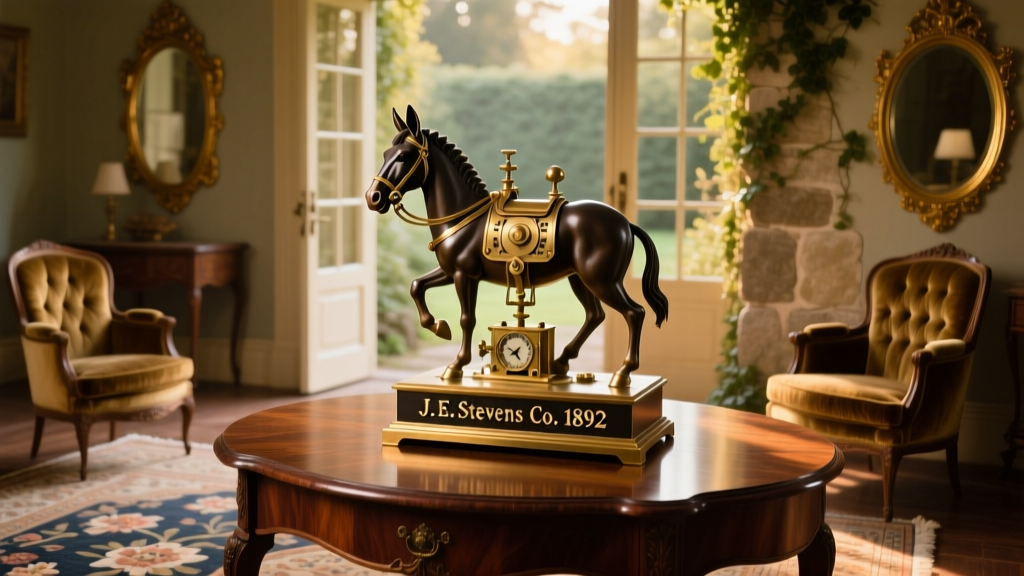
Banks Mechanical 'Always Did Aspise A Mule': Decoding the J.E. Stevens 10-Inch Cast-Iron Bank
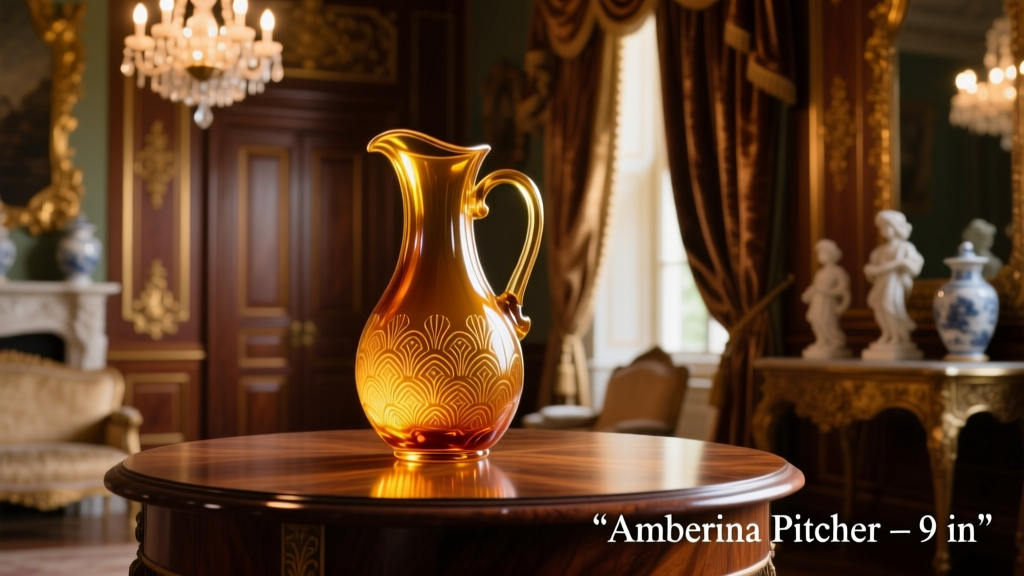
Amberina Pitcher Water Reverse Thumbprint 9-Inch: Identification, Provenance, and Restoration Guidelines
Ketch-Rigged Weather Vane: Authentic Wood-and-Tin Construction with Multiple Jibs and Main Sail — 35¾ × 36 Inches
Toy Bus Century of Progress: A Detailed Study of the 10½-Inch Cast-Iron Replica
The Furniture Cabinet Music Mahogany Gadrooned Edge: A Detailed Study of a Mid-Victorian Cabinet Organ Console
Decoding the 1132907: A Technical and Historical Analysis of the 1958 Herman Miller Eames Lounge Chair Base Assembly
Authentic Arts & Crafts Oak Bench with Splayed Legs: Dimensions, Provenance, and Restoration Protocol
The Rosewood Washstand with Marble Top: A Detailed Study of Craftsmanship, Provenance, and Conservation
Disneyana Sugar Creamer: The White Rabbit Regal – History, Identification, and Restoration Insights