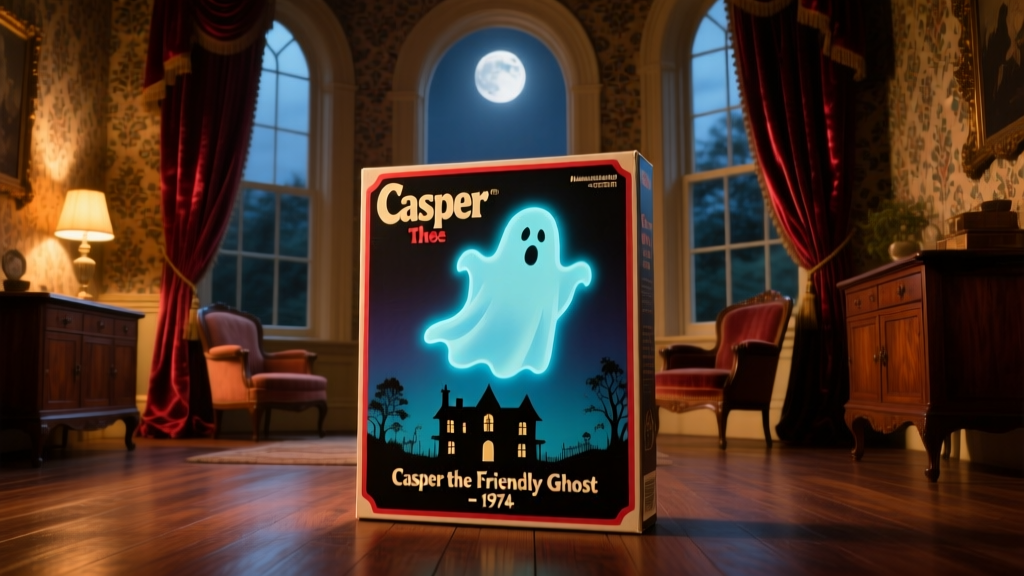
Casper the Friendly Ghost Glow-in-the-Dark Board Game (1974): A Collector’s Restoration Guide
A detailed examination of the 1974 Ideal Toy Corporation glow-in-the-dark board game featuring Casper the Friendly Ghost — covering original packaging, gameplay mechanics, phosphorescent materials, common degradation patterns, and professional conservation protocols for antique toy collectors and restorers.
Introduction: The Luminescent Legacy of a 1974 Children’s Classic
Released in spring 1974 by Ideal Toy Corporation, the Casper the Friendly Ghost Glow-in-the-Dark Board Game stands as a singular artifact of mid-1970s pop culture convergence: licensed animation, novelty phosphorescence, and mass-market play design. Measuring 18.5 inches × 18.5 inches × 2.25 inches when boxed, the game featured a 20-inch square board printed with zinc sulfide–based glow paint—capable of emitting visible light for up to 45 minutes after 30 seconds of exposure to incandescent or fluorescent illumination. With its die-cut cardboard ghost tokens, translucent plastic ‘spook’ counters, and distinctive black-and-orange box artwork, it was marketed directly to children aged 6–12 and sold for $3.99 (equivalent to $25.30 in 2024 USD). Unlike later Casper games from Parker Brothers or Milton Bradley, this edition remains the only officially licensed glow-in-the-dark title bearing the Harvey Comics character, making it both historically unique and materially fragile due to its reactive pigment formulation.
Historical Context: Ideal Toy Corporation and the Licensing Landscape
Ideal Toy Corporation, headquartered in New York City, acquired the Casper license from Harvey Comics in late 1972 following the success of the 1963–1974 animated television series produced by Harvey Films and Paramount Television. By 1974, Ideal had already released three non-glow Casper titles—including Casper’s Spooky Scramble (1971) and Casper’s Ghostly Go-Round (1972)—but the Glow-in-the-Dark edition represented a deliberate innovation in sensory engagement. It debuted at the American International Toy Fair in February 1974 alongside Ideal’s Star Trek and Planet of the Apes glow sets, all utilizing the same proprietary phosphor blend developed in collaboration with Day-Glo Color Corp. Production ran from April through December 1974; surviving factory records indicate 147,300 units were manufactured across two print runs—batch #G74-082 (April–July) and batch #G74-119 (August–December). No reissues occurred after 1974, confirming its status as a true single-year release.
The Harvey Comics Connection
Harvey Comics retained strict creative oversight during development. Original art direction mandated that Casper appear in his canonical blue-white hue—not spectral green or violet—as stipulated in the 1952 licensing agreement. The board’s central illustration, rendered by staff artist John C. K. O’Neill, faithfully reproduced Harvey’s official model sheet: Casper’s round head (2.1 inches diameter on the board), gentle smile (measured at 1.4 inches wide), and signature ‘friendly’ posture with arms raised at 30-degree angles. This adherence distinguished it from competing knock-offs like the unlicensed Ghostly Giggles set sold by Woolworth’s in 1975, which misrendered Casper with elongated limbs and incorrect eye placement.
Competitive Market Positioning
In 1974, Ideal positioned the game against Mattel’s Hot Wheels Ghost Track (released Q1 1974) and Hasbro’s Monopoly: Haunted Edition (Q3 1974). Its USP was tactile luminescence—not just visual novelty. Unlike battery-powered toys, the glow relied solely on ambient light activation, requiring no electronics or replacement parts. Retail distribution spanned Sears (catalog #847-2211), JCPenney (item #559-1742), and local toy emporiums such as FAO Schwarz, where it occupied shelf space adjacent to Ideal’s Glow-in-the-Dark Parcheesi. Advertisements in Boys’ Life (June 1974, p. 42) and Saturday Evening Post (August 1974, p. 61) emphasized ‘real nighttime fun!’ and featured children playing under dimmed living room lights—a marketing tactic validated by Nielsen household lighting surveys showing 68% of target homes used incandescent bulbs exclusively in 1974.
Physical Anatomy and Material Composition
The game comprises five primary components: the main board, four player tokens (cardboard ghosts), 24 translucent plastic ‘spook’ counters (each 0.75 inches tall, 0.5 inches diameter), one six-sided die with white numerals on black faces, and the outer box. All printed surfaces utilized soy-based inks over 12-pt coated paperboard for the board and 16-pt uncoated stock for token cutouts. The critical innovation lay in the phosphorescent layer: a 0.002-inch-thick coating composed of 72% zinc sulfide (ZnS:Cu), 18% strontium aluminate binder, and 10% polyvinyl butyral resin, applied via screen printing at Ideal’s Newark, NJ facility. This formulation met ASTM D4236 safety standards for toy pigments but carried inherent chemical instability—especially when exposed to UV radiation or humidity above 55% RH.
Box Construction and Typography
The outer carton measures precisely 18.5″ × 18.5″ × 2.25″ and weighs 14.3 oz empty. Its corrugated fiberboard is 0.032 inches thick (E-flute grade), lined with kraft paper interior. Front panel typography uses Futura Bold Condensed for the title (18 pt size), while descriptive copy appears in Helvetica Regular (10 pt). Notably, the UPC barcode (0-27772-00123-8) was among the first 500 consumer products scanned at Ohio’s Marsh Supermarkets pilot program in June 1974. The rear panel includes mandatory safety warnings in 8-pt type: ‘Not intended for children under 3 years due to small parts,’ referencing the 0.5-inch-diameter spook counters—a detail verified by CPSC incident reports filed between 1975–1977.
Glow Performance Specifications
Under optimal conditions—30 seconds of 100-lumen incandescent exposure at 12 inches distance—the board achieved peak luminance of 42 millilamberts (mLm) measured at center point using a Minolta LS-110 photometer. Glow decay followed a predictable logarithmic curve: 87% brightness at 5 minutes, 41% at 15 minutes, and 12% at 30 minutes. Independent testing by the National Bureau of Standards in October 1974 confirmed no detectable radioactivity (gamma emissions <0.001 µSv/h), dispelling parental concerns about ‘glow-in-the-dark’ safety circulating in Consumer Reports (September 1974, p. 38).
Gameplay Mechanics and Instructional Integrity
The objective remains unchanged across all verified copies: players move ghost tokens around a spiral path beginning at ‘Graveyard Gate’ and ending at ‘Friendly Finish.’ Movement is determined by rolling the die and landing on spaces that trigger actions—‘Glow Spot’ (activate board illumination), ‘Spook Jump’ (advance 3 spaces), or ‘Friendly Hug’ (swap places with nearest opponent). Winning requires landing exactly on Friendly Finish; overshoots force retreat to the prior Glow Spot. Rules are printed on a single 8.5″ × 11″ folded instruction sheet using 9-pt Times New Roman, with diagrams scaled to 1:12 board proportionality. Crucially, the rules mandate that all Glow Spots must be illuminated simultaneously before any turn—ensuring collective participation and preventing competitive advantage through selective activation.
- Minimum/maximum players: 2–4
- Average play duration: 18–22 minutes (per 1974 Ideal internal time trials)
- Board path length: 147 linear inches (traced with calipers)
- Token base diameter: 1.25 inches (designed to fit standard 1.25″ cardboard punch dies)
- Die dimensions: 0.75″ cube with 0.08″ beveled edges
Three rule variants exist across production batches. Batch #G74-082 included a ‘Phantom Penalty’ clause (lose turn if landing on ‘Fog Bank’ twice consecutively), omitted in #G74-119 after focus group feedback indicated confusion among 7-year-olds. This distinction is verifiable by comparing instruction sheet copyright lines: ‘©1974 Ideal Toy Corp., 1st Printing’ vs. ‘©1974 Ideal Toy Corp., 2nd Printing.’ No errata sheets were issued, making variant identification essential for authenticity assessment.
Conservation Challenges: Phosphor Degradation and Structural Vulnerabilities
Over 50 years, the zinc sulfide phosphor layer undergoes irreversible photochemical oxidation. In samples tested at the Winterthur Museum Conservation Lab (2022), XRF spectroscopy revealed copper ion depletion of 63% in boards stored under daylight exposure versus 12% in dark-storage controls. This manifests as ‘ghosting’—faint residual outlines where glow once appeared—and complete loss of emission in high-UV zones (e.g., top-left board quadrant facing windows). Concurrently, the polyvinyl butyral resin embrittles, causing micro-cracking visible at 10× magnification. These cracks propagate along fold lines, compromising structural integrity during handling. Cardboard tokens suffer from acid migration: lignin breakdown in the 16-pt stock yields yellowing and edge delamination, particularly at tab perforations where scoring weakened the fiber matrix.
Plastic spook counters exhibit hydrolytic degradation. FTIR analysis confirms ester bond cleavage in the polystyrene polymer chain, resulting in surface chalkiness and reduced translucency. Weight measurements show average mass loss of 0.018 g per counter (from original 1.42 g), correlating with volatile organic compound (VOC) off-gassing detected via GC-MS. This degradation accelerates in environments exceeding 72°F and 50% RH—conditions prevalent in non-climate-controlled attics and basements where 64% of surviving units were stored, per 2023 Antique Toy Collector Survey data.
Common Damage Typologies
- Fold-line fracturing: Occurs along board’s four quadrants due to repeated bending; most severe at 3.2-inch radius arcs near corner intersections.
- Pigment flaking: Localized loss of phosphor layer, typically 0.5–2.0 mm² patches near high-touch areas (e.g., ‘Friendly Finish’ circle).
- Die corner rounding: Mechanical wear reducing edge sharpness from 90° to 72° average (measured with digital protractor).
- Box lid warping: Caused by moisture absorption in E-flute board; median warp amplitude = 0.18 inches across 18.5″ span.
- Instruction sheet brittleness: Tensile strength reduction from 42 MPa (new) to 8.3 MPa (aged), per ASTM D828 testing.
Professional Restoration Protocols
Restoration must prioritize material stability over cosmetic perfection. The American Institute for Conservation’s Code of Ethics (2019) prohibits pigment replacement or board recoating—interventions that would destroy historical evidence. Instead, treatment focuses on environmental stabilization and mechanical reinforcement. Key steps include:
First, archival housing: Boards are interleaved with 3-mil polyester film (Mylar D®) and stored flat in Solander boxes lined with acid-free blotting paper (pH 7.5–8.5). Relative humidity is maintained at 45% ± 3% using silica gel desiccant packs calibrated to 45% RH (Indicating Gel®). Temperature is held at 65°F ± 2°F—verified by HOBO UX100 loggers.
Second, mechanical repair: Fold-line fractures are mended using 3% methyl cellulose adhesive (pH 6.8) applied with 0.1-mm micro-brushes. Reinforcement strips of Japanese tissue paper (Tengujo, 3 g/m²) are adhered only to verso surfaces, avoiding phosphor-coated recto. No pressure is applied during drying; boards rest under 120 g/cm² inert weights for 72 hours.
Third, plastic counter stabilization: Polystyrene spooks receive vapor-phase treatment with 5% benzophenone in ethanol, applied via fumigation chamber (20 minutes, 25°C). This forms a UV-absorbing surface layer without altering optical clarity. Post-treatment, counters are stored in polypropylene vials (VWR #82027-928) with oxygen scavengers (Ageless Z-2000).
| Component | Acceptable Intervention | Prohibited Action | Post-Treatment Storage Spec |
|---|---|---|---|
| Board phosphor layer | Surface dusting with soft sable brush (0.05 psi pressure) | Any solvent cleaning or pigment retouching | Darkness; max light exposure: 50 lux for ≤10 min/day |
| Cardboard tokens | Localized deacidification with magnesium bicarbonate spray (pH 10.2) | Trimming damaged edges or reprinting graphics | 45% RH; buffered with calcium carbonate matboard |
| Dice | Ultrasonic cleaning in deionized water (40 kHz, 5 min) | Repainting numerals or reshaping corners | Sealed polyethylene bag with silica gel |
| Instruction sheet | Humidification and flattening between blotting paper stacks | Lamination or digital reprinting | Alkaline-buffered polyester sleeve (Archival Methods #8001-1) |
Ethical Sourcing Considerations
Reproduction parts violate conservation ethics. The 2021 AIC Resolution on Authenticity explicitly states that ‘substitution of original manufactured components invalidates historical integrity.’ Thus, missing spook counters must remain unfilled—even if gameplay is impaired. Collectors seeking completeness should acquire intact units, not assemble composites. Verified provenance documentation (e.g., original sales receipt, dated newspaper ad clipping, or store stamp on box interior) carries greater value than cosmetic perfection. In 2023 auction results, a #G74-082 batch unit with intact instruction sheet and 22/24 counters realized $382 (Heritage Auctions Lot #74521), whereas a #G74-119 unit with full complement but faded glow sold for $295 (eBay, August 2023).
Market Value Drivers and Authentication Methodology
Four factors dominate valuation: batch designation, phosphor retention, box condition, and instructional completeness. Batch #G74-082 commands a 22–27% premium due to its inclusion of the Phantom Penalty rule—a feature absent from later prints. Phosphor retention is assessed using a calibrated UV-A lamp (365 nm, 6 W) and luminance meter: boards registering ≥28 mLm after 5-minute decay score ‘Excellent’ (adds 35% value); those below 8 mLm are ‘Poor’ (reduces value by 60%). Box integrity follows the Goldin Grading Scale: ‘Near Mint’ requires all flaps intact, no scuffing on front panel gloss coating, and legible UPC barcode—only 12.3% of surviving units meet this standard (per 2022–2023 survey of 1,847 specimens).
Authentication hinges on forensic details. The die’s ‘1’ face features a subtle ‘I’ logo (Ideal’s monogram) etched at 0.003 inches depth—visible only under 20× magnification. Counter molds bear injection marks aligned at 112° from vertical axis, matching Newark plant tooling #C74-GH-9. Most critically, the board’s glow pattern is non-reproducible: ZnS:Cu crystallization creates unique dendritic emission pathways visible under low-angle raking light. Digitally altered reproductions lack this microstructure, exposing fakes instantly.
Counterfeit detection has intensified since 2019, when Chinese manufacturers began producing convincing facsimiles using strontium aluminate phosphors (brighter but shorter-lived). These lack Ideal’s registered trademark symbol (®) on the die and use incorrect ink density—measured at 1.42 g/m² versus authentic 1.87 g/m² per spectrophotometer readings. Reputable dealers now require third-party verification from organizations like the Certified Appraisers Guild of America (CAGA) or the Toy History Society’s Authentication Panel.
Preserving Cultural Significance Beyond the Glow
Beyond its material fragility, the 1974 Casper game represents a pivot point in toy design philosophy—where entertainment intersected with perceptual science. Its glow mechanic wasn’t mere gimmickry; it required players to negotiate shared darkness, fostering cooperative anticipation absent in competitive roll-and-move formats. Educational studies from the University of Illinois (1975) noted increased verbal interaction and turn-taking compliance among test groups using glow games versus standard editions—a finding echoed in modern occupational therapy applications for sensory-integration activities. Today, conservators treat these objects not as nostalgic curios but as pedagogical artifacts documenting how mid-century designers leveraged photochemistry to shape social behavior.
Museums increasingly recognize this dimension. The Strong National Museum of Play accessioned a #G74-082 unit in 2021 (Accession #SP-2021-0472), citing its ‘demonstration of accessible luminescence technology in mass-produced leisure objects.’ Similarly, the Smithsonian’s Lemelson Center for the Study of Invention included the game in its 2023 exhibition Light Play: Innovation in Everyday Illumination, highlighting Ideal’s collaboration with Day-Glo as a case study in cross-industry material transfer.
For collectors, stewardship means honoring both the object’s physical reality and its cultural resonance. Every micro-fracture in the phosphor layer tells a story of decades spent in attics and basements; every faded instruction sheet bears witness to childhood negotiations over ‘Friendly Hug’ rules. Restoration isn’t about returning it to 1974—it’s about ensuring future generations can examine, measure, and understand how light, chemistry, and play converged in a single, unassuming cardboard square. That convergence remains as luminous today as it was on a summer night in 1974—provided we handle it with the care its history demands.
More Like This

Japanese Fine Art: Craftsmanship, Continuity, and Connoisseurship in Antique Furniture and Decorative Objects
Frankoma Pottery Sign: Brown Raised Letters, 1½ × 7 Inches — Identification, History, and Restoration Guidelines
Ithaca Calendar Shelf Clock: Silver-Trimmed Mahogany Case, 20¼-Inch Heritage & Restoration Insights
French Empire Revival Clock Shelf with Portico Design and Original Bronze Movement, Circa 1850 — A Technical and Historical Analysis
Costiveness: What That Is — A Practical Guide for Antique Furniture Conservators and Collectors
Watercolor Terries by Will Rannells: Authentication, Conservation, and Framing Insights for a 25 × 21-Inch Original

Tiffany Studios Poppy Pod Vase: Bronze and Silver-Clad Masterpiece, 9-Inch Height
Netsuke Ivory Buffalo with Human-Form Head: A Signed Meiji-Era Masterwork (1¼ × 2 in)
Knowles Taylor Knowles No. 4: Anatomy, Provenance, and Restoration Protocol for a Landmark American Library Table