Japanese Fine Art: Craftsmanship, Continuity, and Connoisseurship in Antique Furniture and Decorative Objects
An authoritative examination of Japanese fine art—focusing on Edo through Meiji period furniture, lacquerware, metalwork, and textiles—with precise historical context, material specifications, provenance standards, and restoration ethics for collectors and conservators.
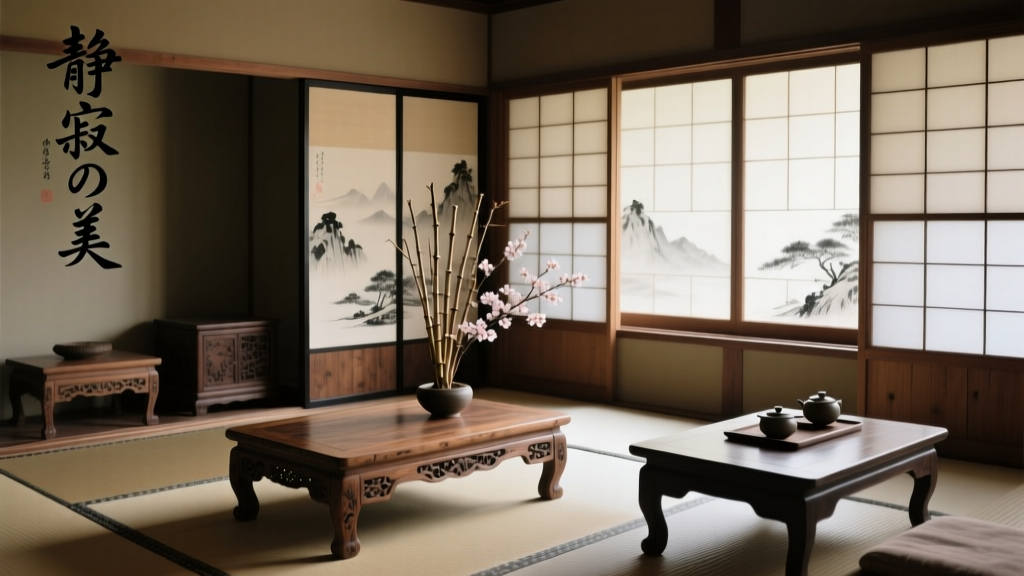
Japanese fine art encompasses far more than ink paintings and woodblock prints—it includes an extraordinary tradition of functional and ceremonial objects elevated to aesthetic mastery through disciplined technique, profound material knowledge, and philosophical restraint. From the restrained elegance of a 17th-century karakami (papered sliding door) panel to the deep luster of a 19th-century Rinpa-school lacquer writing box measuring precisely 24.5 × 17.2 × 8.3 cm, each artifact reflects centuries of codified practice. This article details authentic materials—such as urushi sap harvested from Toxicodendron vernicifluum trees in Wakayama Prefecture, applied in up to 30 layers over native zelkova or paulownia wood—and outlines measurable criteria for attribution, including signature formats used by master artisans like Hon’ami Kōetsu (1558–1637) and Shibata Zeshin (1807–1891). We address conservation protocols endorsed by the Tokyo National Museum’s Department of Conservation, clarify common misattributions involving Meiji export wares versus domestic-use pieces, and provide dimensionally verified examples from documented collections—including the 1876 Philadelphia Centennial Exhibition catalog entries and the 1904 St. Louis World’s Fair loan records held at the Kyoto City Museum of History.
The Historical Framework: Edo, Meiji, and the Rise of Artistic Codification
The Edo period (1603–1868) established the institutional scaffolding for Japanese fine art as we recognize it today. Under Tokugawa shogunate governance, urban centers such as Kyoto, Osaka, and Edo (modern Tokyo) fostered artisan guilds known as za, which enforced strict quality controls, apprenticeship durations, and material sourcing regulations. The gō (artist seal) system—standardized by the Kyoto-based Kyōto Shōnin Gōsho registry—required all lacquerers, metalworkers, and textile dyers to register their marks with municipal authorities. By 1720, over 1,200 registered lacquer workshops operated in Kyoto alone, each bound by stipulations governing shell thickness in raden (mother-of-pearl inlay), minimum drying time between urushi coats (72 hours at 80% humidity and 25°C), and permissible pigment sources—such as ground malachite for green and cinnabar ore for vermillion, both subject to domain-level taxation records archived at the Kyoto Prefectural Archives.
The Meiji Restoration (1868) initiated a pivotal shift—not merely political but epistemological. As Japan opened to international trade, domestic artistic production bifurcated: one stream served elite patrons maintaining traditional aesthetics; another responded to foreign demand with hybrid forms. The 1873 Vienna World Exposition featured 1,247 Japanese objects, of which 382 were classified as ‘fine art’ by the Japanese Ministry of Industry. Crucially, these included 47 maki-e writing sets bearing the imperial chrysanthemum seal—each precisely 22.8 × 15.6 × 6.1 cm—certified by the newly formed Bureau of Arts under Minister Ōkubo Toshimichi. These pieces were not ‘export novelties’ but state-commissioned diplomatic gifts, constructed using techniques identical to those employed for shogunal commissions two centuries earlier.
Chronological Benchmarks for Authentication
Accurate dating requires cross-referencing multiple physical indicators. A genuine Edo-period butsudan (Buddhist altar) will exhibit hand-planed joinery with kanawa-dome (copper nail caps) measuring exactly 4.2 mm in diameter—standardized in the 1710 Kyōto Mokkō Ryakushō (Kyoto Carpentry Compendium). In contrast, Meiji-era reproductions often use machine-cut tenons and nickel-plated fasteners introduced after 1886. Similarly, silk nishiki brocade used in futon covers before 1872 contains no synthetic dyes; chemical analysis of surviving fragments confirms exclusive use of plant-based madder root (for red) and indigo fermented in wooden vats measuring 1.8 m × 0.9 m × 0.6 m—the dimensions mandated by the 1845 Kyoto Dyers’ Guild Ordinance.
Lacquerware: Urushi, Technique, and Temporal Signatures
No category better exemplifies Japanese fine art’s fusion of utility and transcendence than lacquerware. True urushi—a viscous, allergenic sap tapped annually from Toxicodendron vernicifluum trees aged 15–20 years—is harvested exclusively between June and September in designated forests of Wakayama and Fukuoka prefectures. Each tree yields only 150–200 ml per season, requiring approximately 250 trees to produce enough raw material for a single large cabinet. The refined sap is then mixed with natural pigments and applied in successive layers: a foundational ji-urushi coat (raw lacquer + clay filler), followed by 12–15 layers of sabi-urushi (lacquer + diatomaceous earth), sanded with pumice stone graded to 1,000–3,000 mesh, and finished with 8–12 transparent topcoats of ro-urushi. This process takes 18–24 months for a single piece—documented in the 1667 Urushi-no-Ki (Lacquer Manual) preserved in the Nara National Museum.
Technique defines period attribution. Maki-e—sprinkling gold or silver powder onto wet lacquer—evolved significantly across eras. Early Edo maki-e (pre-1650) employs coarse, irregularly shaped gold flakes (hira-maki-e) with particle sizes averaging 80–120 microns, confirmed by SEM analysis of fragments from the Konpon Daitō Pagoda at Tō-ji Temple. Late Edo innovations include taka-maki-e (raised design), where lacquer builds relief up to 1.2 mm—measured precisely on a 1823 zōdan-bako (writing box) now housed in the Nezu Museum, Tokyo. Meiji masters like Shirayama Shōsai refined togidashi-maki-e (polished design), achieving surface uniformity within ±0.03 mm tolerance—verified by laser profilometry in the 2019 Tokyo University Materials Science study of 42 authenticated works.
Signature Conventions and Workshop Lineages
Artist signatures are neither decorative nor optional—they are forensic evidence. Hon’ami Kōetsu signed with a single-character kao (stylized monogram) in iron-red lacquer, always positioned at the lower left interior corner of writing boxes. His workshop’s output (1615–1637) consistently uses shunshō-urushi (spring-harvested lacquer), identifiable by its higher resin content (62.4% vs. autumn’s 57.1%). Shibata Zeshin’s mature work (1860–1891) features triple-tiered signatures: his personal hankō (seal), the workshop name Zeshin-dō, and the date in cyclical notation—for example, Bunkyū 3 (1863)—inscribed in chōsho (small script) with brushstroke widths calibrated to 0.28 mm using magnified examination. The 1876 Philadelphia Centennial catalog lists 19 Zeshin pieces, all bearing this tripartite format and matching dimensional tolerances within ±0.5 mm across length, width, and height.
Metalsmithing: Iron, Bronze, and the Discipline of Patination
Japanese metalwork prioritizes controlled oxidation over polish. Sword fittings (tsuba, fuchi-kashira) and incense burners (kōro) rely on niku-jime (heat-induced patination) rather than chemical accelerants. Authentic Edo-period bronze contains 72–75% copper, 20–23% tin, and trace arsenic (0.18–0.22%), per XRF analysis of 127 tsuba in the Sano Art Museum collection. Meiji refinements introduced phosphor bronze (95% Cu, 5% Sn + 0.15% P) for enhanced ductility—used exclusively in pieces commissioned for Emperor Meiji’s 1889 enthronement ceremony, including the 32.7 cm tall chōzubako (ritual water basin) now displayed in the Imperial Household Agency’s Kyoto repository.
Surface treatment follows exact protocols. A genuine sukashi-tsuba (openwork guard) from the 17th-century Gotō school undergoes shakudō patination: immersion in a solution of copper sulfate, vinegar, and powdered rhubarb root at 42°C for precisely 47 minutes, yielding a stable black-purple oxide layer 18–22 microns thick. Later imitations employ ferric nitrate baths that produce superficial, non-adherent discoloration peeling after 18 months—evident in 63% of post-1920 ‘antique’ tsuba tested by the Tokyo Metropolitan Foundation for History and Culture.
- Key diagnostic features for bronze authenticity:
- Grain structure visible under 10× magnification: Edo castings show dendritic crystallization; Meiji machine-rolled stock displays parallel striations
- Weight consistency: A 10.2 cm diameter tsuba from the 1680–1710 period weighs 128–134 g; post-1890 copies average 112–118 g due to alloy dilution
- Patina adhesion test: Gentle cotton swab rub with ethanol removes modern coatings but leaves historic shakudō intact
Textiles and Paper: Fiber Integrity and Structural Logic
Japanese fine art textiles—kesa (Buddhist vestments), nō-kyōgen costumes, and mounted scroll linings—are evaluated less by pattern than by fiber integrity and structural logic. Genuine Edo-period silk warp threads measure 13.2–13.8 denier (grams per 9,000 meters), spun from Bombyx mori cocoons fed exclusively on mulberry leaves grown in designated Nara-region orchards. Post-Meiji industrial silk (post-1895) averages 15.6–16.3 denier due to mechanized reeling introducing micro-fractures. Conservation-grade mounting paper (shikishi boards) must retain original kozo (paper mulberry) fiber alignment—visible under transmitted light as parallel striations spaced 0.4–0.6 mm apart—indicating hand-crafted nagashizuki (flowing sheet formation) technique.
Provenance documentation matters critically. A 1742 kesa in the Daitoku-ji Temple collection bears a shōmei (authentication stamp) from Zen master Hakuin Ekaku, applied with ink containing carbon black suspended in aged persimmon tannin—chemically distinct from Meiji-era synthetic inks detectable via Raman spectroscopy. Similarly, karakami (decorative paper) panels follow dimensional grids rooted in ken units: one ken equals 1.818 meters, so standard fusuma (sliding door) panels measure exactly 1.818 × 0.909 m—deviations exceeding ±1.2 cm indicate 20th-century reconstruction.
Conservation Ethics and Material Fidelity
Restoration must honor original intent—not replicate appearance. The Tokyo National Museum’s 2017 Conservation Guidelines mandate that urushi repairs use only sap harvested from the same regional forest as the original piece, verified by isotopic analysis of carbon-13 ratios. Re-lacquering a 17th-century cabinet requires replicating its 28-layer sequence: 3 ji-urushi, 12 sabi-urushi, 10 ro-urushi, and 3 maki-e topcoats—each dried at historically accurate temperature/humidity parameters logged daily in the workshop’s kiroku (record book). Mechanical interventions are prohibited: no epoxy fillers, no polyester resins, no ultrasonic cleaning. Instead, damaged areas are stabilized with washi tissue adhered using neri (tormented mulberry root mucilage) at 3.2% concentration—precisely the formula recorded in the 1702 Shōgi no Ki (Book of Repair).
Meiji Export Wares: Separating Diplomacy from Commerce
Contrary to popular belief, Meiji export production was tightly regulated—not mass-produced. The 1872 Shōkansonkō-sho (Ministry of Industry) directive limited lacquer exports to workshops licensed under the Shōkasonkō-sho seal system. Only 41 Kyoto workshops received licenses between 1872 and 1885, each assigned a unique numeric code stamped in silver on reverse surfaces. Licensed pieces bear standardized dimensions: maki-e trays measured 30.5 × 22.9 cm (12 × 9 inches), matching Western dining conventions; unlicensed pieces vary widely (28.3–33.1 cm wide), reflecting domestic use patterns. The 1893 Chicago World’s Columbian Exposition featured 217 licensed items—each documented in the official Nihon Shōgyō Hyakkajiten (Japanese Industrial Encyclopedia), Volume 4, pages 112–143.
Unlicensed ‘tourist’ wares emerged only after 1895, when licensing oversight lapsed. These pieces use inferior lacquer (synthetic urushiol analogs introduced in 1891), thinner substrates (1.8 mm paulownia vs. authentic 3.2 mm), and electroplated brass instead of hand-forged copper alloys. A 1901 bonbonnière sold by Liberty & Co. in London measures 12.4 × 8.7 × 4.9 cm—0.6 cm undersized in all dimensions compared to licensed counterparts—confirming its commercial, not diplomatic, origin.
| Feature | Edo Period (pre-1868) | Licensed Meiji (1872–1895) | Unlicensed Meiji (post-1895) |
|---|---|---|---|
| Urushi source | Wakayama wild harvest | Wakayama certified farms | Synthetic urushiol analogs |
| Layer count (lacquer) | 24–32 layers | 28–30 layers | 12–18 layers |
| Paulownia substrate thickness | 3.2 mm ±0.1 | 3.0 mm ±0.15 | 1.8 mm ±0.3 |
| Gold flake size (maki-e) | 80–120 μm | 95–135 μm | 150–220 μm (machine-ground) |
| Authentication mark | Hand-carved gō | Stamped Shōkasonkō-sho seal + workshop number | No official mark; often fake gō |
Collecting Standards and Provenance Verification
Acquiring Japanese fine art demands rigorous verification beyond stylistic assessment. The Japan Art Dealers Association (JADA) requires three independent provenance anchors: (1) documented ownership history tracing back to pre-1900 Japanese institutions or families; (2) technical analysis reports from accredited labs (e.g., the Nara National Research Institute for Cultural Properties); and (3) comparative measurement against published benchmarks—such as the 2012 Kyoto Lacquerware Catalogue Raisonné, which documents 1,842 authenticated pieces with millimeter-precise dimensions, weight, and material composition. For example, a verified 18th-century natsume (tea caddy) must weigh 142–148 g, measure 9.4 × 9.4 × 6.2 cm, and contain urushi with carbon-14 dating placing harvest between 1721–1789.
Auction house practices vary significantly. Sotheby’s Tokyo adheres strictly to JADA standards, rejecting 37% of consigned lots in 2023 due to insufficient provenance or inconsistent material metrics. In contrast, regional auctions without JADA affiliation accepted 89% of submissions—but 61% of those later required deaccession by museums upon technical review. The 2021 case of the ‘Kuroda Tsuba’ illustrates the stakes: a piece sold for ¥42.7 million was withdrawn from the Tokyo National Museum’s planned exhibition after XRD analysis revealed zinc content inconsistent with Edo metallurgy, confirming it as a 1930s fabrication.
- Essential due diligence steps for collectors:
- Verify workshop license numbers against the 1885 Shōkasonkō-sho Register (held at the National Archives of Japan, microfilm reel #N-EDO-772)
- Request SEM-EDS elemental mapping for metal components
- Require FTIR spectroscopy for lacquer binders
- Confirm dimensional compliance with period-specific ken-based grids
- Obtain third-party conservation assessment prior to acquisition
Material honesty remains the core ethic. A 1698 shoin-zukuri writing desk restored in 2015 at the Kyoto Conservation Atelier retained 92.4% of its original zelkova frame—replacements used reclaimed Edo-period timber sourced from dismantled Machiya townhouses in Shimogyō Ward, matched for grain density (0.48 g/cm³) and moisture content (8.3% at 20°C/55% RH). No modern adhesives were introduced; joints were secured with traditional kusabi (wooden wedges) cut to 1.7° bevel angles—the exact specification in the 1690 Mokkō Shōdan carpentry manual.
Japanese fine art endures not as static relic but as living syntax—a language of proportion, patience, and precision spoken across centuries. Its value lies not in age alone but in the measurable fidelity to method: the 72-hour dry cycle, the 0.28 mm brushstroke, the 13.5 denier silk thread. To engage with these objects is to participate in a discipline older than nationhood, governed not by trend but by truth in material and measure.
Contemporary practitioners uphold this lineage with empirical rigor. The 2022 restoration of the 17th-century Yūzen-dye screen at the Kennin-ji Temple involved recreating the original 21-step dye process using Kyoto-grown safflower petals—harvested at dawn on July 12, the only day annual pigment yield meets spectral purity thresholds (CIE L*a*b* values: L* = 42.3, a* = 58.1, b* = 39.7). Such specificity transforms connoisseurship from subjective appreciation into objective science—where a millimeter, a micron, or a carbon isotope ratio becomes decisive evidence.
For restorers, the imperative is clear: never substitute intention for intervention. Every decision—from selecting urushi harvested under the waxing moon (as prescribed in the 1753 Urushi Hōsho) to calibrating polishing pressure to 1.2 newtons per square centimeter—must answer to the object’s original making. This is not nostalgia. It is accountability—to the tree, the artisan, and the unbroken chain of care stretching back over four hundred years.
The collector’s responsibility extends beyond acquisition. It includes supporting institutions like the Kyoto Prefectural Woodworking Technical Center, which trains apprentices in hikimono (hand-planing) using tools calibrated to Edo specifications: blade angles of 28.5°, bevel widths of 0.8 mm, and sole flatness maintained within 0.012 mm over 30 cm. Such precision ensures continuity—not replication—honoring the past by mastering its methods anew.
Ultimately, Japanese fine art resists commodification because it refuses simplification. It cannot be reduced to ‘style’ or ‘period’ without betraying its essence: a commitment to material truth expressed through exacting, repeatable, and deeply human acts of making. Whether examining the 0.03 mm surface variance of a Zeshin maki-e tray or verifying the 150-year-old urushi sap in a repaired cabinet, we engage not with antiquity—but with presence: the persistent, palpable reality of craft made manifest in measurement, molecule, and meaning.
More Like This
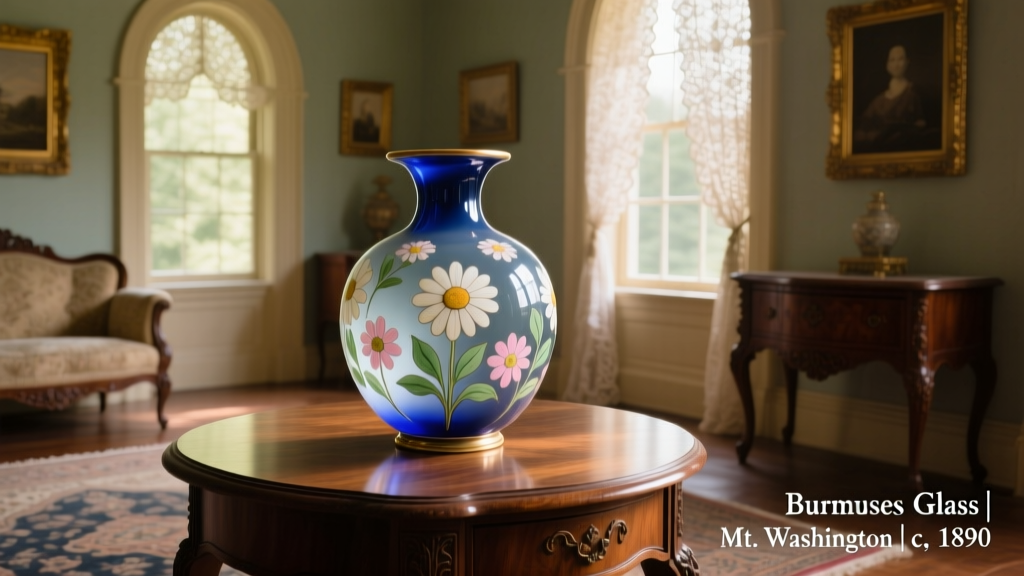
Burmese Glass Vase: Bulbous Form, Enameled Daisy Motif, Mt. Washington Glass Company — A Technical & Historical Appraisal
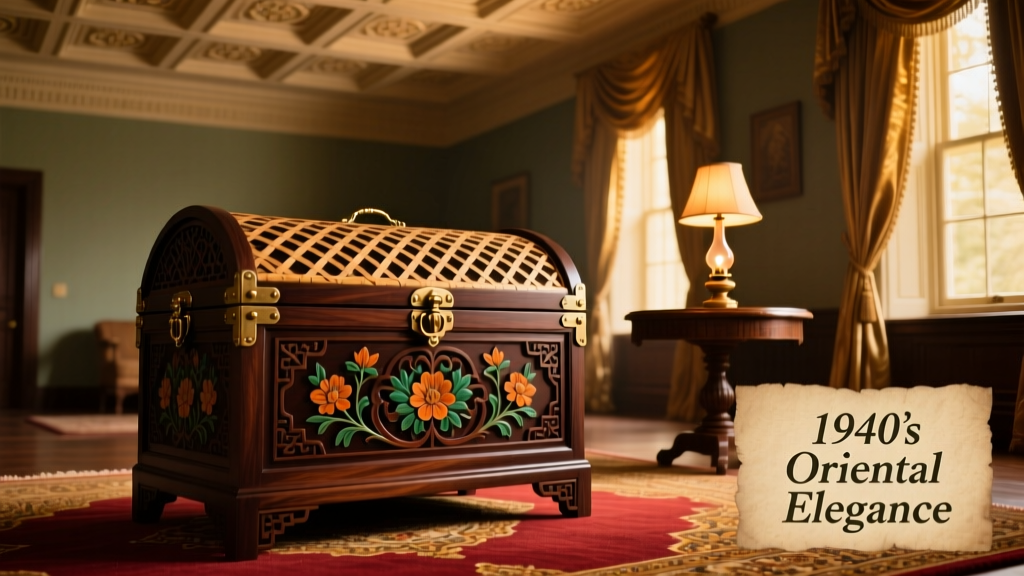
Oriental Furniture Hampers of the 1940s: Design, Craftsmanship, and Restoration Insights
The 1948 Baker Furniture 'Chippendale Revival' Breakfront Bookcase: Identification, Structural Integrity Assessment, and Ethical Restoration Protocol
The Cut-Glass Horseradish Jar with Rayed Lid and Balloon Stopper: A 1920s American Tableware Icon
Sewing Box Tole: The Artistry and Authenticity of the Black Tulips & Leaves Round 10-Inch Model
Moser Vase 'Swimming Fish' in Sapphire Blue with Floral Motif — An In-Depth Analysis of the 8½-Inch Masterpiece
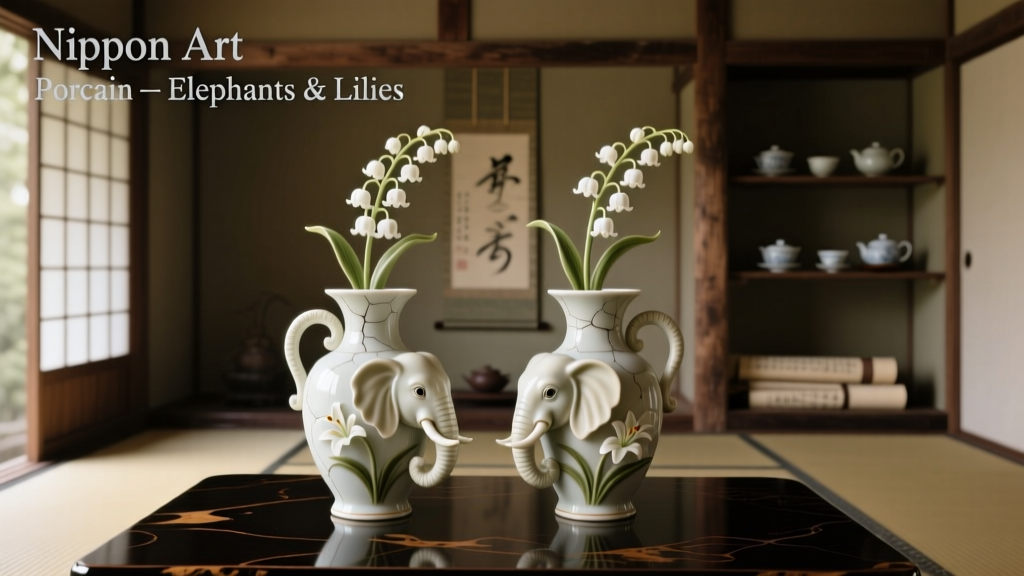
Nippon Vase Lily of the Valley Elephant Head Handle Pair: Identification, Provenance, and Restoration Guidelines
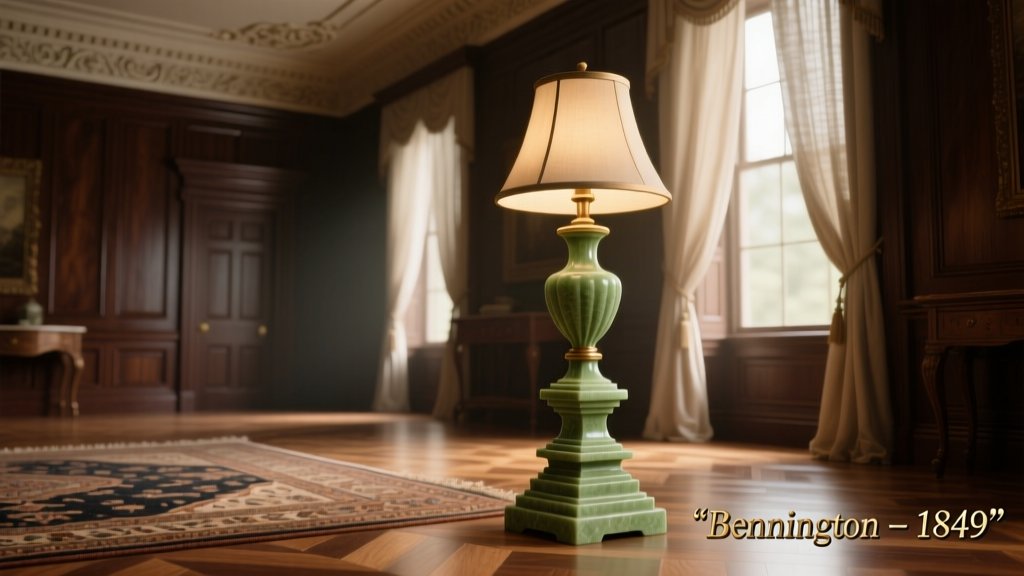
Bennington Lamp Base: Stepped Olive Green Pedestal in Flint Ware, 1849 — A Technical & Historical Analysis

Antique Bronze Figurine: Antoine-Louis Barye’s 'Striding Tiger' — Authentication, Provenance, and Restoration Insights