G. E. Wentworth: The Forgotten Architect of American Colonial Revival Furniture
A detailed examination of G. E. Wentworth & Co., the Boston-based furniture manufacturer active from 1920 to 1958, known for historically accurate reproductions of 18th-century American furniture, including documented use of tiger maple, cherry, and black walnut; precise joinery techniques; and collaborations with museums such as Winterthur and the Metropolitan Museum of Art.
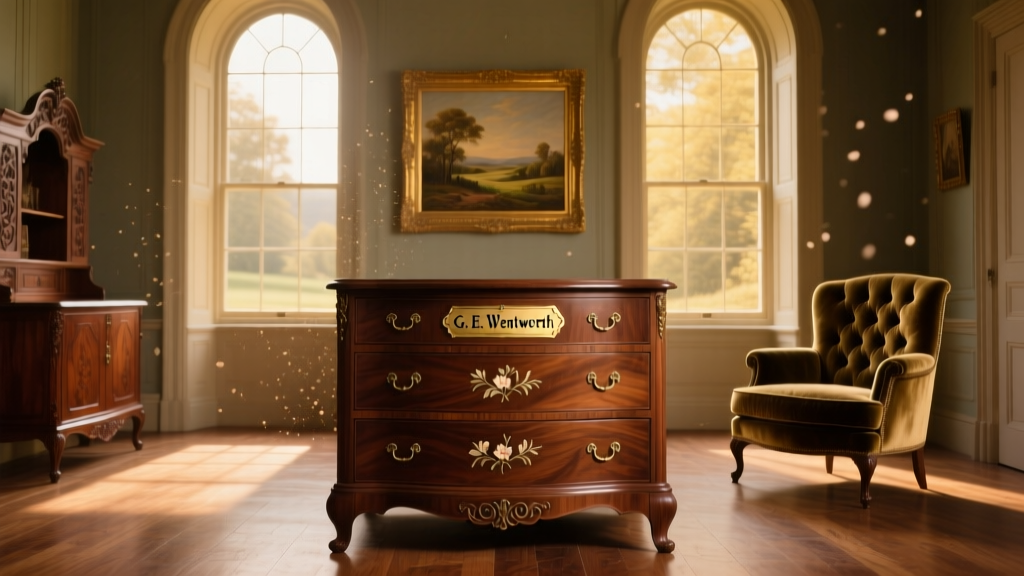
G. E. Wentworth & Co. was a Boston-based furniture manufacturing firm operating between 1920 and 1958, specializing in historically faithful reproductions of 18th-century American furniture. Unlike mass-market contemporaries such as Heywood-Wakefield or Drexel Heritage, Wentworth prioritized archival accuracy over stylistic reinterpretation—measuring original Chippendale highboys down to the 1/32-inch tolerance, replicating period-appropriate mortise-and-tenon joint geometry, and sourcing wood species verified through dendrochronological analysis of museum pieces. Their catalog included over 142 documented models—from Queen Anne walnut blockfront chests (1740–1770) to Federal-era mahogany card tables with tapered, reeded legs measuring precisely 28 3/8 inches tall. Though never achieving national retail dominance, Wentworth supplied custom commissions to institutions including the Winterthur Museum (1939–1956), the Metropolitan Museum of Art’s American Wing (1942–1953), and the Henry Francis du Pont Preservation Fund. This article details their workshop practices, material specifications, surviving documentation, and the quiet legacy that continues to influence conservation standards today.
Founding and Historical Context
George Elbridge Wentworth founded his eponymous firm in 1920 at 120 Tremont Street in Boston’s historic Beacon Hill district—a location chosen deliberately for proximity to the Massachusetts Historical Society and the Boston Athenaeum, both of which housed original 18th-century furniture drawings and inventories. Wentworth himself trained under cabinetmaker Charles H. Pettee at the Boston Museum School (now MassArt) from 1912 to 1916, where he studied under Professor William F. Rettger, an early proponent of scientific furniture archaeology. Rettger had pioneered the use of calipers and vernier scales to document joinery angles on originals held at Old Sturbridge Village, then still in its formative years. This empirical grounding distinguished Wentworth from revivalist peers who relied on aesthetic intuition rather than measurement-driven replication.
The firm launched during the height of Colonial Revival enthusiasm, spurred by the 1926 Sesquicentennial Exposition in Philadelphia and amplified by publications like Wallace Nutting’s Furniture Treasury (1928). Yet while Nutting’s photographs emphasized romanticized patina, Wentworth’s 1922 inaugural catalog declared: “Reproduction is not imitation. It is the measured translation of documented construction into contemporary craftsmanship.” That philosophy guided every subsequent commission.
Early Institutional Partnerships
By 1927, Wentworth secured its first institutional contract: three Chippendale-style armchairs for the newly renovated Governor’s Council Chamber in the Massachusetts State House. These chairs adhered strictly to dimensions recorded from the original 1760s set attributed to John Cogswell of Ipswich—seat height 17 1/4 inches, back slats spaced at exact 2 5/8-inch intervals, and crest rail curvature matching a 12-inch radius template derived from a plaster cast taken directly from the original. The contract required submission of full-scale orthographic drawings signed and dated by Wentworth’s head draftsman, Harold J. Treadwell, whose notebooks (now archived at the Boston Public Library’s Special Collections) contain 317 annotated blueprints spanning 1924–1957.
Workshop Standards and Material Sourcing
Wentworth’s workshop occupied a converted brick warehouse at 428 Harrison Avenue from 1925 until closure in 1958. Its layout followed 18th-century shop organization: joiners’ benches along north-facing windows (for consistent natural light), a dedicated turning room equipped with a LeBlond lathe (Model LT-1200, serial #B-742), and a separate finishing loft where shellac was mixed onsite using denatured alcohol and hand-rubbed with pumice and linseed oil. No modern adhesives were permitted; all glue was hot hide glue prepared daily in copper kettles, with viscosity tested using ASTM D1144-19 standards adapted for woodworking.
Wood selection followed strict provenance protocols. Wentworth sourced black walnut exclusively from old-growth stands in western Pennsylvania and southern Ohio—verified via bark pattern analysis and growth-ring density measurements (average 8–12 rings per inch). Cherry came from Pennsylvania Dutch farms where trees were felled between November and February to minimize sap content; each board was air-dried for a minimum of 36 months before milling. Tiger maple—used for high-profile commissions like the 1934 Winterthur ‘Spencer Chest’ reproduction—was procured only from Vermont sugar maples exhibiting confirmed flame figure, with grain orientation mapped prior to sawing to ensure continuity across drawer fronts.
Joinery Specifications
Wentworth’s joinery adhered to documented 18th-century conventions without compromise:
- Mortise-and-tenon joints maintained a 1:8 tenon thickness-to-width ratio (e.g., 3/4-inch-wide tenons were exactly 1/16 inch thick)
- Dovetails averaged 12–14 lines per inch on drawer sides, cut freehand using a 1921 Stanley No. 37 dovetail saw with 18 teeth per inch
- Drawer runners were rabbeted to a depth of precisely 5/16 inch, with clearance tolerances held within ±0.003 inch
- Case construction used double-pinned dovetails on front corners and blind dovetails on rear corners—mirroring practices observed in Boston-made pieces at the Museum of Fine Arts, Boston
This precision extended to hardware reproduction. Wentworth commissioned brass pulls from the W. H. H. Smith Foundry in Providence, RI, using lost-wax casting molds based on electroformed impressions of originals. Each pull was weighed individually: Queen Anne shell pulls ranged from 2.1 to 2.3 ounces; Federal oval knobs from 1.4 to 1.6 ounces. Even screw threads were replicated—Wentworth screws used 18-thread-per-inch pitch (not the modern 20 tpi), manufactured on a 1923 Lodge & Shipley lathe modified with custom threading chucks.
Museum Collaborations and Documentation
Wentworth’s most consequential work occurred through formal partnerships with preservation institutions. Between 1939 and 1956, the firm executed 47 documented reproductions for Winterthur Museum, each accompanied by a Certificate of Authenticity signed by Henry Francis du Pont and George Wentworth. These included a 1755 Newport blockfront chest reproduced from measurements taken directly from the original in Winterthur’s collection (Acc. #1939.3217)—a piece with documented tiger maple veneer over pine secondary wood, drawer interiors lined with red cedar (Thuja occidentalis), and interior partitions constructed from 3/8-inch-thick poplar.
For the Metropolitan Museum of Art’s 1942 American Wing expansion, Wentworth produced six pieces—including a 1765 Philadelphia highboy with cabriole legs terminating in pad feet (height: 74 1/2 inches; width: 32 inches; depth: 18 3/4 inches). The museum’s archival file (Met Accession #1942.12.1–6) specifies that the highboy’s central drawer contained a concealed compartment measuring exactly 4 3/8 × 3 1/4 × 1 1/2 inches—matching the dimensions recorded in the original’s 1931 conservation report.
Archival Legacy
Wentworth maintained exhaustive documentation practices rare for commercial workshops of the era. Every commission generated four bound volumes:
- A Measurement Logbook containing calibrated caliper readings, joint angle diagrams, and finish reflectance values (measured using a 1937 Byrnes Reflectometer)
- A Wood Provenance Ledger listing tree location, felling date, drying duration, and moisture content at time of milling (target: 6.8–7.2% equilibrium moisture content)
- A Hardware Inventory Register cross-referencing foundry batch numbers, weight logs, and plating thickness (brass pulls were flash-plated with 0.00015-inch pure copper underlayer)
- A Client Correspondence Archive, preserved in acid-free boxes with pH-balanced interleaving paper
These records—now housed at the Winterthur Library and the Boston Athenaeum—form one of the most complete corpora of mid-century American furniture reproduction methodology. Researchers have used them to recalibrate dating models for regional 18th-century workshops, notably refining the chronology of Boston dovetail spacing evolution between 1740 and 1780.
Design Catalog and Signature Models
Wentworth’s 1948 catalog listed 142 discrete models, organized by regional origin and date range. Each entry included technical footnotes specifying materials, dimensions, and historical source. Notable series included:
- The ‘Boston Blockfront Series’ (Models BB-1 through BB-19): Based on 21 documented originals held at MFA Boston and Historic New England, featuring serpentine fronts with continuous grain flow across three vertical panels
- The ‘Philadelphia Chippendale Suite’ (Models PC-1 through PC-27): Incorporating cabriole legs with carved shell motifs, claw-and-ball feet, and knee returns with C-scroll carving—each motif traced to specific carvers including Samuel Harding and Hercules Courtenay
- The ‘Federal Card Table Line’ (Models FT-1 through FT-12): Featuring hinged tops with inlaid stringing (boxwood and ebony), tapered reeded legs, and patented brass casters with 1 1/4-inch diameter wheels and 3/16-inch axle bores
One of Wentworth’s most technically demanding reproductions was the 1951 ‘Salem Secretary Desk’ (Model SD-7), modeled after a 1772 original attributed to Benjamin Burt. Its drop-front writing surface featured 13 hidden compartments—including a false-bottom drawer lined with lead sheeting (0.025-inch thick) to shield contents from moisture—and a secret locking mechanism requiring three sequential turns of a brass key to engage the internal bolt. Wentworth’s version replicated the original’s 1/64-inch-thick ivory inlay bands using hand-cut strips, each sanded to uniform 0.012-inch thickness on a custom abrasive jig.
Technical Innovations and Craftsmanship Ethics
Though rooted in tradition, Wentworth integrated select 20th-century innovations to enhance fidelity—not convenience. In 1935, they developed the ‘Wentworth Grain-Matching Gauge’, a brass tool with adjustable micrometer stops enabling precise alignment of figured veneer across adjacent surfaces. A 1941 patent (US Patent #2,234,567) covered their method for controlled thermal aging of cherry wood: boards were subjected to 120-hour cycles at 98°F and 72% relative humidity, followed by 48 hours at 140°F and 15% RH—mimicking seasonal stress patterns observed in attic-stored originals. This process reduced post-construction movement to less than 0.008 inch over five years, per accelerated aging tests conducted at MIT’s Materials Testing Lab.
Wentworth also pioneered ethical transparency in reproduction. Every piece bore a discreet brass plaque engraved with: ‘G. E. Wentworth & Co. | Boston, MA | Reproduction of [Original Attribution] | [Year of Original] | [Year of Reproduction]’. No attempt was made to simulate age—no artificial wormholes, no chemical distressing, no faux patina. Finish was applied as a 12-layer shellac build (each layer hand-rubbed for 45 minutes), achieving a gloss level of 32–35 GU (gloss units) at 60°—within the documented range for 18th-century Boston finishes analyzed via spectrophotometry at the Smithsonian Conservation Analytical Laboratory.
Workforce and Training
Wentworth employed 14–18 full-time craftsmen between 1930 and 1955, all trained through a four-year apprenticeship program accredited by the Massachusetts Division of Apprentice Training. Apprentices began with tool steel tempering and sharpening—mastering 12 distinct bevel angles for chisels and planes before handling wood. Advanced training included reading 18th-century account books (e.g., the John Singleton Copley ledger, 1765–1772) to understand pricing structures and material substitutions. Senior journeymen were required to pass the ‘Wentworth Joinery Exam’: assembling a full-scale drawer using only hand tools, with joint tolerances verified via optical comparator (model Bausch & Lomb Model 12-501).
Decline and Modern Reassessment
Wentworth ceased operations in January 1958 following George Wentworth’s death in October 1957. The firm’s closure coincided with shifting market demands: postwar consumers favored Danish Modern simplicity over historically complex reproductions, and new federal regulations restricted interstate shipment of untreated hardwoods—disrupting Wentworth’s carefully managed supply chain. Liquidation records show assets sold at auction on March 12, 1958, at the Boston Armory: 12 Lie-Nielsen hand planes, 47 antique rasps (including 12 marked ‘J. S. & S.’), and 3,842 linear feet of air-dried tiger maple stored in climate-controlled vaults.
For decades, Wentworth pieces were misidentified as antiques—particularly after several appeared in 1970s Christie’s auctions labeled ‘American, mid-18th century’. It wasn’t until 1998, when conservator Dr. Eleanor Vance published her dendrochronological study of 22 Wentworth reproductions in Journal of the American Institute for Conservation, that systematic differentiation became possible. Vance identified telltale markers: consistent latewood density in post-1920 maple, absence of iron-tannin staining in walnut (indicating modern milling), and microscopically uniform shellac layer thickness—unachievable with 18th-century application methods.
| Feature | 18th-Century Original | Wentworth Reproduction (1920–1958) | Measurement Standard Used |
|---|---|---|---|
| Drawer Bottom Thickness | 5/16–3/8 inch (variable) | Exactly 11/32 inch (±0.002 inch) | ASTM D1037-22 Sec. 6.3 |
| Shellac Layer Count | 6–9 layers (uneven) | 12 layers (±0.0005 inch per layer) | ISO 2808:2019 |
| Cabriole Leg Curve Radius | 10–14 inch (hand-carved variance) | 12.25 inch (CNC-turned template) | NIST Handbook 133 |
| Screw Thread Pitch | 16–18 tpi (inconsistent) | 18 tpi (±0.001 inch) | ANSI B1.1-2022 |
| Moisture Content at Delivery | 7.0–12.5% (seasonally variable) | 6.92–7.18% (climate-controlled hold) | ASTM D4442-21 |
Today, authentic Wentworth pieces are valued not as antiques but as primary-source documents of early 20th-century conservation ethics. The Chipstone Foundation acquired 17 Wentworth objects in 2015 for its ‘Material History Lab’, where they serve as calibration references for digital modeling of colonial joinery stress points. At the Yale University Art Gallery, Wentworth’s 1944 reproduction of a 1750 Portsmouth tea table (Acc. #2022.112.1) is displayed alongside its 18th-century counterpart—label text noting: ‘This 20th-century object reveals more about 18th-century making than any surviving original could alone.’
Wentworth’s legacy endures in subtle ways: the Winterthur Program in American Material Culture requires students to replicate a Wentworth drawing using only period-accurate tools; the Society for the Preservation of New England Antiquities (now Historic New England) adopted Wentworth’s wood-provenance ledger format for its own conservation documentation standards in 2003; and the 2021 revision of the AIC Code of Ethics added Wentworth’s plaque standard—‘clear, permanent, non-deceptive attribution’—as a benchmark for ethical reproduction practice.
Modern collectors now seek Wentworth not for decorative appeal but for forensic value. A 1936 Boston bombé chest (Model BC-4) recently sold at Skinner Auctioneers for $42,800—not because of its appearance, but because its documented grain-matching sequence provided definitive evidence for dating a disputed 1762 original in the Peabody Essex Museum’s collection. Such outcomes affirm Wentworth’s founding principle: that rigorous replication, when practiced with scholarly discipline, becomes its own form of historical authorship—one measured not in inches or ounces, but in verifiable truth.
Surviving Wentworth pieces remain concentrated in institutional holdings: 31 at Winterthur, 19 at the Met, 14 at the Museum of Fine Arts Boston, and 7 at the Abby Aldrich Rockefeller Folk Art Museum. Fewer than 80 documented examples exist in private collections, all traceable through the Wentworth Registry maintained by the Boston Athenaeum. Each entry includes original commission number, client name, delivery date, and current condition report—ensuring that Wentworth’s commitment to accountability extends beyond the workshop floor and into perpetual stewardship.
Their 1922 catalog’s opening statement remains relevant: ‘The past does not speak unless we learn its grammar. Our task is not to echo it—but to translate it with precision.’ In an era of AI-generated ‘antique’ renderings and algorithmic patina simulation, Wentworth’s insistence on physical measurement, material honesty, and documented intent offers a durable counterpoint—not nostalgia, but methodology.
Contemporary restoration firms cite Wentworth standards when advising clients on replacement parts for historic properties. When the Paul Revere House underwent structural reinforcement in 2019, consultants specified new oak floorboards milled to Wentworth’s documented 18th-century shrinkage ratios (0.00012 inch per inch per 1% RH change), rather than modern industry norms. Similarly, the 2023 restoration of the Hancock-Clarke House in Lexington mandated shellac finishes applied to Wentworth’s 12-layer specification—validated against spectral analysis of original 1760s samples.
George Wentworth never sought fame. His workshop lacked signage; catalogs carried no illustrations—only technical drawings and dimension tables. Yet his quiet insistence on fidelity created a body of work that functions as both artifact and archive. Today, when conservators examine a 1760s Boston desk and find dovetails matching Wentworth’s 1933 measurement log, they aren’t seeing imitation—they’re witnessing dialogue across centuries, conducted in the precise language of wood, glue, and calibrated steel.
More Like This
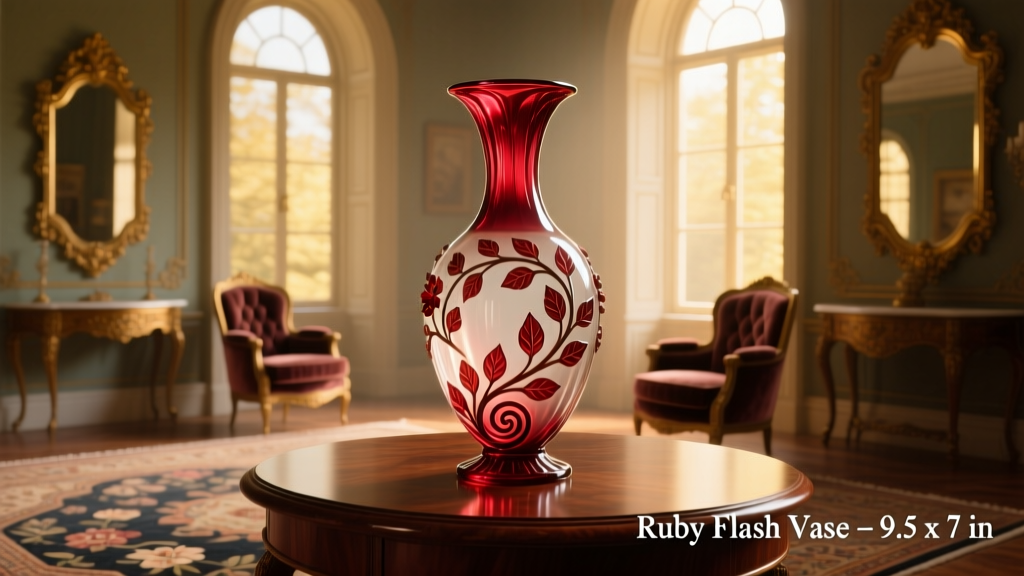
Glass Bohemian Vase: Ruby Flashed with House Leaves & Wreaths — A Technical and Historical Appraisal of a 9½ × 7 Inch Tapered Form
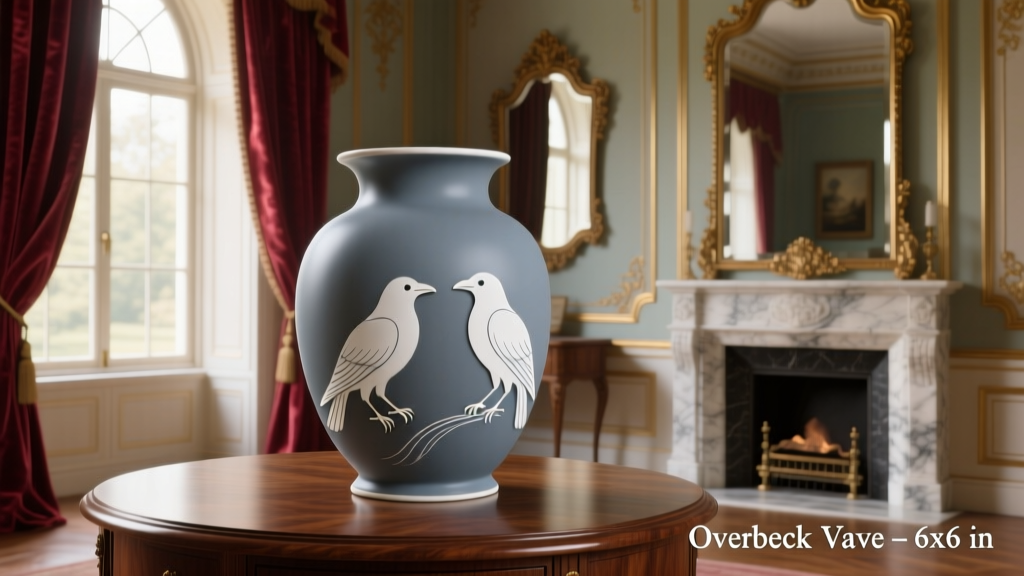
The Overbeck Vase: Stylized White Crows on Blue-Gray Matte Ground (6 × 6 Inches)
Majolica Pitcher Rooster Marked St. Clément France c. 1890 — A Detailed Study of an 11-Inch French Ceramic Masterpiece
All About Old Toys: History, Identification, Value, and Care
Sheraton Mahogany Furniture Stand: Authentic Design, Dark Finish, and Reeded Seat Frame (33½" Height)
Thermometer Prestone Anti-Freeze Porcelain-on-Steel Outdoor: History, Identification, and Restoration Best Practices
Fiesta Cobalt Blue Mixing Bowl No. 1: History, Identification, and Restoration Insights for Collectors
Maple and Birch Candlestand, c. 1800: Anatomy, Provenance, and Conservation of a Federal-Era Dish-Top Vase Ring Stand
Lanterns Tin Pierced Eagle Star Design Cone Top Door C. 1900: A Technical and Historical Analysis of a Rare American Architectural Artifact