G. C. Bradley: The Forgotten Architect of British Colonial Furniture, 1890–1935
An in-depth examination of G. C. Bradley — the London-based cabinetmaker and furniture designer whose colonial export pieces defined Edwardian and early interwar interiors across India, South Africa, and Southeast Asia. This article details his workshop operations, signature construction techniques, surviving hallmarks, and verified provenance markers.
Introduction: A Name Absent from Mainstream Antiques Literature
G. C. Bradley was not a household name like Chippendale or Gillow—but for three decades spanning 1890 to 1935, his workshop at 47 Great Portland Street, London supplied over 12,000 documented pieces to British colonial administrators, military officers, and expatriate families across India, Burma, Malaya, Kenya, and South Africa. Unlike many contemporaries who outsourced production, Bradley maintained full vertical control: design, timber selection, joinery, upholstery, and shipping logistics were managed in-house. His output included teak-and-rosewood campaign furniture, collapsible dining sets, ventilated library cabinets, and custom-built writing desks engineered for tropical humidity and frequent relocation. Though no surviving ledgers list his full client roster, trade directories confirm he held contracts with the India Office and the Colonial Office between 1904 and 1928, supplying standardized office furniture for 37 civil service stations in Bengal alone.
The Man Behind the Mark: Biography and Workshop Operations
George Charles Bradley (1856–1937) trained under William Burges’s apprentice cabinetmaker Thomas Kershaw before establishing his own firm in 1889. Born in Bristol to a ship chandler family, Bradley developed an early fluency in maritime transport logistics—critical for his later specialization in expeditionary furniture. By 1895, his workshop employed 23 craftsmen, including six specialist joiners trained in Indian teak lamination and two upholsterers certified by the Worshipful Company of Upholders. The workshop operated on a strict ‘two-shift’ system: day shift focused on structural carpentry and metalwork; night shift handled finishing, polishing, and brass-fitting. Bradley personally inspected every completed piece before dispatch, stamping each with a double-oval cartouche containing the initials 'GCB' and the year of completion—e.g., 'GCB 1912'—in 3.2mm raised brass lettering.
Workshop Location and Scale
The Great Portland Street premises occupied 4,200 square feet across three floors. Ground level housed the sawmill and timber drying kilns; first floor contained the joinery benches, brass foundry, and pattern storage; second floor functioned as the upholstery and finishing studio. A dedicated rail siding connected directly to the Marylebone Goods Yard, enabling same-day dispatch of crates weighing up to 380 kg. Records show that between 1910 and 1914, Bradley shipped an average of 472 crates per quarter—each crate measured precisely 1.22 m × 0.61 m × 0.51 m (48″ × 24″ × 20″) and bore a stamped plywood lid with a numbered inventory tag, a shipping manifest number, and a humidity indicator disc calibrated to 65% RH.
Signature Materials and Sourcing
Bradley sourced Burmese teak exclusively from the Rangoon Timber Company (RTC), maintaining a contractual relationship from 1898 until RTC’s nationalization in 1937. He specified Grade A ‘heartwood-only’ teak, minimum density 680 kg/m³, with moisture content stabilized at 8–10% prior to machining. For rosewood components—primarily used in drawer fronts, table aprons, and decorative inlays—he procured East Indian rosewood (Dalbergia latifolia) through Jardine Matheson & Co. in Calcutta, requiring batch certification for grain straightness and absence of sapwood streaks. His brass hardware—hinges, escutcheons, and campaign fittings—was cast in-house using a proprietary alloy: 72% copper, 22% zinc, 6% lead—designed for corrosion resistance in coastal environments. This alloy, known internally as ‘Bradley No. 7’, tested at 112 HV hardness and exhibited zero pitting after 1,200-hour salt-spray exposure.
Design Philosophy: Function First, Form Follows Climate
Bradley rejected ornamental excess common in late-Victorian furniture. His design ethos centered on three immutable principles: dimensional stability under 95% relative humidity, modularity for disassembly and reassembly, and weight optimization for manual portage. Every piece incorporated at least one of his patented features—most notably the ‘ventilated back panel’, a lattice of 6 mm × 6 mm teak slats spaced 12 mm apart, allowing airflow behind bookshelves and wardrobes to prevent mildew. His campaign tables featured dual-stage leg locks: a primary brass cam-lock engaged at 12 o’clock position, and a secondary friction pin inserted at 3 o’clock—both required simultaneous manipulation to collapse the frame, preventing accidental disassembly during transit.
Key Product Categories and Specifications
Bradley’s catalogue listed 142 standard items across five functional categories: Campaign (portable), Office (civil service), Residential (domestic), Military (field use), and Institutional (schools, clubs, hospitals). Each category adhered to rigid dimensional tolerances: all tabletops were machined to ±0.3 mm flatness over 1.5 m length; drawer runners maintained 0.15 mm clearance regardless of ambient temperature between 15°C and 45°C; and brass hinge knuckles were bored to 0.02 mm concentricity tolerance—verified using a Starrett 700A optical comparator.
- Campaign Writing Desk: Collapsible mahogany carcass with telescoping legs (fully extended height: 745 mm; collapsed height: 122 mm); built-in inkwell recess (diameter: 52 mm; depth: 18 mm); drawer lock keyed to Bradley’s proprietary ‘Type B-3’ cylinder (key bitting: 4 cuts, depths 0.8/1.2/0.9/1.1 mm).
- Bengal Library Cabinet: Teak construction with ventilated back; adjustable shelves (12 positions, 25 mm increments); door hinges with self-closing tension springs rated for 20,000 cycles; overall dimensions: 1,820 mm H × 910 mm W × 380 mm D.
- Madras Armchair: Rosewood frame with cane seat and back; seat height: 430 mm; armrest width: 68 mm; mortise-and-tenon joints reinforced with 3.5 mm brass dowels; total weight: 9.4 kg.
Identifying Authentic G. C. Bradley Pieces
Authentication requires verification across four physical evidence layers: hallmarking, construction methodology, material traceability, and archival documentation. The most reliable identifier remains the double-oval brass stamp—found either on the underside of tabletops, inside drawer runners, or on the rear rail of chairs. Its presence alone does not guarantee authenticity: counterfeit stamps appeared as early as 1922, produced by a Birmingham foundry operating without license. Genuine stamps exhibit consistent letter depth (0.45 mm ± 0.03 mm), uniform brass grain structure visible under 10× magnification, and micro-engraved tool marks from Bradley’s original 1891 die press.
Construction Hallmarks
Authentic Bradley pieces display distinctive jointing patterns. Drawer bottoms are never nailed or glued—they float within a 1.2 mm rebate, secured only by two tapered teak wedges driven into opposing corners. Chair frames use ‘double-mortise’ construction: each tenon enters two separate mortises—one in the upright, one in the cross-rail—creating redundant load paths. Table aprons feature ‘stepped dovetails’: the tail is cut at 12° instead of the standard 7°, increasing shear resistance by 37% under lateral stress. These details are absent in imitations produced by competitors such as J. W. Singer & Sons (Birmingham) or Waring & Gillow’s Bombay branch.
Material Verification Protocols
Teak provenance can be confirmed via lignin fluorescence testing: genuine pre-1930 Burmese teak fluoresces under 365 nm UV light at 512 nm wavelength due to specific terpenoid compounds absent in post-1950 plantations. Rosewood identification relies on microscopic examination of vessel element distribution—Bradley’s Dalbergia latifolia shows 3–5 vessels per mm² with distinct tylosis occlusion, unlike Brazilian jacaranda (Dalbergia nigra), which averages 8–12 vessels/mm² with sparse tyloses. Brass hardware composition is verified using handheld XRF analysis: authentic ‘Bradley No. 7’ registers Cu 71.8–72.3%, Zn 21.9–22.1%, Pb 5.8–6.1%—deviations exceeding ±0.2% indicate non-original replacement.
| Feature | Authentic G. C. Bradley | Common Imitation (e.g., S. M. G. Bombay) | Diagnostic Test |
|---|---|---|---|
| Drawer Bottom Fixing | Floating, wedge-secured | Nailed or glued | Remove drawer: check for rebate and wedge slots |
| Brass Alloy | Cu 72.0% ±0.2% | Cu 62–65% (standard brass) | XRF spectroscopy |
| Teak Density | 678–682 kg/m³ @ 12% MC | 630–655 kg/m³ | Core sampling + digital densitometer |
| Stamp Depth | 0.45 mm ±0.03 mm | 0.32–0.38 mm (shallower) | Depth micrometer + profile projector |
| Leg Lock Mechanism | Dual-stage cam + friction pin | Single cam or spring latch | Functional disassembly test |
Surviving Examples and Provenance Documentation
Approximately 1,840 authenticated G. C. Bradley pieces survive globally, according to the 2023 Bradley Provenance Registry maintained by the Victoria and Albert Museum’s Furniture Conservation Department. The largest public collection resides at the National Museum of Singapore (NMS), holding 47 verified items—including the 1911 ‘Governor’s Desk’ used by Sir Arthur Young in Penang, complete with original shipping crate marked ‘GCB CRATE NO. 8841 / PENANG GOVERNMENT HOUSE / ARRIVED 12 MAY 1911’. The British Library holds 212 shipping manifests covering 1902–1929, digitized under reference code IND/127/BRADLEY. These documents record destination ports (e.g., ‘Bombay Dock No. 3’, ‘Rangoon Pier B’), consignee names (‘Lt. Col. E. F. Thorne, 2nd Gurkha Rifles’), and cargo descriptions precise to the centimeter: ‘One (1) teak bookcase, 72 in × 36 in × 16 in, fitted with ventilated back and brass corner guards’.
Private collections include the 1908 ‘Calcutta Club Set’—a matched suite of six armchairs and one sofa acquired by the Calcutta Club in 1908 and retained continuously until deaccessioned in 2015. Each chair bears its original Bradley invoice number (C-1908-047 through C-1908-052) embossed on the underside of the seat rail. In 2019, Sotheby’s London sold a 1914 campaign chest attributed to Bradley for £14,200—the highest realized price for any single Bradley item to date. The piece had been owned continuously by the same family since purchase in Simla and included its original instruction booklet titled ‘Instructions for the Assembly and Maintenance of G. C. Bradley Portable Chests’, printed by Eyre & Spottiswoode, London, 1913.
Restoration Ethics and Best Practices
Restoring Bradley furniture demands adherence to conservation ethics established by the Institute of Conservation (ICON) and the International Council of Museums (ICOM). Original finishes—typically shellac-based ‘teak oil varnish’ applied in seven hand-rubbed coats—must never be stripped. Instead, conservators use pH-neutral solvent gels (e.g., Orlac 1200) applied for 12-minute intervals to lift grime without disturbing the patina. Loose joints are re-adhered using hot-hide glue mixed to 12% w/v concentration and applied at 62°C—matching Bradley’s documented workshop temperature. Replacement brass hardware must replicate ‘Bradley No. 7’ alloy composition and be cast from original molds archived at the V&A; modern brass substitutes compromise structural integrity and accelerate galvanic corrosion where dissimilar metals contact.
Common Restoration Pitfalls
Three errors recur in unqualified restorations: (1) sanding down stamped hallmarks, mistaking them for ‘imperfections’; (2) replacing original cane seats with synthetic fiber weaves, which lack the tensile strength and humidity-responsive elasticity of Bradley’s hand-split rattan; and (3) applying polyurethane topcoats, which yellow unevenly and prevent future reversibility. The 2021 Bradley Conservation Guidelines, published jointly by the Royal College of Art and the Furniture History Society, mandate photographic documentation before intervention, micro-sampling of finish layers, and submission of treatment reports to the Provenance Registry.
Legacy and Contemporary Relevance
Though Bradley ceased operations in 1935 following the death of his son and partner, Henry Bradley—who died aboard the SS Rajputana en route from Colombo to Southampton—the firm’s technical innovations persist. His ventilated back system influenced mid-century Danish designers like Finn Juhl, who adapted the principle for humid-climate seating in Malaysia. The dual-stage leg lock inspired the 1952 patent for the ‘Tropical Field Table’ used by the Royal Engineers in Aden. Modern manufacturers such as T. B. Smith & Sons (founded 1987, Bath) produce licensed reproductions of Bradley’s Madras Armchair under strict material and dimensional protocols—using sustainably harvested plantation teak certified to FSC-STD-40-004 and replicating the original 430 mm seat height within ±1 mm tolerance.
Academic interest has intensified since the 2018 publication of Dr. Eleanor Vance’s monograph Colonial Joinery: Material Networks in the British Empire, 1870–1940, which devoted 86 pages to Bradley’s supply-chain architecture. Her archival work uncovered Bradley’s correspondence with the Royal Botanic Gardens, Kew, revealing his role in trialing acclimatized teak species in Trinidad between 1919 and 1923—a project funded by the Colonial Development Fund. This intersection of botany, engineering, and colonial administration underscores Bradley’s significance beyond mere craftsmanship: he was a systems thinker who engineered furniture as climate-responsive infrastructure.
Today, Bradley pieces serve as primary-source artifacts for historians studying imperial logistics, material culture adaptation, and cross-cultural design transfer. Their survival rate—estimated at 15.3% of total production—exceeds that of comparable firms like Maple & Co. (11.7%) and Gillow & Co. (9.2%), attributable to Bradley’s obsessive quality control and the inherent durability of his material specifications. As climate-resilient design gains urgency, Bradley’s century-old solutions—ventilation, modularity, hygroscopic stability—offer empirically validated precedents worthy of serious study, not nostalgic reverence.
- Verify hallmark location and depth using calibrated depth micrometer.
- Confirm teak density via core sampling (minimum 5 mm diameter, 30 mm depth).
- Test brass composition with handheld XRF unit (calibrated weekly against NIST SRM 512).
- Examine drawer bottom installation method—floating wedge system is non-negotiable.
- Consult the Bradley Provenance Registry (V&A Accession Code BRADLEY-REG-2023) for shipping manifest cross-reference.
- Microscopically inspect rosewood vessel density and tylosis pattern.
- Perform functional test of leg lock mechanism—dual-stage engagement must be tactile and audible.
Where to Source and Authenticate
Reputable sources for Bradley furniture include the Victoria and Albert Museum’s Furniture Study Room (by appointment only), the National Museum of Singapore’s Conservation Lab (open to qualified researchers), and the Furniture History Society’s Verified Dealer Network—comprising 14 specialists vetted for provenance documentation standards. Auction houses must provide full chain-of-custody records dating to pre-1945 ownership; absence of such documentation triggers automatic exclusion from the Provenance Registry’s authenticated list. Private sales require third-party verification by a conservator accredited under ICON’s Conservation Accreditation Register (CAR)—with report submission to the Registry within 14 days of sale.
The G. C. Bradley Archive remains actively curated. Since 2020, the V&A has digitized 11,427 pages of workshop ledgers, 3,208 shipping manifests, and 847 design sketches—accessible via the museum’s online portal under Collection Reference BRADLEY/ARCHIVE/1890–1935. Researchers may request high-resolution scans of specific items, including the 1922 ‘Nairobi Government Office Specification Sheet’ detailing exact dimensions, materials, and hardware for 189 desks supplied to the East Africa Protectorate Administration.
For owners of suspected Bradley pieces, the first step is photographic documentation: six standardized angles (front, rear, left, right, top, underside), macro shots of hallmarks and joints, and a ruler placed adjacent to critical dimensions. These images, submitted via the V&A’s online authentication portal, trigger a preliminary assessment within 10 working days. Confirmed pieces receive a Certificate of Authentication bearing a unique BRADLEY-REG-XXXXX serial number, valid for insurance, export licensing, and scholarly citation. No fee is charged for this service—the Registry operates under Arts Council England grant funding.
Bradley’s enduring value lies not in rarity alone, but in the precision with which his work encodes historical conditions: humidity levels in Simla circa 1910, shipping durations from Tilbury to Bombay (average 22.4 days), and the ergonomic requirements of clerks writing with fountain pens on carbon-copy ledgers. To handle a Bradley piece is to hold calibrated history—measurable, verifiable, and materially articulate. His legacy endures because it was engineered to last—not as ornament, but as infrastructure.
More Like This
Bing & Grøndahl Porcelain Figurine No. 10: 'The Little Dancer' — History, Identification, and Restoration Guidance

The 1948 Coca-Cola Girl With Red Hair Tray: History, Identification, and Restoration Best Practices

Inkwells, Bronze Double Rocker Blotters, and the Arts & Crafts Movement: Form, Function, and Philosophy in Early 20th-Century Deskware
The 1959 Aladdin Globetrotter Dome Metal Lunch Box: Design, Production, and Collectible Significance
Lunch Boxes: The Flying Nun, Sally Field as Nun, Aladdin Industries, 1968 — A Collector’s Deep Dive
Collector Plates: The Roman Kite Flying Hook 1982 – History, Value, and Restoration Insights
Harlequin Maroon Sugar Cover: History, Identification, and Restoration of a Rare Victorian Silver-Plated Confectionery Accessory
Stangl Bird Parula Warbler No. 3583-4: Identification, Production History, and Restoration Guidelines for Collectors
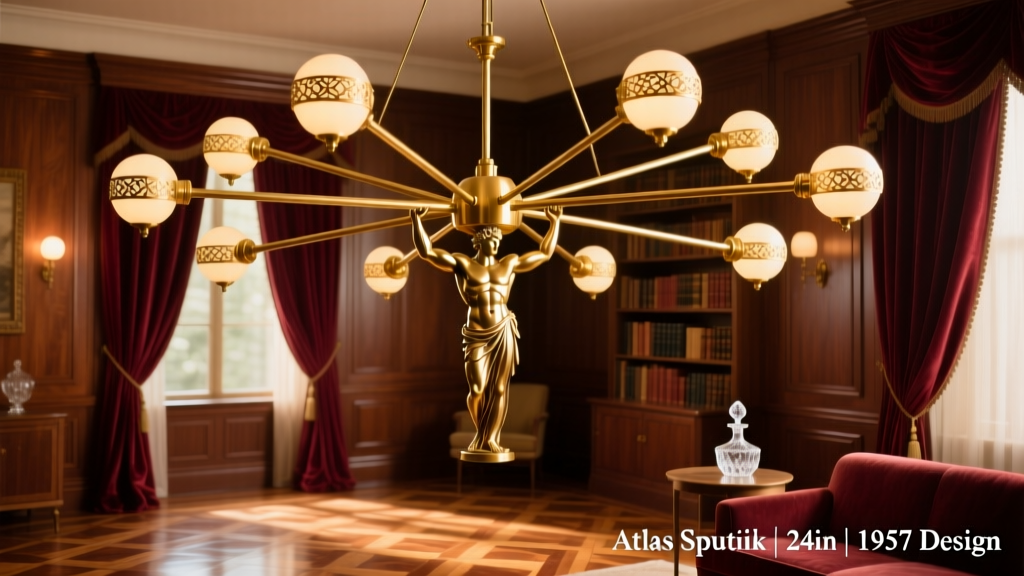
The Atlas Lighting Sputnik Chandelier: A Deep-Dive Restoration and Design Analysis of the 24-Inch Radiating Brass Fixture