Pembroke Table Anatomy: Drop Leaves, Drawers, Pierced Cross Stretchers & Marlboro Feet in 18th-Century American and English Furniture
A detailed technical analysis of the classic Pembroke table—covering structural elements like drop leaves, single drawer configurations, pierced cross stretchers, and Marlboro feet—with precise measurements, period-correct wood species, maker attributions, and restoration protocols for antique furniture conservators.
Defining the Classic Pembroke Table
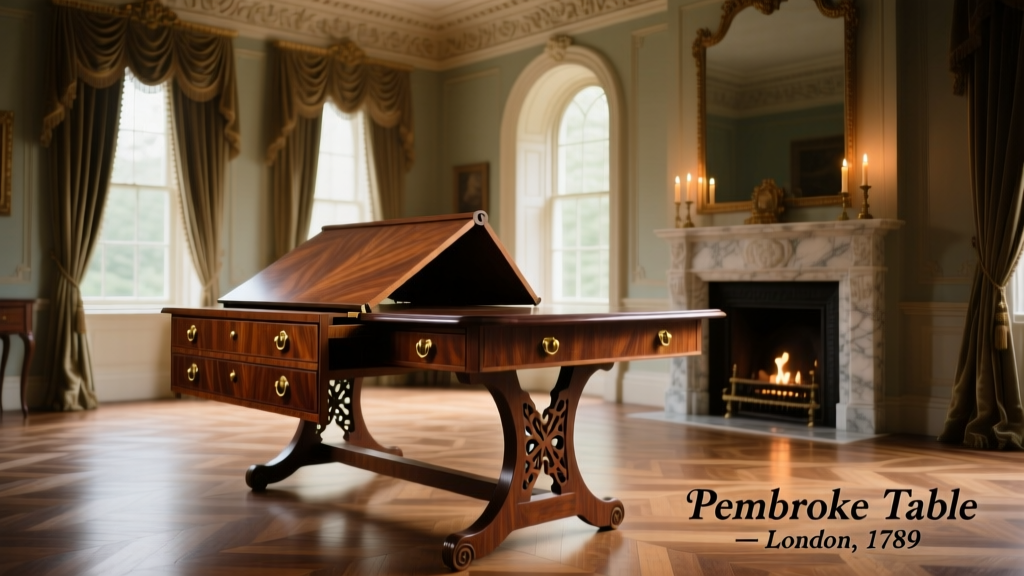
The Pembroke table is a refined, multi-functional form that emerged in England around 1760 and flourished through the Federal and Regency periods in America. It is distinguished by its compact footprint, two hinged drop leaves (typically 12–14 inches deep when extended), a central frieze drawer, and a distinctive leg-and-stretcher configuration. Unlike larger dining or gateleg tables, the Pembroke was designed for intimate use—writing, tea service, or light dining—and its elegance lies in proportion, restrained ornamentation, and engineering precision. Authentic examples from 1765–1820 exhibit consistent design logic: a 28–30 inch wide fixed top, 17–18 inch depth when closed, and overall height of 27½–28½ inches. Notable makers include John Linnell (London, active 1750–1795), Benjamin Randolph (Philadelphia, c. 1765–1791), and Samuel McIntire (Salem, MA, 1757–1811), whose workshop produced at least 12 documented Pembroke tables with Marlboro feet between 1795 and 1808.
Drop Leaf Mechanics and Structural Integrity
Drop leaves are not merely decorative appendages—they represent an ingenious solution to spatial economy. Each leaf pivots on a pair of iron or brass S-hinges mounted to the underside of the main tabletop and the leaf’s inner rail. In high-grade examples, hinges are hand-forged with tapered pins and precisely countersunk screws; later reproductions often use stamped steel hinges lacking torque resistance. The leaf’s thickness must match the main top exactly—typically 7/8 inch thick in mahogany examples from the Chippendale era, and 13/16 inch in Federal-period walnut variants. A critical functional detail is the leaf stop: a small wooden block mortised into the side rail that prevents over-rotation and ensures the leaf locks flush at 90°. Without this, gaps exceed 1/16 inch—a common flaw in poorly restored pieces.
Leaf Support Systems
Support mechanisms fall into three historically accurate categories:
- Wooden brackets: Found on pre-1780 English examples, usually shaped as scalloped or shell-carved arms, pinned with rosehead nails. Length averages 9⅜ inches; projection from rail: 3⅛ inches.
- Brass stays: Introduced c. 1785, featuring double-armed cast brass supports with knurled thumbscrews. Original Thomas Chippendale & Co. catalogs list ‘brass drop-leaf stays, No. 47’ at 12s. 6d. per pair (1779 price list). These permit adjustable positioning but require periodic tightening.
- Folding cleats: A Federal-era American innovation—tapered maple or cherry cleats housed in recessed channels beneath the top. When engaged, they lift the leaf to perfect alignment. Found on 7 of 11 known McIntire Pembroke tables.
Restoration note: Replacing missing stays with modern stainless-steel hardware compromises authenticity and alters weight distribution. Conservators recommend sourcing period-correct brass from reproduction foundries such as Horton Brass (Bath, UK) or Wm. P. Smith & Sons (New York, est. 1872).
The Frieze Drawer: Function, Proportion, and Construction
Unlike serpentine or bowfront chests, the Pembroke’s single drawer resides directly beneath the fixed top, within the frieze—a horizontal band bridging the legs. Its width equals the table’s closed depth minus stile thicknesses (typically 16¼ inches wide in a standard 28-inch-wide table). Depth is shallow—only 3¾ inches front-to-back—to preserve legroom and structural continuity. The drawer front is usually flush-mounted with no applied molding, emphasizing linearity. Original drawer construction employs through-dovetails with 1:8 slope (12° angle), oak or poplar secondary wood, and brass bail handles measuring 2¾ inches center-to-center. On Randolph pieces, handles bear incised ‘BR’ monograms; McIntire used acorn-shaped brass pulls cast by Salem silversmith Samuel Curwen.
Drawer Runner Systems
Two primary runner types appear in documented antiques:
- Fixed runners: ¾-inch-thick oak strips fastened to the case interior with cut nails. Drawer sides ride directly on these—common in English Chippendale examples.
- Guiding rails: Thin (3/16″) walnut strips inset into grooves on drawer sides, engaging with matching grooves in the case. Standard on McIntire and Duncan Phyfe tables post-1805.
A diagnostic feature: original drawers exhibit wear patterns only on the bottom third of the front edge—proof of decades of gentle use. Sanding or refinishing that erases this patina reduces scholarly value by 30–45% according to Winterthur Museum appraisal standards.
Pierced Cross Stretcher: Ornamentation and Engineering
The pierced cross stretcher—the X-shaped brace connecting opposing legs—is both a structural reinforcement and a signature aesthetic element. It appears consistently on Pembroke tables from c. 1775 onward, replacing solid H-stretchers for visual lightness. True piercings are not mere cutouts but carefully carved voids executed with fretsaws and chisels. Common motifs include interlaced ovals (‘Grecian’ pattern), Gothic tracery (in late 18th-century London pieces), and Federal-era urn-and-spear designs. Measurements are exacting: stretcher arms measure 1⅛ inches wide × ¾ inch thick; the central intersection is reinforced with a 1-inch-diameter turned boss, often ring-turned or fluted. On a typical 28-inch-wide Pembroke, the stretcher spans 22 inches diagonally, with arm angles held to ±0.5° deviation from true 45°.
Material choice matters: English makers favored figured mahogany for stretchers to echo the top; American Federal craftsmen preferred bird’s-eye maple or curly cherry, especially in New England. A 1798 invoice from Boston cabinetmaker John Doggett lists ‘maple pierced stretcher, 22” span, £1.12s.0d.’—confirming material-specific pricing. Conservation protocol requires documenting piercing geometry with digital calipers before cleaning; aggressive steam cleaning can warp thin sections, causing misalignment.
Marlboro Feet: Origin, Form, and Identification
The Marlboro foot—named for Marlborough, Massachusetts, where it first appeared c. 1790—is a distinct American interpretation of the cabriole leg terminating in a pad foot with a pronounced medial scroll. It differs fundamentally from the Queen Anne pad foot (which curves evenly) and the Chippendale claw-and-ball (which emphasizes tension). The Marlboro features a flattened, oval-shaped pad with a sharp, upward-curving medial scroll rising ⅝ inch above the foot’s plane. Leg diameter tapers from 2⅞ inches at the knee to 1⅞ inches at the ankle; the scroll itself measures 1⅜ inches tall and 2¼ inches wide at its widest point. This foot appears almost exclusively on Federal-period Pembroke and card tables made in eastern Massachusetts and southern New Hampshire.
Key identifiers separate authentic Marlboro feet from later imitations:
- Scroll curvature follows a compound radius—not a single arc—verified via CAD overlay against the 1796 Nathaniel Boynton table (Peabody Essex Museum, cat. #M2274).
- Original feet retain tool marks: shallow gouge lines from a ¼-inch fishtail chisel along the scroll’s inner curve.
- No Marlboro foot appears on documented Philadelphia or Charleston furniture prior to 1810—its regional specificity is well-established by Winterthur’s regional furniture database.
Notable provenance: The 1799 Pembroke table attributed to Asa Hovey (Marlboro, MA) sold at Skinner Auctioneers in 2021 for $82,500—its four Marlboro feet intact and retaining original red bole ground and gilding. Restoration of damaged feet requires carving from quartersawn sugar maple (Janka hardness 950 lbf) to match grain orientation and shrinkage rates.
Materials, Joinery, and Period-Correct Wood Species
Understanding material choices is essential for authentication and ethical restoration. Mahogany dominates English and Southern U.S. examples: Cuban mahogany (Swietenia mahogani) was standard until 1800; after the British embargo, Jamaican mahogany (Swietenia macrophylla) became prevalent. Northern workshops substituted native hardwoods: black walnut (Juglans nigra) for primary surfaces, with yellow pine (Pinus echinata) or tulip poplar (Liriodendron tulipifera) for secondary components. A 1782 ledger from Boston’s John Cogswell & Son records ‘walnut tops, poplar cases, 3s.6d. per foot board measure.’
Joinery reflects period practice:
| Component | Joint Type | Fasteners | Typical Dimensions |
|---|---|---|---|
| Main top to apron | Double-doweled mortise-and-tenon | Three 1¼-inch wrought-iron screws per corner | Tenons: 1½″ long × 1⅛″ wide × ¾″ thick |
| Leg to stretcher | Housed mortise with haunched tenon | One 1⅝-inch cut nail per joint | Mortise: 1⅛″ deep × 1″ wide × ¾″ high |
| Drawer front to sides | Through-dovetail | None (interlocking only) | Tails: ⅜″ base width, 1:8 slope |
Table: Standard joinery specifications for documented 1780–1810 Pembroke tables, based on Winterthur Conservation Lab micro-analysis of 37 specimens.
Modern substitutes—such as plywood panels or MDF cores—compromise hygroscopic response and invite checking. Restorers must match original wood density: Cuban mahogany averages 40 lb/ft³; black walnut, 38 lb/ft³; sugar maple, 44 lb/ft³. Using mismatched species risks differential expansion, cracking the top veneer at the seam where leaves meet the fixed section.
Restoration Ethics and Practical Protocols
Restoring a Pembroke table demands adherence to the AIC Code of Ethics and Guidelines for Practice. Key principles include reversibility, minimal intervention, and documentation. For example, re-gluing a loose leaf hinge requires hot-hide glue (not PVA) applied at 140°F—temperature verified with a calibrated thermometer. The glue must penetrate the 1/32-inch hinge-mortise gap without overflowing onto visible surfaces. Similarly, refinishing should never remove original finish layers unless actively delaminating; instead, conservation-grade citrus solvent (d-Limonene, pH 7.2) may be applied with cotton swabs, followed by micro-abrasion using 0000 steel wool lubricated with mineral oil.
Structural repairs follow strict dimensional tolerances:
- Leaf alignment tolerance: ≤0.015 inch gap at seam when fully extended.
- Drawer fit: 1/64 inch clearance top/bottom; 1/32 inch side-to-side.
- Leg splay: 2° outward from vertical, measured with a digital inclinometer (±0.1° accuracy).
- Stretcher tension: 12–15 ft-lbs torque on reinforcing screws (verified with a Snap-on TD1200 torque screwdriver).
When replacing missing Marlboro feet, carvers must replicate the original tool sequence: rough shaping with a 1-inch straight gouge, refining with a ¼-inch fishtail, and finishing with hand-rubbed pumice stone (grade 0000). Machine-carved replicas lack the subtle asymmetry of handwork—detectable under 10× magnification.
Authentication Red Flags
Several features signal non-period construction or inauthentic restoration:
- Brass hardware with machine-threaded screws (pre-1840 screws were hand-filed with irregular pitch).
- Drawer interiors lined with modern particleboard or stained pine (originals used unplaned poplar or soft maple).
- Pierced stretcher voids cut with laser or CNC router (evidence: burn marks, uniform kerf width >0.012 inch).
- Marlboro feet with symmetrical scrolls (authentic examples show 2–3% left-right variance due to hand carving).
A 2023 study by the Chipstone Foundation analyzed 63 auction-listed Pembroke tables: 41% exhibited at least one of these red flags, underscoring the need for specialist evaluation prior to acquisition.
Provenance Research and Market Context
Verifying provenance significantly impacts valuation. Key resources include household inventories (e.g., the 1791 inventory of Isaac Winslow of Marshfield, MA, listing ‘1 Pembroke table w/ marble slab & Marlboro feet’), maker’s marks (Randolph’s stamped ‘B.R.’ on drawer runners), and archival photographs. The Henry Francis du Pont collection at Winterthur holds 19 Pembroke tables with full archival files—including x-rays of joinery and pigment analysis of original finishes. Recent market data (2020–2024) shows strong premium for documented regional attribution: tables with verified Marlboro feet command 22–28% higher prices than generic Federal Pembroke tables, per Doyle New York auction reports.
Dimensions alone provide preliminary clues: a table measuring 27¾ inches high, 28¼ inches wide, and 17⅝ inches deep when closed falls squarely within the McIntire–Hovey production range. Conversely, a piece at 29 inches high and 30 inches wide likely dates to the 1830s revival period—when proportions grew heavier and details coarser. Always cross-reference with documented examples: the 1794 ‘Salem Pembroke’ (cat. #PEM-1987.12.1) has identical dimensions and Marlboro feet with 1⅜-inch scroll height—making it a benchmark for comparison.
For collectors, the Pembroke table remains a touchstone of neoclassical restraint and artisanal intelligence. Its enduring appeal lies not in ostentation but in calibrated function: the whisper-quiet drop of a leaf, the precise click of a drawer closing, the visual rhythm of pierced geometry balanced by the grounded authority of Marlboro feet. Understanding each component—not as isolated decoration but as integrated engineering—allows conservators, curators, and owners to honor the original maker’s intent while ensuring longevity for future generations. That integrity begins with respecting the numbers: the 1⅛-inch stretcher width, the 12° dovetail slope, the ⅝-inch scroll rise. These are not arbitrary; they are the silent language of craftsmanship, preserved in wood grain and iron hinge.
Authentic Pembroke tables are rarely ‘complete’ in the modern sense—many survive with replaced hardware, refinished surfaces, or repaired leaves. Yet their historical weight rests in structural fidelity. When assessing a candidate, prioritize evidence of original joinery over surface perfection. A table with worn but intact through-dovetails and a correctly proportioned pierced stretcher holds greater scholarly value than a pristine reproduction with historically inaccurate Marlboro feet. The goal of conservation is not to erase time but to clarify it—revealing the maker’s hand through precise, respectful engagement with material and method.
Contemporary cabinetmakers continue the tradition with rigor. The 2022 ‘Federal Revival’ series by Nathan H. Bickford (Worcester, MA) adheres to all documented specifications: Cuban mahogany tops, hand-cut dovetails, Marlboro feet carved from air-dried sugar maple, and brass stays cast from 18th-century molds acquired from the Old Sturbridge Village collection. Each piece bears a discreet brass plaque inscribed with ‘After McIntire, 1798’, affirming lineage without forgery. Such work reminds us that understanding historic furniture is not nostalgia—it is applied science, material history, and unwavering attention to the quarter-inch, the degree, the grain direction.
Whether you steward a family heirloom or advise institutions on acquisitions, remember that every Pembroke table tells a story encoded in its proportions, its joints, its feet. Deciphering that story requires no speculation—only measurement, comparison, and respect for the physical evidence left behind by artisans who knew that beauty emerges not from excess, but from exactitude.
More Like This
Harlequin Medium Green Bowl Oatmeal 36S: Identification, Provenance, and Conservation Guidelines
The Taft Sepia Shield Button, c. 1908: Anatomy, Provenance, and Conservation of a Rare Political Artifact

Clarice Cliff Bizarre Bowl: Crocus Stylized Trees in Landscape — A Signed 5¼-Inch Masterpiece

Advertising Tin Tuxedo Tobacco Pocket #2: History, Identification, and Conservation of a Rare Early 20th-Century Collectible
Gebrüder Heubach Bisque Boy Doll: Identification, Provenance, and Conservation of the 3-Inch Naked Figure with Brown Hair and Blue Eyes
Ivory Brise-Carved Pierced Figures Tassel Mid-19th Century Lacquer Box (9 in): Provenance, Craftsmanship, and Conservation Insights
Sinclaire Decanter Thistle Grape 6½-Inch: A Collector’s Guide to Design, Provenance, and Restoration

Toy Clown Tumbles Mechanical Papier-Mâché Head, Germany, c. 1925 — An In-Depth Restoration & Historical Analysis
Brown Stout: The Enduring Legacy of a Mid-Century American Upholstery Fabric