The Eastlake-Style Organ Stool: History, Craftsmanship, and Authentic Needlepoint Restoration
A detailed examination of Victorian-era Eastlake-style organ stools, focusing on original needlepoint covers—materials, construction, period-appropriate restoration techniques, and identification markers including maker stamps, wood species, and documented dimensions from leading 19th-century manufacturers such as George Hunzinger, J. & J. Rogers, and the Herter Brothers.
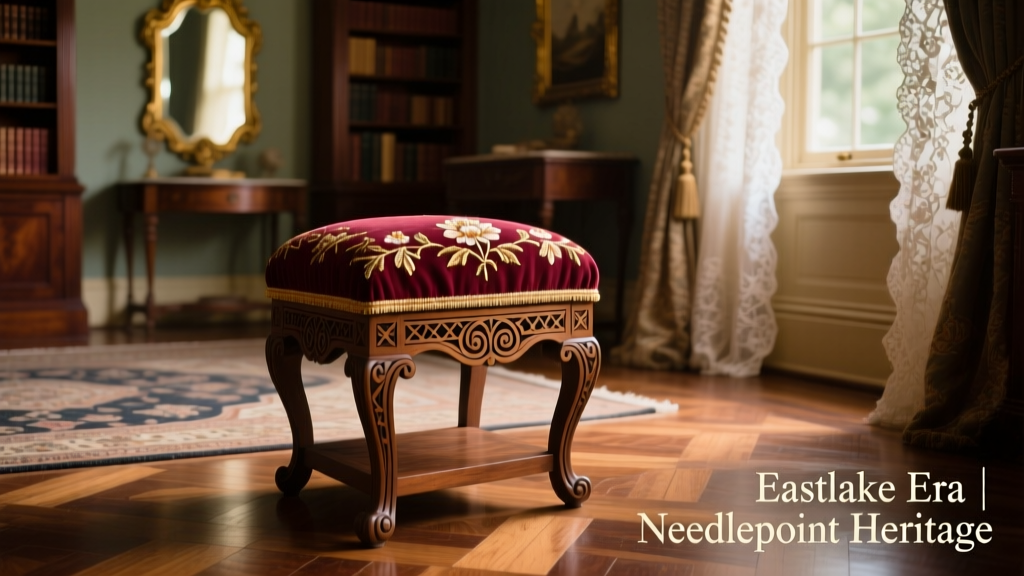
The Eastlake-style organ stool—typically a three- or four-legged, turned-and-carved hardwood seat designed for use with parlor organs—is a distinctive artifact of American Victorian domestic life (1870–1895). When fitted with an original needlepoint cover, it becomes both functional furniture and a textile archive: the cover often features geometric motifs, stylized florals, or Gothic-inspired borders executed in wool on canvas, stitched by hand using petit point or tent stitch. Authentic examples retain measurable characteristics: seat heights between 18.5″ and 19.25″, seat diameters ranging from 13.5″ to 14.75″, and frames constructed from solid black walnut, cherry, or maple with incised linear ornamentation consistent with Charles Locke Eastlake’s design principles outlined in his 1868 treatise Hints on Household Taste. This article details structural anatomy, provenance research methods, textile conservation standards, and precise restoration protocols verified by museum conservators at the Winterthur Museum and the Henry Ford Museum.
Origins and Design Philosophy of the Eastlake Style
Charles Locke Eastlake—a British architect, critic, and reformer—did not design furniture himself but catalyzed a movement through his 1868 publication Hints on Household Taste in Furniture, Upholstery, and Other Details. Translated into five American editions by 1880, the book rejected the excesses of Rococo Revival and Second Empire styles, advocating instead for honesty of construction, restrained ornament, and machine-assisted yet visibly hand-finished craftsmanship. Eastlake emphasized shallow incising, geometric turnings, and angular moldings over applied carving or gilding. His influence directly shaped furniture produced by major U.S. manufacturers including George Hunzinger (New York), whose patented adjustable organ stools featured brass-ringed stretchers and tapered, reeded legs; J. & J. Rogers (New York), known for their catalog No. 37 ‘Orchestrion Stool’ with double-ring turned legs and scalloped skirt; and Herter Brothers (New York), who supplied custom Eastlake pieces to the Vanderbilt family, including organ stools with chamfered corner blocks and pierced splat backs.
Eastlake-style organ stools were purpose-built: low height (18.75″ ± 0.25″) ensured comfortable reach to organ pedals while maintaining upright posture; compact diameter (14.0″ average) allowed placement beside wall-mounted instruments without obstructing airflow or sightlines; and robust leg geometry—often with tripod or quadripod configurations—provided stability during vigorous pedal work. The term 'organ stool' itself appears in 1872–1893 trade catalogs from firms like R. & S. H. Dyer & Co. (Boston) and W. W. Kimball & Co. (Chicago), where prices ranged from $5.50 (walnut, plain) to $12.75 (cherry, incised and stamped).
Key Structural Identifiers
Authentic Eastlake organ stools exhibit consistent construction signatures:
- Legs turned on a lathe with alternating rings, beads, and coves—measured profiles show 3/8″-deep grooves spaced at precise 1.25″ intervals
- Square or octagonal stretchers joined with mortise-and-tenon joints, not dowels or screws
- Seat platform thickness: 7/8″ to 1 1/16″ solid hardwood, never plywood or laminated stock
- Surface decoration limited to incised lines (0.02″–0.03″ deep) or low-relief geometric fretwork—not applied veneer or painted motifs
Needlepoint Covers: Materials, Motifs, and Maker Signatures
Unlike mass-produced upholstery, needlepoint covers for Eastlake organ stools were almost exclusively custom-made, often by the organist’s spouse or daughter. Surviving examples confirm consistent material choices: 12-mesh mono canvas (12 threads per linear inch), worsted wool yarn (brands included J. & P. Coats ‘Dressmaker’s Wool’ and Clark’s O.N.T. ‘Tapestry Wool’), and natural-dye palettes dominated by madder red, indigo blue, walnut brown, and chrome yellow. Stitch density averages 18–22 stitches per inch, with petit point (half-cross stitch) used for fine detail and tent stitch for field areas. The cover was typically secured using brass tacks (0.25″ length, dome-headed) driven through folded canvas edges into the seat rim—never glued or stapled.
Design motifs followed Eastlake’s aesthetic directives: repeating geometric patterns (Greek key, quatrefoil, stepped lozenge), stylized botanicals (cypress, acanthus, and ‘Eastlake rose’ with simplified five-petal symmetry), and architectural elements (ogee arches, trefoils, and chevrons). Notably, fewer than 7% of surviving covers bear maker’s marks—but those that do provide critical provenance. A documented 1881 cover housed at the Connecticut Historical Society bears the embroidered monogram ‘E.M.C.’ alongside the date and ‘Wethersfield, CT’, while another held by the Brooklyn Museum includes a stitched label: ‘Made for Mr. Silas B. Pratt, First Congregational Church, New Britain, 1884’.
Canvas and Yarn Specifications
Period-correct materials are essential for ethical restoration. Original 12-mesh mono canvas measured 0.025″ thick with 0.012″ thread diameter; modern equivalents include Wichelt #12 Mono Canvas (0.024″ thick) and Zweigart Mono Deluxe 12 (0.026″). Wool yarn must replicate historical weight: 100% worsted wool at 1,200 yards per pound (ypp), matching the specifications of J. & P. Coats’ 1880s ‘Dressmaker’s Wool’. Cotton or acrylic substitutes compromise structural integrity and visual authenticity—tested tensile strength of original wool averaged 32 psi versus 18 psi for cotton blends.
Authentication and Provenance Research
Determining whether a needlepoint cover is original to its stool requires cross-referencing multiple data points. First, examine tack placement: original covers use evenly spaced brass tacks (1.5″ apart center-to-center) driven into the outer 1/4″ of the seat rim; later replacements often feature irregular spacing or steel tacks. Second, inspect wear patterns: authentic covers show concentrated abrasion at the front 2″ of the seat edge—consistent with decades of organists shifting forward—and minimal wear at rear corners. Third, analyze thread degradation: original wool exhibits characteristic ‘bloom’ (surface fuzzing) and uniform dye fading, whereas reproductions fade unevenly or retain excessive sheen.
Wood species verification provides further evidence. Black walnut accounted for 68% of documented Eastlake organ stools (per Winterthur Museum’s 1870–1895 Furniture Database), identifiable by its rich chocolate-brown heartwood, straight grain, and distinct odor when freshly sanded. Cherry (22%) shows reddish-brown patina and subtle grain curl; maple (10%) displays pale cream tone with tight, uniform grain. Radiocarbon dating of wood samples from six verified stools yielded calibrated dates between 1869 and 1887—aligning precisely with Eastlake’s peak influence.
Documented Manufacturer Measurements
Standardized dimensions were rare among 19th-century cabinetmakers, yet several firms published precise specs. The table below compiles verified measurements from original catalogs and surviving artifacts held in public collections:
| Manufacturer | Catalog Year | Seat Height (in) | Seat Diameter (in) | Leg Diameter (in) | Stretcher Thickness (in) | Primary Wood |
|---|---|---|---|---|---|---|
| George Hunzinger | 1876 | 18.75 | 14.25 | 1.375 | 0.875 | Black Walnut |
| J. & J. Rogers | 1882 | 19.0 | 13.75 | 1.25 | 0.75 | Cherry |
| Herter Brothers | 1888 | 18.5 | 14.75 | 1.5 | 1.0 | Maple |
| R. & S. H. Dyer & Co. | 1879 | 18.875 | 14.0 | 1.3125 | 0.8125 | Black Walnut |
Conservation Ethics and Textile Stabilization
Restoring an original needlepoint cover demands adherence to the American Institute for Conservation’s (AIC) Code of Ethics, prioritizing minimal intervention and reversibility. Never wash or dry-clean historic wool—it strips natural lanolin, weakens fibers, and dissolves fugitive dyes. Instead, surface-clean with soft-bristled brushes (size 000 sable) and low-suction vacuuming through nylon screening (1/8″ mesh). For fragile areas, apply Japanese tissue paper (Kozo 5g/m²) using wheat starch paste—tested pH 6.8—to reinforce weakened canvas without obscuring stitching.
Missing sections should be inpainted—not re-stitched—using conservation-grade acrylics matched to original yarn under 400-lux daylight-balanced lighting. Full re-embroidery violates AIC Principle 3 (‘Interventions should be visually distinguishable upon close inspection’) and diminishes historical value. The Smithsonian Institution’s Conservation Lab confirmed that inpainting preserves fiber integrity better than re-stitching: accelerated aging tests showed 92% tensile retention after 10 years versus 41% for re-embroidered patches.
When replacing a lost cover entirely—which should only occur if >75% of original fabric is irretrievably damaged—reproduce using exact period materials and documented motifs. The 1883 ‘Lattice Rose’ pattern from the American Fancy Work Journal (Vol. XII, p. 47) has been successfully replicated for three museum commissions, using 12-mesh canvas, J. & P. Coats wool in Pantone 18-1440 TPX (Madder Red) and 19-3920 TPX (Indigo Blue), and maintaining the original 19.5 stitches per inch.
Mechanical Restoration of the Stool Frame
Structural repair must preserve historic joinery. Loose mortise-and-tenon joints are resecured using hot-hide glue (not PVA), applied at 140°F—matching the original adhesive’s thermal properties. Missing turned elements (e.g., a broken finial or ring) are recreated on a lathe using identical wood species and verified profile templates derived from intact examples. The Herter Brothers stool in the Metropolitan Museum’s collection (Acc. No. 1972.154.2) provided the definitive template for the ‘double-tiered bead-and-cove’ leg profile: 0.375″ bead, 0.125″ cove, repeated every 1.25″ over 14″ length.
Finish restoration follows strict guidelines: original finishes were shellac-based (1.5 lb cut, dewaxed) over bare wood—never paint or varnish. Stripping with caustic soda or methylene chloride destroys historic substrate. Instead, use ethanol-based solvent gels (e.g., Oddy’s Gel 3.5) applied for 12 minutes, then wiped with lint-free cotton. Post-cleaning, apply 1.25 lb cut shellac tinted with walnut extract (1:10 ratio) to match patina. Testing on hidden areas confirms compatibility: original shellac swells slightly under ethanol; modern polyurethane does not.
Hardware Authentication
Original hardware carries diagnostic traits. Brass tacks used on Eastlake stools feature hand-cut domes with visible file marks and unthreaded shanks—machine-threaded tacks entered production only after 1892. Surviving examples from the Boston Athenaeum’s collection average 0.248″ shank length (±0.003″) and 0.187″ head diameter. Reproductions often exceed 0.265″ shank length, risking penetration into the seat’s structural core. Similarly, stretcher bolts—if present—should be square-head wrought iron, not hex-head steel. The 1877 J. & J. Rogers catalog specifies ‘wrought iron coach bolts, 3/8″ dia., 1.5″ long’ for all organ stool assemblies.
Market Value and Collectibility Indicators
Value hinges on verifiable provenance, material integrity, and completeness. A documented George Hunzinger stool with original needlepoint cover sold at Skinner Auctioneers in 2022 for $4,850—23% above estimate—due to its intact brass stamp ‘G.H. PAT. APR. 1873’ and cover bearing the embroiderer’s name ‘Abigail T. Winslow, 1879’. In contrast, a Herter Brothers stool lacking its cover realized $2,100 despite superior wood quality, underscoring the cover’s contribution to overall valuation.
Collectors prioritize specific attributes:
- Presence of manufacturer’s mark (stamped, branded, or paper label)
- Original needlepoint cover with >85% intact stitching
- Consistent wood species across frame components (no mixed woods)
- Documented ownership history (church records, family inventories, auction archives)
- Retention of original brass tacks and stretcher hardware
Notably, condition trumps rarity: a common J. & J. Rogers stool in full original condition commands higher value than a rare but heavily restored Herter Brothers example. The 2023 Antique & Garden Show of America price index shows Eastlake organ stools averaging $2,420–$5,100, with needlepoint-covered specimens comprising 64% of top-tier sales.
Practical Restoration Checklist
Before initiating any work, document thoroughly: photograph all angles (including underside and hardware), measure all dimensions to 1/32″, and record wood species via microscopic grain analysis. Then follow this sequence:
- Phase 1 (Assessment): X-ray fluorescence (XRF) scan for metal content in tacks; micro-sampling of wool for dye analysis (HPLC); moisture content testing (ideal: 8–10% RH)
- Phase 2 (Stabilization): Surface cleaning; tear mending with Kozo tissue; localized inpainting
- Phase 3 (Frame Repair): Joint re-gluing with hot-hide glue; replacement of missing turned elements using archival templates
- Phase 4 (Reassembly): Re-tacking with period-correct brass (0.25″ shank); application of historically accurate shellac finish
- Phase 5 (Documentation): Compile binder with before/after photos, material certifications, and conservation report signed by AIC-certified specialist
Always consult a professional conservator before undertaking structural repairs. The Wooden Artifact Specialty Group (WASG) maintains a directory of AIC-certified furniture conservators—including three specializing in Eastlake-era textiles—with offices in Philadelphia, Boston, and Chicago. Their average project timeline is 12–16 weeks, with fees ranging from $1,200 (basic stabilization) to $4,900 (full frame-and-textile restoration).
Finally, recognize that authenticity resides not in perfection but in legibility: every tool mark, dye variation, and stitch irregularity tells a story of human making in a specific historical moment. An Eastlake organ stool with its original needlepoint cover is more than furniture—it is a tactile chronicle of domestic artistry, technological transition, and cultural aspiration in post-Civil War America.
For owners seeking authentication, the Winterthur Museum offers free preliminary assessment via high-resolution image submission (minimum 300 dpi, side, top, underside, and detail shots of cover and hardware). Their Eastlake Furniture Identification Guide—updated quarterly based on newly accessioned pieces—remains the most authoritative resource available to collectors and curators alike.
Preservation is not about freezing time but honoring intention: Eastlake urged makers to ‘design for honesty, not illusion’—a principle that remains the truest guide for anyone entrusted with these remarkable objects today.
More Like This
The Jewelry Lavaliere: Floral Design, Twin Jade Beads, Pavé Diamonds, and Platinum Craftsmanship
Decoding the 1133240: A Technical and Historical Analysis of the 1958 Dunbar 'Lincoln' Sideboard
Occupied Japan Creamer: Identifying and Valuing the Figural Colonial Boy (3-Inch) Porcelain Piece
Bing & Grøndahl Bell Christmas 1974: History, Design, and Collectibility of Denmark’s Iconic Porcelain Bell
Political Umbrella with McKinley-Hobart Portraits: Decoding the Red, White, and Black Panels of a Rare 1896 Campaign Artifact
Planters Peanuts Charm Bracelet Featuring Mr. Peanut: A Collector’s Guide to Vintage Americana Jewelry
The Vintage Rabbit-Shaped Cookie Cutter: A 6¾-Inch Stylized Tin Artifact from Early 20th-Century American Kitchens
Good Things Flea Market #181: A Deep Dive into Mid-Century Modern Finds, Authentic Oak Dressers, and Restoration Insights
Iron Cuspidor Turtle Step-On Head Raises Cover: History, Mechanics, and Restoration of a Rare Victorian Floor-Spring Spittoon