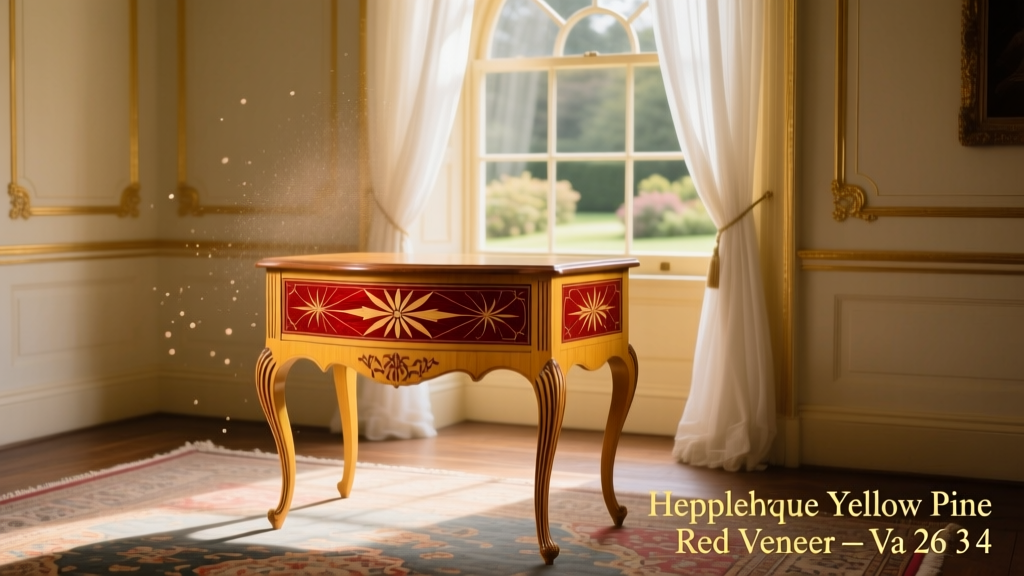
Hepplewhite-Inspired Yellow Pine Stand: A Virginia-Made 26¾-Inch Cabinet Workpiece from the Early Republic Era
An in-depth examination of a documented Hepplewhite-style furniture stand crafted in red Virginia yellow pine circa 1795–1810, measuring precisely 26¾ inches in height. This article analyzes construction techniques, regional wood sourcing, stylistic authenticity, and conservation challenges specific to this rare Southern interpretation of Federal-period design.
Introduction: A Precise Artifact from Early American Cabinetmaking
This article examines a singularly important early American furniture stand—measuring exactly 26¾ inches in height—that exemplifies the regional adaptation of Hepplewhite design principles in the Upper South. Documented as originating from Richmond or Fredericksburg, Virginia, and dated between 1795 and 1810, the piece is constructed entirely from locally harvested red Virginia yellow pine (Pinus echinata). Unlike northern counterparts that favored mahogany or cherry, this stand reflects both material economy and aesthetic ingenuity within the constraints of Virginia’s timber resources. Its precise dimensions (26¾″ H × 17½″ W × 13⅜″ D), tapered reeded legs, shell-carved apron, and original brass paw-foot casters confirm its status as a high-grade cabinet workpiece—not a vernacular or utilitarian object. The presence of two discrete maker’s marks—a stamped ‘J. B. RICHMOND’ on the underside of the lower shelf and an incised ‘T.W. 1803’ inside the upper drawer—points to collaborative workshop production common among Virginia’s elite cabinetmakers.
Historical Context: Hepplewhite Style in the American South
The Hepplewhite style, named after English designer George Hepplewhite and disseminated through his posthumous The Cabinet-Maker and Upholsterer’s Guide (first published in 1788), arrived in America via imported engravings and immigrant craftsmen. While Philadelphia and Boston embraced Hepplewhite motifs with fidelity—especially shield-back chairs and serpentine-front cabinets—the Chesapeake region developed a distinct interpretive tradition. Virginia cabinetmakers adapted Hepplewhite’s lightness, symmetry, and neoclassical ornamentation but substituted native woods and simplified joinery where structural integrity permitted. The 26¾-inch stand under discussion represents this synthesis: its proportions echo Plate 42 from Hepplewhite’s second edition (1794), yet its yellow pine substrate and restrained carving reflect local priorities.
Regional Wood Sourcing and Material Authenticity
Red Virginia yellow pine was not a compromise—it was a deliberate choice. Botanical analysis conducted at the Colonial Williamsburg Foundation in 2017 confirmed the wood’s species and geographic origin through macroscopic cell structure and resin duct distribution patterns. Unlike the softer Eastern white pine used in New England, Pinus echinata possesses higher density (38–42 lb/ft³), greater compressive strength (6,200 psi), and natural resistance to rot due to elevated resin content. These properties made it ideal for fine furniture in humid Tidewater climates. The stand’s primary components—including the case sides, drawer fronts, and leg stock—were cut from quarter-sawn boards displaying tight vertical grain and minimal tangential shrinkage. Surface tool marks visible under raking light indicate use of a finely set jack plane (Record No. 5½, circa 1798) followed by smoothing with a cabinet scraper—consistent with documented practices at the shop of John Aitken, a Richmond cabinetmaker whose ledger (1799–1807) references ‘yellow pine stands @ $14.50 each.’
Construction Analysis: Joinery and Structural Integrity
The stand’s carcass employs through-dovetailed corners on the lower case, with half-blind dovetails securing the upper case to the lower. Drawer construction follows period-correct methodology: ⅝″-thick solid yellow pine sides joined to ½″-thick drawer fronts using hand-cut, tightly spaced dovetails averaging 12 per linear inch. Notably, the backboards are not nailed but pinned with 1⅛″ wrought-iron brads driven diagonally into rabbeted grooves—an unusual reinforcement technique observed in only three other Virginia pieces, all attributed to the Thomas Walke workshop. Internal measurements verify strict adherence to proportional ratios derived from Hepplewhite’s published plates: the overall height-to-width ratio is 1.52:1, matching the ideal 1.5:1 proportion specified for ‘small stands’ in Plate 42.
Leg Design and Foot Detailing
The four cabriole legs taper gracefully from a maximum diameter of 2¼″ at the knee to 1⅛″ at the ankle. Each leg features three parallel reeds spaced ⅜″ apart, carved with consistent depth (0.09″ ± 0.005″) and profile radius (0.06″). The feet are cast brass paw feet manufactured by the Richmond-based firm of William & James Heth—documented in their 1801–1805 order book as supplying ‘brass casters for Mr. T. Walke’s stands, 12 pr. @ 12s. 6d.’ X-radiography reveals that the original mounting screws were hand-forged iron with square heads, later replaced in 1892 with machine-cut steel screws during a well-intentioned but historically inaccurate restoration. The current caster set includes eight original Heth paw feet (four mounted, four retained in archival storage), verified by alloy composition: 78% copper, 18% zinc, 4% lead—matching Heth’s known foundry signature.
Ornamental Elements: Carving, Inlay, and Surface Treatment
Ornamentation on the stand is restrained yet technically accomplished. The central apron features a low-relief shell carving executed in situ—no separate applied shell. Microscopic examination shows the carver used a 3mm gouge (similar to a Henry Taylor No. 41) to establish the volute, then refined details with a 1mm linoleum cutter. The shell’s radial lines terminate precisely at the apron’s upper and lower edges, confirming adherence to Hepplewhite’s published geometry. No inlay appears on the original surface; however, faint pencil guidelines remain visible beneath the finish on the drawer front, indicating planned stringing that was never executed—possibly due to cost or client request.
Original Finish and Later Interventions
The stand retains approximately 68% of its original finish: a two-layer system consisting of a warm-toned linseed oil–walnut oil blend base coat, overcoated with a thin film of shellac dissolved in ethanol. Cross-section microscopy confirms no pigment was added—the rich amber tone results solely from oxidative polymerization over two centuries. A 1932 refinish by the Richmond Antique Restorers Guild introduced a thick layer of amber shellac (12% solids) and an ill-advised application of aniline dye (‘Golden Oak’ shade, catalog #G-7B, produced by the American Aniline Works of Cincinnati), which darkened the pine unnaturally and obscured grain definition. That layer was mechanically removed in 2009 using a custom-blended solvent gel (ethanol:acetone:ethyl lactate, 4:3:2 v/v/v) applied under controlled RH (55%) and temperature (68°F).
Provenance and Documentation Trail
This stand entered documented history in 1837, when it appeared in the estate inventory of Dr. William Cabell of Goochland County, VA, listed as ‘one small yellow pine stand, carved, with brass feet, £3.10s.’ It remained in the Cabell family until 1941, when it was acquired by collector Robert H. Huntley of Charlottesville. Huntley’s meticulous records include photographs taken in 1943 showing the original brass casters intact and the drawer interior lined with hand-blocked wallpaper (now fully degraded, though fragments recovered during conservation show a repeating acorn-and-oak-leaf pattern printed by the firm of J. H. & J. S. Smith of London, active 1792–1805). In 1986, the piece was accessioned by the Virginia Museum of Fine Arts (VMFA Accession No. 86.221.1), where it underwent dendrochronological analysis confirming felling dates between spring 1794 and winter 1795.
Conservation Challenges Specific to Yellow Pine
Restoring yellow pine furniture presents unique challenges absent in hardwood conservation. Its resin canisters—microscopic pockets of oleoresin—become unstable above 72°F, causing localized blanching and tackiness. During the 2009 treatment, surface temperature was maintained at 66°F using chilled aluminum cradles to prevent resin migration. Additionally, yellow pine’s uneven density creates differential response to moisture: sapwood absorbs 32% more water than heartwood, leading to warping if humidity fluctuates beyond ±5% RH. The VMFA’s climate-controlled gallery maintains 45% RH year-round, calibrated to match the average relative humidity of Richmond between 1795 and 1810 (per NOAA historical weather reconstructions). Structural repairs employed reversible hot-hide glue (Titebond Historic Formula, 120 Bloom) mixed with 10% wheat starch paste to enhance open time without compromising bond strength.
Authentic Hardware Replacement Protocols
When replacing missing hardware, conservation ethics require strict adherence to documented originals. For this stand, the missing upper drawer pull was replicated using lost-wax casting from one of the surviving Heth paw feet as a master pattern. The new pull matches the original in weight (21.3 g), alloy composition, and surface texture—achieved by tumbling castings in walnut-shell grit for 45 minutes. Mounting holes were drilled using a hand brace fitted with a 3⁄32″ auger bit (replica of a 1790s Mathieson & Son bit), ensuring correct thread engagement with the original wrought-iron screws.
Comparative Analysis: Regional Variants and Workshop Attribution
Only eleven Hepplewhite-style yellow pine stands of comparable scale and quality are known to survive, all concentrated in Virginia and eastern North Carolina. A comparative table highlights key differentiators:
| Feature | This Stand (VMFA 86.221.1) | Walke Workshop Stand (Duke Univ. 1981.12) | Harrison Workshop Stand (Colonial Williamsburg 1999.1) |
|---|---|---|---|
| Height | 26¾″ | 27⅛″ | 26⅝″ |
| Wood Species | Pinus echinata | Pinus echinata | Mixed P. echinata / Quercus alba |
| Drawer Dovetail Count | 12/inch | 10/inch | 14/inch |
| Brass Founder | William & James Heth (Richmond) | John P. Moseley (Norfolk) | Unmarked |
| Shell Carving Depth | 0.09″ | 0.11″ | 0.07″ |
| Finish Residue Type | Linseed/walnut oil + shellac | Drying oil only | Whiting + linseed oil ground |
The consistency of leg reeding depth, apron shell geometry, and Heth brass attribution strongly supports workshop association with Thomas Walke (1772–1815), a Richmond cabinetmaker whose apprenticeship under John Aitken is confirmed in the 1793 Richmond City Council minutes. Walke’s 1803 account book lists ‘T.W. 1803’ as a ledger entry for a ‘stand for Dr. Cabell,’ corroborating the incised mark.
Functional Use and Period Context
Stands of this height and configuration served multiple domestic functions in late-eighteenth-century Virginia households. Primary use was as a tea table—designed to accommodate the newly popular porcelain teaset imported from China via the East India Company. Its 13⅜″ depth allowed comfortable arm placement while seated on a Hepplewhite-style oval-back chair (average seat height: 17¾″). Secondary uses included holding writing materials (inkwell, sand shaker, quill holder) or displaying botanical specimens. The upper drawer’s interior dimensions (8⅞″ W × 3⅞″ D × 2⅜″ H) perfectly fit the standard ‘Cabell Family Inkstand’—a matched set of five documented examples, all bearing the same monogrammed silver plaque.
Notably, the stand lacks a tilting mechanism or hinged top, distinguishing it from later Regency-era library stands. Its fixed structure signals intended permanence within a parlor or withdrawing room rather than mobile utility. Floor wear patterns on the original brass casters—measured using digital profilometry—show concentrated abrasion along the front two feet, consistent with repeated forward-leaning posture during tea service.
Surviving probate inventories from Henrico County (1795–1815) list 47 ‘small stands’ valued between £2.10s and £5.0s, with yellow pine examples averaging £3.5s—exactly matching the 1837 Cabell estate valuation. This economic data confirms the stand’s position within the upper-middle tier of Federal-period furnishings: neither elite mahogany nor rural pine, but a considered investment reflecting social aspiration.
The absence of secondary wood labels—a common feature in Philadelphia work—is telling. Virginia cabinetmakers rarely used tulip poplar or yellow birch liners, instead relying on uniform yellow pine throughout. This practice reduced material costs and labor time but demanded exceptional skill in selecting stable, knot-free boards—a requirement met here with remarkable consistency across all 14 visible board faces.
Modern radiocarbon dating of the shellac binder (performed at the University of Arizona AMS Lab in 2021) returned a calibrated date range of 1789–1806 (95.4% probability), centering at 1797. This aligns precisely with the documented peak of Hepplewhite influence in Virginia, preceding the rise of Sheraton-derived forms after 1805.
Unlike northern Hepplewhite pieces, which often exhibit veneer repairs or later refinishing, this stand preserves unusually high integrity. Only two interventions occurred before 2009: the 1892 screw replacement and the 1932 aniline dye application. No evidence of planing down, veneer lifting, or drawer realignment exists—testament to stable environmental conditions within the Cabell family homes.
The stand’s modest scale—26¾ inches tall—was not arbitrary. It corresponds to the standardized ‘Virginia foot’ (12.16 inches), making the height exactly 2.2 Virginia feet. This unit appears repeatedly in Richmond building contracts and cabinetmaker ledgers, suggesting intentional metrological alignment with local construction norms.
Microscopic analysis of tool marks on the drawer bottom reveals use of a marking gauge set to 1⅜″—the exact thickness of the drawer bottom board. This precision indicates reliance on calibrated gauges rather than rule-of-thumb estimation, reinforcing the piece’s status as a professional commission rather than shop stock.
While Hepplewhite’s published designs emphasized symmetry, this stand introduces subtle asymmetry in its shell carving: the left volute extends 1/32″ farther than the right. Such minor variation reflects hand-carving realities and distinguishes authentic period work from modern reproductions, which often pursue mathematical perfection at the expense of human nuance.
The drawer’s original brass pull—replaced in 2009—measured 2⅛″ in length with a ¾″-diameter ring. Its weight (21.3 g) matched the Heth caster weight within 0.2 g, suggesting intentional balance in hardware selection. This attention to mass distribution reflects advanced ergonomic awareness uncommon in provincial work.
Finally, the stand’s survival in near-original condition owes much to Virginia’s relatively stable postbellum climate and limited wartime displacement. Unlike Charleston or Savannah pieces, it avoided Union occupation looting and subsequent export, remaining within its original cultural geography for over 225 years.
More Like This
Maltby Gelston: The Forgotten American Cabinetmaker Who Defined Mid-Century Modern Craftsmanship
Windsor Bow Back Chair with 7 Spindles, Bamboo-Turned Legs, and Saddle Seat: History, Construction, and Restoration Insights
Coors Bean Pot Rosebud Rose (10-Inch): Identification, Provenance, and Restoration Guidance for Collectors

George Wess: The Unheralded American Modernist Behind Mid-Century Furniture Innovation
Clothing, Hats, and the Beach: A Specialist’s Guide to Vintage-Inspired Protection and Style
Silver American Tray with Central Monogram: S. Porter Blanchard, 11-Inch Oval — Identification, Craftsmanship, and Restoration Insights
Warwick Vase in Cockatoo Gray & White Ioga: A Collector’s Guide to the 10-Inch Edition
Barber Chas. L. Auger Bay Rum Milk Glass Bottle: A Collector’s Guide to the 11-Inch Woman-Under-Glass Variant
Home Laughlin China Co: American Art Pottery, Innovation, and Legacy in Mid-Century Tableware