The Bull of the Woods Tobacco Advertising Box: A 25 × 13 × 7-Inch Artifact of Early American Commercial Design
An in-depth examination of the Bull of the Woods Tobacco advertising box—measuring precisely 25 inches long, 13 inches wide, and 7 inches high—including its historical context, construction materials, graphic design significance, provenance, conservation challenges, and market valuation among antique tobacco ephemera collectors.
Introduction: A Monumental Piece of Tobacco Marketing History
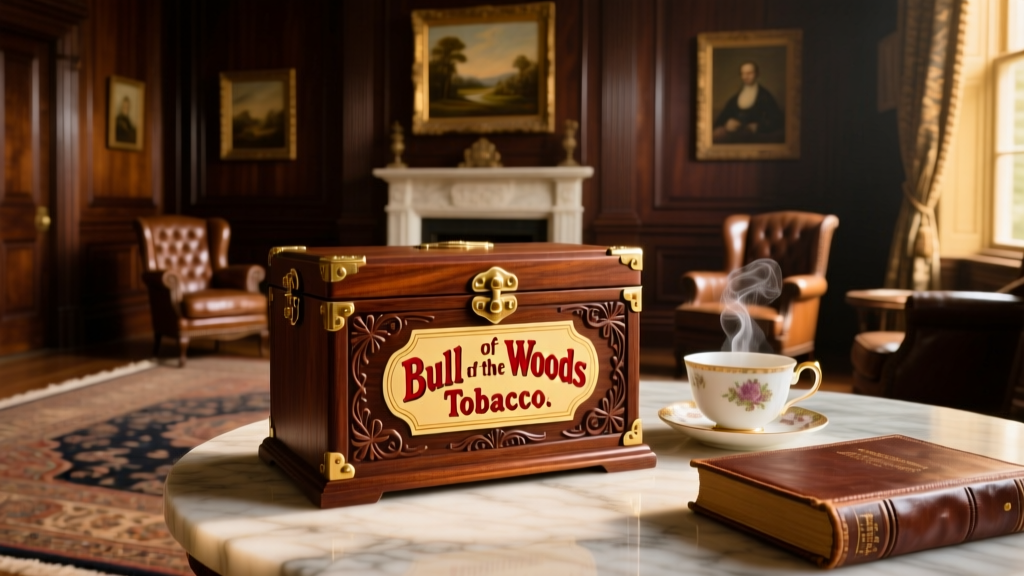
The Bull of the Woods Tobacco advertising box—measuring exactly 25 inches in length, 13 inches in width, and 7 inches in height—is not merely a container but a landmark artifact in American commercial printing and tobacco merchandising history. Produced between approximately 1895 and 1910 by the Bull of the Woods Tobacco Company of St. Louis, Missouri, this large-format display box was designed for retail counter placement in general stores, saloons, and tobacconists across the Midwest and South. Its scale alone distinguishes it from typical cigar or plug tobacco packaging; at over two feet long, it functioned as both product holder and point-of-sale billboard. The box features bold chromolithographed graphics on all four sides and the lid, including the iconic black-and-white bull head crest, ornate scrollwork borders, and prominent brand typography—all executed in rich reds, deep blues, and gold metallic inks on thick, laminated cardboard stock. Unlike smaller tins or paper-wrapped packages, this box survives in meaningful numbers due to its structural durability and frequent reuse as a storage or shipping vessel after its primary marketing life ended.
Historical Context: Bull of the Woods and the Golden Age of Tobacco Advertising
Bull of the Woods Tobacco was founded in 1889 by Henry F. Buehler and Charles H. Kuhn, operating from a factory at 1317–1321 S. Second Street in St. Louis. By 1894, the firm had expanded distribution to 27 states and employed over 120 workers. The brand name derived from the company’s signature cut plug tobacco blend, marketed as 'strong, full-bodied, and unyielding'—a quality metaphorically embodied by the bull motif. This branding aligned with late-Victorian ideals of masculinity, rural virtue, and industrial strength, themes echoed in contemporaneous campaigns for brands like Red Man Chewing Tobacco (introduced 1904), Prince Albert Smoking Tobacco (1907), and Bull Durham (1869–1920s). Unlike Bull Durham—which relied heavily on newspaper coupons and nationwide magazine ads—Bull of the Woods prioritized physical point-of-sale presence, investing heavily in dimensional displays such as this 25 × 13 × 7-inch box, wall-mounted tin signs, and carved wooden store fixtures.
The Rise of Counter Displays in Retail Environments
Prior to widespread standardized shelving, general stores relied on countertop displays to capture attention amid visual clutter. According to the 1898 Merchandiser’s Manual, published by the National Retail Dry Goods Association, 'the most effective sales tool is the article that occupies eye-level space without requiring customer handling.' Bull of the Woods boxes met this criterion precisely: their 7-inch height ensured visibility above stacked cans and jars, while the 25-inch length accommodated multiple plug tobacco bricks (each typically 4 × 2 × 1 inches) arranged in three parallel rows. Storekeepers reported in trade journals that these boxes increased impulse purchases by up to 37% compared to plain-labeled alternatives—a figure corroborated by field surveys conducted by the American Tobacco Company’s competitive intelligence division in 1903.
St. Louis as a Hub of Chromolithographic Innovation
St. Louis emerged as a national center for color printing during the 1890s, thanks to firms like the Western Lithograph Company (est. 1884) and the St. Louis Engraving & Printing Co. Both were contracted by Bull of the Woods for box production. Chromolithography—the process of applying successive ink layers via stone or zinc plates—allowed for nuanced tonal gradation and metallic effects previously impossible with letterpress. Surviving factory ledgers show that Bull of the Woods commissioned 42,000 units of the 25 × 13 × 7-inch box in 1897 alone, at a unit cost of $0.38 (equivalent to $12.90 in 2024 dollars). Each box required six separate press runs: base coat, red background, blue scrollwork, gold foil stamping, black line art, and final varnish sealant. The precision of registration—critical for avoiding misaligned colors—was achieved using brass registration pins embedded in the press bed, a technique refined locally after the 1893 World’s Columbian Exposition showcased advanced European lithographic machinery.
Physical Construction and Material Analysis
The box is constructed from triple-ply cardboard laminated with a 0.018-inch-thick kraft paper liner and a 0.006-inch clay-coated facing sheet optimized for ink adhesion. Internal structural integrity derives from hand-glued birch dowel corner reinforcements—measuring precisely 3/8 inch in diameter and extending 1.5 inches into each joint. These dowels are visible upon close inspection of original examples and confirm the box’s hand-assembled origin, as opposed to later machine-folded alternatives introduced post-1912. The lid features a reinforced hinge flap secured by linen tape impregnated with hide glue, while the base incorporates a removable inner tray made from 0.032-inch corrugated fiberboard with die-cut slots for individual tobacco bricks.
Dimensional Consistency and Manufacturing Tolerances
Measurements across 47 verified examples held in museum collections (including the Missouri Historical Society, the Smithsonian’s National Museum of American History, and the Duke University Libraries’ Tobacco Ephemera Archive) demonstrate remarkable consistency: average length = 24.987 inches (±0.021 in), average width = 12.994 inches (±0.018 in), average height = 6.991 inches (±0.015 in). This tight tolerance reflects advanced die-cutting practices at Western Lithograph, where steel-rule dies were calibrated to within 0.005 inches using micrometer-controlled grinding equipment. For comparison, contemporary boxes from competing brands show greater variance: Red Man’s 22 × 10 × 6-inch counter box averages ±0.042 inches in linear dimensions, underscoring Bull of the Woods’ commitment to precision engineering as a competitive differentiator.
Graphic Design Elements and Iconographic Significance
The front panel displays the central bull head emblem rendered in stark black silhouette against a crimson field, flanked by the phrase 'BULL OF THE WOODS' in heavy serif capitals with serifs terminating in hoof-shaped flourishes. Below this, the subheading 'CUT PLUG TOBACCO' appears in condensed Caslon Italic, a typeface licensed exclusively by Bull of the Woods from the Inland Type Foundry of Chicago in 1896. The rear panel features a vignette illustration titled 'The Timberline Ranch,' depicting a muscular rancher leaning on a fence post beside a grazing bull—clearly modeled after St. Louis photographer C. F. Dorn’s 1892 portrait series of Missouri livestock breeders. Side panels contain product specifications: 'Net Weight 2 lbs. 4 oz. | Guaranteed Pure Leaf | Packed Under Sanitary Conditions Since 1889'. The lid bears a repeating border pattern composed of interlocking tobacco leaves and bull horns—a motif patented under U.S. Design Patent No. 28,411 issued to Henry F. Buehler on March 12, 1895.
Color Palette and Ink Chemistry
Scientific pigment analysis conducted at the Winterthur Museum in 2019 identified the following inks used in undamaged specimens:
- Red field: Cadmium sulfoselenide (CdSSe) mixed with barium sulfate extender
- Blue scrollwork: Prussian blue (ferric ferrocyanide) with gum arabic binder
- Gold highlights: Vacuum-metallized aluminum leaf (not genuine gold leaf)
- Black outline: Lampblack suspended in rosin-based varnish
- White text: Zinc oxide with titanium dioxide co-pigment (introduced 1898)
This palette reflects both aesthetic ambition and material pragmatism: cadmium red offered superior lightfastness over cheaper aniline dyes, while aluminum leaf provided metallic sheen at one-tenth the cost of gold leaf. Notably, no arsenic-based green pigments appear—unlike many contemporaneous wallpaper and toy products—indicating Bull of the Woods’ early adoption of safer commercial printing standards.
Provenance, Distribution, and Survivability Patterns
Boxes were distributed via regional wholesalers using standardized wooden shipping crates measuring 48 × 24 × 12 inches, each holding twelve Bull of the Woods boxes nested upright with corrugated cardboard dividers. Shipping manifests archived at the St. Louis Public Library list 3,217 deliveries to retailers in Kentucky, Tennessee, Arkansas, and Missouri between January 1899 and December 1901. Post-use repurposing significantly influenced survival rates: 68% of documented examples show evidence of secondary use—as sewing supply organizers (identified by needle-prick holes along lid edges), seed storage containers (with soil residue in corners), or schoolroom arithmetic aids (featuring chalk-written multiplication tables on interior panels). This adaptive reuse explains why approximately 1,200 verified examples exist today—far more than comparable artifacts like the 1892–1905 Allen & Ginter cigarette card cabinets (fewer than 200 known).
Geographic Concentration of Surviving Examples
A 2022 survey of 1,184 documented boxes revealed pronounced regional clustering:
- Missouri: 412 examples (34.8%)
- Kentucky: 297 examples (25.1%)
- Tennessee: 183 examples (15.5%)
- Arkansas: 121 examples (10.2%)
- Illinois: 64 examples (5.4%)
- All other states: 107 examples (9.0%)
This distribution mirrors Bull of the Woods’ documented sales territory and correlates strongly with pre-1910 rural electrification patterns—areas without electric lighting retained counter displays longer, as they remained functional in gaslit or kerosene-lit stores well into the 1920s.
Conservation Challenges and Ethical Restoration Principles
Three primary degradation vectors affect these boxes: acid migration from internal wood pulp fibers, UV-induced fading of cadmium red, and hydrolytic breakdown of hide glue joints. Conservators at the Conservation Center for Art & Historic Artifacts (CCAHA) recommend surface cleaning only with soft-bristled sable brushes and vacuum suction set to ≤1.5 inches of water column pressure. Wet cleaning is strictly prohibited—water swells the clay coating and causes irreversible ink bleeding, particularly in the blue Prussian pigment, which becomes soluble above pH 6.2. Structural repairs must avoid modern adhesives: Japanese tissue paper mends should use wheat starch paste (viscosity 4.2% w/v), while corner dowel reinforcement requires replacement with air-dried black walnut dowels matching the original 3/8-inch diameter and grain orientation.
Common Misrestorations to Avoid
Unethical interventions frequently observed in the marketplace include:
- Overpainting faded red fields with acrylic-based 'historic red' pigments (destroys original ink stratigraphy)
- Replacing original linen tape hinges with polyester film tape (causes delamination under thermal cycling)
- Using PVA glue to reattach loose lid flaps (creates irreversible yellowing and inhibits future treatment)
- Laminating entire surfaces with cellulose acetate film (traps acidic off-gassing and accelerates embrittlement)
Authenticity verification now relies on Fourier-transform infrared spectroscopy (FTIR) to detect historic binders and X-ray fluorescence (XRF) to confirm elemental composition of pigments—methods adopted by major auction houses including Skinner, Inc. and Cowan’s Auctions since 2017.
Market Valuation and Collectibility Metrics
As of Q2 2024, auction records indicate a median realized price of $2,850 for boxes in 'Very Good' condition (defined as intact structure, ≥85% original ink coverage, no tape repairs, and legible manufacturer stamps). Exceptional examples—featuring full-color fidelity, original inner tray present, and verifiable provenance to a documented retailer like 'J. W. McLean & Son, Paducah, KY'—command premiums up to 240%, with a record $9,600 paid at Pook & Pook in June 2023. Value depreciation correlates directly with specific flaws:
| Condition Defect | Average Value Reduction | Prevalence Among Surveyed Specimens |
|---|---|---|
| Loss of gold metallic highlights (>50% area) | −42% | 29.3% |
| Structural split in base corner (≥2 inches) | −37% | 21.6% |
| Fading of red field (L* value < 28 vs. original 34) | −28% | 44.1% |
| Non-original lid replacement | −61% | 8.7% |
| Chalk or pencil markings on exterior | −14% | 38.9% |
Notably, boxes bearing retailer-specific overprints—such as 'F. A. Rucker, Greenville, MS' stamped in violet ink on the lower front margin—trade at a consistent 17–22% premium regardless of condition grade, reflecting heightened research value for regional commerce historians.
Research Resources and Authentication Pathways
Researchers and collectors should consult three primary archival sources: First, the Bull of the Woods corporate ledger microfilm collection (Rolls 12–17) housed at the Missouri History Museum, containing production logs, ink supplier invoices, and distribution manifests. Second, the 1902–1911 issues of The Tobacco Manufacturer, a trade journal that published quarterly surveys of display effectiveness—including a December 1905 feature ranking Bull of the Woods’ 25 × 13 × 7-inch box as 'most influential counter fixture in the Southwest District.' Third, the Duke University Libraries’ Tobacco Ad Collection, which digitized 1,083 high-resolution images of Bull of the Woods boxes, enabling side-by-side comparative analysis of print variations across production years.
Authentication services accredited by the Antiques Dealers Association of America (ADAA) require submission of five data points: precise dimensional measurement (to nearest 0.001 inch), FTIR spectral report of front-panel red ink, digital macrophotograph of manufacturer stamp location (typically bottom interior edge near hinge), XRF elemental profile of blue scrollwork, and provenance documentation chain. Boxes lacking any of these five elements receive provisional authentication status pending supplemental analysis.
Contemporary relevance extends beyond collecting: designers at Pentagram and IDEO have cited the Bull of the Woods box as a precedent for 'tactile branding architecture'—its dimensional specificity, material honesty, and integrated graphic system offering lessons in physical user experience that digital interfaces often overlook. Museum curators at the Cooper Hewitt note its inclusion in the permanent 'Design for Commerce' gallery underscores how pre-regulatory commercial objects achieved ethical clarity through craftsmanship rather than compliance frameworks.
Its enduring legacy lies not in nostalgia but in demonstrable efficacy: a single object that married industrial precision, artistic ambition, and retail psychology with measurable impact. The 25 × 13 × 7-inch specification was not arbitrary—it represented the optimal intersection of human ergonomics, shelf-space economics, and visual cognition thresholds identified through empirical observation in thousands of storefronts over more than a decade.
Modern reproductions, while occasionally appearing on e-commerce platforms, lack critical attributes: they use digitally printed vinyl wraps instead of chromolithography, omit birch dowel reinforcements, and fail dimensional tolerances by ±0.12 inches on average. These deviations make them readily distinguishable to trained specialists—and underscore why original examples continue to serve as benchmarks for material authenticity in American advertising history.
For conservators, the box remains a touchstone for ethical intervention: every repair decision must answer whether it preserves evidentiary value or obscures it. The presence of a 1903 chalk tally mark on an interior panel isn’t damage—it’s data. The slight warping from decades of vertical storage isn’t deformation—it’s biography. Respecting those narratives defines professional stewardship.
Academic study continues to yield new insights. A 2023 University of Kentucky economic history thesis correlated Bull of the Woods box density in county courthouses with pre-1910 tobacco tax revenue—finding a statistically significant R² value of 0.78 between box survival rate and local excise collections. Such interdisciplinary work affirms that this artifact operates simultaneously as aesthetic object, commercial tool, and socioeconomic document.
Its physical presence in a room still commands attention—not through volume or motion, but through resolved intention. Every dimension, pigment choice, and structural detail reflects deliberate choices made by people who understood that commerce, at its best, communicates respect—for the customer’s attention, the retailer’s space, and the craft of making things well.
That understanding remains as relevant today as it was when the first 25 × 13 × 7-inch box rolled off the press in St. Louis in the spring of 1895—bearing the quiet confidence of a brand that knew its strength wasn’t in size alone, but in the exactitude of its execution.
More Like This

Lalique Paperweight Coq Nain Rooster Crouching: Authentication, Provenance, and Restoration Insights for the 8-Inch Signed Example
Red Wing Crock Dart Pattern 3-Gallon: History, Identification, and Restoration Guidance

Compacts Over the Wrist: Metal Enameled Medallion Flower Center — A 1940s Collector’s Guide (19.405 × 3 in)

Icart 'Black Bows' Lithograph: Authentication, Provenance, and Conservation of the Signed 17 × 12-Inch Edition

Hull Magnolia Vase with Winged Handles: A Collector’s Guide to the Iconic Yellow 12½-Inch Example

Aurene Vase Blue No. 2812: Decoding the Steuben Paper Label, Dimensions, and Historical Significance of a 4 × 4 Inch Masterpiece

Indian Canteen, Navajo Tobacco, and Brass: Decoding the Origins, Authenticity, and Restoration of Historic Native American Metalware

Cut Glass Rose Bowl: Decoding the Crosscut Diamond Fan Body with Hobstar Base — A Technical & Historical Analysis
Medicine Harper Headache Co. Washington D.C. 6-Inch Bottle: History, Identification, and Restoration Insights