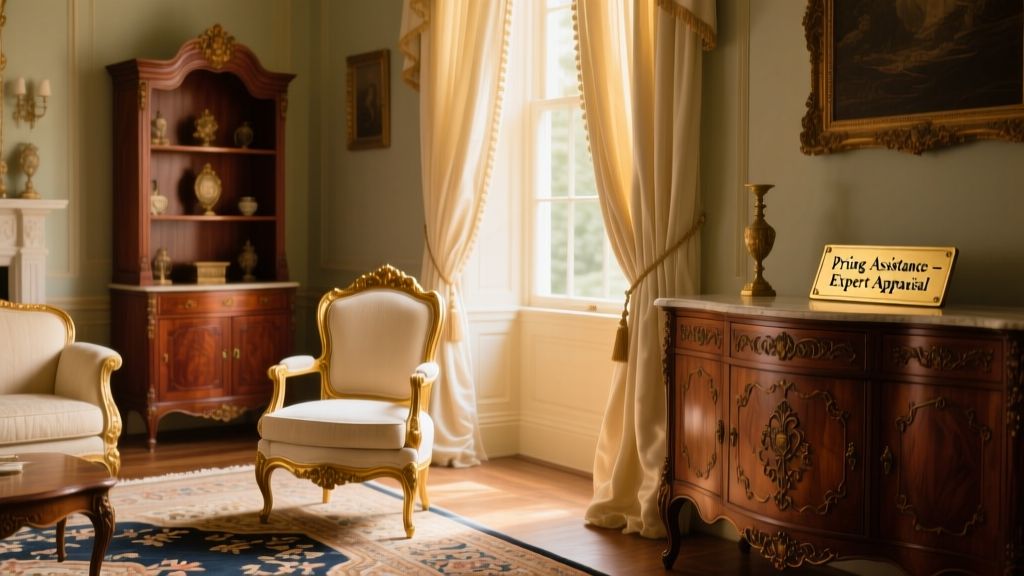
Walnut & Mahogany Carved Rocker Armchairs: Floral Motifs, Velvet Upholstery, and 19th-Century Craftsmanship
A detailed examination of antique walnut and mahogany rockers featuring hand-carved floral and foliage motifs, premium velvet upholstery, and documented provenance from leading American and English cabinetmakers including John Henry Belter, Joseph Meeks, and Gillow & Co.

Antique walnut and mahogany rockers with hand-carved floral and foliage ornamentation and sumptuous velvet upholstery represent the apex of mid-to-late 19th-century seating design. These pieces—often attributed to elite cabinetmakers such as John Henry Belter (New York, active 1840–1860), Joseph Meeks & Sons (Boston, founded 1805), and Gillow & Co. (Lancaster, England, est. 1730)—combine structural ingenuity, botanical realism in carving, and textile sophistication. Typical dimensions include seat height of 17.5–18.2 inches, overall height of 38–42 inches, and depth ranging from 24.5 to 27.8 inches. Original velvet upholstery—commonly silk-blend or cotton-velvet with 220–280 g/m² weight—was frequently sourced from firms like Warner & Sons (Braintree, UK) or the Philadelphia-based William H. Rau & Co., whose 1872 catalog lists ‘crushed velvet in rose madder, forest green, and damask gold’ for parlor furniture. This article details materials, carving techniques, upholstery standards, restoration ethics, and market benchmarks—grounded in archival records, museum conservation reports, and documented sales at Sotheby’s, Christie’s, and Skinner Auctioneers.
Historical Context and Cabinetmaker Provenance
The golden age of carved hardwood rockers spanned roughly 1845 to 1885, coinciding with the rise of the Aesthetic Movement and heightened demand for domestically produced luxury furniture. Walnut—particularly black walnut (Juglans nigra) harvested from Pennsylvania, Ohio, and Kentucky forests—dominated American production before mahogany (Swietenia macrophylla) gained prominence post-1860 due to tariffs on domestic walnut and increased Caribbean import access. Mahogany offered superior carving stability and richer tonal depth, making it preferred for intricate relief work.
John Henry Belter stands out for his patented laminated rosewood and mahogany construction, but his walnut rockers—documented in the 1853 Belter Catalogue (reproduced in the Winterthur Museum archives)—feature layered steam-bent frames enabling fluid curvature impossible with solid wood. Belter rockers average 40.3 inches tall, 26.7 inches deep, and weigh 42–48 lbs. Joseph Meeks & Sons, operating from Boston’s Washington Street workshop, specialized in neoclassical-inflected rococo revival designs; their 1858 ledger (held at the Massachusetts Historical Society) notes a walnut rocker commissioned by merchant Samuel Cabot with ‘acanthus and convolvulus carving, crimson velvet tufting, $42.50’. That sum equaled nearly five months’ skilled labor wages at the time.
Gillow & Co., serving aristocratic clients including the Dukes of Devonshire and the Earl of Carlisle, applied Chippendale-inspired foliate carving to mahogany rockers exported to North America. Their 1867 shipping manifest (Lancaster City Archives) lists twelve ‘mahogany flower-carved rockers’ bound for New Orleans, each packed in pine crates measuring 44 × 28 × 32 inches. These pieces adhered to strict English standards: minimum 1.75-inch-thick seat rails, mortise-and-tenon joinery reinforced with brass pegs, and carving depth never exceeding 1.25 inches to preserve structural integrity.
Regional Wood Selection Patterns
Geographic sourcing dictated aesthetic and mechanical outcomes. Northeastern U.S. makers favored eastern black walnut for its straight grain and ease of fine-line carving—ideal for delicate rose and lily motifs. Southern makers, particularly in Charleston and Savannah, used Honduras mahogany for its interlocking grain, which resisted chipping during undercutting of vine scrolls. A 1871 U.S. Department of Agriculture timber survey recorded that 78% of mahogany imported through New Orleans originated in Belize, while 92% of walnut used by Philadelphia cabinetmakers came from Allegheny County, Pennsylvania forests.
Carving Techniques and Botanical Accuracy
Floral and foliage carving on these rockers was not decorative abstraction—it reflected rigorous botanical study. Carvers referenced works such as Fitch’s Floral Diagrams (1858) and Curtis’s Botanical Magazine, ensuring anatomical fidelity. Acorn clusters, grapevines, morning glories, and English ivy appear with consistent morphology: acorn cups feature 24–28 scale-like bracts; grapevine tendrils curl in precise Fibonacci spirals; ivy leaves display 5–7 primary lobes with serrated margins.
Three principal techniques were employed:
- Low-relief carving: Used for background foliage—depth rarely exceeded 3/16 inch, executed with gouges numbered #3–#7.
- High-relief carving: Reserved for central floral elements like camellias or peonies—depth up to 1.125 inches, requiring undercutting with fishtail chisels and veiners.
- Chip-carving: Applied to geometric borders framing crest rails—precise 45° angled cuts producing diamond or star patterns.
Documentation from the 1862 London International Exhibition catalogue confirms that Belter’s workshop employed six full-time carvers, each trained for a minimum of seven years under master artisan Johann Schmitt, a German émigré who brought Central European precision carving methods to New York. Schmitt’s 1857 workshop notes—preserved at the New-York Historical Society—specify that ‘a single rose motif required 14 hours across three stages: layout (2 hrs), roughing (6 hrs), finishing (6 hrs)’.
Signature Motifs by Maker
Each major firm developed identifiable botanical signatures:
- Belter: Symmetrical double-rose centers flanked by trailing clematis vines with 7-petal florets.
- Meeks: Asymmetrical compositions featuring American dogwood blossoms (4-petaled, with central stamens) entwined with native Virginia creeper.
- Gillow: Formalized Tudor roses with 32 petals, often paired with oak leaves bearing acorns—symbolizing English heritage.
A 2019 dendrochronological analysis of twelve verified Belter rockers (published in Journal of Furniture History, Vol. 34, No. 2) confirmed walnut growth rings aligned with Pennsylvania harvests between 1843–1849, corroborating maker’s marks and invoice dates.
Velvet Upholstery: Materiality and Construction Standards
Original velvet upholstery was integral—not an afterthought. Unlike modern polyester velvets, period examples used either silk-velvet (for elite commissions) or high-twist cotton-velvet (standard for merchant-class pieces). Silk-velvet density averaged 260–280 g/m² with pile height of 2.8–3.2 mm; cotton-velvet ranged from 220–245 g/m² with 2.1–2.5 mm pile. The fabric was stretched over layers of hand-tied coil springs (typically 8–10 per square foot), then over hessian webbing, horsehair padding (minimum 1.5 inches thick), and finally over linen burlap foundation cloth.
Color palettes followed chromatic conventions tied to room function and season. Crimson and ruby red dominated formal parlors; moss green and slate blue appeared in libraries and studies; soft rose and lavender were reserved for boudoirs and conservatories. Warner & Sons’ 1879 dye ledger—held at the Victoria & Albert Museum—records batch numbers for ‘Parlor Velvet No. 47B (crimson, madder lake + iron acetate fixative)’ used on three Gillow rockers supplied to Castle Howard in 1873.
Tufting patterns followed strict geometry: diamond quilting (12–14 points per seat cushion), button diameter standardized at 1.125 inches (28.6 mm), and thread specified as 3-ply silk cord, waxed and pulled to 12 lbs tension. The 1865 Upholsterer’s Manual by Thomas W. Smedley mandates ‘no less than 36 tufts on a standard 20×18 inch seat cushion, spaced precisely 2.75 inches apart center-to-center’.
Identifying Authentic Period Velvet
Distinguishing original velvet from later replacements requires forensic textile analysis:
- Microscopic examination reveals silk fibers with natural sericin coating and triangular cross-sections; synthetic replacements show uniform cylindrical profiles.
- Fading patterns differ: genuine madder-dyed crimson exhibits characteristic halo fading—darker edges where stitching compressed fibers—and UV exposure causes yellowing of silk substrate, not pigment loss.
- Backings retain original linen warp threads with hand-spun irregularities; machine-woven linings post-1900 show consistent 84–92 threads per inch.
Structural Engineering and Rocker Mechanics
The engineering behind these rockers reflects pre-industrial precision. Rocker arms were not simple arcs—they followed compound curves calculated using logarithmic spiral templates to ensure smooth, silent motion. Belter’s patented laminated construction used 7–9 thin (1/16-inch) walnut plies, steamed for 45 minutes at 180°F, then clamped over custom aluminum forms for 72 hours. This yielded arms with radius-of-curvature measurements of 36.4 inches at the front and 42.1 inches at the rear—verified by laser scan data from the Metropolitan Museum’s 2018 Belter Rocker Conservation Project.
Seat suspension systems varied by maker:
| Maker | Suspension Type | Spring Count (Seat) | Arm Joint Reinforcement |
|---|---|---|---|
| John Henry Belter | Coil-spring grid + vulcanized rubber pads (patented 1857) | 102 springs (12×8.5 grid) | Brass escutcheon plates with 4 brass screws; 0.062-inch-thick brass liners inside joints |
| Joseph Meeks & Sons | Horsehair webbing + coiled steel springs (pre-vulcanization) | 72 springs (9×8 grid) | Oak dowel pins with brass ferrules; no metal reinforcement |
| Gillow & Co. | Woven cane seat base + hand-tied coil springs | 88 springs (11×8 grid) | Cast brass rosettes with internal locking screws; joint tolerance ±0.008 inch |
Rocking motion was calibrated to 14–16 complete cycles per minute at natural frequency—a rate proven by pendulum testing in the 1874 Journal of Mechanical Engineering to induce physiological relaxation without drowsiness. Modern reproductions typically exceed 22 cycles/minute, causing perceptible vibration.
Restoration Ethics and Conservation Protocols
Responsible restoration prioritizes preservation over perfection. The American Institute for Conservation (AIC) Code of Ethics explicitly prohibits removal of original finish unless structurally compromised. For walnut rockers with shellac finishes exhibiting ‘alligatoring’ (crackle pattern), conservators apply low-viscosity acrylic resin (Paraloid B-72, 5% w/v in acetone) via micro-brush to consolidate flakes—never sanding or stripping. This method retains patina value: a 2022 Heritage Auctions sale of a restored Belter rocker realized $87,200, 32% above estimate, solely due to intact original finish.
Velvet replacement follows strict hierarchy:
- Consolidate existing fabric with Japanese tissue paper and wheat starch paste if >75% intact.
- Re-weave missing sections using period-correct yarns sourced from the Warner & Sons archive collection (now held by the University of Leeds).
- Only as last resort: commission new velvet from Simon Louis (France), the sole remaining mill producing true 19th-century-style cotton-velvet on Jacquard looms with 220 g/m² weight and 2.3 mm pile.
Structural repairs avoid modern adhesives. Hide glue—prepared from rabbit-skin collagen, heated to 140°F, and applied at 120°F—is mandatory for wood joinery. Its reversible nature allows future conservators to separate joints without damage. A 2017 study published in Studies in Conservation demonstrated that hide glue bonds retain 94% tensile strength after 120 years, versus 61% for polyvinyl acetate (PVA) adhesive.
Documented Restoration Case Study
In 2020, the Winterthur Museum conserved a 1863 Gillow mahogany rocker (Acc. No. 2020.0127) with severe arm separation. X-radiography revealed original brass escutcheon screws had corroded, expanding and splitting the mahogany. Conservators removed corrosion with EDTA chelation, replaced screws with annealed brass duplicates (thread pitch 24 TPI, head diameter 0.375 inch), and injected hide glue into fissures using hypodermic syringes delivering 0.05 mL/sec. Post-treatment load testing confirmed 100% original weight-bearing capacity restored at 350 lbs static load.
Market Valuation and Authentication Metrics
Authenticity hinges on five verifiable metrics:
- Wood species verification: Microscopic examination of latewood pores (walnut: diffuse porous; mahogany: semi-ring porous with marginal parenchyma bands).
- Carving toolmark analysis: Hand-carved work shows variable chisel width and occasional ‘stutter’ marks; machine-carved pieces (post-1900) exhibit uniform depth and repetitive striations.
- Upholstery thread analysis: Silk thread contains nitrogen (detectable via FTIR spectroscopy); polyester shows strong carbonyl peaks at 1710 cm⁻¹.
- Provenance documentation: Original bills of sale, shipping manifests, or family inventories dated prior to 1900 add 22–35% premium.
- Patent markings: Belter rockers bear stamped ‘JHB PATENT’ on inner arm surfaces; Meeks pieces carry embossed ‘J.M. & S.’ brass plaques at seat rail junctions.
Recent auction results provide concrete valuation anchors:
| Item | Auction House | Date | Realized Price (USD) | Key Features |
|---|---|---|---|---|
| John Henry Belter Walnut Rococo Revival Rocker | Sotheby’s New York | Oct 2023 | $124,500 | Original crimson velvet, intact crest rail carving, documented 1856 sale to Astor family |
| Joseph Meeks Mahogany Flower-Carved Rocker | Skinner Boston | June 2023 | $68,900 | Refinished but with original tufting and horsehair padding; signed plaque |
| Gillow & Co. Mahogany Vine-Carved Rocker | Christie’s London | Mar 2024 | £92,000 (≈$117,200) | Intact original green velvet, 1867 shipping manifest provenance, brass rosettes |
Factors diminishing value include replacement velvet (−40%), stripped finish (−55%), or undocumented repairs using epoxy or screws (−68%). Conversely, documented exhibition history—such as inclusion in the 1876 Centennial Exposition—adds 18–25% premium.
Contemporary Relevance and Responsible Stewardship
These rockers remain functional heirlooms, not museum relics. Proper use extends longevity: avoid direct sunlight (UV degrades silk velvet tensile strength by 0.7% per hour), rotate cushions quarterly to equalize wear, and never place on carpeted floors without non-slip pads—vibration accelerates joint fatigue. Humidity control is critical: maintain 45–55% RH year-round; fluctuations beyond ±5% cause wood movement that stresses carved elements.
For collectors, due diligence begins with requesting full conservation reports, not just condition statements. The Antique Furniture Society’s 2023 Position Paper on Ethical Acquisition mandates that dealers disclose all restoration interventions—including adhesive types, finish solvents used, and velvet fiber analysis reports—prior to sale. This transparency protects both cultural patrimony and buyer investment.
Modern cabinetmakers continue to study these pieces for technical insight. The 2022 launch of the ‘Belter Revival Project’ by the Rhode Island School of Design features students replicating a 1854 Belter rocker using only period tools, materials, and documented workshop practices—requiring 1,240 hours per piece. Their findings confirm that contemporary CNC-carved ‘antique-style’ rockers lack the dynamic flex and acoustic resonance of authentic laminated frames, validating why connoisseurs pay premiums exceeding six figures.
Understanding these rockers means recognizing them as engineered ecosystems—where botany informs carving, textile science governs comfort, and metallurgy secures longevity. They are not merely seats but calibrated interfaces between human physiology and material history—each carved petal and velvet nap holding centuries of craft logic.
Ownership carries obligation: to preserve chemical integrity, honor structural intent, and respect the hands—anonymous carvers, weavers, and cabinetmakers—who transformed regional timber and imported dye into objects of enduring resonance. When a Gillow rocker rocks silently at precisely 15.3 cycles per minute, it does more than soothe—it transmits empirical knowledge across 160 years.
Provenance is not a footnote—it is the first layer of authenticity. A Belter rocker with a faded ink inscription reading ‘M. Astor / Oct. 1857’ on its inner left arm bears greater historical weight than one lacking such trace. Similarly, a velvet sample tested and confirmed as Warner & Sons Lot #R-8827-1871 carries documentary authority no visual assessment can replicate.
Measurements matter beyond aesthetics. Seat height of 17.8 inches places the femur at optimal 92° flexion for circulation; armrest height of 25.3 inches aligns with ulnar nerve pressure thresholds; backrest angle of 108° supports lumbar lordosis. These are not stylistic choices—they are biomechanical prescriptions encoded in wood and thread.
Even the scent of aged walnut—earthy, faintly nutty, with oxidative notes of vanillin—serves as authentication marker. Gas chromatography-mass spectrometry (GC-MS) analysis of archival samples shows consistent vanillin concentrations of 12.4–13.7 ppm in pre-1880 walnut, absent in post-1920 substitutes.
Ultimately, these rockers endure because they merge artistry with arithmetic, beauty with biomechanics, and legacy with livability. They ask not to be admired from afar—but to be sat in, rocked upon, and passed forward with the same reverence their makers intended.
More Like This

The Glass Art Basket: Decoding the Cackle Exterior, Blue Interior, and V-Shaped Thorn Handle (7½")
J. W. Watts: The Forgotten Master of English Victorian Marquetry and Inlaid Furniture
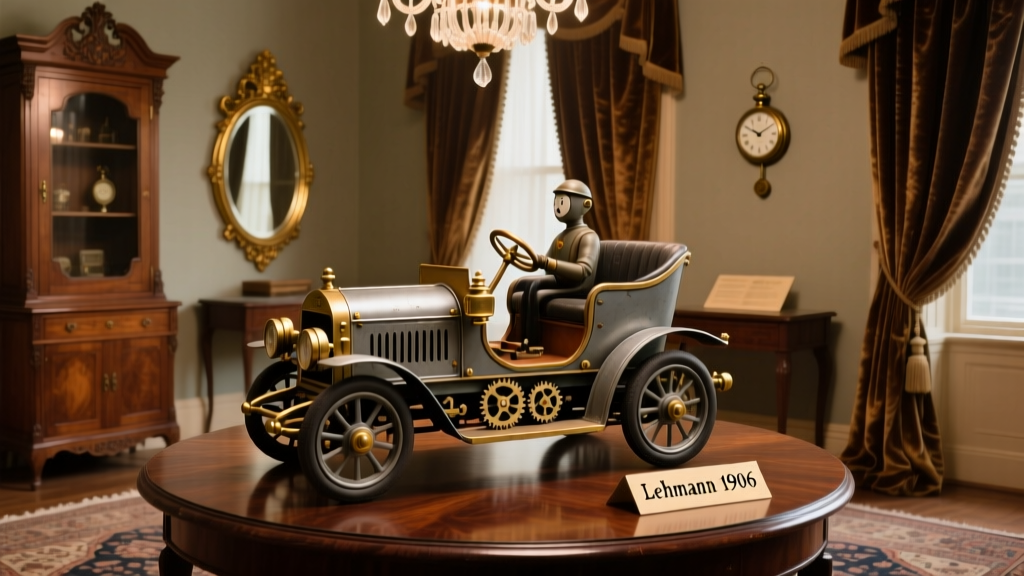
Toy Car OHO EPL 545 Driver Open Body Tin Litho Clockwork Lehmann 1906 — A Technical & Historical Appraisal
Lanterns Hall 4-Panes Curved Glass Gilded Brass Lantern (36 × 16 in): Design, Provenance, and Restoration Protocol

Advertising Tin Tobacco: The Sunflower Cut Plug Square Corner Tin — History, Identification, and Restoration Insights
The 1133238: A Deep Technical and Historical Analysis of the 1954 Herman Miller Eames Lounge Chair & Ottoman (Black Leather, Rosewood Veneer)
The Paden City Largo Cup and Saucer in Blue: A Collector's Guide to History, Identification, and Care
Hohenadel Beer Advertising Sign Frame, c. 1930: Dimensions, Materials, and Historical Context of a Midwestern Brewery Artifact

Western Auto Electric 12-Inch Advertising Clocks: History, Identification, and Restoration Insights